

Financial highlights for the period ended June 30, 2026
Introduction
Raison d'être
The Office of the Superintendent of Financial Institutions (OSFI) was established in 1987 by an Act of Parliament: the Office of the Superintendent of Financial Institutions Act (OSFI Act). It is an independent agency of the Government of Canada and reports to Parliament through the Minister of Finance.
OSFI’s purpose is to contribute to public confidence in the Canadian financial system by regulating and supervising approximately 350 federally regulated financial institutions (FRFIs) and 1200 federally regulated pension plans (FRPPs).
In exercising its mandate OSFI protects the rights and interests of depositors, policyholders, and creditors of financial institutions while having due regard for the need to allow financial institutions to compete effectively and take reasonable risks. OSFI also protects the rights and interests of pension plan members, former members, and entitled beneficiaries.
OSFI’s mandate is to:
- ensure FRFIs and FRPPs remain in sound financial condition and determine if pension plans are meeting minimum funding requirements and other requirements under the legislation
- ensure FRFIs protect themselves against threats to their integrity and security, including foreign interference
- act early when issues arise and require FRFIs and FRPPs to take necessary corrective measures without delay
- monitor and evaluate risks and promote sound risk-management by FRFIs and FRPPs
OSFI also provides supervision services to the Canada Mortgage and Housing Corporation in accordance with the National Housing Act.
The Office of the Chief Actuary (OCA), which is an independent unit within OSFI, provides actuarial valuation and advisory services for the Canada Pension Plan, the Old Age Security program, the Canada Student Loans and Employment Insurance Programs and other public sector pension and benefit plans.
Basis of Presentation
These quarterly financial statements have been prepared by management as required by Section 65.1 of the Financial Administration Act and in accordance with Public Sector Accounting Standards (PSAS), using the accrual basis of accounting.
These quarterly financial statements have not been subject to an external audit or review.
OSFI’s Funding Model
OSFI recovers its costs from several revenue sources. It is mainly funded through assessments on the financial institutions and private pension plans that it regulates and supervises, as well as through a user-pay program for legislative approvals and other selected services. OSFI also receives revenues for cost-recovered services. These include revenues from provinces on behalf of which OSFI supervises institutions on contract, and revenues from other federal organizations to which OSFI provides administrative support.
The accompanying quarterly financial statements reflect OSFI’s legislated authority to spend revenues from assessments and other sources as per Section 17(2) of the OSFI Act as well as any authorities granted by Parliament and used by OSFI. OSFI receives an annual parliamentary appropriation pursuant to Section 16 of the OSFI Act to support the operations of the OCA. Such funding is presented as Government Funding in the Statement of Operations and the amount is consistent with the Main and Supplementary Estimates per the Appropriation Act in effect for the reporting period.
Financial Review and Highlights - Fiscal Year to Date
Statement of Financial Position and Statement of Cash Flows
The majority of OSFI’s revenue is derived from base assessments on FRFIs. Assessments are billed annually, usually in the second quarter of the fiscal year. As a result of this annual cycle, some accounts in OSFI’s Statement of Financial Position can vary significantly throughout the year. In between base assessment billings, OSFI’s cash entitlement balance decreases gradually as payments pertaining to operational costs and asset acquisitions are issued. Similarly, OSFI’s accrued base assessments balance increases, to reflect expenses incurred but not yet billed. After the base assessments are billed and collected, cash and accounts receivable increase, as do unearned base assessments. OSFI last invoiced its base assessments in August 2025.
During the three months ended June 30, 2026, OSFI’s cash entitlement balance decreased by $82.6 million, its trade and other receivables increased by $2.7 million, and its accrued base assessments increased by $68.0 million.
As explained in Note 3 (a) to the financial statements, OSFI has a revolving expenditure authority from the Treasury Board Secretariat to draw upon the Consolidated Revenue Fund to ensure the availability of funds prior to receipt of revenue. Additional information on OSFI’s sources and uses of cash can be found in its Statement of Cash Flows.
Statement of Operations
OSFI operates on a cost recovery model. Assessment revenue is recorded at an amount necessary to balance revenue and expenses after all other sources of revenue are taken into account. OSFI’s total expenses for the three months ended June 30, 2026, were $76.9 million, a $0.4 million or 0.6% increase from the same period last year. Decreased personnel costs ($1.1 million or 1.7%), resulting from fewer FTE’s were partially offset by annual compensation adjustments and and higher professional service costs ($ 0.8 million or 16.3%) related to investments in system renewal as well as small increases in amortization and other costs.
OSFI’s total year-to-date expenses of $76.9 million were $8.0 million or 9.4% lower than planned (versus $4.7 million or 5.8% lower than planned for the same period last year). OSFI monitors its performance via monthly reporting and regular forecast exercises.
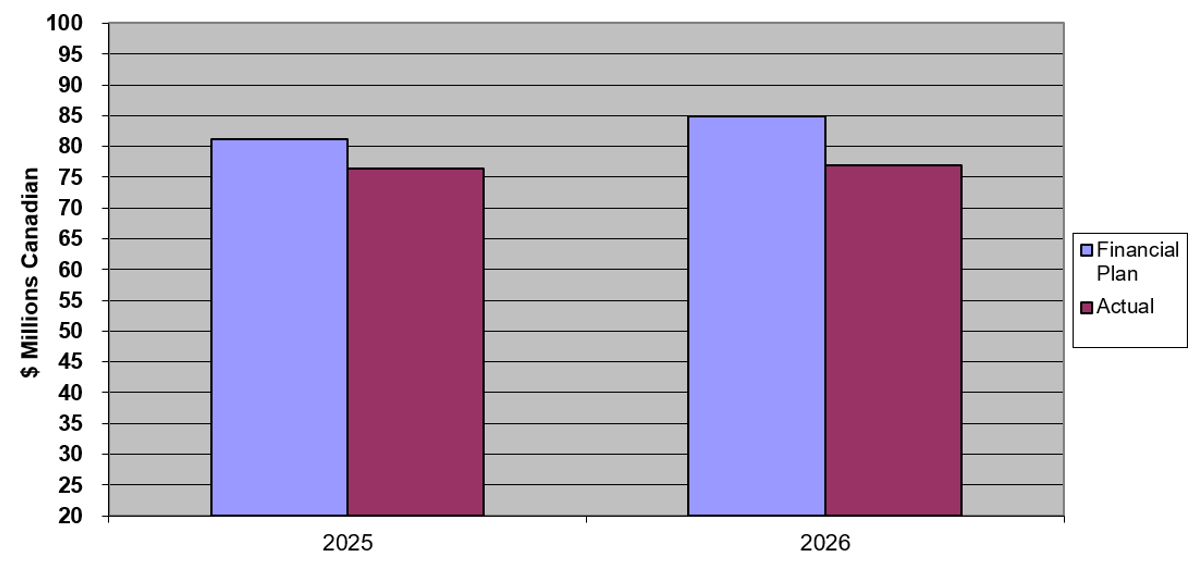
Chart 1 - Text version
| 2025 | 2026 | |
|---|---|---|
| Financial Plan | $81.1 | $84.8 |
| Actual | $76.4 | $76.9 |
Government Funding
In addition to its assessment and cost-recovered services revenues, OSFI was granted a parliamentary appropriation of $1.2 million for the fiscal year ending March 31, 2027 (2026 - $1.3 million). During the three months ended June 30, 2026, OSFI recognized $0.3 million (2025 - $0.3 million) of this annual amount.
Risks and Uncertainties
OSFI operates in a constantly changing environment reflected in uncertain economic and financial conditions and an industry that can undergo periods of rapid change and that is becoming increasingly complex. The intensity and pace at which the risk environment is changing requires a reimagining of OSFI’s approach to its risk appetite. OSFI needs a more rigorous and future focussed risk appetite framework that grapples with both identified and other yet-to-be foreseen risks. The risks that exist in such circumstances can have financial consequences, thereby affecting financial statements.
Enterprise Risks
Through its Enterprise Risk Management (ERM) framework and processes, OSFI identifies its key external and internal risksFootnote 1. While OSFI continues to actively address the suite of risks covered by its framework, it also monitors for new ones.
External Risks
External risks are closely monitored. For a fulsome narrative of external risks currently faced by the Canadian financial system, and the actions OSFI is taking in response (Real estate secured lending (RESL) and mortgage risks, Non-bank financial institution (NBFI) risk, and Liquidity and funding and liquidity risks), please consult OSFI’s 2026-27 Annual Risk Outlook.
Internal Risks
OSFI actively manages internal risks to support sound decision-making, effective resource allocation, and the achievement of its mandate. Key areas of focus include:
Information Security
Information security remains a priority given an increasingly complex environment characterized by cyber, geopolitical, and AI-enabled threats. OSFI continues to strengthen its information security capabilities, governance, monitoring, and controls to protect sensitive information and support its mandate.
Strategic Execution and Change Management
A complex operating environment, modernization efforts, organizational change, and competing priorities may affect the timely delivery of strategic initiatives and operational activities. OSFI is strengthening governance, prioritization, organizational agility, and resource allocation to support effective execution of its Strategic and Operational Plans.
Workforce Capacity and Capability
Competition for specialized talent and evolving business needs may affect OSFI's ability to attract, develop, and retain critical expertise. Through its Human Capital Strategy, OSFI is enhancing workforce planning, leadership development, succession management, and building in emerging areas.
Supervisory Information, Data and Analytics
OSFI relies on high-quality information and data to support supervisory assessments and decision-making. Increasing complexity in data, analytics, AI-enabled tools and digital technologies may affect the ability to identify and assess emerging risks. OSFI continues to strengthen its data management, analytical capabilities, and supporting systems to enhance regulatory and supervisory effectiveness.
Financial Risks
Financial risks, primarily liquidity risk and credit risk, are closely managed and continue to be rated low. Please refer to Note 12 to the financial statements for a full analysis of the financial risks to which OSFI is exposed.
Significant Changes in Relation to Operations, Personnel and Programs
On April 27, 2026, OSFI announced that the Deputy Superintendent, Risk, Strategy and Policy sector, Angie Radiskovic would replace Ben Gully as the Deputy Superintendent, Supervision effective June 10, 2026. Mr. Gully left OSFI to take a position as the new Secretary General to the Basel Committee on Banking Supervision.
Also on April 27, 2026, OSFI announced that Jing Yang will be joining OSFI on August 24, 2026 as the new Deputy Superintendent, Risk, Strategy and Policy.
On June 16, 2026 OSFI announced the retirements of Kathy Thompson, Deputy Superintendent Integrity, National Security and Integrated Solutions and Assia Billig, Chief Actuary later this year.
Josée Turcotte has been appointed Deputy Superintendent, Integrity, National Security and Integrated Solutions, effective September 8, 2026.
Laurence Frappier has been appointed Chief Actuary, effective October 1, 2026.
There have been no other significant changes in relation to Operations, Personnel and Programs during the quarter ended June 30, 2026.
Approval by Senior Officials
Approved by,
Adelle Laniel, CPA
Chief Financial Officer
Peter Routledge,
Superintendent