

Actuarial Report (32nd) on the Canada Pension Plan (Revised version)
The Office of the Chief Actuary (OCA) removed section E.5.3.3 of Appendix E, Uncertainty of results, from this revised report. The section contained illustrative scenarios and estimated quantitative impacts of climate change risk on the base Canada Pension Plan (CPP) minimum contribution rate. The OCA chose to remove the section to avoid potential misrepresentation of risks given concerns with the public data used for the illustrative scenarios. The OCA remains committed to continue assessing the potential impact of climate risk on the CPP and will publish a quantitative analysis once updated data is released.
Accessibility statement
The Web Content Accessibility Guidelines (WCAG) defines requirements for designers and developers to improve accessibility for people with disabilities. It defines three levels of conformance: Level A, Level AA, and Level AAA. This report is partially conformant with WCAG 2.0 level AA. If you require a compliant version, please contact webmaster@osfi-bsif.gc.ca.
8 April 2026
The Honourable François-Philippe Champagne, P.C., M.P.
Minister of Finance and National Revenue
Ottawa, Canada
K1A 0A6
Dear Minister:
I am providing you with a revised version of the Thirty‑Second Actuarial Report on the Canada Pension Plan, prepared as at 31 December 2024, which was originally tabled in the House of Commons on 8 December 2025. The revisions pertain to the illustration of climate change risk on the Canada Pension Plan and have no impact on the main results of the report that was previously submitted. Revisions were made to the scenario analysis sections included in the highlights of the report and the appendix.
This report, as well as the original report, is prepared in accordance with section 115 of the Canada Pension Plan, which provides that an actuarial report shall be prepared every three years for purposes of the financial state review by the Minister of Finance and the ministers of the Crown from the provinces.
Yours sincerely,
Assia Billig, FCIA, FSA, PhD
Chief Actuary
Table of content
- 1 Highlights of the report
- 2 Introduction
- 3 Methodology
- 4 Best‑estimate assumptions
- 5 Results - base CPP
- 6 Results – additional CPP
- 7 Reconciliation with previous triennial report
- 8 Actuarial opinion
- Appendix A - Summary of plan provisions
- Appendix B - Data, assumptions and methodology
- Appendix C - Financing the Canada Pension Plan
- Appendix D - Detailed reconciliation with previous triennial report
- Appendix E - Uncertainty of results
- Appendix F - Adjustment factors
List of tables
- Table 1 Best-estimate assumptions from 32nd report compared with 31st report - Canada
- Table 2 Population of Canada less Quebec
- Table 3 Economic assumptions
- Table 4 Contributions - base CPP
- Table 5 Beneficiaries - base CPP
- Table 6 Beneficiaries by sex - base CPP
- Table 7 Expenditures - base CPP
- Table 8 Expenditures - base CPP, year 2025 constant dollars
- Table 9 Expenditures as percentage of contributory earnings - base CPP
- Table 10 Historical results - base CPP
- Table 11 Financial projections - base CPP, statutory contribution rate of 9.9%
- Table 12 Financial projections - base CPP, statutory contribution rate of 9.9%, year 2025 constant dollars
- Table 13 Sources of revenues and funding of expenditures - base CPP, statutory contribution rate of 9.9%
- Table 14 Financial projections - base CPP, minimum contribution rate of 9.21% for 2028 to 2033, 9.19% for 2034+
- Table 15 Progression of minimum contribution rate over time – base CPP
- Table 16 Contributions - additional CPP
- Table 17 Beneficiaries - additional CPP
- Table 18 Beneficiaries by sex – additional CPP
- Table 19 Expenditures - additional CPP
- Table 20 Expenditures – additional CPP, year 2025 constant dollars
- Table 21 Historical results - additional CPP
- Table 22 Financial projections - additional CPP, statutory first and second additional contribution rates of 2.0% and 8.0%
- Table 23 Financial projections - statutory first and second additional contribution rates of 2.0% and 8.0%, year 2025 constant dollars
- Table 24 Sources of revenues - additional CPP, statutory first and second additional contribution rates of 2.0% and 8.0%
- Table 25 Financial projections - additional CPP, first and second additional minimum contribution rates of 2.01% and 8.04%
- Table 26 Progression of additional minimum contribution rates over time
- Table 27 Change in assets - 31 December 2021 to 31 December 2024 - base CPP
- Table 28 Summary of expenditures – 2022 to 2024 – base CPP
- Table 29 Reconciliation of changes in minimum contribution rate
- Table 30 Change in assets - 31 December 2021 to 31 December 2024 - additional CPP
- Table 31 Summary of expenditures – 2022 to 2024 – additional CPP
- Table 32 Reconciliation of changes in additional minimum contribution rates
- Table 33 Scheduled contribution rates as per legislation
- Table 34 Projected maximum additional CPP retirement benefit
- Table 35 Projected maximum additional CPP disability benefit
- Table 36 Projected maximum additional CPP survivor's benefit, survivor under age 65
- Table 37 Projected maximum additional CPP survivor's benefit, survivor age 65 or over
- Table 38 Data Sources
- Table 39 Cohort fertility rates by age and year of birth
- Table 40 Annual fertility rates by age group
- Table 41 Assumed annual mortality improvement rates for Canada
- Table 42 Mortality rates for Canada
- Table 43 Life expectancies for Canada, without mortality improvements after the year shown
- Table 44 Life expectancies for Canada, with mortality improvements after the year shown
- Table 45 Population of Canada by age
- Table 46 Population of Canada less Quebec by age
- Table 47 Analysis of population of Canada less Quebec by age
- Table 48 Births, net migrants, and deaths for Canada less Quebec
- Table 49 Active and employed populations (Canada, ages 15 and over)
- Table 50 Labour force participation, employment, and unemployment rates (Canada, ages 15 and over)
- Table 51 Labour force participation rates (Canada)
- Table 52 Employment of population (Canada, ages 18 to 69)
- Table 53 Active and employed populations (Canada less Quebec, ages 15 and over)
- Table 54 Labour force participation rates (Canada less Quebec)
- Table 55 Employment of population and proportion of earners (Canada less Quebec, ages 18 to 69)
- Table 56 Real wage increase and related components
- Table 57 Average annual earnings (Canada less Quebec, by age group)
- Table 58 Total earnings (Canada less Quebec, ages 18 to 69)
- Table 59 Average pensionable earnings up to YMPE (Canada less Quebec)
- Table 60 Average pensionable earnings up to YAMPE (Canada less Quebec)
- Table 61 Proportion of contributors to the CPP, by age group
- Table 62 Total adjusted contributory earnings for pensionable earnings up to YMPE
- Table 63 Total adjusted contributory earnings for pensionable earnings up to YAMPE
- Table 64 Net assets as at 31 December 2024
- Table 65 Initial asset mix as at 31 December 2024 for base and additional CPP
- Table 66 Real rates of return by asset type (before investment expenses and allocation for rebalancing and diversification)
- Table 67 Asset mix, portfolio risk, and expected rates of return (before investment expenses)
- Table 68 Additional CPP pool structure
- Table 69 Asset mix, portfolio risk, and expected rates of return (before investment expenses)
- Table 70 Ultimate rates of return on base and additional CPP assets (2042+)
- Table 71 Annual rates of return on CPP assets
- Table 72 Benefits payable as at 31 December 2024 – base and additional CPP
- Table 73 Benefit eligibility rates by type of benefit (percentage)
- Table 74 Average earnings-related benefit as percentage of maximum benefit - base CPP
- Table 75 Average additional earnings-related benefit as percentage of maximum additional benefit - additional CPP
- Table 76 Retirement pension take-up rates (cohort aged 65 in 2031+)
- Table 77 New retirement beneficiaries and pensions - base CPP
- Table 78 New retirement beneficiaries and pensions - additional CPP
- Table 79 Mortality rates of retirement beneficiaries
- Table 80 Life expectancies of retirement beneficiaries, with improvements after the year shown
- Table 81 CPP working beneficiaries who are contributors as a proportion of retirement beneficiaries (2025+)
- Table 82 Average contributory earnings of working beneficiaries with pensionable earnings up to the YMPE
- Table 83 Average contributory earnings of working beneficiaries with pensionable earnings up to the YAMPE
- Table 84 Working beneficiaries - contributors, contributions, and post-retirement benefits
- Table 85 Ultimate disability incidence rates (2029+)
- Table 86 Number of new disability beneficiaries
- Table 87 New disability pensions and post-retirement disability benefits
- Table 88 Disability termination rates in 2025 and 2035 (ultimate), by age, sex, and duration of disability
- Table 89 Assumed proportion of contributors married or in a common-law relationship at time of death (2026+)
- Table 90 Number of new survivor beneficiaries - base CPP
- Table 91 Number of new survivor beneficiaries - additional CPP
- Table 92 Average new monthly survivor's pension - base CPP
- Table 93 Average new survivor pension - additional CPP
- Table 94 Mortality rates of survivor beneficiaries
- Table 95 Life expectancies of survivor beneficiaries, with improvements after the year shown
- Table 96 Number of death benefits
- Table 97 New children's benefits
- Table 98 Operating expenses – base CPP
- Table 99 Operating expenses - additional CPP
- Table 100 Full funding rates in respect of the amendments to the base CPP
- Table 101 Additional CPP balance sheet (open group basis)
- Table 102 Base CPP balance sheet (open group basis)
- Table 103 Additional CPP balance sheet (open group basis)
- Table 104 Reconciliation of changes in minimum contribution rate - base CPP
- Table 105 Reconciliation of changes in additional minimum contribution rates
- Table 106 Base CPP MCR as at December 31, 2024 based on different levels of starting assets
- Table 107 Probability distribution of MCR as at 31 December 2027 based on 2025-2027 intervaluation investment experience
- Table 108 Additional CPP FAMCR as at December 31, 2045 based on different levels of starting assets
- Table 109 Probability distribution of FAMCR as at 31 December 2048 based on 2046-2048 investment returns experience
- Table 110 Individual sensitivity test assumptions - Canada
- Table 111 Sensitivity of base CPP minimum contribution rate
- Table 112 Sensitivity of additional CPP minimum contribution rates
- Table 113 Higher and lower economic growth sensitivity scenarios
- Table 114 Assumed annual nominal wage increase by category of earners and scenario (2025-2055)
- Table 115 Impact on the base CPP MCR of different earners and earnings distributions
- Table 116 Alternative assumptions – Changes relative to CPP32 best-estimate assumptions
- Table 117 Adjustment factors
- Table 118 Cumulative adjustments from adjustment factors on the retirement pension by age
List of charts
- Chart 1 Historical and projected total and cohort fertility rates for Canada
- Chart 2 Life expectancies at birth for Canada, without mortality improvements after the year shown
- Chart 3 Life expectancies at Age 65 for Canada, without mortality improvements after the year shown
- Chart 4 Net migration rate (Canada)
- Chart 5 Age distribution of the population of Canada less Quebec
- Chart 6 Population of Canada less Quebec
- Chart 7 Components of the labour market
- Chart 8 Illustrative two-pool investment structure of the CPPIB
- Chart 9 Historical and projected retirement pension take-up rates for males at ages 60, 65 and 70
- Chart 10 Historical and projected retirement pension take-up rates for females at ages 60, 65 and 70
- Chart 11 Historical disability incidence rates
- Chart 12 Assets/Expenditures ratio – base CPP (statutory and minimum contribution rates)
- Chart 13 Assets/Expenditures ratio – additional CPP (statutory and additional minimum contribution rates)
- Chart 14 Scenario impact on distribution of earners categories relative to best estimate
1 Highlights of the report
| Base CPP | Additional CPP | |
|---|---|---|
| Contributions |
|
|
Under the statutory contribution rate of 9.9% for year 2025 and thereafter:
|
Under the statutory first and second additional contribution rates of 2.0% and 8.0% respectively for year 2025 and thereafter:
|
|
| Expenditures |
|
|
| Assets |
|
|
| Minimum contribution rates needed to sustain the CPP |
|
|
|
||
| Base CPP | Additional CPP | |
|---|---|---|
| Real rate of return assumption | The 32nd CPP Actuarial Report is based on an assumed 75-year average annual real rate of return of 4.05% for the base CPP and 3.53% for the additional CPP. | |
| If lower average returns are assumed (2.45% for the base CPP and 2.33% for the additional CPP), this would result in: | ||
|
|
|
| If higher average returns are assumed (5.65% for the base CPP and 4.73% for the additional CPP), this would result in: | ||
|
|
|
| Mortality assumption | The 32nd CPP Actuarial Report is based on the assumption that mortality will continue to improve but at a slower pace than over the last few decades. | |
| If longevity were to improve faster than assumed (projected life expectancies at age 65 in 2050 that are approximately 2.5 years higher), this would result in: | ||
|
|
|
| If longevity were to improve slower than assumed (projected life expectancies at age 65 in 2050 that are approximately 2.5 years lower), this would result in: | ||
|
|
|
| Economic growth | The 32nd CPP Actuarial Report is based on the assumption of moderate and sustained economic growth. | |
| If lower economic growth is assumed with total employment earnings in 2035 being 11% lower, this would result in: | ||
|
|
|
| If higher economic growth is assumed with total employment earnings in 2035 being 16% higher, this would result in: | ||
|
|
|
| The impacts are in the opposite direction for the base and additional Plans due to the different financing approaches of the two components of the CPP. | ||
|
Table B Footnotes
|
||
The 32nd CPP Actuarial Report includes a section that uses scenario analysis to assess and illustrate relevant risks to the funding of the base CPP. Since the additional CPP is still at its early stages, it is not included in this section. The scenarios presented are not meant to represent forecasts or predictions and should be interpreted with caution.
| Earnings distribution |
The 32nd CPP Actuarial Report assumes the same increase in earnings at each earnings level. The pattern of increase in earnings by earnings level may change as new technologies, automatization, immigration patterns, population aging and skills requirements evolve. These changes could affect the future funding of the CPP. Two scenarios were analyzed and their impacts on the MCR relative to the best estimate are as follows:
|
|---|---|
| Acute economic event |
The 32nd CPP Actuarial Report is based on the assumption of sustained moderate economic growth. A scenario was developed to illustrate the impact of an acute, relatively short-term economic event that unfolds over a period of 4 years starting in 2026. This scenario results in higher inflation and unemployment, and lower growth in real wages and real rates of return. This hypothetical acute economic event scenario would result in:
|
| Climate scenarios |
Climate change can affect the CPP through various channels given its potential impact on the future demographic, economic, and investment environments. However, there is a lot of uncertainty on the direction and magnitude of these potential impacts, and the risk is evolving constantly. A framework was developed by the OCA to estimate the potential impact of climate change on the MCR. However, the section with illustrative scenarios and estimated quantitative impacts on the base CPP MCR was removed from this revised report. This decision was taken to avoid potential misrepresentation of risks following concerns with the public data used for the illustrative scenarios. |
|
Table C Footnotes
|
|
2 Introduction
2.1 Purpose of the report
This is the 32nd Actuarial Report on the Canada Pension Plan since the inception of the Canada Pension Plan (CPP or the Plan) in 1966. The valuation date is 31 December 2024. This report has been prepared in compliance with the timing and information requirements of the Canada Pension Plan. Section 113.1 of the Canada Pension Plan provides that the Minister of Finance and ministers of the Crown from the provinces shall review the financial state of the CPP once every three years and may consequently make recommendations to change the benefits or contribution rates, or both. Section 113.1 identifies the factors the ministers consider in their review, including information to be provided by the Chief Actuary.
The CPP retirement pension is subject to adjustment factors for early (pre-65) or late (post-65) commencement. In accordance with subsection 115(1.11) of the Canada Pension Plan, in the first actuarial report prepared after 2015 and in every third report that follows, the Chief Actuary is required to specify the adjustment factors as calculated according to a methodology that they deem appropriate. The relevant material is presented in Appendix - F. The Minister of Finance and ministers of the Crown from the provinces shall, as part of their triennial review, review the adjustment factors specified by the Chief Actuary and may make recommendations as to whether the scheduled adjustment factors should be changed. This 32nd CPP Actuarial Report as at 31 December 2024 is the second report for which the Chief Actuary is required to specify the factors in accordance with the legislation.
Since 1 January 2019, the CPP has two components: the base and additional Plans. The CPP consisted only of the base Plan (or base CPP) prior to 2019, and this component continues. The additional Plan (or additional CPP) is the enhancement to the CPP as of 2019. When not qualified, the term "CPP" or the "Plan" used in this report refers to the entire CPP, that is, to both its components.
An important purpose of the report is to inform contributors and beneficiaries of the current and projected financial states of the base and additional CPP. The report provides information to evaluate the financial sustainability of the base and additional Plans over a long period, assuming that the legislation remains unchanged. Such information facilitates a better understanding of the financial states of the base and additional Plans and the factors that influence costs, and thus contributes to an informed public discussion of issues related to the finances of the two components of the CPP.
The previous triennial report was the 31st Actuarial Report on the Canada Pension Plan as at 31 December 2021, which was tabled in the House of Commons on 14 December 2022.
This 32nd CPP Actuarial Report takes into account all amendments to date regarding the CPP statute, with the most recent changes listed in the following section. It also takes into account recent demographic, economic, and investment experience data as described in section B.2 of Appendix - B. Additionally, the report is based on the Chief Actuary's best-estimate assumptions, which consider various forecasts from experts in these areas.
This report presents projections of CPP revenues and expenditures for both of its components, the base and additional CPP, over a long period of time. Given the length of the projection period and the number of assumptions required, it is unlikely that actual future experience will develop precisely in accordance with the best-estimate projections.
This 32nd CPP Actuarial Report is intended solely for the above purposes. It was prepared to meet those specific objectives and may not be suitable for any other purposes prior to obtaining approval from the Office of the Chief Actuary (OCA).
For any questions regarding the proper use of this report, please contact the OCA.
2.2 Recent amendments
The Canada Pension Plan was subject to amendments after 31 December 2021 as followsFootnote 1:
- Under the Budget Implementation Act, 2024, No. 1, which received Royal Assent on 20 June 2024, a top-up to the death benefit is provided for certain individuals, a new children's benefit for part-time students is created for dependent children of disabled or deceased contributors, eligibility is extended for the disabled contributors' child's benefit after the disabled parent reaches ages 65, and entitlement to a survivor's pension is ended following a credit split. The amendments are all effective 1 January 2025 and are taken into account in this 32nd CPP Actuarial Report.
2.3 Subsequent events
For this 32nd CPP Actuarial Report, there were no subsequent events, i.e. events which became known to the Chief Actuary after the valuation date, but before the report date, and that were deemed to have an effect on the financial states of the base or additional CPP as at the valuation date or during the projection period.
The Canadian and global economies are going through a period of heightened uncertainty, due in part to escalating trade tensions, environmental risks, and geopolitical conflicts. The future impacts of these issues and risks on the financial state of the CPP are still uncertain and evolving, and as such, they have not been recognized as subsequent events for the purpose of this report.
2.4 Independent peer review process
As part of its policy of ensuring that it provides sound and relevant actuarial advice to Members of Parliament and to the Canadian population, and as was done for previous reports, the OCA has commissioned an external peer review of this actuarial report on the CPP.Footnote 2
The external peer review is intended to ensure that the actuarial reports meet high professional standards and are based on reasonable methods and assumptions. Over the years, peer review recommendations have been carefully considered and many of them implemented.
2.5 Scope of the report
Section 3 presents a general overview of the methodology used in preparing the actuarial estimates included in this report, which are based on the best-estimate assumptions described in section 4. The results for the base Plan and additional Plan are presented separately in sections 5 and 6, respectively, and include for each component the projections of the revenues, expenditures, and assets over the next 75 years. Section 7 provides the reconciliation of the results for the base and additional Plans with those of the 31st CPP Actuarial Report, while section 8 provides the actuarial opinion.
The various appendices provide a summary of the Plan provisions, a description of the data, assumptions and methodology employed, supplemental information on the financing of the CPP, detailed reconciliations of the results with the previous report, and the uncertainty of results. In addition, Appendix F provides the adjustment factors for pre-65 and post-65 retirement pension take-up as calculated on the basis of this report and in accordance with subsection 115(1.11) of the Canada Pension Plan.
3 Methodology
The actuarial examination of the CPP involves projections of the revenues and expenditures of both components (base CPP and additional CPP) over a long period of time, so that the future impacts of historical and projected trends in demographic, economic, and investment factors can be properly assessed. The actuarial estimates in this report are based on the provisions of the Canada Pension Plan as at 31 December 2024,Footnote 3 historical experience data used for the starting point of the projections, and best‑estimate assumptions regarding future demographic, economic and investment experience.
The revenues of the base and additional Plans include both contributions and investment income. The projection of contributions begins with a projection of the working-age population. This requires assumptions regarding demographic factors such as fertility, migration, and mortality. Total contributory earnings for each component of the Plan are derived by applying labour force participation and job creation rates to the projected population and by projecting future average employment earnings. This requires assumptions about various factors such as wage increases, earnings distributions, and unemployment rates. Contributions for each of the components of the CPP are obtained by applying the respective component's contribution rate(s) to the respective contributory earnings. Investment income is projected on the basis of the existing portfolios of assets for the base and additional CPP, the respective projected net cash flows (contributions less expenditures), and the respective assumptions regarding the future asset mix and rates of return on investments net of investment expenses. Since the assumptions regarding the future asset mix differ between the base and additional Plans, the resulting assumptions regarding investment returns differ as well.
Expenditures for each component of the Plan consist of the benefits paid out and operating expenses. Newly emerging benefits are projected by applying assumptions regarding retirement, disability, and death to the populations eligible for benefits, together with the benefit provisions and the earnings histories of cohorts (actual and projected). The projection of total benefits, which includes the continuation of benefits already in pay at the valuation date, requires further assumptions such as assumptions regarding the mortality rates of retirement beneficiaries. Operating expenses, excluding operating expenses relating to professional management of the CPP Fund by the Canada Pension Plan Investment Board (CPPIB), are projected by considering the historical and projected relationship between expenses and total employment earnings, while CPPIB operating expenses are considered in the determination of the rates of return.
The assumptions and results presented in the following sections make it possible to measure the financial states of the base and additional CPP separately in each projection year and to calculate the minimum contribution rates. The minimum contribution rates are determined separately for each component based on prescribed methodologies.
For the base Plan, the minimum contribution rate (MCR) is the sum of two types of rates. The first rate is referred to as the "steady‑state" contribution rate. The second type of rate that makes up the MCR is the full funding rate for increased or new benefits.
For the additional CPP, there are two additional minimum contribution rates (AMCRs), the first additional minimum contribution rate (FAMCR) and the second additional minimum contribution rate (SAMCR). The FAMCR is applicable to contributory earnings below the Year's Maximum Pensionable Earnings (YMPE) and the SAMCR is applicable to contributory earnings between the YMPE and the Year's Additional Maximum Pensionable Earnings (YAMPE).
Details of the methodologies used to determine the MCR and AMCRs are presented in Appendix - C.
A wide variety of factors influence both the current and projected financial states of the components of the CPP. Accordingly, the results shown in this report differ from those shown in previous reports. Likewise, future actuarial examinations will likely reveal results that differ from the projections included in this report.
4 Best‑estimate assumptions
4.1 Introduction
The information required by statute, which is presented in sections 5 and 6 of this report, necessitates making numerous assumptions regarding future demographic, economic, and investment trends. The projections included in this report cover a long period of time (75 years).
The assumptions selected reflect the long projection period and the expectation that the CPP will continue indefinitely. The assumptions are determined by examining historical short- to long-term trends and applying judgment as to the extent these trends will continue in the future. These assumptions, which do not include any margins for adverse deviations, reflect the Chief Actuary's best judgment and are referred to in this report as the best-estimate assumptions. The assumptions were selected to be independently reasonable and appropriate in the aggregate, taking into account certain interrelationships between them.
The use of best-estimate assumptions is considered to be the most appropriate choice for projecting the long-term financial state of the CPP given the Plan's legislation. Under section 113.1 of the Canada Pension Plan, the Chief Actuary must determine the lowest constant contribution rates that, if maintained over the foreseeable future, achieve certain measures for the base and additional Plans. References to the 'lowest constant rate(s)' in section 113.1 justify using best-estimate assumptions without any adjustments for adverse deviations.
For this 32nd CPP Actuarial Report, there were no subsequent events, i.e. events which became known to the Chief Actuary after the valuation date, but before the report date, and that were deemed to have an effect on the financial states of the base or additional CPP as at the valuation date or during the projection period.
The Chief Actuary held a virtual seminar in September 2024 on the long-term demographic, economic, and investment outlook for Canada to obtain opinions from a wide range of individuals with relevant expertise. Experts in the fields of demographics, economics, and investments were invited to present their views. The topics discussed included short- to long-term perspectives on capital markets and risks, the labour market and the economy, as well as population projections with a separate session on immigration.
Among the participants at the seminar were representatives from the OCA, federal departments including Statistics Canada, Employment and Social Development Canada (ESDC), and the Department of Finance, representatives from provincial and territorial governments, as well as representatives from Retraite Québec, the CPPIB, the U.S. Office of the Chief Actuary of the Social Security Administration, and other organizations. Representatives of the OCA also attended workshops hosted by Retraite Québec in October 2024 to launch the actuarial valuation of the Quebec Pension Plan.
OCA staff also sought expert perspectives on demographic, economic, and investment-related topics by attending various webinars, consulting numerous publications, and consulting with other experts. These expert perspectives were all considered in developing the best-estimate assumptions for this 32nd CPP Actuarial Report.
Table 1 presents a summary of the most important assumptions used in this report compared with those used in the previous triennial report. The assumptions are described in more detail in Appendix - B of this report.
| Assumptions | 32nd report (as at 31 December 2024) | 31st report (as at 31 December 2021) |
|---|---|---|
| Total fertility rate | 1.35 (2033+) | 1.54 (2029+) |
| Mortality | Statistics Canada Life Tables (CLT 1-year table: 2019) with assumed future improvementsTable 1 Footnote 1,Table 1 Footnote 2 | Statistics Canada Life Tables (CLT 1-year table: 2019) with assumed future improvementsTable 1 Footnote 2 |
| Canadian life expectancy for male at birth in 2025Table 1 Footnote 3 | 87.8 years | 86.9 years |
| Canadian life expectancy for female at birth in 2025Table 1 Footnote 3 | 91.0 years | 90.2 years |
| Canadian life expectancy for male at age 65 in 2025Table 1 Footnote 3 | 21.6 years | 21.5 years |
| Canadian life expectancy for female at age 65 in 2025Table 1 Footnote 3 | 24.1 years | 24.0 years |
| Net migration rate (including changes in non-permanent residents) | 0.72% of population (for 2051+) | 0.64% of population (for 2031+) |
| Non-permanent residents level | 2.5% of population (for 2050+)Table 1 Footnote 4 | N/A Not applicableTable 1 Footnote 5 |
| Participation rate (age group 18-69) | 80.0% (2035) | 80.0% (2035) |
| Employment rate (age group 18-69) | 75.3% (2035) | 75.3% (2035) |
| Unemployment rate (age group 18-69) | 5.9% (2028+) | 5.9% (2027+) |
| Rate of increase in prices | 2.0% (2027+) | 2.0% (2026+) |
| Real wage increase | 0.8% (2025+) | 0.9% (2026+) |
| Real rate of return (average 2025-2099) - base CPP assets | 4.05% | 4.01% |
| Real rate of return (average 2025-2099) - additional CPP assets | 3.53% | 3.57% |
| Retirement rates for cohort at age 60 - males | 21.0% (2026+) | 26.0% (2022+) |
| Retirement rates for cohort at age 60 - females | 22.0% (2026+) | 28.0% (2022+) |
| CPP disability incidence rates (per 1,000 eligible) - males | 2.70 (2029+) | 2.76 (2026+)Table 1 Footnote 6 |
| CPP disability incidence rates (per 1,000 eligible) - females | 3.40 (2029+) | 3.48 (2026+)Table 1 Footnote 6 |
|
Table 1 Footnotes
|
||
4.2 Demographic assumptions
The population projections start with the Canada and Quebec populations on 1 July 2024, to which are applied fertility, migration, and mortality assumptions. The relevant population for the Canada Pension Plan is the population of Canada less that of Quebec and is obtained by subtracting the projected results for Quebec from those for Canada. The population projections are essential in determining the future number of CPP contributors and beneficiaries.
The age distribution of the population has changed significantly since the inception of the Plan in 1966. The proportion of the Canadian population aged 65 and above has increased from 7.6% in 1966 to 12.1% in 1996, and reached 18.9% in 2024, which indicates an aging population. It is assumed that the population aging will continue in the future, albeit to a more modest extent.
4.2.1 Fertility
One of the causes of the aging of the Canadian population is the decline in the total fertility rate that has occurred since the late 1950s. The total fertility rate in Canada decreased rapidly from a level of about 4.0 children per woman in the late 1950s to 1.6 by the mid-1980s. The total fertility rate then hovered between 1.5 and 1.7 until 2008. Similar to the experience in other industrialized countries, Canada's total fertility rate has decreased since 2008, with steeper decreases since 2020. Canada, once in the middle of the pack amongst industrialized countries, is now positioned with Italy and Japan as one of the countries with lower fertility rates.
The total fertility rate for Canada stood at 1.41 in 2020, and decreased further to 1.26 in 2023, the lowest rate ever recorded. Although not identical, the total fertility rate in Quebec followed a similar pattern to that of Canada. In 2020, the Quebec fertility rate was 1.53 and then declined further to 1.39 in 2023.
The rapid decrease in the total fertility rate between the late 1950s and mid-1980s occurred as a result of changes in a variety of social, medical, economic, and environmental-related factors. It is unlikely that the rate will return to historical levels in the absence of significant societal changes. Decreases in the fertility rate since 2008 could be largely attributable to the 2008 economic downturn and continuing economic uncertainty. The housing crisis, the increase in the number of non-permanent residents which tend to have lower fertility, as well as increased anxiety and mental health issues can also help explain the steep decreases in recent years.
To project the fertility rates in Canada for most age groups, a 20-year period of data ending in 2023 was used to establish a trending model that provides the best fit using historical patterns and anticipated future movements. Some adjustments were made for age groups 25-29 and 30-34. Fertility rates for certain age groups were also adjusted upwards to account for expected effects from the Canada-Wide Early Learning and Child Care plan (CWELCC).
The assumed age-specific fertility rates lead to an assumed total fertility rate for Canada that will increase from its 2023 level of 1.26 children per woman to an ultimate level of 1.35 in 2033. It is assumed that the increase from 2023 levels will result from the positive impact of the CWELCC, as well as a renewed rise in fertility rates among the 30–39 age group, driven by delayed childbearing decisions.
For Quebec, the fertility rate for each age group is based on an analysis of historical differences with the Canada fertility rate. The assumed age-specific fertility rates for Quebec lead to a total fertility rate for the province that will slightly increase from its 2023 level of 1.39 to an ultimate level of 1.40 in 2033.
4.2.2 Mortality
Another element that has contributed to the aging of the population is the significant reduction in the age-specific mortality rates, especially at older ages. This can be measured by the increase in life expectancy at age 65, which directly affects how long retirement benefits will be paid to beneficiaries. Calendar year male life expectancy (without future mortality improvements) at age 65 increased by 43% between 1966 and 2023, rising from 13.6 to 19.5 years. For women, it increased by 31%, from 16.9 to 22.2 years over the same period. Although the overall gains in life expectancy at age 65 since 1966 are similar for males and females, 67% of the increase occurred after 1991 for males, while for females, 47% of the increase occurred during that period.
Although Statistics Canada life tables were available up to 2023, data for calendar years 2020 to 2023 were excluded from the analysis for purposes of setting long-term mortality rates. Mortality tables for these years reflect significant mortality increases related to COVID-19 and opioid-related deaths, which are assumed to be temporary. Long-term future mortality rates are therefore determined by applying assumed mortality improvement rates to Statistics Canada's 2019 life tables. The projected mortality improvement rates are assumed to gradually reduce from their 15-year average ending in 2019 to ultimate levels in 2039, which are for both sexes 1.0% per year for ages below 90, 0.6% per year for ages 90 to 94, and 0.2% per year for ages 95 and above.
The assumed ultimate mortality improvement rates are based on an analysis of the Canadian experience over the period 1954 to 2019 and the possible drivers of future mortality improvements. Consideration was also given to benchmarks from peers as well as educational notes and research published by the Canadian Institute of Actuaries, including the most recent Mortality Improvements Research paper published in April 2024.
Short-term adjustments are then applied to projected mortality rates to match historical data available (2020 to 2023) and to reflect the temporary continuing impacts of the COVID-19 pandemic and opioid crisis. The COVID-19 pandemic is assumed to have a residual effect on mortality in 2024 and 2025, followed by an assumed full recovery and reversion to the projected unadjusted mortality rates for year 2026 and onward. The short-term adjustments also reflect the expectation that the opioid crisis will be temporary, and that mortality for affected age groups will revert to unadjusted mortality rates by 2039.
Considering the above, cohort life expectancy (with assumed future mortality improvements) at age 65 in 2025 is projected to be 21.6 years for males, and 24.1 years for females.
The mortality improvement rates for Quebec were developed using a similar methodology as for Canada. However, given that Quebec is not as affected by the opioid crisis, no corresponding short-term adjustments were applied. Quebec's cohort life expectancy (with future improvements) at age 65 in 2025 is projected to be 21.9 years for males and 23.9 years for females.
To project CPP benefits, the mortality rates for CPP retirement, survivor, and disability beneficiaries reflect actual experience for those segments of the population. Specific mortality experience for CPP beneficiaries is discussed further in Appendix - B of this report.
4.2.3 Net migration
Net migration corresponds to the number of immigrants less the net number of emigrants (i.e. the number of emigrants less the number of returning Canadians) plus the net increase in the number of non-permanent residents (NPR).
To select the assumptions regarding the short-term and ultimate rates, the components of net migration were analyzed separately by considering trends in the historical data as well as qualitative factors that could influence future trends. Consideration was also given to the federal government's short-term immigration targets and to long-term perspectives of various experts regarding levels of future immigration and non-permanent residents. For this valuation, a new methodology was developed to estimate the annual levels of NPR as a proportion of the population, from which the net increase in NPR is then derived.
In line with the government's short-term immigration targets, the immigration rate is expected to decrease from 1.12% of the population in 2024 to 0.96% in 2025, 0.92% in 2026, and 0.88% in 2027. After that, it is projected to gradually decrease to an ultimate rate of 0.82% by 2034. The ultimate rate of 0.82% corresponds to the 20-year average ending in 2024, which was selected to give some weight to generally higher levels of immigration observed since 2016 while still reflecting longer term historical trends.
The historical net emigration rate has been relatively stable. The net emigration rate is expected to decrease slightly from 0.12% of the population in 2024 to 0.11% by 2026 and remain at that level thereafter.
In recent years, there has been a significant increase in the number of NPR. By the end of 2024, the number of NPR reached an unprecedented level, representing 7.3% of the population. By contrast, based on the 20-year average ending in 2024, NPR represented 2.7% of the population. In addition, for the first time ever, the government announced short-term target for NPR, which is set at 5% of the population by the end of 2026.
To address the higher levels and volatility of the number of NPR in recent years, a new method was developed for this report to project the number of NPR separately from the rest of the population. For this purpose, an assumption is made for each year of the projection period regarding the level of NPR as a percentage of the population. The resulting annual changes in NPR can then be determined and flow through the overall net migration rate.
Based on the new NPR method, the number of NPR as a percentage of the population is expected to decrease from 7.3% of the population in 2024 to 5% of the population by 2026 as per the government's short-term targets. It is further assumed that this proportion will decrease to 4% by 2035 and to an ultimate rate of 2.5% by 2050. The ultimate rate of 2.5% was selected to give some weight to recent higher levels of NPR, while still reflecting longer-term historical trends.
As a result of the above, the net migration rate for Canada, including net changes in the level of NPR, is projected to decrease from its 2024 level of 2.88% of the populationFootnote 4 to -0.34% in 2025 and -0.29% in 2026, and is then assumed to increase to 0.82% in 2027. Thereafter, the net migration rate is assumed to gradually transition to an ultimate level of 0.72% of the population in 2051. The assumed short-term net migration rate varies from the ultimate rate of 0.72% due to the Government of Canada's short-term targets and the assumed changes in the net migration components as percentages of the population.
For the Quebec population, the ultimate net migration rate assumption is set at 0.45% in 2051 and thereafter. The net migration assumption varies in the short term like for Canada.
4.2.4 Population projections
Table 2 shows the population of Canada less Quebec for three age groups (0-19, 20-64, and 65 and over) throughout the projection period. The ratio of the number of people aged 20-64 to those aged 65 and over is a measure that approximates the ratio of the number of working-age people to retirees. Because of the aging population, this ratio is projected to drop from an estimated value of 3.2 in 2025 to 1.9 by 2080.
| Year | Total | Age 0-19 | Age 20-64 | Age 65 and over | Ratio of 20-64 to 65 and over |
|---|---|---|---|---|---|
| 2025 | 32,182 | 6,698 | 19,368 | 6,116 | 3.2 |
| 2026 | 32,149 | 6,677 | 19,139 | 6,333 | 3.0 |
| 2027 | 32,483 | 6,705 | 19,234 | 6,544 | 2.9 |
| 2028 | 32,768 | 6,718 | 19,292 | 6,758 | 2.9 |
| 2029 | 33,054 | 6,731 | 19,359 | 6,963 | 2.8 |
| 2030 | 33,330 | 6,743 | 19,437 | 7,150 | 2.7 |
| 2031 | 33,600 | 6,757 | 19,535 | 7,307 | 2.7 |
| 2032 | 33,863 | 6,768 | 19,655 | 7,440 | 2.6 |
| 2033 | 34,123 | 6,777 | 19,780 | 7,567 | 2.6 |
| 2034 | 34,372 | 6,785 | 19,896 | 7,692 | 2.6 |
| 2035 | 34,615 | 6,788 | 20,013 | 7,815 | 2.6 |
| 2040 | 35,799 | 6,854 | 20,665 | 8,280 | 2.5 |
| 2045 | 36,878 | 7,022 | 21,227 | 8,628 | 2.5 |
| 2050 | 37,863 | 7,129 | 21,657 | 9,077 | 2.4 |
| 2055 | 38,997 | 7,247 | 22,103 | 9,647 | 2.3 |
| 2060 | 40,154 | 7,379 | 22,420 | 10,355 | 2.2 |
| 2065 | 41,374 | 7,514 | 22,883 | 10,976 | 2.1 |
| 2070 | 42,639 | 7,665 | 23,509 | 11,466 | 2.1 |
| 2075 | 43,907 | 7,843 | 24,020 | 12,044 | 2.0 |
| 2080 | 45,144 | 8,033 | 24,507 | 12,604 | 1.9 |
| 2085 | 46,347 | 8,221 | 25,040 | 13,087 | 1.9 |
| 2090 | 47,549 | 8,406 | 25,677 | 13,467 | 1.9 |
| 2095 | 48,803 | 8,594 | 26,276 | 13,933 | 1.9 |
| 2100 | 50,125 | 8,789 | 26,890 | 14,446 | 1.9 |
|
Table 2 Footnotes
|
|||||
4.3 Economic and investment assumptions
The main economic assumptions to project the CPP cash flows are labour force participation rates, job creation rates, unemployment rates, the rate of increase in prices, and real increases in average employment earnings. Real rates of return by asset class as well as other investment assumptions are used to project the assets.
The economic assumptions selected in this report are based on the overall expectation of sustained moderate economic growth. Furthermore, a key element underlying the best‑estimate economic assumptions relates to the continued trend toward longer working lives. Older workers are expected to exit the workforce at a later age, which could alleviate the impact of the aging of the population on future labour force growth. However, despite the expected later exit ages, labour force growth is projected to weaken as the working-age population expands at a slower pace and baby boomers continue to exit the labour force.
4.3.1 Labour force
Employment levels vary with the rate of unemployment and reflect trends in increased workforce participation by women, longer periods of formal education among young adults, changes in the age structure of the working-age population, as well as changing retirement patterns of older workers.
As the population ages, older age groups with lower labour force participation increase in size. As a result, the labour force participation rate for Canadians aged 15 and over is expected to decline from an estimated value of 65.2% in 2025 to 64.4% in 2035. A more useful measure of the working-age population is the participation rate of those aged 18 to 69, which is expected to increase from an estimated 77.3% in 2025 to 80.0% in 2035. The increase in the participation rate for those aged 18 to 69 reflects several trends.
For example, it is assumed that female participation rates will continue to grow at a faster pace than male participation rates until 2035, thereby continuing to reduce the gap in participation rates between males and females, albeit at a slower pace than in the past. A part of this projected reduction can be attributed to the continuing impact of the Canada-Wide Early Learning and Child Care plan on female labour force participation.
It is also assumed that participation rates for age groups 55 and over for both sexes will increase as a result of an expected continued trend toward longer working lives.
It is expected that the projected aging of the population will create upward pressure on future participation rates as a larger proportion of the population no longer in the workforce will require services from a relatively smaller working-aged population. The participation rates for all age groups are thus expected to increase in response to this demographic shift.
Overall, the male participation rate of those aged 18 to 69 is expected to be 81.0% in 2025 and to increase to 83.1% by 2035, while the female participation rate for the same age group is expected to be 73.5% in 2025 and to increase to 76.9% by 2035. As such, the difference between male and female participation rates for the age group 18 to 69 is projected to be 7.5% in 2025 and decrease to 6.2% by 2035. Thereafter, the gap between participation rates for males and females, age group 18 to 69, is projected to vary between 6.1 and 6.2 percentage points.
The job creation rate, measured by the annual change in employment, was on average 1.6% from 1976 to 2024. Future job creation rates will depend on changes in the unemployment rates and the rate of labour force growth.
The unemployment rate (ages 15+) is projected to rise from 6.3% in 2024 to 7.0% in 2025, and then gradually decline to 6.1% by 2028.
In 2025 and 2026, the labour force is expected to contract mainly due to a decline in the NPR population. This will contribute to negative job creation during those years. Stronger job creation rates are expected in 2027 and 2028 at rates of 1.2% and 1.0% respectively, as labour force growth resumes and unemployment falls. Starting in 2029, job creation rates are assumed to align with labour force growth, averaging 0.8% annually until 2035 and 0.4% thereafter. The aging population is the primary factor behind this slower long-term growth.
4.3.2 Price increases
On December 13, 2021, the Bank of Canada and the federal Government renewed their commitment to keep inflation between 1% and 3% with a target at the mid-point of 2% until the end of 2026. They further noted that the Bank of Canada will use the flexibility of the 1% to 3% range to actively seek the maximum sustainable level of employment to an extent that is consistent with keeping medium-term inflation expectations at 2%.
Despite the mid-point target of 2%, price increases (inflation), as measured by changes in the Consumer Price Index (CPI), will fluctuate from year to year. For instance, global imbalances in supply and demand during the COVID-19 outbreak, pent-up demand following the lifting of restrictions in 2021 and 2022, as well as the war in Ukraine that commenced in February 2022, contributed to upward pressure on prices, resulting in inflation peaking at 8.1% in June 2022. As the pandemic became more manageable, fiscal stimulus wound down. This, combined with demand and supply returning to equilibrium, allowed the inflation rate to gradually align with the Bank's 2% target, which it hit in August 2024. On an annual basis, the average inflation rate in 2024 was 2.4%.
In this report, the inflation rate in Canada is assumed to be 2.2% for 2025, decreasing to 2.1% in 2026, and returning to the 2.0% target for 2027 and thereafter. These assumed price increases are based on short-term forecasts from various economistsFootnote 5 as well as the expectation that the Bank of Canada and federal Government will continue to renew the inflation target of 2.0%, and that the Bank of Canada will be successful in keeping inflation at its mid-point target in the long term.
4.3.3 Real wage increases
Wage increases affect the financial state of the CPP in two ways. In the short term, an increase in the average wage translates into higher contribution income, with little immediate impact on benefits. Over the long term, higher average wages produce higher benefits. The difference between nominal wage increases and inflation represents increases in the real wage, which is also referred to in this report as the real wage increase.
Two wage measures are used in this report: the average annual earnings (AAE) and the average weekly earnings (AWE). The assumed increase in AAE is used to project the total employment earnings of CPP contributors, while the assumed increase in the AWE is used to project the increase in the YMPE from one year to the next. The two measures are assumed to grow at the same pace over the projection period.
Real AAE and real AWE are projected to increase by 0.8% in 2025 and for every year thereafter. This assumption is developed taking into account historical trends and future views on labour productivity, average hours worked and other contributing factors. The ultimate real AAE and real AWE increase assumption combined with the ultimate price increase assumption results in an assumed increase in nominal AAE and nominal AWE of 2.8% in 2027 and thereafter.
4.3.4 Real rates of return on investments
Real rates of return on investments are the excess of the nominal rates of return over price increases and are required for the projection of revenue arising from investment income. A real rate of return is assumed for each year in the projection period and for each of the main asset categories in which the base and additional CPP assets are invested. The assumption for each asset class is based on a combination of analysis of historical data (yields, returns, spreads, premiums, etc.) and potential future drivers, as well as judgment on the extent to which past trends will continue in the future. Consideration is also given to forecasts from relevant experts.
The assumed long-term real rates of return on base and additional CPP assets take into account the assumed asset mixes of investments of each CPP component. The real rates of return on investments are net of all investment expenses, including the CPPIB operating expenses.
The ultimate annual real rates of return for the base and additional CPP are respectively 4.02% and 3.53%, and these are reached in 2042.
For the period 2025 to 2041, the projected annual real rates of return for the base CPP are higher than the assumed ultimate long-term rates beginning in 2042, mainly due to a greater allocation to equities and the use of leverage. The average real rates of return for the 10-year period 2025-2034 for the base and additional CPP are respectively 4.23% and 3.47%.
The 75-year average real rate of return on the assets over the 2025-2099 projection period is assumed to be 4.05% for the base CPP and 3.53% for the additional CPP.
Table 3 summarizes the main economic assumptions over the projection period.
| Year | Real increase average annual earnings | Real increase average weekly earnings (YMPE) | Price increase | Labour force (Canada, 15+) | Real rates of return on investments | ||||
|---|---|---|---|---|---|---|---|---|---|
| Participation rate | Job creation rate | Unemployment rate | Labour force annual increase | Base CPP | Additional CPP | ||||
| 2025 | 0.8 | 0.8 | 2.2 | 65.2 | (0.7) | 7.0 | 0.0 | 4.2 | 3.3 |
| 2026 | 0.8 | 0.8 | 2.1 | 64.8 | (0.4) | 6.7 | (0.7) | 4.3 | 3.4 |
| 2027 | 0.8 | 0.8 | 2.0 | 64.7 | 1.2 | 6.4 | 0.9 | 4.3 | 3.5 |
| 2028 | 0.8 | 0.8 | 2.0 | 64.6 | 1.0 | 6.1 | 0.7 | 4.3 | 3.5 |
| 2029 | 0.8 | 0.8 | 2.0 | 64.5 | 0.7 | 6.1 | 0.7 | 4.3 | 3.5 |
| 2030 | 0.8 | 0.8 | 2.0 | 64.4 | 0.7 | 6.1 | 0.7 | 4.2 | 3.5 |
| 2031 | 0.8 | 0.8 | 2.0 | 64.3 | 0.8 | 6.1 | 0.8 | 4.2 | 3.5 |
| 2032 | 0.8 | 0.8 | 2.0 | 64.3 | 0.8 | 6.1 | 0.8 | 4.2 | 3.5 |
| 2033 | 0.8 | 0.8 | 2.0 | 64.3 | 0.8 | 6.1 | 0.8 | 4.2 | 3.5 |
| 2034 | 0.8 | 0.8 | 2.0 | 64.4 | 0.7 | 6.1 | 0.7 | 4.1 | 3.5 |
| 2035 | 0.8 | 0.8 | 2.0 | 64.4 | 0.7 | 6.1 | 0.7 | 4.1 | 3.5 |
| 2040 | 0.8 | 0.8 | 2.0 | 64.0 | 0.4 | 6.1 | 0.4 | 4.1 | 3.5 |
| 2045 | 0.8 | 0.8 | 2.0 | 63.7 | 0.4 | 6.1 | 0.4 | 4.0 | 3.5 |
| 2050 | 0.8 | 0.8 | 2.0 | 63.2 | 0.2 | 6.1 | 0.2 | 4.0 | 3.5 |
| 2055 | 0.8 | 0.8 | 2.0 | 62.7 | 0.3 | 6.1 | 0.3 | 4.0 | 3.5 |
| 2060 | 0.8 | 0.8 | 2.0 | 62.1 | 0.3 | 6.1 | 0.3 | 4.0 | 3.5 |
| 2065 | 0.8 | 0.8 | 2.0 | 61.6 | 0.4 | 6.1 | 0.4 | 4.0 | 3.5 |
| 2070 | 0.8 | 0.8 | 2.0 | 61.2 | 0.4 | 6.1 | 0.4 | 4.0 | 3.5 |
| 2075 | 0.8 | 0.8 | 2.0 | 60.8 | 0.4 | 6.1 | 0.4 | 4.0 | 3.5 |
| 2080 | 0.8 | 0.8 | 2.0 | 60.4 | 0.4 | 6.1 | 0.4 | 4.0 | 3.5 |
| 2085 | 0.8 | 0.8 | 2.0 | 60.2 | 0.4 | 6.1 | 0.4 | 4.0 | 3.5 |
| 2090 | 0.8 | 0.8 | 2.0 | 60.0 | 0.4 | 6.1 | 0.4 | 4.0 | 3.5 |
| 2095 | 0.8 | 0.8 | 2.0 | 59.8 | 0.4 | 6.1 | 0.4 | 4.0 | 3.5 |
| 2100 | 0.8 | 0.8 | 2.0 | 59.6 | 0.4 | 6.1 | 0.4 | 4.0 | 3.5 |
4.4 Other assumptions
This report is based on several other key assumptions, such as retirement pension take-up rates and disability incidence rates.
4.4.1 Retirement pension take-up rates
The retirement pension take-up rates are determined on a cohort basis and reflect the distribution of the age at which individuals are expected to take their retirement benefits, from ages 60 through 70. The sex-distinct take-up rate for a given age and year corresponds to the number of emerging (new) retirement beneficiaries divided by the total number of people eligible for retirement benefits.
Under the CPP, the unreduced pension age is 65. In 1987, the flexible retirement age provision became effective such that a person can choose to receive a reduced retirement pension as early as age 60, or an increased pension if deferred beyond age 65 up to age 70. This provision had the overall effect of lowering the average age at pension take-up to below age 65. In 1986, the average age at pension take-up was 65.2, compared to an average age of 62.7 over the decade ending in 2019. However, recent data suggest a reversal of this trend, with individuals increasingly opting to retire later. In 2024, the average age at benefit take-up was 64.0 for males and 63.8 for females.
The age 60 retirement pension take-up rates have decreased over the past decade. The take-up rates at age 60 in 2024 were 21.7% for males and 23.3% for females – the lowest levels observed since the introduction of the flexible retirement provisions in 1987. The trends of decreasing rates at lower ages are offset by increasing rates at higher ages. These trends will continue to be monitored for the next CPP valuation.
The assumption reflects the historical experience including recent trends. From 2030, the retirement benefit take-up rates at age 60 are assumed to be 21% for males and 22% for females. The rates are assumed to be 32% for both sexes at age 65 and 10% for both sexes at age 70. These assumptions result in a projected average retirement pension take-up age of 64.3 for both males and females. The same retirement pension take-up rate assumptions for the base CPP apply to the additional CPP.
4.4.2 Disability incidence rates - disability pension
The sex-distinct disability incidence rate in respect of the disability benefit at any given age is the number of new disability beneficiaries divided by the total number of people eligible for the disability benefit at that age. The disability incidence rates for the base Plan are the same as for the additional Plan.
Due to administrative changes to the disability program, disability incidence rates decreased significantly in the mid-1990s, and they have remained relatively stable until the late 2010s. However, the disability incidence rates have been decreasing overall since 2018.
The ultimate disability incidence rate assumptions of 2.70 per thousand eligible for males and 3.40 per thousand eligible for females were selected taking into account long-term historical trends, more recent trends, the consistent gap between female and male rates observed since 1996, and trends by causes of disability. The assumed ultimate disability incidence rates are reached gradually by 2029.
5 Results - base CPP
5.1 Overview
The key observations and findings of the actuarial projections of the financial state of the base CPP presented in this report are as follows.
- With the statutory contribution rate of 9.9%, contributions to the base CPP are projected to be more than sufficient to cover the expenditures over the period 2025 to 2030. Thereafter, a portion of investment income is required to make up the difference between contributions and expenditures. In 2031, about 1.0% of investment income will be required to pay for expenditures. This is expected to gradually increase to about 12% by 2050 and about 26% by 2070, after which it is expected to be fairly stable.
- With the statutory contribution rate of 9.9%, total assets of the base Plan are expected to grow over the projection period. The pace of growth is expected to gradually slow as positive net cash flows diminish and eventually turn negative, requiring an increasing share of investment income to pay for expenditures. Total assets are expected to increase from $651 billion at the end of 2024 to $963 billion by the end of 2030. Assets are then projected to reach $2.9 trillion by 2050 and $27.3trillion by 2100. The ratio of assets to the following year's expenditures is projected to increase slightly from 9.7 to 10.4 between 2025 and 2030 and to continue to grow thereafter to values of 14.1 in 2050 and 20.7 in 2100.
- With the statutory contribution rate of 9.9%, investment income of the base Plan, which is expected to represent 37% of revenues (i.e. contributions and investment income) in 2025, is further projected to represent 39% of revenues in 2030, 48% of revenues in 2050, and 63% of revenues by 2100. This illustrates the importance of investment income as a source of revenues for the base Plan.
- The minimum contribution rate (MCR) to sustain the base Plan is 9.21% of contributory earnings for years 2028 to 2033 and 9.19% for the year 2034 and thereafter. The statutory contribution rate of 9.9% applies to the first three years after the valuation year, that is, to the current triennial review period of 2025-2027.
- The MCR consists of two separate components. First, the steady-state contribution rate, which is the lowest rate that results in the projected ratio of the assets to the following year's expenditures of the base Plan remaining generally constant over the long term, before consideration of any full funding of increased or new benefits, is 9.18% for the year 2028 and thereafter. The second component is the full funding rate that is required to fully fund the amendments made to the Canada Pension Plan under the Budget Implementation Act, 2018, No. 1. The full funding rate is 0.03% for years 2028 to 2033 and 0.01% for the year 2034 and thereafter. The amendments made to the Canada Pension Plan under the Budget Implementation Act, 2024, No. 1 were determined not to require separate full funding and thus are financed entirely by the steady-state contribution rate.
- Under the MCR, the ratio of assets to the following year's expenditures is projected to increase from 10.1 in 2028 to 10.9 in 2037 and to be about the same fifty years later in 2087.
- The MCR determined for this report is lower than the MCR of 9.54% for year 2034 and thereafter determined under the 31st CPP Actuarial Report. Experience over the period 2022 to 2024 was better than expected overall, leading to a decrease in the MCR. The main contributing factor for this was better than expected investment experience, which lowers the MCR by 0.21 percentage points. Methodology changes, mainly to better reflect non-permanent residents, also led to a decrease in the MCR of 0.11 percentage points. The net result of all changes since the 31st CPP Actuarial Report is a decrease in the MCR of 0.35 percentage points for the year 2034 and thereafter.
- The MCR is less than the statutory rate of 9.9%, and thus the insufficient rates provisions do not apply. Therefore, in the absence of specific action by the federal and provincial Ministers of Finance, the statutory contribution rate will remain at 9.9% for the year 2025 and thereafter.
- Although the pay-as-you-go rate is expected to increase over time from 9.3% in 2025 to 13.9% by 2100 due to the retirement of the baby boom generation and the projected continued aging of the population, the statutory contribution rate of 9.9% is sufficient to finance the base Plan over the long term. The pay-as-you-go rate is the contribution rate that would need to be paid if there were no assets.
- The number of contributors to the CPP is expected to grow from 16.1 million in 2025 to 19.3 million in 2050 and 24.5 million by 2100. Under the statutory contribution rate of 9.9%, base CPP contributions are expected to increase from $73 billion in 2025 to $177 billion in 2050 and $905 billion by 2100.
- The number of base CPP retirement beneficiaries is expected to increase from 6.4 million in 2025 to 9.5 million in 2050 and 15.5 million by 2100.
- Total expenditures of the base Plan are expected to grow from approximately $68 billion in 2025 to $88 billion in 2030. Thereafter, total expenditures are projected to grow at a slower pace, reaching $197 billion in 2050 and $1.3 trillion by 2100.
- For the base CPP, as described in Appendix F, the adjustment factors calculated on the basis of this report and in accordance with subsection 115(1.11) of the Canada Pension Plan are 0.6% per month for pre-65 retirement pension take-up and 0.7% per month for post-65 retirement pension take-up. These adjustment factors are the same as the current legislated factors for pre-65 and post-65 retirement pension take-up.
5.2 Contributions
Projected contributions are the product of the contribution rate, the number of contributors, and the average contributory earnings. The contribution rate for the base CPP is set by law and is 9.9%. As of 1 January 2019, all contributors to the base CPP also contribute to the additional CPP.
Table 4 presents the projected number of CPP contributors, including CPP retirement beneficiaries who are working (i.e. "working beneficiaries"), their base CPP contributory earnings and contributions. The total number of contributors are directly linked to the assumed labour force participation rates applied to the projected working-age population and the job creation rates. Within this total, the number of working beneficiaries who are contributors is based on the number of retirement beneficiaries in pay. Hence, the demographic, economic, and retirement-related assumptions all have an influence on the expected level of contributions.
In this report, the number of CPP contributors is expected to increase continuously throughout the projection period, from an estimated 16.1 million in 2025 to 17.0 million in 2030, 19.3 million in 2050, and 24.5 million by 2100. The future increase in the number of contributors is limited by the projected lower growth in the working-age population and labour force.
The growth in base CPP contributory earnings, which are derived by subtracting the Year's Basic Exemption (YBE) from pensionable earnings (up to the YMPE) is linked to the growth in average employment earnings through the assumption regarding annual increases in wages and is affected by the freeze on the YBE since 1998.
Contributions to the base CPP are expected to increase from an estimated $73 billion in 2025 to $88 billion in 2030, $177 billion in 2050, and to continue increasing thereafter, reaching $905 billion in 2100 as shown in Table 4. The projected YMPE is also shown, which is assumed to increase according to the increases in the average weekly earnings assumption. The YMPE is projected to increase from $71,300 in 2025 to $82,100 in 2030, $142,700 in 2050, and $567,600 by 2100.
Since the statutory contribution rate for the base CPP is constant at 9.9%, contributions to the base CPP increase at the same rate as total contributory earnings over the projection period.
| Year | Contribution rate (%) | YMPE ($) | Number of contributors (thousands) | Contributory earnings ($ million) | Contributions ($ million) |
|---|---|---|---|---|---|
| 2025 | 9.9 | 71,300 | 16,114 | 733,218 | 72,589 |
| 2026 | 9.9 | 73,400 | 16,121 | 756,595 | 74,903 |
| 2027 | 9.9 | 75,600 | 16,424 | 794,101 | 78,616 |
| 2028 | 9.9 | 77,700 | 16,683 | 829,989 | 82,169 |
| 2029 | 9.9 | 79,900 | 16,825 | 861,449 | 85,283 |
| 2030 | 9.9 | 82,100 | 16,960 | 893,245 | 88,431 |
| 2031 | 9.9 | 84,400 | 17,108 | 927,034 | 91,776 |
| 2032 | 9.9 | 86,800 | 17,267 | 962,880 | 95,325 |
| 2033 | 9.9 | 89,200 | 17,429 | 999,736 | 98,974 |
| 2034 | 9.9 | 91,700 | 17,584 | 1,037,774 | 102,740 |
| 2035 | 9.9 | 94,300 | 17,740 | 1,077,475 | 106,670 |
| 2040 | 9.9 | 108,200 | 18,316 | 1,282,894 | 127,007 |
| 2045 | 9.9 | 124,300 | 18,843 | 1,521,171 | 150,596 |
| 2050 | 9.9 | 142,700 | 19,280 | 1,790,525 | 177,262 |
| 2055 | 9.9 | 163,800 | 19,749 | 2,108,774 | 208,769 |
| 2060 | 9.9 | 188,000 | 20,159 | 2,475,330 | 245,058 |
| 2065 | 9.9 | 215,900 | 20,626 | 2,912,278 | 288,316 |
| 2070 | 9.9 | 247,900 | 21,166 | 3,435,340 | 340,099 |
| 2075 | 9.9 | 284,600 | 21,698 | 4,047,374 | 400,690 |
| 2080 | 9.9 | 326,700 | 22,206 | 4,759,241 | 471,165 |
| 2085 | 9.9 | 375,100 | 22,738 | 5,599,158 | 554,317 |
| 2090 | 9.9 | 430,600 | 23,313 | 6,594,010 | 652,807 |
| 2095 | 9.9 | 494,400 | 23,904 | 7,766,468 | 768,880 |
| 2100 | 9.9 | 567,600 | 24,486 | 9,137,861 | 904,648 |
5.3 Expenditures
The projected number of base CPP beneficiaries by type of benefit is presented in Table 5, while Table 6 presents information for male and female beneficiaries separately. The number of retirement, disability, and survivor beneficiaries increases throughout the projection period. In particular, the number of retirement beneficiaries is expected to increase from an estimated 6.4 million in 2025 to 7.3 million by 2030, a 14% increase, due to the aging of the population and continued retirement of the baby boomers. By 2050, the number of retirement beneficiaries is projected to be 9.5 million and to then further increase to 15.5 million by 2100.
| Year | RetirementTable 5 Footnote 2,Table 5 Footnote 3,Table 5 Footnote 4,Table 5 Footnote 5 | DisabilityTable 5 Footnote 4,Table 5 Footnote 6 | SurvivorTable 5 Footnote 5,Table 5 Footnote 6 | Children | DeathTable 5 Footnote 7 |
|---|---|---|---|---|---|
| 2025 | 6,433 | 350 | 1,476 | 235 | 185 |
| 2026 | 6,615 | 352 | 1,501 | 241 | 189 |
| 2027 | 6,804 | 357 | 1,528 | 245 | 195 |
| 2028 | 6,991 | 360 | 1,555 | 250 | 201 |
| 2029 | 7,172 | 362 | 1,583 | 255 | 207 |
| 2030 | 7,343 | 366 | 1,611 | 260 | 212 |
| 2031 | 7,500 | 371 | 1,639 | 264 | 218 |
| 2032 | 7,641 | 377 | 1,668 | 267 | 224 |
| 2033 | 7,774 | 384 | 1,696 | 270 | 230 |
| 2034 | 7,900 | 391 | 1,724 | 272 | 237 |
| 2035 | 8,020 | 397 | 1,752 | 274 | 243 |
| 2040 | 8,499 | 436 | 1,878 | 280 | 275 |
| 2045 | 8,926 | 479 | 1,975 | 288 | 300 |
| 2050 | 9,458 | 512 | 2,036 | 296 | 318 |
| 2055 | 10,192 | 531 | 2,070 | 300 | 328 |
| 2060 | 11,033 | 535 | 2,091 | 303 | 333 |
| 2065 | 11,772 | 547 | 2,120 | 307 | 339 |
| 2070 | 12,434 | 573 | 2,173 | 310 | 351 |
| 2075 | 13,087 | 591 | 2,249 | 313 | 370 |
| 2080 | 13,674 | 603 | 2,330 | 316 | 391 |
| 2085 | 14,131 | 618 | 2,396 | 320 | 410 |
| 2090 | 14,519 | 640 | 2,433 | 324 | 421 |
| 2095 | 14,958 | 659 | 2,447 | 329 | 426 |
| 2100 | 15,464 | 677 | 2,458 | 333 | 433 |
|
Table 5 Footnotes
|
|||||
| Year | Males | Females | ||||||
|---|---|---|---|---|---|---|---|---|
| RetirementTable 6 Footnote 2,Table 6 Footnote 3,Table 6 Footnote 4,Table 6 Footnote 5 | DisabilityTable 6 Footnote 4,Table 6 Footnote 6 | SurvivorTable 6 Footnote 5,Table 6 Footnote 6 | DeathTable 6 Footnote 7 | RetirementTable 6 Footnote 2,Table 6 Footnote 3,Table 6 Footnote 4,Table 6 Footnote 5 | DisabilityTable 6 Footnote 4,Table 6 Footnote 6 | SurvivorTable 6 Footnote 5,Table 6 Footnote 6 | DeathTable 6 Footnote 7 | |
| 2025 | 3,063 | 154 | 310 | 107 | 3,369 | 196 | 1,165 | 78 |
| 2026 | 3,147 | 154 | 320 | 109 | 3,468 | 198 | 1,182 | 80 |
| 2027 | 3,233 | 156 | 329 | 112 | 3,570 | 201 | 1,199 | 83 |
| 2028 | 3,319 | 157 | 338 | 115 | 3,672 | 203 | 1,217 | 86 |
| 2029 | 3,400 | 158 | 347 | 117 | 3,772 | 204 | 1,236 | 89 |
| 2030 | 3,475 | 159 | 356 | 120 | 3,868 | 206 | 1,255 | 92 |
| 2031 | 3,543 | 162 | 365 | 123 | 3,957 | 209 | 1,275 | 96 |
| 2032 | 3,603 | 164 | 373 | 125 | 4,038 | 213 | 1,295 | 99 |
| 2033 | 3,659 | 167 | 381 | 128 | 4,115 | 216 | 1,315 | 102 |
| 2034 | 3,710 | 170 | 389 | 131 | 4,189 | 220 | 1,335 | 106 |
| 2035 | 3,759 | 173 | 397 | 134 | 4,260 | 224 | 1,355 | 109 |
| 2040 | 3,949 | 190 | 428 | 147 | 4,550 | 246 | 1,451 | 127 |
| 2045 | 4,125 | 210 | 447 | 157 | 4,801 | 269 | 1,528 | 143 |
| 2050 | 4,370 | 225 | 456 | 163 | 5,088 | 287 | 1,580 | 154 |
| 2055 | 4,731 | 233 | 460 | 167 | 5,461 | 298 | 1,610 | 161 |
| 2060 | 5,156 | 233 | 464 | 169 | 5,878 | 302 | 1,627 | 165 |
| 2065 | 5,522 | 237 | 472 | 172 | 6,250 | 309 | 1,648 | 167 |
| 2070 | 5,839 | 249 | 484 | 179 | 6,595 | 324 | 1,689 | 172 |
| 2075 | 6,145 | 257 | 497 | 189 | 6,942 | 334 | 1,752 | 181 |
| 2080 | 6,414 | 262 | 506 | 199 | 7,260 | 341 | 1,825 | 192 |
| 2085 | 6,619 | 269 | 509 | 208 | 7,513 | 349 | 1,886 | 202 |
| 2090 | 6,796 | 279 | 509 | 213 | 7,723 | 361 | 1,924 | 208 |
| 2095 | 7,007 | 287 | 509 | 215 | 7,951 | 371 | 1,938 | 211 |
| 2100 | 7,253 | 296 | 509 | 218 | 8,211 | 381 | 1,949 | 215 |
|
Table 6 Footnotes
|
||||||||
Table 7 shows the amount of projected base CPP expenditures by type. Total expenditures of the base Plan are expected to grow from approximately $68 billion in 2025 to $88 billion in 2030. Thereafter, total expenditures are projected to grow at a slower pace, reaching $197 billion in 2050 and $1.3 trillion by 2100. Table 8 shows the same information but in millions of year 2025 constant dollars.
Table 9 shows the projected base CPP expenditures by type expressed as a percentage of contributory earnings. These are referred to as the pay-as-you-go (or "PayGo") rates. A pay-as-you-go rate corresponds to the contribution rate that would need to be paid to cover expenditures if there were no assets. Although the total pay-as-you-go rate is expected to increase significantly from approximately 9.3% in 2025 to 13.9% by the end of the projection period in 2100, the statutory contribution rate of 9.9% is sufficient to finance the base Plan over the projection period.
| Year | RetirementTable 7 Footnote 1 | DisabilityTable 7 Footnote 2 | Survivor | Children | Death | Operating expensesTable 7 Footnote 3 | Total |
|---|---|---|---|---|---|---|---|
| 2025 | 55,700 | 4,829 | 5,664 | 673 | 500 | 754 | 68,119 |
| 2026 | 58,951 | 4,953 | 5,810 | 706 | 510 | 750 | 71,679 |
| 2027 | 62,432 | 5,077 | 5,967 | 737 | 523 | 784 | 75,521 |
| 2028 | 66,079 | 5,197 | 6,133 | 768 | 537 | 818 | 79,532 |
| 2029 | 69,877 | 5,328 | 6,318 | 799 | 552 | 847 | 83,720 |
| 2030 | 73,728 | 5,484 | 6,521 | 830 | 566 | 877 | 88,006 |
| 2031 | 77,592 | 5,682 | 6,743 | 860 | 580 | 908 | 92,365 |
| 2032 | 81,436 | 5,905 | 6,983 | 888 | 594 | 941 | 96,747 |
| 2033 | 85,290 | 6,153 | 7,239 | 914 | 609 | 974 | 101,179 |
| 2034 | 89,184 | 6,403 | 7,509 | 939 | 625 | 1,009 | 105,669 |
| 2035 | 93,129 | 6,670 | 7,795 | 965 | 641 | 1,045 | 110,244 |
| 2036 | 97,121 | 6,938 | 8,094 | 990 | 656 | 1,080 | 114,878 |
| 2037 | 101,131 | 7,236 | 8,407 | 1,014 | 671 | 1,117 | 119,576 |
| 2038 | 105,177 | 7,561 | 8,732 | 1,039 | 687 | 1,154 | 124,350 |
| 2039 | 109,304 | 7,909 | 9,070 | 1,063 | 704 | 1,192 | 129,242 |
| 2040 | 113,559 | 8,264 | 9,418 | 1,091 | 719 | 1,232 | 134,283 |
| 2041 | 117,955 | 8,640 | 9,776 | 1,121 | 733 | 1,273 | 139,497 |
| 2042 | 122,484 | 9,034 | 10,141 | 1,149 | 746 | 1,315 | 144,869 |
| 2043 | 127,167 | 9,439 | 10,513 | 1,178 | 759 | 1,358 | 150,414 |
| 2044 | 132,052 | 9,853 | 10,892 | 1,209 | 772 | 1,403 | 156,181 |
| 2045 | 137,187 | 10,274 | 11,277 | 1,240 | 783 | 1,450 | 162,211 |
| 2046 | 142,601 | 10,699 | 11,666 | 1,271 | 793 | 1,497 | 168,526 |
| 2047 | 148,303 | 11,126 | 12,057 | 1,303 | 802 | 1,546 | 175,137 |
| 2048 | 154,325 | 11,555 | 12,452 | 1,336 | 811 | 1,596 | 182,074 |
| 2049 | 160,713 | 11,990 | 12,849 | 1,370 | 819 | 1,647 | 189,387 |
| 2050 | 167,546 | 12,421 | 13,249 | 1,402 | 826 | 1,699 | 197,144 |
| 2051 | 174,872 | 12,858 | 13,651 | 1,434 | 833 | 1,755 | 205,403 |
| 2052 | 182,649 | 13,302 | 14,054 | 1,467 | 838 | 1,813 | 214,122 |
| 2053 | 190,857 | 13,752 | 14,458 | 1,501 | 843 | 1,872 | 223,283 |
| 2054 | 199,574 | 14,189 | 14,865 | 1,535 | 848 | 1,933 | 232,943 |
| 2055 | 208,917 | 14,593 | 15,276 | 1,569 | 851 | 1,994 | 243,200 |
| 2060 | 263,009 | 16,633 | 17,439 | 1,752 | 862 | 2,334 | 302,028 |
| 2065 | 325,973 | 19,223 | 20,043 | 1,959 | 876 | 2,731 | 370,805 |
| 2070 | 397,355 | 22,763 | 23,358 | 2,184 | 905 | 3,207 | 449,772 |
| 2075 | 481,077 | 26,534 | 27,605 | 2,429 | 952 | 3,769 | 542,366 |
| 2080 | 578,548 | 30,604 | 32,718 | 2,709 | 1,005 | 4,421 | 650,004 |
| 2085 | 688,396 | 35,431 | 38,503 | 3,031 | 1,051 | 5,188 | 771,599 |
| 2090 | 813,460 | 41,521 | 44,754 | 3,392 | 1,078 | 6,095 | 910,299 |
| 2095 | 962,961 | 48,354 | 51,560 | 3,792 | 1,089 | 7,167 | 1,074,924 |
| 2100 | 1,143,791 | 56,224 | 59,342 | 4,237 | 1,106 | 8,422 | 1,273,123 |
|
Table 7 Footnotes
|
|||||||
| Year | RetirementTable 8 Footnote 2 | DisabilityTable 8 Footnote 3 | Survivor | Children | Death | Operating expensesTable 8 Footnote 4 | Total |
|---|---|---|---|---|---|---|---|
| 2025 | 55,700 | 4,829 | 5,664 | 673 | 500 | 754 | 68,119 |
| 2026 | 57,738 | 4,851 | 5,691 | 691 | 499 | 734 | 70,205 |
| 2027 | 59,949 | 4,875 | 5,730 | 708 | 502 | 753 | 72,517 |
| 2028 | 62,207 | 4,893 | 5,774 | 723 | 506 | 770 | 74,872 |
| 2029 | 64,492 | 4,917 | 5,831 | 737 | 509 | 782 | 77,269 |
| 2030 | 66,713 | 4,962 | 5,900 | 751 | 512 | 793 | 79,631 |
| 2031 | 68,832 | 5,040 | 5,982 | 763 | 514 | 805 | 81,937 |
| 2032 | 70,825 | 5,136 | 6,073 | 772 | 517 | 818 | 84,142 |
| 2033 | 72,723 | 5,246 | 6,172 | 779 | 519 | 831 | 86,270 |
| 2034 | 74,552 | 5,352 | 6,277 | 785 | 522 | 843 | 88,333 |
| 2035 | 76,324 | 5,466 | 6,388 | 791 | 525 | 856 | 90,350 |
| 2036 | 78,034 | 5,575 | 6,503 | 795 | 527 | 868 | 92,302 |
| 2037 | 79,663 | 5,700 | 6,622 | 798 | 529 | 879 | 94,193 |
| 2038 | 81,226 | 5,839 | 6,744 | 802 | 531 | 891 | 96,033 |
| 2039 | 82,758 | 5,988 | 6,867 | 804 | 533 | 903 | 97,853 |
| 2040 | 84,293 | 6,135 | 6,991 | 810 | 533 | 915 | 99,677 |
| 2041 | 85,840 | 6,288 | 7,114 | 816 | 533 | 926 | 101,517 |
| 2042 | 87,388 | 6,445 | 7,235 | 820 | 532 | 938 | 103,358 |
| 2043 | 88,950 | 6,602 | 7,353 | 824 | 531 | 950 | 105,211 |
| 2044 | 90,556 | 6,757 | 7,469 | 829 | 529 | 962 | 107,102 |
| 2045 | 92,233 | 6,907 | 7,582 | 834 | 526 | 975 | 109,056 |
| 2046 | 93,993 | 7,052 | 7,689 | 838 | 522 | 987 | 111,081 |
| 2047 | 95,834 | 7,190 | 7,791 | 842 | 518 | 999 | 113,175 |
| 2048 | 97,770 | 7,320 | 7,889 | 846 | 514 | 1,011 | 115,350 |
| 2049 | 99,821 | 7,447 | 7,981 | 851 | 509 | 1,023 | 117,631 |
| 2050 | 102,025 | 7,564 | 8,068 | 854 | 503 | 1,035 | 120,048 |
| 2051 | 104,398 | 7,676 | 8,150 | 856 | 497 | 1,048 | 122,624 |
| 2052 | 106,902 | 7,785 | 8,225 | 859 | 491 | 1,061 | 125,323 |
| 2053 | 109,516 | 7,891 | 8,296 | 861 | 484 | 1,074 | 128,123 |
| 2054 | 112,272 | 7,982 | 8,363 | 864 | 477 | 1,087 | 131,045 |
| 2055 | 115,224 | 8,048 | 8,425 | 865 | 470 | 1,100 | 134,132 |
| 2060 | 131,383 | 8,309 | 8,712 | 875 | 431 | 1,166 | 150,875 |
| 2065 | 147,485 | 8,697 | 9,068 | 886 | 396 | 1,236 | 167,769 |
| 2070 | 162,834 | 9,328 | 9,572 | 895 | 371 | 1,314 | 184,314 |
| 2075 | 178,558 | 9,849 | 10,246 | 902 | 353 | 1,399 | 201,307 |
| 2080 | 194,493 | 10,288 | 10,999 | 911 | 338 | 1,486 | 218,515 |
| 2085 | 209,605 | 10,788 | 11,723 | 923 | 320 | 1,580 | 234,939 |
| 2090 | 224,336 | 11,451 | 12,342 | 935 | 297 | 1,681 | 251,043 |
| 2095 | 240,531 | 12,078 | 12,879 | 947 | 272 | 1,790 | 268,497 |
| 2100 | 258,767 | 12,720 | 13,425 | 959 | 250 | 1,905 | 288,026 |
|
Table 8 Footnotes
|
|||||||
| Year | RetirementTable 9 Footnote 1 | DisabilityTable 9 Footnote 2 | Survivor | Children | Death | Operating expensesTable 9 Footnote 3 | Total |
|---|---|---|---|---|---|---|---|
| 2025 | 7.60 | 0.66 | 0.77 | 0.09 | 0.07 | 0.10 | 9.29 |
| 2026 | 7.79 | 0.65 | 0.77 | 0.09 | 0.07 | 0.10 | 9.47 |
| 2027 | 7.86 | 0.64 | 0.75 | 0.09 | 0.07 | 0.10 | 9.51 |
| 2028 | 7.96 | 0.63 | 0.74 | 0.09 | 0.06 | 0.10 | 9.58 |
| 2029 | 8.11 | 0.62 | 0.73 | 0.09 | 0.06 | 0.10 | 9.72 |
| 2030 | 8.25 | 0.61 | 0.73 | 0.09 | 0.06 | 0.10 | 9.85 |
| 2031 | 8.37 | 0.61 | 0.73 | 0.09 | 0.06 | 0.10 | 9.96 |
| 2032 | 8.46 | 0.61 | 0.73 | 0.09 | 0.06 | 0.10 | 10.05 |
| 2033 | 8.53 | 0.62 | 0.72 | 0.09 | 0.06 | 0.10 | 10.12 |
| 2034 | 8.59 | 0.62 | 0.72 | 0.09 | 0.06 | 0.10 | 10.18 |
| 2035 | 8.64 | 0.62 | 0.72 | 0.09 | 0.06 | 0.10 | 10.23 |
| 2036 | 8.71 | 0.62 | 0.73 | 0.09 | 0.06 | 0.10 | 10.30 |
| 2037 | 8.75 | 0.63 | 0.73 | 0.09 | 0.06 | 0.10 | 10.35 |
| 2038 | 8.79 | 0.63 | 0.73 | 0.09 | 0.06 | 0.10 | 10.39 |
| 2039 | 8.82 | 0.64 | 0.73 | 0.09 | 0.06 | 0.10 | 10.43 |
| 2040 | 8.85 | 0.64 | 0.73 | 0.09 | 0.06 | 0.10 | 10.47 |
| 2041 | 8.88 | 0.65 | 0.74 | 0.08 | 0.06 | 0.10 | 10.50 |
| 2042 | 8.91 | 0.66 | 0.74 | 0.08 | 0.05 | 0.10 | 10.54 |
| 2043 | 8.94 | 0.66 | 0.74 | 0.08 | 0.05 | 0.10 | 10.58 |
| 2044 | 8.98 | 0.67 | 0.74 | 0.08 | 0.05 | 0.10 | 10.62 |
| 2045 | 9.02 | 0.68 | 0.74 | 0.08 | 0.05 | 0.10 | 10.66 |
| 2046 | 9.07 | 0.68 | 0.74 | 0.08 | 0.05 | 0.10 | 10.72 |
| 2047 | 9.13 | 0.68 | 0.74 | 0.08 | 0.05 | 0.10 | 10.78 |
| 2048 | 9.19 | 0.69 | 0.74 | 0.08 | 0.05 | 0.10 | 10.84 |
| 2049 | 9.27 | 0.69 | 0.74 | 0.08 | 0.05 | 0.09 | 10.92 |
| 2050 | 9.36 | 0.69 | 0.74 | 0.08 | 0.05 | 0.09 | 11.01 |
| 2051 | 9.45 | 0.69 | 0.74 | 0.08 | 0.04 | 0.09 | 11.10 |
| 2052 | 9.55 | 0.70 | 0.73 | 0.08 | 0.04 | 0.09 | 11.19 |
| 2053 | 9.66 | 0.70 | 0.73 | 0.08 | 0.04 | 0.09 | 11.30 |
| 2054 | 9.77 | 0.69 | 0.73 | 0.08 | 0.04 | 0.09 | 11.41 |
| 2055 | 9.91 | 0.69 | 0.72 | 0.07 | 0.04 | 0.09 | 11.53 |
| 2060 | 10.63 | 0.67 | 0.70 | 0.07 | 0.03 | 0.09 | 12.20 |
| 2065 | 11.19 | 0.66 | 0.69 | 0.07 | 0.03 | 0.09 | 12.73 |
| 2070 | 11.57 | 0.66 | 0.68 | 0.06 | 0.03 | 0.09 | 13.09 |
| 2075 | 11.89 | 0.66 | 0.68 | 0.06 | 0.02 | 0.09 | 13.40 |
| 2080 | 12.16 | 0.64 | 0.69 | 0.06 | 0.02 | 0.09 | 13.66 |
| 2085 | 12.29 | 0.63 | 0.69 | 0.05 | 0.02 | 0.09 | 13.78 |
| 2090 | 12.34 | 0.63 | 0.68 | 0.05 | 0.02 | 0.09 | 13.80 |
| 2095 | 12.40 | 0.62 | 0.66 | 0.05 | 0.01 | 0.09 | 13.84 |
| 2100 | 12.52 | 0.62 | 0.65 | 0.05 | 0.01 | 0.09 | 13.93 |
|
Table 9 Footnotes
|
|||||||
5.4 Financial projections with statutory contribution rate
5.4.1 Market value of assets as at 31 December 2024
Since 1999, the excess cash flows of the Plan (contributions less Plan expenditures) have been invested in the capital markets. Those assets, as is usually the case for private pension plans, are valued at market. The market value of base CPP assets is $651 billion as at 31 December 2024.
5.4.2 Projected financial state
Table 10 presents the historical results of the base CPP, while Table 11 and Table 12 present the projected financial state of the base CPP using the statutory contribution rate of 9.9% in current dollars and in year 2025 constant dollars, respectively. The projected financial state of the base CPP using the minimum contribution rate of 9.21% for years 2028-2033, and 9.19% for 2034 and thereafter is discussed in the next section 5.5.
The rate of increase in base CPP assets is expected to gradually slow as positive net cash flows diminish and eventually turn negative, requiring an increasing share of investment income to pay for expenditures. As shown in Table 10, the base CPP assets as at 31 December 2024 are $651 billion. As shown in Table 11, base CPP assets are projected to increase to $963 billion in 2030, $2.9 trillion in 2050, and $27 trillion by 2100.
The investment performance of the base Plan from 2022 to 2024 was significantly better than expected. As a result, the projected assets of the base CPP are substantially higher than projected under the previous triennial actuarial report (the 31st CPP Actuarial Report as at 31 December 2021).
| Year | PayGo rate (%) | Contribution rate (%) | Contributions ($ million) | Expenditures ($ million) | Net cash flows ($ million) | Net investment incomeTable 10 Footnote 1 ($ million) | Assets at 31 Dec.Table 10 Footnote 2 ($ million) | Yield/Return Table 10 Footnote 1 (%) | Assets/expenditures ratio |
|---|---|---|---|---|---|---|---|---|---|
| 1966 | 0.05 | 3.6 | 531 | 8 | 523 | 2 | 525 | 0.7 | 52.5 |
| 1970 | 0.45 | 3.6 | 773 | 97 | 676 | 193 | 3,596 | 6.2 | 24.1 |
| 1975 | 1.42 | 3.6 | 1,426 | 561 | 865 | 607 | 9,359 | 7.2 | 11.5 |
| 1980 | 2.72 | 3.6 | 2,604 | 1,965 | 639 | 1,466 | 18,433 | 8.7 | 7.6 |
| 1985 | 4.31 | 3.6 | 4,032 | 4,826 | (794) | 3,113 | 31,130 | 10.8 | 5.7 |
| 1986 | 4.20 | 3.6 | 4,721 | 5,503 | (782) | 3,395 | 33,743 | 10.9 | 4.7 |
| 1987 | 5.02 | 3.8 | 5,393 | 7,130 | (1,737) | 3,654 | 35,660 | 10.9 | 4.3 |
| 1988 | 5.41 | 4.0 | 6,113 | 8,272 | (2,159) | 3,886 | 37,387 | 11.0 | 4.0 |
| 1989 | 5.89 | 4.2 | 6,694 | 9,391 | (2,697) | 4,162 | 38,852 | 11.3 | 3.7 |
| 1990 | 5.82 | 4.4 | 7,889 | 10,438 | (2,549) | 4,386 | 40,689 | 11.4 | 3.5 |
| 1991 | 6.31 | 4.6 | 8,396 | 11,518 | (3,122) | 4,476 | 42,043 | 11.2 | 3.2 |
| 1992 | 7.07 | 4.8 | 8,883 | 13,076 | (4,193) | 4,497 | 42,347 | 11.0 | 3.0 |
| 1993 | 7.79 | 5.0 | 9,166 | 14,273 | (5,107) | 4,480 | 41,720 | 10.9 | 2.7 |
| 1994 | 8.33 | 5.2 | 9,585 | 15,362 | (5,777) | 4,403 | 40,346 | 11.0 | 2.5 |
| 1995 | 7.91 | 5.4 | 10,911 | 15,986 | (5,075) | 4,412 | 39,683 | 11.3 | 2.4 |
| 1996 | 8.71 | 5.6 | 10,757 | 16,723 | (5,966) | 4,177 | 37,894 | 11.0 | 2.2 |
| 1997 | 8.67 | 6.0 | 12,165 | 17,570 | (5,405) | 3,971 | 36,460 | 10.8 | 2.0 |
| 1998 | 8.11 | 6.4 | 14,473 | 18,338 | (3,865) | 3,940 | 36,535 | 10.9 | 1.9 |
| 1999 | 8.23 | 7.0 | 16,052 | 18,877 | (2,825) | 764 | 42,783 | 24.6 | 2.2 |
| 2000 | 7.69 | 7.8 | 19,977 | 19,683 | 294 | 4,446 | 47,523 | 9.9 | 2.3 |
| 2001 | 7.85 | 8.6 | 22,469 | 20,515 | 1,954 | 3,154 | 52,631 | 6.2 | 2.4 |
| 2002 | 8.16 | 9.4 | 24,955 | 21,666 | 3,289 | 187 | 56,107 | 0.3 | 2.5 |
| 2003 | 8.19 | 9.9 | 27,454 | 22,716 | 4,738 | 6,769 | 67,614 | 11.1 | 2.8 |
| 2004 | 8.29 | 9.9 | 28,459 | 23,833 | 4,626 | 6,475 | 78,715 | 8.9 | 3.2 |
| 2005 | 8.37 | 9.9 | 29,539 | 24,976 | 4,563 | 11,083 | 94,361 | 13.2 | 3.6 |
| 2006 | 8.33 | 9.9 | 31,000 | 26,080 | 4,920 | 14,300 | 113,581 | 14.4 | 4.1 |
| 2007 | 8.15 | 9.9 | 33,621 | 27,691 | 5,930 | 3,269 | 122,780 | 2.7 | 4.2 |
| 2008 | 8.03 | 9.9 | 36,053 | 29,259 | 6,794 | (18,350) | 111,224 | (14.2) | 3.6 |
| 2009 | 8.16 | 9.9 | 37,492 | 30,901 | 6,591 | 9,021 | 126,836 | 7.6 | 4.0 |
| 2010 | 8.83 | 9.9 | 35,885 | 32,023 | 3,862 | 11,804 | 142,502 | 8.9 | 4.2 |
| 2011 | 8.73 | 9.9 | 38,202 | 33,691 | 4,511 | 8,057 | 155,070 | 5.4 | 4.3 |
| 2012 | 8.84 | 9.9 | 40,682 | 36,321 | 4,361 | 15,664 | 175,095 | 9.7 | 4.7 |
| 2013 | 8.73 | 9.9 | 42,632 | 37,575 | 5,057 | 23,887 | 204,039 | 13.2 | 5.3 |
| 2014 | 8.70 | 9.9 | 44,181 | 38,808 | 5,373 | 32,136 | 241,548 | 15.2 | 5.9 |
| 2015 | 8.79 | 9.9 | 46,026 | 40,883 | 5,143 | 38,667 | 285,358 | 15.6 | 6.7 |
| 2016 | 9.06 | 9.9 | 46,492 | 42,561 | 3,931 | 12,244 | 301,533 | 4.2 | 6.8 |
| 2017 | 9.17 | 9.9 | 48,139 | 44,596 | 3,543 | 35,257 | 340,333 | 11.4 | 7.3 |
| 2018 | 9.30 | 9.9 | 49,594 | 46,591 | 3,003 | 28,364 | 371,700 | 8.2 | 7.6 |
| 2019 | 9.27 | 9.9 | 52,166 | 48,844 | 3,322 | 47,041 | 422,063 | 12.4 | 8.2 |
| 2020 | 9.62 | 9.9 | 52,833 | 51,322 | 1,511 | 51,320 | 474,894 | 12.0 | 9.0 |
| 2021 | 9.46 | 9.9 | 55,535 | 53,045 | 2,490 | 66,341 | 543,725 | 13.8 | 9.8 |
| 2022 | 8.98 | 9.9 | 61,133 | 55,433 | 5,700 | (27,359) | 522,066 | (5.0) | 8.7 |
| 2023 | 8.96 | 9.9 | 66,567 | 60,213 | 6,354 | 33,585 | 562,005 | 6.3 | 8.7 |
| 2024 | 8.98 | 9.9 | 71,347 | 64,711 | 6,636 | 81,975 | 650,616 | 14.3 | 9.5 |
|
Table 10 Footnotes
|
|||||||||
| Year | PayGo rate (%) | Contribution rate (%) | Contributory earnings ($ million) | Contributions ($ million) | Expenditures ($ million) | Net cash flows ($ million) | Net investment incomeTable 11 Footnote 2 ($ million) | Assets at 31 Dec. ($ million) | Net rate of returnTable 11 Footnote 1, Table 11 Footnote 2 (%) | Assets/ expenditures ratio |
|---|---|---|---|---|---|---|---|---|---|---|
| 2025 | 9.29 | 9.9 | 733,218 | 72,589 | 68,119 | 4,470 | 42,313 | 697,399 | 6.41 | 9.7 |
| 2026 | 9.47 | 9.9 | 756,595 | 74,903 | 71,679 | 3,224 | 45,139 | 745,762 | 6.39 | 9.9 |
| 2027 | 9.51 | 9.9 | 794,101 | 78,616 | 75,521 | 3,095 | 47,753 | 796,610 | 6.32 | 10.0 |
| 2028 | 9.58 | 9.9 | 829,989 | 82,169 | 79,532 | 2,636 | 50,734 | 849,980 | 6.29 | 10.2 |
| 2029 | 9.72 | 9.9 | 861,449 | 85,283 | 83,720 | 1,563 | 53,843 | 905,387 | 6.27 | 10.3 |
| 2030 | 9.85 | 9.9 | 893,245 | 88,431 | 88,006 | 426 | 56,999 | 962,811 | 6.23 | 10.4 |
| 2031 | 9.96 | 9.9 | 927,034 | 91,776 | 92,365 | (589) | 60,308 | 1,022,530 | 6.21 | 10.6 |
| 2032 | 10.05 | 9.9 | 962,880 | 95,325 | 96,747 | (1,422) | 63,802 | 1,084,909 | 6.19 | 10.7 |
| 2033 | 10.12 | 9.9 | 999,736 | 98,974 | 101,179 | (2,205) | 67,400 | 1,150,105 | 6.16 | 10.9 |
| 2034 | 10.18 | 9.9 | 1,037,774 | 102,740 | 105,669 | (2,929) | 71,233 | 1,218,409 | 6.15 | 11.1 |
| 2035 | 10.23 | 9.9 | 1,077,475 | 106,670 | 110,244 | (3,574) | 75,223 | 1,290,057 | 6.13 | 11.2 |
| 2036 | 10.30 | 9.9 | 1,115,651 | 110,449 | 114,878 | (4,429) | 79,450 | 1,365,078 | 6.12 | 11.4 |
| 2037 | 10.35 | 9.9 | 1,155,755 | 114,420 | 119,576 | (5,156) | 83,811 | 1,443,732 | 6.10 | 11.6 |
| 2038 | 10.39 | 9.9 | 1,197,087 | 118,512 | 124,350 | (5,839) | 88,364 | 1,526,258 | 6.08 | 11.8 |
| 2039 | 10.43 | 9.9 | 1,239,659 | 122,726 | 129,242 | (6,515) | 93,147 | 1,612,889 | 6.07 | 12.0 |
| 2040 | 10.47 | 9.9 | 1,282,894 | 127,007 | 134,283 | (7,277) | 98,265 | 1,703,877 | 6.06 | 12.2 |
| 2041 | 10.50 | 9.9 | 1,328,216 | 131,493 | 139,497 | (8,004) | 103,645 | 1,799,519 | 6.05 | 12.4 |
| 2042 | 10.54 | 9.9 | 1,374,507 | 136,076 | 144,869 | (8,792) | 108,886 | 1,899,613 | 6.02 | 12.6 |
| 2043 | 10.58 | 9.9 | 1,421,930 | 140,771 | 150,414 | (9,643) | 114,927 | 2,004,897 | 6.02 | 12.8 |
| 2044 | 10.62 | 9.9 | 1,470,877 | 145,617 | 156,181 | (10,564) | 121,271 | 2,115,604 | 6.02 | 13.0 |
| 2045 | 10.66 | 9.9 | 1,521,171 | 150,596 | 162,211 | (11,615) | 127,936 | 2,231,924 | 6.02 | 13.2 |
| 2046 | 10.72 | 9.9 | 1,572,061 | 155,634 | 168,526 | (12,892) | 134,933 | 2,353,965 | 6.02 | 13.4 |
| 2047 | 10.78 | 9.9 | 1,624,757 | 160,851 | 175,137 | (14,286) | 142,272 | 2,481,950 | 6.02 | 13.6 |
| 2048 | 10.84 | 9.9 | 1,678,961 | 166,217 | 182,074 | (15,856) | 149,964 | 2,616,058 | 6.02 | 13.8 |
| 2049 | 10.92 | 9.9 | 1,734,294 | 171,695 | 189,387 | (17,692) | 158,019 | 2,756,385 | 6.02 | 14.0 |
| 2050 | 11.01 | 9.9 | 1,790,525 | 177,262 | 197,144 | (19,882) | 166,441 | 2,902,944 | 6.02 | 14.1 |
| 2051 | 11.10 | 9.9 | 1,850,791 | 183,228 | 205,403 | (22,175) | 175,236 | 3,056,005 | 6.02 | 14.3 |
| 2052 | 11.19 | 9.9 | 1,912,875 | 189,375 | 214,122 | (24,748) | 184,416 | 3,215,673 | 6.02 | 14.4 |
| 2053 | 11.30 | 9.9 | 1,976,617 | 195,685 | 223,283 | (27,598) | 193,987 | 3,382,063 | 6.02 | 14.5 |
| 2054 | 11.41 | 9.9 | 2,041,750 | 202,133 | 232,943 | (30,810) | 203,954 | 3,555,207 | 6.02 | 14.6 |
| 2055 | 11.53 | 9.9 | 2,108,774 | 208,769 | 243,200 | (34,431) | 214,317 | 3,735,093 | 6.02 | 14.7 |
| 2060 | 12.20 | 9.9 | 2,475,330 | 245,058 | 302,028 | (56,971) | 272,193 | 4,738,499 | 6.02 | 15.0 |
| 2065 | 12.73 | 9.9 | 2,912,278 | 288,316 | 370,805 | (82,489) | 341,535 | 5,941,545 | 6.02 | 15.4 |
| 2070 | 13.09 | 9.9 | 3,435,340 | 340,099 | 449,772 | (109,673) | 425,589 | 7,401,960 | 6.02 | 15.8 |
| 2075 | 13.40 | 9.9 | 4,047,374 | 400,690 | 542,366 | (141,676) | 528,332 | 9,188,015 | 6.02 | 16.3 |
| 2080 | 13.66 | 9.9 | 4,759,241 | 471,165 | 650,004 | (178,839) | 654,255 | 11,378,526 | 6.02 | 16.9 |
| 2085 | 13.78 | 9.9 | 5,599,158 | 554,317 | 771,599 | (217,282) | 810,104 | 14,094,189 | 6.02 | 17.7 |
| 2090 | 13.80 | 9.9 | 6,594,010 | 652,807 | 910,299 | (257,492) | 1,005,739 | 17,508,093 | 6.02 | 18.6 |
| 2095 | 13.84 | 9.9 | 7,766,468 | 768,880 | 1,074,924 | (306,043) | 1,253,150 | 21,827,616 | 6.02 | 19.6 |
| 2100 | 13.93 | 9.9 | 9,137,861 | 904,648 | 1,273,123 | (368,474) | 1,566,036 | 27,290,800 | 6.02 | 20.7 |
|
Table 11 Footnotes
|
||||||||||
| Year | PayGo rate (%) | Contribution rate (%) | Contributory earnings ($ million) | Contributions ($ million) | Expenditures ($ million) | Net cash flows ($ million) | Net investment incomeTable 12 Footnote 2 ($ million) | Assets at 31 Dec. ($ million) |
|---|---|---|---|---|---|---|---|---|
| 2025 | 9.29 | 9.9 | 733,218 | 72,589 | 68,119 | 4,470 | 42,313 | 697,399 |
| 2026 | 9.47 | 9.9 | 741,033 | 73,362 | 70,205 | 3,158 | 44,210 | 730,423 |
| 2027 | 9.51 | 9.9 | 762,517 | 75,489 | 72,517 | 2,972 | 45,854 | 764,927 |
| 2028 | 9.58 | 9.9 | 781,351 | 77,354 | 74,872 | 2,482 | 47,761 | 800,171 |
| 2029 | 9.72 | 9.9 | 795,066 | 78,712 | 77,269 | 1,443 | 49,694 | 835,618 |
| 2030 | 9.85 | 9.9 | 808,247 | 80,016 | 79,631 | 385 | 51,575 | 871,193 |
| 2031 | 9.96 | 9.9 | 822,374 | 81,415 | 81,937 | (522) | 53,499 | 907,088 |
| 2032 | 10.05 | 9.9 | 837,424 | 82,905 | 84,142 | (1,237) | 55,489 | 943,554 |
| 2033 | 10.12 | 9.9 | 852,429 | 84,390 | 86,270 | (1,880) | 57,469 | 980,642 |
| 2034 | 10.18 | 9.9 | 867,512 | 85,884 | 88,333 | (2,449) | 59,546 | 1,018,511 |
| 2035 | 10.23 | 9.9 | 883,039 | 87,421 | 90,350 | (2,929) | 61,648 | 1,057,260 |
| 2036 | 10.30 | 9.9 | 896,398 | 88,743 | 92,302 | (3,559) | 63,836 | 1,096,806 |
| 2037 | 10.35 | 9.9 | 910,412 | 90,131 | 94,193 | (4,062) | 66,019 | 1,137,258 |
| 2038 | 10.39 | 9.9 | 924,481 | 91,524 | 96,033 | (4,509) | 68,242 | 1,178,691 |
| 2039 | 10.43 | 9.9 | 938,587 | 92,920 | 97,853 | (4,933) | 70,525 | 1,221,171 |
| 2040 | 10.47 | 9.9 | 952,276 | 94,275 | 99,677 | (5,402) | 72,941 | 1,264,766 |
| 2041 | 10.50 | 9.9 | 966,586 | 95,692 | 101,517 | (5,825) | 75,426 | 1,309,568 |
| 2042 | 10.54 | 9.9 | 980,660 | 97,085 | 103,358 | (6,273) | 77,686 | 1,355,303 |
| 2043 | 10.58 | 9.9 | 994,602 | 98,466 | 105,211 | (6,745) | 80,389 | 1,402,372 |
| 2044 | 10.62 | 9.9 | 1,008,666 | 99,858 | 107,102 | (7,244) | 83,163 | 1,450,793 |
| 2045 | 10.66 | 9.9 | 1,022,702 | 101,247 | 109,056 | (7,809) | 86,013 | 1,500,550 |
| 2046 | 10.72 | 9.9 | 1,036,192 | 102,583 | 111,081 | (8,498) | 88,938 | 1,551,568 |
| 2047 | 10.78 | 9.9 | 1,049,927 | 103,943 | 113,175 | (9,232) | 91,937 | 1,603,850 |
| 2048 | 10.84 | 9.9 | 1,063,680 | 105,304 | 115,350 | (10,046) | 95,008 | 1,657,364 |
| 2049 | 10.92 | 9.9 | 1,077,192 | 106,642 | 117,631 | (10,989) | 98,148 | 1,712,026 |
| 2050 | 11.01 | 9.9 | 1,090,311 | 107,941 | 120,048 | (12,107) | 101,351 | 1,767,701 |
| 2051 | 11.10 | 9.9 | 1,104,911 | 109,386 | 122,624 | (13,238) | 104,615 | 1,824,417 |
| 2052 | 11.19 | 9.9 | 1,119,583 | 110,839 | 125,323 | (14,485) | 107,937 | 1,882,096 |
| 2053 | 11.30 | 9.9 | 1,134,206 | 112,286 | 128,123 | (15,836) | 111,312 | 1,940,668 |
| 2054 | 11.41 | 9.9 | 1,148,609 | 113,712 | 131,045 | (17,332) | 114,737 | 2,000,020 |
| 2055 | 11.53 | 9.9 | 1,163,052 | 115,142 | 134,132 | (18,990) | 118,203 | 2,060,017 |
| 2060 | 12.20 | 9.9 | 1,236,521 | 122,416 | 150,875 | (28,459) | 135,971 | 2,367,060 |
| 2065 | 12.73 | 9.9 | 1,317,651 | 130,447 | 167,769 | (37,322) | 154,526 | 2,688,233 |
| 2070 | 13.09 | 9.9 | 1,407,785 | 139,371 | 184,314 | (44,943) | 174,404 | 3,033,286 |
| 2075 | 13.40 | 9.9 | 1,502,239 | 148,722 | 201,307 | (52,585) | 196,098 | 3,410,260 |
| 2080 | 13.66 | 9.9 | 1,599,936 | 158,394 | 218,515 | (60,121) | 219,944 | 3,825,172 |
| 2085 | 13.78 | 9.9 | 1,704,853 | 168,780 | 234,939 | (66,159) | 246,664 | 4,291,452 |
| 2090 | 13.80 | 9.9 | 1,818,498 | 180,031 | 251,043 | (71,011) | 277,363 | 4,828,387 |
| 2095 | 13.84 | 9.9 | 1,939,930 | 192,053 | 268,497 | (76,444) | 313,015 | 5,452,162 |
| 2100 | 13.93 | 9.9 | 2,067,312 | 204,664 | 288,026 | (83,362) | 354,294 | 6,174,159 |
|
Table 12 Footnotes
|
||||||||
Over the period 2025 to 2030, contributions are projected to exceed expenditures for the base CPP. Thereafter, a small but increasing portion of investment income is required to cover the shortfall. This causes the total revenues (contributions and investment income) to continue to be higher than expenditures but to a lesser extent over the long term, which causes the assets to grow at a slower pace.
Table 13 shows in more detail the sources of the revenues required to cover the expenditures, from which the following observations can be made:
- From 2031 onward, a portion of investment income is required to fund net cash outflows. It is projected that in 2050, 12% of investment income will be required to pay for expenditures.
- Investment income, which is expected to represent 37% of revenues in 2025, is projected to represent 48% of revenues in 2050. This clearly underscores the growing importance of investment income as a source of revenue for the base Plan.
| Year | Contributions ($ million) | Net investment incomeTable 13 Footnote 1 ($ million) | Total revenues ($ million) | Net investment income as % of total revenues (%) | Expenditures ($ million) | Expenditures as % of total revenues (%) | Net cash flows (contributions less expenditures) ($ million) | % of net investment income needed to pay expenditures (%) |
|---|---|---|---|---|---|---|---|---|
| 2025 | 72,589 | 42,313 | 114,902 | 36.8 | 68,119 | 59.3 | 4,470 | 0.0 |
| 2026 | 74,903 | 45,139 | 120,041 | 37.6 | 71,679 | 59.7 | 3,224 | 0.0 |
| 2027 | 78,616 | 47,753 | 126,369 | 37.8 | 75,521 | 59.8 | 3,095 | 0.0 |
| 2028 | 82,169 | 50,734 | 132,903 | 38.2 | 79,532 | 59.8 | 2,636 | 0.0 |
| 2029 | 85,283 | 53,843 | 139,126 | 38.7 | 83,720 | 60.2 | 1,563 | 0.0 |
| 2030 | 88,431 | 56,999 | 145,430 | 39.2 | 88,006 | 60.5 | 426 | 0.0 |
| 2031 | 91,776 | 60,308 | 152,084 | 39.7 | 92,365 | 60.7 | (589) | 1.0 |
| 2032 | 95,325 | 63,802 | 159,127 | 40.1 | 96,747 | 60.8 | (1,422) | 2.2 |
| 2033 | 98,974 | 67,400 | 166,374 | 40.5 | 101,179 | 60.8 | (2,205) | 3.3 |
| 2034 | 102,740 | 71,233 | 173,973 | 40.9 | 105,669 | 60.7 | (2,929) | 4.1 |
| 2035 | 106,670 | 75,223 | 181,893 | 41.4 | 110,244 | 60.6 | (3,574) | 4.8 |
| 2036 | 110,449 | 79,450 | 189,899 | 41.8 | 114,878 | 60.5 | (4,429) | 5.6 |
| 2037 | 114,420 | 83,811 | 198,230 | 42.3 | 119,576 | 60.3 | (5,156) | 6.2 |
| 2038 | 118,512 | 88,364 | 206,876 | 42.7 | 124,350 | 60.1 | (5,839) | 6.6 |
| 2039 | 122,726 | 93,147 | 215,873 | 43.1 | 129,242 | 59.9 | (6,515) | 7.0 |
| 2040 | 127,007 | 98,265 | 225,271 | 43.6 | 134,283 | 59.6 | (7,277) | 7.4 |
| 2041 | 131,493 | 103,645 | 235,138 | 44.1 | 139,497 | 59.3 | (8,004) | 7.7 |
| 2042 | 136,076 | 108,886 | 244,963 | 44.5 | 144,869 | 59.1 | (8,792) | 8.1 |
| 2043 | 140,771 | 114,927 | 255,698 | 44.9 | 150,414 | 58.8 | (9,643) | 8.4 |
| 2044 | 145,617 | 121,271 | 266,888 | 45.4 | 156,181 | 58.5 | (10,564) | 8.7 |
| 2045 | 150,596 | 127,936 | 278,532 | 45.9 | 162,211 | 58.2 | (11,615) | 9.1 |
| 2046 | 155,634 | 134,933 | 290,567 | 46.4 | 168,526 | 58.0 | (12,892) | 9.6 |
| 2047 | 160,851 | 142,272 | 303,123 | 46.9 | 175,137 | 57.8 | (14,286) | 10.0 |
| 2048 | 166,217 | 149,964 | 316,182 | 47.4 | 182,074 | 57.6 | (15,856) | 10.6 |
| 2049 | 171,695 | 158,019 | 329,714 | 47.9 | 189,387 | 57.4 | (17,692) | 11.2 |
| 2050 | 177,262 | 166,441 | 343,703 | 48.4 | 197,144 | 57.4 | (19,882) | 11.9 |
| 2051 | 183,228 | 175,236 | 358,464 | 48.9 | 205,403 | 57.3 | (22,175) | 12.7 |
| 2052 | 189,375 | 184,416 | 373,791 | 49.3 | 214,122 | 57.3 | (24,748) | 13.4 |
| 2053 | 195,685 | 193,987 | 389,672 | 49.8 | 223,283 | 57.3 | (27,598) | 14.2 |
| 2054 | 202,133 | 203,954 | 406,087 | 50.2 | 232,943 | 57.4 | (30,810) | 15.1 |
| 2055 | 208,769 | 214,317 | 423,086 | 50.7 | 243,200 | 57.5 | (34,431) | 16.1 |
| 2060 | 245,058 | 272,193 | 517,250 | 52.6 | 302,028 | 58.4 | (56,971) | 20.9 |
| 2065 | 288,316 | 341,535 | 629,850 | 54.2 | 370,805 | 58.9 | (82,489) | 24.2 |
| 2070 | 340,099 | 425,589 | 765,688 | 55.6 | 449,772 | 58.7 | (109,673) | 25.8 |
| 2075 | 400,690 | 528,332 | 929,022 | 56.9 | 542,366 | 58.4 | (141,676) | 26.8 |
| 2080 | 471,165 | 654,255 | 1,125,419 | 58.1 | 650,004 | 57.8 | (178,839) | 27.3 |
| 2085 | 554,317 | 810,104 | 1,364,421 | 59.4 | 771,599 | 56.6 | (217,282) | 26.8 |
| 2090 | 652,807 | 1,005,739 | 1,658,546 | 60.6 | 910,299 | 54.9 | (257,492) | 25.6 |
| 2095 | 768,880 | 1,253,150 | 2,022,031 | 62.0 | 1,074,924 | 53.2 | (306,043) | 24.4 |
| 2100 | 904,648 | 1,566,036 | 2,470,685 | 63.4 | 1,273,123 | 51.5 | (368,474) | 23.5 |
|
Table 13 Footnotes
|
||||||||
5.5 Financial projections with minimum contribution rate
The results presented in Table 14 are based on the best-estimate assumptions, but use the MCR of 9.21% for years 2028-2033 and 9.19% thereafter as opposed to the statutory contribution rate of 9.9% for 2025 and thereafter.Footnote 6 The determination of the MCR is described in Appendix - C of this report.
Under the MCR (including full funding), the ratio of assets to the following year's expenditures is projected to increase from 10.1 in 2028 to 10.9 in 2037 and to 10.8 fifty years later in 2087. Excluding full funding (i.e. under the steady-state contribution rate only), the ratio of assets to the following year's expenditures is projected to be 10.9 in 2037 and to be the same fifty years later in 2087.
In the case that the MCR, as determined for an actuarial report, exceeds the statutory contribution rate, the insufficient rates provisions of the CPP statute would result in adjustments to the base CPP statutory contribution rate and possibly to the indexation of benefits in pay if the federal and provincial Ministers of Finance make no recommendation to either increase the statutory rate or maintain it. In respect of this 32nd CPP Actuarial Report, the MCR is less than the statutory rate of 9.9%, and thus the insufficient rates provisions do not apply. Therefore, in the absence of specific action by the federal and provincial Ministers of Finance, the statutory contribution rate will remain as scheduled at 9.9% for the year 2025 and thereafter.
| Year | PayGo rate (%) | Contribution rate (%) | Contributory earnings ($ million) | Contributions ($ million) | Expenditures ($ million) | Net cash flows ($ million) | Net investment incomeTable 14 Footnote 1 ($ million) | Assets at 31 Dec. ($ million) | Assets/ expenditures ratio |
|---|---|---|---|---|---|---|---|---|---|
| 2025 | 9.29 | 9.90 | 733,218 | 72,589 | 68,119 | 4,470 | 42,313 | 697,399 | 9.7 |
| 2026 | 9.47 | 9.90 | 756,595 | 74,903 | 71,679 | 3,224 | 45,139 | 745,762 | 9.9 |
| 2027 | 9.51 | 9.90 | 794,101 | 78,616 | 75,521 | 3,095 | 47,753 | 796,610 | 10.0 |
| 2028 | 9.58 | 9.21 | 829,989 | 76,442 | 79,532 | (3,090) | 50,535 | 844,054 | 10.1 |
| 2029 | 9.72 | 9.21 | 861,449 | 79,339 | 83,720 | (4,381) | 53,267 | 892,940 | 10.1 |
| 2030 | 9.85 | 9.21 | 893,245 | 82,268 | 88,006 | (5,738) | 56,012 | 943,214 | 10.2 |
| 2031 | 9.96 | 9.21 | 927,034 | 85,380 | 92,365 | (6,985) | 58,875 | 995,104 | 10.3 |
| 2032 | 10.05 | 9.21 | 962,880 | 88,681 | 96,747 | (8,066) | 61,882 | 1,048,920 | 10.4 |
| 2033 | 10.12 | 9.21 | 999,736 | 92,076 | 101,179 | (9,103) | 64,952 | 1,104,768 | 10.5 |
| 2034 | 10.18 | 9.19 | 1,037,774 | 95,371 | 105,669 | (10,298) | 68,200 | 1,162,671 | 10.5 |
| 2035 | 10.23 | 9.19 | 1,077,475 | 99,020 | 110,244 | (11,224) | 71,552 | 1,222,998 | 10.6 |
| 2036 | 10.30 | 9.19 | 1,115,651 | 102,528 | 114,878 | (12,350) | 75,084 | 1,285,732 | 10.8 |
| 2037 | 10.35 | 9.19 | 1,155,755 | 106,214 | 119,576 | (13,362) | 78,697 | 1,351,067 | 10.9 |
| 2038 | 10.39 | 9.19 | 1,197,087 | 110,012 | 124,350 | (14,338) | 82,444 | 1,419,173 | 11.0 |
| 2039 | 10.43 | 9.19 | 1,239,659 | 113,925 | 129,242 | (15,317) | 86,357 | 1,490,212 | 11.1 |
| 2040 | 10.47 | 9.19 | 1,282,894 | 117,898 | 134,283 | (16,385) | 90,528 | 1,564,356 | 11.2 |
| 2041 | 10.50 | 9.19 | 1,328,216 | 122,063 | 139,497 | (17,434) | 94,889 | 1,641,810 | 11.3 |
| 2042 | 10.54 | 9.19 | 1,374,507 | 126,317 | 144,869 | (18,551) | 99,069 | 1,722,328 | 11.5 |
| 2043 | 10.58 | 9.19 | 1,421,930 | 130,675 | 150,414 | (19,739) | 103,920 | 1,806,509 | 11.6 |
| 2044 | 10.62 | 9.19 | 1,470,877 | 135,174 | 156,181 | (21,007) | 108,982 | 1,894,484 | 11.7 |
| 2045 | 10.66 | 9.19 | 1,521,171 | 139,796 | 162,211 | (22,415) | 114,267 | 1,986,335 | 11.8 |
| 2046 | 10.72 | 9.19 | 1,572,061 | 144,472 | 168,526 | (24,054) | 119,778 | 2,082,059 | 11.9 |
| 2047 | 10.78 | 9.19 | 1,624,757 | 149,315 | 175,137 | (25,822) | 125,521 | 2,181,758 | 12.0 |
| 2048 | 10.84 | 9.19 | 1,678,961 | 154,297 | 182,074 | (27,777) | 131,498 | 2,285,479 | 12.1 |
| 2049 | 10.92 | 9.19 | 1,734,294 | 159,382 | 189,387 | (30,005) | 137,711 | 2,393,185 | 12.1 |
| 2050 | 11.01 | 9.19 | 1,790,525 | 164,549 | 197,144 | (32,595) | 144,156 | 2,504,745 | 12.2 |
| 2051 | 11.10 | 9.19 | 1,850,791 | 170,088 | 205,403 | (35,315) | 150,830 | 2,620,260 | 12.2 |
| 2052 | 11.19 | 9.19 | 1,912,875 | 175,793 | 214,122 | (38,329) | 157,735 | 2,739,666 | 12.3 |
| 2053 | 11.30 | 9.19 | 1,976,617 | 181,651 | 223,283 | (41,632) | 164,868 | 2,862,902 | 12.3 |
| 2054 | 11.41 | 9.19 | 2,041,750 | 187,637 | 232,943 | (45,306) | 172,222 | 2,989,818 | 12.3 |
| 2055 | 11.53 | 9.19 | 2,108,774 | 193,796 | 243,200 | (49,403) | 179,787 | 3,120,201 | 12.3 |
| 2060 | 12.20 | 9.19 | 2,475,330 | 227,483 | 302,028 | (74,546) | 220,439 | 3,819,093 | 12.1 |
| 2065 | 12.73 | 9.19 | 2,912,278 | 267,638 | 370,805 | (103,166) | 265,750 | 4,597,484 | 11.9 |
| 2070 | 13.09 | 9.19 | 3,435,340 | 315,708 | 449,772 | (134,064) | 316,464 | 5,469,002 | 11.7 |
| 2075 | 13.40 | 9.19 | 4,047,374 | 371,954 | 542,366 | (170,412) | 373,184 | 6,442,509 | 11.4 |
| 2080 | 13.66 | 9.19 | 4,759,241 | 437,374 | 650,004 | (212,630) | 435,874 | 7,517,029 | 11.2 |
| 2085 | 13.78 | 9.19 | 5,599,158 | 514,563 | 771,599 | (257,036) | 505,167 | 8,705,475 | 10.9 |
| 2087 | 13.80 | 9.19 | 5,976,884 | 549,276 | 824,632 | (275,357) | 535,091 | 9,219,037 | 10.8 |
| 2090 | 13.80 | 9.19 | 6,594,010 | 605,989 | 910,299 | (304,310) | 582,662 | 10,035,399 | 10.7 |
| 2095 | 13.84 | 9.19 | 7,766,468 | 713,738 | 1,074,924 | (361,185) | 669,229 | 11,518,211 | 10.4 |
| 2100 | 13.93 | 9.19 | 9,137,861 | 839,769 | 1,273,123 | (433,353) | 763,620 | 13,128,645 | 10.0 |
|
Table 14 Footnotes
|
|||||||||
Table 15 shows the progression of the MCR over time under the best‑estimate assumptions of this report. As shown in Table 15, the MCR is projected to be relatively stable and remain below the statutory contribution rate of 9.9% over the next four triennial valuation reports, if the best-estimate assumptions of this report are realized. Thus, the current statutory contribution rate is projected to be sufficient over subsequent reports as long as the best-estimate assumptions remain the same and base Plan experience does not deviate materially from the assumptions.
| Valuation yearTable 15 Footnote 1 | Steady-state target yearsTable 15 Footnote 2 | Steady-state target A/E ratioTable 15 Footnote 3 | Steady-state contribution rateTable 15 Footnote 4 | Full funding rateTable 15 Footnote 5 | Minimum contribution rate (MCR)Table 15 Footnote 6 | Average PayGo rate over target years period | ||
|---|---|---|---|---|---|---|---|---|
| Prior to 2034 | 2034+ | Prior to 2034 | 2034+ | |||||
| 2024 | 2037 and 2087 | 10.9 | 9.18% | 0.03% | 0.01% | 9.21% | 9.19% | 12.2 |
| 2027 | 2040 and 2090 | 11.5 | 9.18% | 0.02% | 0.01% | 9.20% | 9.19% | 12.4 |
| 2030 | 2043 and 2093 | 12.1 | 9.20% | N/A Not applicable | N/A Not applicableTable 15 Footnote 7 | N/A Not applicable | 9.20% | 12.6 |
| 2033 | 2046 and 2096 | 12.7 | 9.20% | N/A Not applicable | N/A Not applicable | N/A Not applicable | 9.20% | 12.8 |
| 2036 | 2049 and 2099 | 13.3 | 9.19% | N/A Not applicable | N/A Not applicable | N/A Not applicable | 9.19% | 13.0 |
|
Table 15 Footnotes
|
||||||||
6 Results – additional CPP
6.1 Overview
The key observations and findings of the actuarial projections of the financial state of the additional CPP presented in this report are as follows.
- With the statutory first and second additional contribution rates of 2.0% and 8.0%, respectively, contributions to the additional CPP are projected to be higher than expenditures up to and including the year 2057. Thereafter, a portion of investment income is required to make up the difference between contributions and expenditures.
- With the statutory first and second additional contribution rates of 2.0% and 8.0%, respectively, total assets are expected to increase rapidly over the first several decades as contributions are projected to exceed expenditures. The additional CPP assets are projected to grow from $54 billion at the end of 2024 to $214 billion by 2030, $1.4 trillion by 2050, and $11 trillion by 2100. As the additional CPP is in its early stages, the ratio of assets to the following year's expenditures is high and is projected to increase from 99.7 in 2025 to 102.4 in 2026. The ratio will decrease after that, and as the additional CPP matures and more benefits are paid out, the ratio is projected to stabilize at about 24 by 2085 and remain close to that level for the years following up to 2100.
- As it matures, investment income will become the major source of revenues of the additional Plan. With the statutory first and second additional contribution rates of 2.0% and 8.0%, respectively, investment income of the additional Plan is expected to represent 16% of revenues (contributions and investment income) in 2025, and by 2040, it is expected to represent more than 50% of revenues. This proportion is expected to continue increasing to about 62% of revenues by 2050 and 72% of revenues by 2100.
- The first additional minimum contribution rate (FAMCR) applicable to pensionable earnings between the YBE and YMPE is 2.01% for the year 2028 and thereafter. The second additional minimum contribution rate (SAMCR) applicable to pensionable earnings above the YMPE up to the YAMPE is 8.04% for the year 2028 and thereafter.
- Under the FAMCR and SAMCR of 2.01% and 8.04%, respectively, for 2028 and thereafter, the additional CPP open group assets represent 104.3% of its open group actuarial obligations as at 31 December 2024, and the ratio of invested assets to expenditures stabilizes at a value of 24.5 for the target years 2088 and 2098.
- The AMCRs determined for this report are higher than the AMCRs of 1.97% and 7.88% determined under the 31st CPP Actuarial Report due to changes in assumptions.
- The AMCRs determined for this report are higher than the statutory rates. However, as per the Additional Canada Pension Plan Sustainability Regulations, the AMCRs fall within a range that requires no immediate action. Therefore, in the absence of specific action by the federal and provincial Finance Ministers, the statutory additional contribution rates will remain as scheduled at 2.0% and 8.0%.
- The number of contributors to the additional CPP is the same as to the base CPP, since an individual cannot contribute to the additional Plan without also contributing to the base Plan. Under the statutory first and second additional contribution rates of 2.0% and 8.0%, respectively, additional contributions are expected to increase from $19 billion in 2025 to $23 billion in 2030, $46 billion in 2050, and $232 billion by 2100.
- The number of beneficiaries of additional retirement benefits is expected to increase from 1.5 million in 2025 to 3.0 million in 2030, 8.6 million in 2050, and 15.5 million by 2100.
- Total additional CPP expenditures are expected to steadily grow over time as the additional Plan matures and individuals accrue benefits. Total additional CPP expenditures are projected to increase from approximately $609 million in 2025 to $1.9 billion in 2030, $29 billion in 2050, and $458 billion by 2100.
- For the additional CPP, as described in Appendix F, the adjustment factors calculated on the basis of this report and in accordance with subsection 115(1.11) of the Canada Pension Plan are 0.4% per month for pre-65 retirement pension take-up and 0.5% per month for post-65 retirement pension take-up. These adjustment factors are 20 basis points lower than the current legislated adjustment factors for both pre-65 and post-65 pension take-up.
6.2 Contributions
Projected additional contributions are the product of the additional contribution rates, the number of contributors, and the average first and second additional contributory earnings. The first and second additional contribution rates for the additional CPP are set by law and are 2.0% and 8.0%, respectively.
Table 16 presents the projected number of contributors to the additional CPP, including CPP retirement beneficiaries who are working (i.e. working beneficiaries), their additional contributory earnings, and additional contributions.
As all contributors to the additional Plan are contributors to the base Plan, the number of contributors to the additional Plan is linked to the same assumed labour force participation rates applied to the working-age population and the same assumed job creation rates as for the base Plan. The number of working beneficiaries who are contributors is derived from the number of retirement beneficiaries in pay.
The additional contributory earnings relating to the first tier of the additional CPP are the same as the base CPP contributory earnings (pensionable earnings between the YBE and YMPE). As such, the projected total first additional contributory earnings shown in Table 16 are the same as the projected total base CPP contributory earnings shown in Table 4.
The second additional contributory earnings relating to pensionable earnings above the YMPE up to the YAMPE are based on the assumed annual increases in wages and the assumed proportion of individuals with pensionable earnings between the YMPE and YAMPE.
As shown in Table 16, total contributions to the additional CPP are expected to be $19 billion in 2025. Thereafter, total contributions to the additional Plan are projected to continue increasing, reaching $23billion in 2030, $46billion in 2050, and $232 billion by 2100.
The projected YMPE and YAMPE are also shown, which are assumed to increase according to increases in the average weekly earnings assumption, with the YAMPE equal to 114% of the YMPE (rounded down to the nearest $100). The YAMPE is projected to increase from $81,200 in 2025 to $93,500 in 2030, $162,600 in 2050, and $647,000 by 2100.
The first and second additional contributions to the additional CPP increase at the same rate as the first and second additional contributory earnings, respectively, throughout the projection period. This growth is reflected in the projected total additional contributions.
| Year | First Additional contribution rate (%) | Second additional contribution rate (%) | YMPE ($) | YAMPE ($) | Number of contributors (thousands) | First additional contributory earnings ($ million) | Second additional contributory earnings ($ million) | Additional contributions ($ million) |
|---|---|---|---|---|---|---|---|---|
| 2025 | 2.0 | 8.0 | 71,300 | 81,200 | 16,114 | 733,218 | 52,385 | 18,855 |
| 2026 | 2.0 | 8.0 | 73,400 | 83,600 | 16,121 | 756,595 | 53,969 | 19,449 |
| 2027 | 2.0 | 8.0 | 75,600 | 86,100 | 16,424 | 794,101 | 56,427 | 20,396 |
| 2028 | 2.0 | 8.0 | 77,700 | 88,500 | 16,683 | 829,989 | 58,964 | 21,317 |
| 2029 | 2.0 | 8.0 | 79,900 | 91,000 | 16,825 | 861,449 | 61,069 | 22,114 |
| 2030 | 2.0 | 8.0 | 82,100 | 93,500 | 16,960 | 893,245 | 63,245 | 22,925 |
| 2031 | 2.0 | 8.0 | 84,400 | 96,200 | 17,108 | 927,034 | 65,942 | 23,816 |
| 2032 | 2.0 | 8.0 | 86,800 | 98,900 | 17,267 | 962,880 | 68,157 | 24,710 |
| 2033 | 2.0 | 8.0 | 89,200 | 101,600 | 17,429 | 999,736 | 70,480 | 25,633 |
| 2034 | 2.0 | 8.0 | 91,700 | 104,500 | 17,584 | 1,037,774 | 73,299 | 26,619 |
| 2035 | 2.0 | 8.0 | 94,300 | 107,500 | 17,740 | 1,077,475 | 76,126 | 27,640 |
| 2040 | 2.0 | 8.0 | 108,200 | 123,300 | 18,316 | 1,282,894 | 89,652 | 32,830 |
| 2045 | 2.0 | 8.0 | 124,300 | 141,700 | 18,843 | 1,521,171 | 105,887 | 38,894 |
| 2050 | 2.0 | 8.0 | 142,700 | 162,600 | 19,280 | 1,790,525 | 123,730 | 45,709 |
| 2055 | 2.0 | 8.0 | 163,800 | 186,700 | 19,749 | 2,108,774 | 145,479 | 53,814 |
| 2060 | 2.0 | 8.0 | 188,000 | 214,300 | 20,159 | 2,475,330 | 170,294 | 63,130 |
| 2065 | 2.0 | 8.0 | 215,900 | 246,100 | 20,626 | 2,912,278 | 199,427 | 74,200 |
| 2070 | 2.0 | 8.0 | 247,900 | 282,600 | 21,166 | 3,435,340 | 234,485 | 87,466 |
| 2075 | 2.0 | 8.0 | 284,600 | 324,400 | 21,698 | 4,047,374 | 275,391 | 102,979 |
| 2080 | 2.0 | 8.0 | 326,700 | 372,400 | 22,206 | 4,759,241 | 323,260 | 121,046 |
| 2085 | 2.0 | 8.0 | 375,100 | 427,600 | 22,738 | 5,599,158 | 379,598 | 142,351 |
| 2090 | 2.0 | 8.0 | 430,600 | 490,800 | 23,313 | 6,594,010 | 445,680 | 167,535 |
| 2095 | 2.0 | 8.0 | 494,400 | 563,600 | 23,904 | 7,766,468 | 524,601 | 197,297 |
| 2100 | 2.0 | 8.0 | 567,600 | 647,000 | 24,486 | 9,137,861 | 616,027 | 232,039 |
6.3 Expenditures
Under the additional CPP, there are only earnings-related benefits. As such, for the additional CPP, there are only retirement, disability, and survivor beneficiaries. The projected number of additional CPP beneficiaries by type of benefit is given in Table 17, while Table 18 presents information for male and female beneficiaries separately. The number of additional retirement beneficiaries increases over time as the number of contributors reaching age 60 (earliest retirement age) and older with at least one valid contribution to the additional CPP increases.
The total number of retirement beneficiaries receiving additional retirement benefits is projected to increase from an estimated 1.5 million in 2025 to 3.0 million in 2030, 8.6 million in 2050, and 15.5 million by 2100.
The total number of disability and survivor beneficiaries receiving additional benefits increases over time as well. Since eligibility to these benefits is harmonized between the base and additional CPP, all new disability and survivor beneficiaries of the base CPP are also entitled to additional benefits if they (in the case of disability beneficiaries) and their deceased partners (in the case of survivor beneficiaries) had made at least one contribution to the additional Plan. The total number of disability beneficiaries receiving additional benefits is projected to increase from an estimated 160,000 in 2025 to 267,000 in 2030, 500,000 in 2050, and 666,000 by 2100. The total number of survivor beneficiaries receiving additional benefits is projected to increase from about 184,000 in 2025 to 369,000 in 2030, 1.6 million in 2050, and 2.5 million by 2100.
| Year | RetirementTable 17 Footnote 2,Table 17 Footnote 3,Table 17 Footnote 4 | DisabilityTable 17 Footnote 5 | Survivor Table 17 Footnote 4, Table 17 Footnote 5 |
|---|---|---|---|
| 2025 | 1,535 | 160 | 184 |
| 2026 | 1,814 | 186 | 216 |
| 2027 | 2,105 | 209 | 251 |
| 2028 | 2,402 | 230 | 287 |
| 2029 | 2,700 | 249 | 327 |
| 2030 | 3,005 | 267 | 369 |
| 2031 | 3,312 | 284 | 414 |
| 2032 | 3,618 | 300 | 462 |
| 2033 | 3,930 | 316 | 513 |
| 2034 | 4,245 | 330 | 568 |
| 2035 | 4,557 | 344 | 625 |
| 2040 | 5,999 | 407 | 941 |
| 2045 | 7,330 | 462 | 1,280 |
| 2050 | 8,593 | 500 | 1,583 |
| 2055 | 9,809 | 521 | 1,807 |
| 2060 | 10,900 | 526 | 1,956 |
| 2065 | 11,738 | 538 | 2,058 |
| 2070 | 12,428 | 564 | 2,147 |
| 2075 | 13,087 | 581 | 2,239 |
| 2080 | 13,674 | 594 | 2,327 |
| 2085 | 14,131 | 608 | 2,395 |
| 2090 | 14,519 | 630 | 2,433 |
| 2095 | 14,958 | 648 | 2,447 |
| 2100 | 15,464 | 666 | 2,458 |
|
Table 17 Footnotes
|
|||
| Year | Males | Females | ||||
|---|---|---|---|---|---|---|
| RetirementTable 18 Footnote 2,Table 18 Footnote 3,Table 18 Footnote 4 | DisabilityTable 18 Footnote 5 | SurvivorTable 18 Footnote 4,Table 18 Footnote 5 | RetirementTable 18 Footnote 2,Table 18 Footnote 3,Table 18 Footnote 4 | DisabilityTable 18 Footnote 5 | SurvivorTable 18 Footnote 4,Table 18 Footnote 5 | |
| 2025 | 794 | 74 | 56 | 741 | 86 | 128 |
| 2026 | 936 | 85 | 66 | 878 | 101 | 150 |
| 2027 | 1,083 | 95 | 76 | 1,022 | 114 | 174 |
| 2028 | 1,231 | 103 | 87 | 1,170 | 126 | 200 |
| 2029 | 1,379 | 111 | 99 | 1,321 | 137 | 228 |
| 2030 | 1,527 | 119 | 111 | 1,477 | 148 | 258 |
| 2031 | 1,675 | 126 | 124 | 1,637 | 158 | 290 |
| 2032 | 1,821 | 133 | 137 | 1,798 | 167 | 325 |
| 2033 | 1,967 | 139 | 151 | 1,963 | 176 | 362 |
| 2034 | 2,113 | 145 | 166 | 2,132 | 185 | 402 |
| 2035 | 2,257 | 151 | 181 | 2,299 | 193 | 444 |
| 2040 | 2,911 | 178 | 257 | 3,088 | 229 | 683 |
| 2045 | 3,501 | 202 | 328 | 3,830 | 260 | 952 |
| 2050 | 4,056 | 219 | 384 | 4,537 | 281 | 1,199 |
| 2055 | 4,605 | 228 | 421 | 5,205 | 293 | 1,386 |
| 2060 | 5,116 | 229 | 446 | 5,784 | 297 | 1,510 |
| 2065 | 5,513 | 233 | 465 | 6,225 | 305 | 1,593 |
| 2070 | 5,838 | 245 | 481 | 6,590 | 319 | 1,665 |
| 2075 | 6,145 | 252 | 496 | 6,941 | 329 | 1,743 |
| 2080 | 6,414 | 258 | 505 | 7,260 | 336 | 1,822 |
| 2085 | 6,619 | 264 | 509 | 7,513 | 344 | 1,885 |
| 2090 | 6,796 | 274 | 509 | 7,723 | 356 | 1,923 |
| 2095 | 7,007 | 282 | 509 | 7,951 | 366 | 1,938 |
| 2100 | 7,253 | 290 | 509 | 8,211 | 376 | 1,949 |
|
Table 18 Footnotes
|
||||||
Table 19 shows the amount of projected additional CPP expenditures by type. Projected additional benefit expenditures are low over the first few years as additional benefits are in the early phase of accrual after the start of the additional Plan in 2019. As higher additional benefits become payable to a greater number of beneficiaries over time, projected additional expenditures will increase to reach $1.9 billion in 2030, $29 billion in 2050, and $458 billion by 2100. Table 20 presents the same information but in year 2025 constant dollars.
| Year | RetirementTable 19 Footnote 1 | Disability | Survivor | Operating expensesTable 19 Footnote 2 | Total |
|---|---|---|---|---|---|
| 2025 | 311 | 20 | 6 | 273 | 609 |
| 2026 | 444 | 33 | 9 | 277 | 763 |
| 2027 | 619 | 49 | 13 | 290 | 971 |
| 2028 | 844 | 69 | 19 | 302 | 1,234 |
| 2029 | 1,119 | 94 | 26 | 313 | 1,551 |
| 2030 | 1,434 | 121 | 34 | 324 | 1,914 |
| 2031 | 1,801 | 152 | 45 | 336 | 2,333 |
| 2032 | 2,223 | 186 | 57 | 348 | 2,814 |
| 2033 | 2,711 | 224 | 71 | 360 | 3,367 |
| 2034 | 3,268 | 266 | 89 | 373 | 3,996 |
| 2035 | 3,893 | 312 | 109 | 386 | 4,700 |
| 2036 | 4,587 | 361 | 132 | 399 | 5,480 |
| 2037 | 5,353 | 414 | 159 | 413 | 6,339 |
| 2038 | 6,194 | 473 | 189 | 427 | 7,282 |
| 2039 | 7,122 | 536 | 224 | 441 | 8,322 |
| 2040 | 8,149 | 604 | 263 | 456 | 9,472 |
| 2041 | 9,283 | 676 | 308 | 471 | 10,738 |
| 2042 | 10,528 | 753 | 358 | 486 | 12,126 |
| 2043 | 11,894 | 835 | 415 | 502 | 13,646 |
| 2044 | 13,395 | 921 | 478 | 519 | 15,314 |
| 2045 | 15,046 | 1,012 | 550 | 536 | 17,144 |
| 2046 | 16,861 | 1,106 | 629 | 554 | 19,149 |
| 2047 | 18,847 | 1,203 | 716 | 572 | 21,339 |
| 2048 | 21,018 | 1,303 | 813 | 590 | 23,725 |
| 2049 | 23,392 | 1,407 | 920 | 609 | 26,328 |
| 2050 | 25,994 | 1,512 | 1,038 | 628 | 29,172 |
| 2051 | 28,848 | 1,618 | 1,166 | 649 | 32,282 |
| 2052 | 31,949 | 1,726 | 1,307 | 670 | 35,652 |
| 2053 | 35,299 | 1,834 | 1,459 | 692 | 39,284 |
| 2054 | 38,923 | 1,941 | 1,624 | 715 | 43,203 |
| 2055 | 42,862 | 2,044 | 1,802 | 738 | 47,446 |
| 2060 | 66,710 | 2,519 | 2,910 | 863 | 73,002 |
| 2065 | 95,490 | 2,994 | 4,431 | 1,010 | 103,925 |
| 2070 | 127,473 | 3,607 | 6,419 | 1,186 | 138,685 |
| 2075 | 163,550 | 4,281 | 8,928 | 1,394 | 178,154 |
| 2080 | 204,045 | 5,008 | 11,940 | 1,635 | 222,628 |
| 2085 | 248,061 | 5,884 | 15,352 | 1,919 | 271,215 |
| 2090 | 296,226 | 7,007 | 18,978 | 2,254 | 324,465 |
| 2095 | 352,041 | 8,289 | 22,700 | 2,651 | 385,681 |
| 2100 | 418,658 | 9,780 | 26,634 | 3,115 | 458,188 |
|
Table 19 Footnotes
|
|||||
| Year | RetirementTable 20 Footnote 2 | Disability | Survivor | Operating expensesTable 20 Footnote 3 | Total |
|---|---|---|---|---|---|
| 2025 | 311 | 20 | 6 | 273 | 609 |
| 2026 | 435 | 32 | 9 | 271 | 747 |
| 2027 | 594 | 47 | 12 | 278 | 932 |
| 2028 | 795 | 65 | 18 | 284 | 1,162 |
| 2029 | 1,033 | 87 | 24 | 289 | 1,431 |
| 2030 | 1,298 | 109 | 31 | 293 | 1,732 |
| 2031 | 1,598 | 135 | 40 | 298 | 2,070 |
| 2032 | 1,933 | 162 | 50 | 303 | 2,447 |
| 2033 | 2,312 | 191 | 61 | 307 | 2,871 |
| 2034 | 2,732 | 222 | 74 | 312 | 3,340 |
| 2035 | 3,190 | 256 | 89 | 316 | 3,852 |
| 2036 | 3,686 | 290 | 106 | 321 | 4,403 |
| 2037 | 4,217 | 326 | 125 | 325 | 4,993 |
| 2038 | 4,783 | 365 | 146 | 330 | 5,624 |
| 2039 | 5,392 | 406 | 170 | 334 | 6,301 |
| 2040 | 6,049 | 448 | 195 | 338 | 7,031 |
| 2041 | 6,756 | 492 | 224 | 343 | 7,814 |
| 2042 | 7,511 | 537 | 255 | 347 | 8,651 |
| 2043 | 8,320 | 584 | 290 | 351 | 9,545 |
| 2044 | 9,186 | 632 | 328 | 356 | 10,502 |
| 2045 | 10,116 | 680 | 370 | 360 | 11,526 |
| 2046 | 11,114 | 729 | 415 | 365 | 12,622 |
| 2047 | 12,179 | 777 | 463 | 370 | 13,789 |
| 2048 | 13,316 | 825 | 515 | 374 | 15,031 |
| 2049 | 14,529 | 874 | 571 | 378 | 16,353 |
| 2050 | 15,829 | 921 | 632 | 382 | 17,764 |
| 2051 | 17,222 | 966 | 696 | 387 | 19,272 |
| 2052 | 18,699 | 1,010 | 765 | 392 | 20,867 |
| 2053 | 20,255 | 1,052 | 837 | 397 | 22,542 |
| 2054 | 21,897 | 1,092 | 914 | 402 | 24,304 |
| 2055 | 23,640 | 1,127 | 994 | 407 | 26,168 |
| 2060 | 33,324 | 1,258 | 1,454 | 431 | 36,467 |
| 2065 | 43,204 | 1,355 | 2,005 | 457 | 47,021 |
| 2070 | 52,238 | 1,478 | 2,630 | 486 | 56,832 |
| 2075 | 60,704 | 1,589 | 3,314 | 517 | 66,124 |
| 2080 | 68,595 | 1,684 | 4,014 | 550 | 74,842 |
| 2085 | 75,531 | 1,792 | 4,674 | 584 | 82,581 |
| 2090 | 81,693 | 1,932 | 5,234 | 622 | 89,481 |
| 2095 | 87,934 | 2,070 | 5,670 | 662 | 96,336 |
| 2100 | 94,715 | 2,213 | 6,026 | 705 | 103,659 |
|
Table 20 Footnotes
|
|||||
6.4 Financial projections with statutory additional contribution rates
Table 21 presents the historical results of the additional CPP, while Table 22 and Table 23 present the projected financial state of the additional CPP using the statutory first and second additional contribution rates of 2.0% and 8.0% in current dollars and in year 2025 constant dollars, respectively. The projected financial state of the additional CPP using the FAMCR and SAMCR of 2.01% and 8.04%, respectively, for year 2028 and thereafter is discussed in the next section 6.5.
As shown in Table 21, the market value of the additional CPP assets is $54 billion as at 31 December 2024. Additional contributions are projected to be higher than additional expenditures up to and including the year 2057. Over that period, as shown in Table 22, the additional assets are therefore projected to grow rapidly, from $54 billion at the end of 2024 to $214 billion by 2030, $1.4 trillion by 2050, and $11 trillion by 2100.
| Year | First and second additional contribution ratesTable 21 Footnote 1 (%) | Contributions ($ million) | Expenditures ($ million) | Net cash flows ($ million) | Net investment incomeTable 21 Footnote 3 ($ million) | Assets at 31 Dec. ($ million) | Net rate of returnTable 21 Footnote 2,Table 21 Footnote 3 (%) | Assets/ expenditures ratio |
|---|---|---|---|---|---|---|---|---|
| 2019 | 0.3 | 1,601 | 130 | 1,471 | 62 | 1,533 | 7.6 | 8.1 |
| 2020 | 0.6 | 3,198 | 189 | 3,009 | 370 | 4,912 | 11.6 | 24.5 |
| 2021 | 1.0 | 5,688 | 201 | 5,488 | 645 | 11,045 | 8.1 | 36.6 |
| 2022 | 1.5 | 9,310 | 302 | 9,008 | (893) | 19,160 | (5.5) | 44.6 |
| 2023 | 2.0 | 13,430 | 430 | 13,000 | 1,699 | 33,859 | 6.4 | 70.3 |
| 2024 | 2.0 and 8.0 | 16,334 | 482 | 15,853 | 4,525 | 54,237 | 10.6 | 89.1 |
|
Table 21 Footnotes
|
||||||||
| Year | First and second additional contribution rates (%) | First additional contributory earnings ($ million) | Second additional contributory earnings ($ million) | Contributions ($ million) | Expenditures ($ million) | Net cash flows ($ million) | Net investment incomeTable 22 Footnote 2 ($ million) | Assets at 31 Dec. ($ million) | Net rate of returnTable 22 Footnote 1,Table 22 Footnote 2 (%) | Assets/ expenditures ratio |
|---|---|---|---|---|---|---|---|---|---|---|
| 2025 | 2.0 and 8.0 | 733,218 | 52,385 | 18,855 | 609 | 18,246 | 3,549 | 76,031 | 5.51 | 99.7 |
| 2026 | 2.0 and 8.0 | 756,595 | 53,969 | 19,449 | 763 | 18,687 | 4,727 | 99,445 | 5.47 | 102.4 |
| 2027 | 2.0 and 8.0 | 794,101 | 56,427 | 20,396 | 971 | 19,425 | 6,038 | 124,908 | 5.47 | 101.2 |
| 2028 | 2.0 and 8.0 | 829,989 | 58,964 | 21,317 | 1,234 | 20,082 | 7,463 | 152,453 | 5.48 | 98.3 |
| 2029 | 2.0 and 8.0 | 861,449 | 61,069 | 22,114 | 1,551 | 20,563 | 9,027 | 182,043 | 5.50 | 95.1 |
| 2030 | 2.0 and 8.0 | 893,245 | 63,245 | 22,925 | 1,914 | 21,010 | 10,668 | 213,721 | 5.50 | 91.6 |
| 2031 | 2.0 and 8.0 | 927,034 | 65,942 | 23,816 | 2,333 | 21,483 | 12,430 | 247,634 | 5.50 | 88.0 |
| 2032 | 2.0 and 8.0 | 962,880 | 68,157 | 24,710 | 2,814 | 21,896 | 14,329 | 283,859 | 5.51 | 84.3 |
| 2033 | 2.0 and 8.0 | 999,736 | 70,480 | 25,633 | 3,367 | 22,266 | 16,350 | 322,475 | 5.51 | 80.7 |
| 2034 | 2.0 and 8.0 | 1,037,774 | 73,299 | 26,619 | 3,996 | 22,623 | 18,515 | 363,614 | 5.52 | 77.4 |
| 2035 | 2.0 and 8.0 | 1,077,475 | 76,126 | 27,640 | 4,700 | 22,940 | 20,818 | 407,371 | 5.53 | 74.3 |
| 2036 | 2.0 and 8.0 | 1,115,651 | 78,372 | 28,583 | 5,480 | 23,103 | 23,307 | 453,781 | 5.54 | 71.6 |
| 2037 | 2.0 and 8.0 | 1,155,755 | 81,179 | 29,609 | 6,339 | 23,270 | 25,893 | 502,945 | 5.54 | 69.1 |
| 2038 | 2.0 and 8.0 | 1,197,087 | 83,970 | 30,659 | 7,282 | 23,377 | 28,624 | 554,946 | 5.54 | 66.7 |
| 2039 | 2.0 and 8.0 | 1,239,659 | 86,745 | 31,733 | 8,322 | 23,410 | 31,492 | 609,848 | 5.54 | 64.4 |
| 2040 | 2.0 and 8.0 | 1,282,894 | 89,652 | 32,830 | 9,472 | 23,358 | 34,553 | 667,760 | 5.54 | 62.2 |
| 2041 | 2.0 and 8.0 | 1,328,216 | 92,423 | 33,958 | 10,738 | 23,221 | 37,774 | 728,755 | 5.54 | 60.1 |
| 2042 | 2.0 and 8.0 | 1,374,507 | 95,907 | 35,163 | 12,126 | 23,037 | 41,107 | 792,899 | 5.53 | 58.1 |
| 2043 | 2.0 and 8.0 | 1,421,930 | 98,851 | 36,347 | 13,646 | 22,701 | 44,656 | 860,256 | 5.53 | 56.2 |
| 2044 | 2.0 and 8.0 | 1,470,877 | 102,364 | 37,607 | 15,314 | 22,293 | 48,381 | 930,929 | 5.53 | 54.3 |
| 2045 | 2.0 and 8.0 | 1,521,171 | 105,887 | 38,894 | 17,144 | 21,750 | 52,286 | 1,004,966 | 5.53 | 52.5 |
| 2046 | 2.0 and 8.0 | 1,572,061 | 108,996 | 40,161 | 19,149 | 21,012 | 56,372 | 1,082,349 | 5.53 | 50.7 |
| 2047 | 2.0 and 8.0 | 1,624,757 | 112,531 | 41,498 | 21,339 | 20,159 | 60,641 | 1,163,149 | 5.53 | 49.0 |
| 2048 | 2.0 and 8.0 | 1,678,961 | 116,091 | 42,866 | 23,725 | 19,141 | 65,095 | 1,247,385 | 5.53 | 47.4 |
| 2049 | 2.0 and 8.0 | 1,734,294 | 120,203 | 44,302 | 26,328 | 17,974 | 69,736 | 1,335,095 | 5.53 | 45.8 |
| 2050 | 2.0 and 8.0 | 1,790,525 | 123,730 | 45,709 | 29,172 | 16,536 | 74,562 | 1,426,194 | 5.53 | 44.2 |
| 2051 | 2.0 and 8.0 | 1,850,791 | 128,018 | 47,257 | 32,282 | 14,976 | 79,574 | 1,520,743 | 5.53 | 42.7 |
| 2052 | 2.0 and 8.0 | 1,912,875 | 132,358 | 48,846 | 35,652 | 13,194 | 84,771 | 1,618,708 | 5.53 | 41.2 |
| 2053 | 2.0 and 8.0 | 1,976,617 | 136,174 | 50,426 | 39,284 | 11,142 | 90,150 | 1,720,000 | 5.53 | 39.8 |
| 2054 | 2.0 and 8.0 | 2,041,750 | 141,171 | 52,129 | 43,203 | 8,926 | 95,710 | 1,824,636 | 5.53 | 38.5 |
| 2055 | 2.0 and 8.0 | 2,108,774 | 145,479 | 53,814 | 47,446 | 6,368 | 101,447 | 1,932,451 | 5.53 | 37.1 |
| 2060 | 2.0 and 8.0 | 2,475,330 | 170,294 | 63,130 | 73,002 | (9,872) | 132,601 | 2,516,678 | 5.53 | 31.9 |
| 2065 | 2.0 and 8.0 | 2,912,278 | 199,427 | 74,200 | 103,925 | (29,725) | 167,776 | 3,175,424 | 5.53 | 28.7 |
| 2070 | 2.0 and 8.0 | 3,435,340 | 234,485 | 87,466 | 138,685 | (51,219) | 207,457 | 3,918,974 | 5.53 | 26.8 |
| 2075 | 2.0 and 8.0 | 4,047,374 | 275,391 | 102,979 | 178,154 | (75,175) | 252,446 | 4,762,156 | 5.53 | 25.5 |
| 2080 | 2.0 and 8.0 | 4,759,241 | 323,260 | 121,046 | 222,628 | (101,583) | 303,564 | 5,720,612 | 5.53 | 24.7 |
| 2085 | 2.0 and 8.0 | 5,599,158 | 379,598 | 142,351 | 271,215 | (128,864) | 362,177 | 6,821,173 | 5.53 | 24.2 |
| 2090 | 2.0 and 8.0 | 6,594,010 | 445,680 | 167,535 | 324,465 | (156,930) | 430,420 | 8,104,553 | 5.53 | 24.1 |
| 2095 | 2.0 and 8.0 | 7,766,468 | 524,601 | 197,297 | 385,681 | (188,383) | 510,710 | 9,615,313 | 5.53 | 24.1 |
| 2100 | 2.0 and 8.0 | 9,137,861 | 616,027 | 232,039 | 458,188 | (226,148) | 605,248 | 11,393,815 | 5.53 | 24.0 |
|
Table 22 Footnotes
|
||||||||||
| Year | First / second additional contribution rates (%) | First additional contributory earnings ($ million) | Second additional contributory earnings ($ million) | Contributions ($ million) | Expenditures ($ million) | Net cash flows ($ million) | Net investment incomeTable 23 Footnote 2 ($ million) | Assets at 31 Dec. ($ million) |
|---|---|---|---|---|---|---|---|---|
| 2025 | 2.0 and 8.0 | 733,218 | 52,385 | 18,855 | 609 | 18,246 | 3,549 | 76,031 |
| 2026 | 2.0 and 8.0 | 741,033 | 52,859 | 19,049 | 747 | 18,302 | 4,630 | 97,400 |
| 2027 | 2.0 and 8.0 | 762,517 | 54,183 | 19,585 | 933 | 18,652 | 5,798 | 119,940 |
| 2028 | 2.0 and 8.0 | 781,351 | 55,508 | 20,068 | 1,162 | 18,906 | 7,026 | 143,520 |
| 2029 | 2.0 and 8.0 | 795,066 | 56,363 | 20,410 | 1,432 | 18,979 | 8,331 | 168,015 |
| 2030 | 2.0 and 8.0 | 808,247 | 57,227 | 20,743 | 1,732 | 19,011 | 9,652 | 193,384 |
| 2031 | 2.0 and 8.0 | 822,374 | 58,498 | 21,127 | 2,070 | 19,058 | 11,026 | 219,676 |
| 2032 | 2.0 and 8.0 | 837,424 | 59,276 | 21,491 | 2,448 | 19,043 | 12,462 | 246,874 |
| 2033 | 2.0 and 8.0 | 852,429 | 60,095 | 21,856 | 2,871 | 18,985 | 13,941 | 274,959 |
| 2034 | 2.0 and 8.0 | 867,512 | 61,274 | 22,252 | 3,340 | 18,912 | 15,478 | 303,958 |
| 2035 | 2.0 and 8.0 | 883,039 | 62,388 | 22,652 | 3,852 | 18,800 | 17,061 | 333,859 |
| 2036 | 2.0 and 8.0 | 896,398 | 62,970 | 22,966 | 4,403 | 18,563 | 18,727 | 364,602 |
| 2037 | 2.0 and 8.0 | 910,412 | 63,947 | 23,324 | 4,993 | 18,331 | 20,397 | 396,180 |
| 2038 | 2.0 and 8.0 | 924,481 | 64,848 | 23,677 | 5,624 | 18,054 | 22,106 | 428,571 |
| 2039 | 2.0 and 8.0 | 938,587 | 65,677 | 24,026 | 6,301 | 17,725 | 23,844 | 461,736 |
| 2040 | 2.0 and 8.0 | 952,276 | 66,547 | 24,369 | 7,031 | 17,339 | 25,648 | 495,670 |
| 2041 | 2.0 and 8.0 | 966,586 | 67,259 | 24,712 | 7,814 | 16,898 | 27,489 | 530,338 |
| 2042 | 2.0 and 8.0 | 980,660 | 68,426 | 25,087 | 8,651 | 16,436 | 29,329 | 565,704 |
| 2043 | 2.0 and 8.0 | 994,602 | 69,144 | 25,424 | 9,545 | 15,878 | 31,236 | 601,726 |
| 2044 | 2.0 and 8.0 | 1,008,666 | 70,197 | 25,789 | 10,501 | 15,288 | 33,177 | 638,393 |
| 2045 | 2.0 and 8.0 | 1,022,702 | 71,189 | 26,149 | 11,526 | 14,623 | 35,152 | 675,651 |
| 2046 | 2.0 and 8.0 | 1,036,192 | 71,842 | 26,471 | 12,622 | 13,849 | 37,156 | 713,408 |
| 2047 | 2.0 and 8.0 | 1,049,927 | 72,718 | 26,816 | 13,789 | 13,027 | 39,186 | 751,633 |
| 2048 | 2.0 and 8.0 | 1,063,680 | 73,547 | 27,157 | 15,031 | 12,127 | 41,240 | 790,262 |
| 2049 | 2.0 and 8.0 | 1,077,192 | 74,660 | 27,517 | 16,353 | 11,164 | 43,314 | 829,244 |
| 2050 | 2.0 and 8.0 | 1,090,311 | 75,343 | 27,834 | 17,764 | 10,070 | 45,403 | 868,458 |
| 2051 | 2.0 and 8.0 | 1,104,911 | 76,426 | 28,212 | 19,272 | 8,940 | 47,505 | 907,874 |
| 2052 | 2.0 and 8.0 | 1,119,583 | 77,467 | 28,589 | 20,867 | 7,722 | 49,615 | 947,411 |
| 2053 | 2.0 and 8.0 | 1,134,206 | 78,138 | 28,935 | 22,542 | 6,393 | 51,729 | 986,957 |
| 2054 | 2.0 and 8.0 | 1,148,609 | 79,417 | 29,326 | 24,304 | 5,021 | 53,843 | 1,026,469 |
| 2055 | 2.0 and 8.0 | 1,163,052 | 80,236 | 29,680 | 26,168 | 3,512 | 55,951 | 1,065,805 |
| 2060 | 2.0 and 8.0 | 1,236,521 | 85,068 | 31,536 | 36,467 | (4,931) | 66,239 | 1,257,176 |
| 2065 | 2.0 and 8.0 | 1,317,651 | 90,230 | 33,571 | 47,021 | (13,449) | 75,910 | 1,436,710 |
| 2070 | 2.0 and 8.0 | 1,407,785 | 96,091 | 35,843 | 56,832 | (20,989) | 85,015 | 1,605,976 |
| 2075 | 2.0 and 8.0 | 1,502,239 | 102,215 | 38,222 | 66,124 | (27,902) | 93,699 | 1,767,541 |
| 2080 | 2.0 and 8.0 | 1,599,936 | 108,672 | 40,692 | 74,842 | (34,150) | 102,051 | 1,923,125 |
| 2085 | 2.0 and 8.0 | 1,704,853 | 115,581 | 43,344 | 82,581 | (39,237) | 110,277 | 2,076,936 |
| 2090 | 2.0 and 8.0 | 1,818,498 | 122,910 | 46,203 | 89,481 | (43,278) | 118,701 | 2,235,076 |
| 2095 | 2.0 and 8.0 | 1,939,930 | 131,036 | 49,282 | 96,336 | (47,055) | 127,567 | 2,401,739 |
| 2100 | 2.0 and 8.0 | 2,067,312 | 139,367 | 52,496 | 103,658 | (51,163) | 136,929 | 2,577,690 |
|
Table 23 Footnotes
|
||||||||
Table 24 shows in more detail the sources of the revenues (contributions and investment income) required to cover the additional CPP expenditures. With the growth in the additional assets, the importance of the investment income increases rapidly. By 2080, investment income is projected to represent about 71% of revenues of the additional CPP.
The additional CPP relies more heavily on investment income as a source of revenues than the base CPP. This results in the additional contribution rates being more sensitive to financial market environments than is the case for the base CPP. The sensitivity of the base and additional CPP to investment experience is examined in Appendix - E of this report.
Table 24 also shows the projected additional CPP expenditures as a percentage of total additional revenues. This percentage is projected to increase as the additional Plan matures from about 3% in 2025 to 10% in 2035. It continues to grow but at a decreasing pace and stabilizes at about 54% by 2085.
| Year | Contributions ($ million) | Net investment incomeTable 24 Footnote 1 ($ million) | Total revenues ($ million) | Net investment income as % of revenues (%) | Expenditures ($ million) | Expenditures as % of revenues (%) | Net cash flows (contributions less expenditures) ($ million) | % of net investment income needed to pay expenditures (%) |
|---|---|---|---|---|---|---|---|---|
| 2025 | 18,855 | 3,549 | 22,404 | 15.8 | 609 | 2.7 | 18,246 | 0.0 |
| 2026 | 19,449 | 4,727 | 24,176 | 19.6 | 763 | 3.2 | 18,687 | 0.0 |
| 2027 | 20,396 | 6,038 | 26,434 | 22.8 | 971 | 3.7 | 19,425 | 0.0 |
| 2028 | 21,317 | 7,463 | 28,780 | 25.9 | 1,234 | 4.3 | 20,082 | 0.0 |
| 2029 | 22,114 | 9,027 | 31,141 | 29.0 | 1,551 | 5.0 | 20,563 | 0.0 |
| 2030 | 22,925 | 10,668 | 33,592 | 31.8 | 1,914 | 5.7 | 21,010 | 0.0 |
| 2031 | 23,816 | 12,430 | 36,246 | 34.3 | 2,333 | 6.4 | 21,483 | 0.0 |
| 2032 | 24,710 | 14,329 | 39,040 | 36.7 | 2,814 | 7.2 | 21,896 | 0.0 |
| 2033 | 25,633 | 16,350 | 41,983 | 38.9 | 3,367 | 8.0 | 22,266 | 0.0 |
| 2034 | 26,619 | 18,515 | 45,135 | 41.0 | 3,996 | 8.9 | 22,623 | 0.0 |
| 2035 | 27,640 | 20,818 | 48,458 | 43.0 | 4,700 | 9.7 | 22,940 | 0.0 |
| 2036 | 28,583 | 23,307 | 51,890 | 44.9 | 5,480 | 10.6 | 23,103 | 0.0 |
| 2037 | 29,609 | 25,893 | 55,503 | 46.7 | 6,339 | 11.4 | 23,270 | 0.0 |
| 2038 | 30,659 | 28,624 | 59,283 | 48.3 | 7,282 | 12.3 | 23,377 | 0.0 |
| 2039 | 31,733 | 31,492 | 63,225 | 49.8 | 8,322 | 13.2 | 23,410 | 0.0 |
| 2040 | 32,830 | 34,553 | 67,383 | 51.3 | 9,472 | 14.1 | 23,358 | 0.0 |
| 2041 | 33,958 | 37,774 | 71,732 | 52.7 | 10,738 | 15.0 | 23,221 | 0.0 |
| 2042 | 35,163 | 41,107 | 76,270 | 53.9 | 12,126 | 15.9 | 23,037 | 0.0 |
| 2043 | 36,347 | 44,656 | 81,003 | 55.1 | 13,646 | 16.8 | 22,701 | 0.0 |
| 2044 | 37,607 | 48,381 | 85,987 | 56.3 | 15,314 | 17.8 | 22,293 | 0.0 |
| 2045 | 38,894 | 52,286 | 91,180 | 57.3 | 17,144 | 18.8 | 21,750 | 0.0 |
| 2046 | 40,161 | 56,372 | 96,533 | 58.4 | 19,149 | 19.8 | 21,012 | 0.0 |
| 2047 | 41,498 | 60,641 | 102,139 | 59.4 | 21,339 | 20.9 | 20,159 | 0.0 |
| 2048 | 42,866 | 65,095 | 107,962 | 60.3 | 23,725 | 22.0 | 19,141 | 0.0 |
| 2049 | 44,302 | 69,736 | 114,038 | 61.2 | 26,328 | 23.1 | 17,974 | 0.0 |
| 2050 | 45,709 | 74,562 | 120,271 | 62.0 | 29,172 | 24.3 | 16,536 | 0.0 |
| 2051 | 47,257 | 79,574 | 126,831 | 62.7 | 32,282 | 25.5 | 14,976 | 0.0 |
| 2052 | 48,846 | 84,771 | 133,617 | 63.4 | 35,652 | 26.7 | 13,194 | 0.0 |
| 2053 | 50,426 | 90,150 | 140,576 | 64.1 | 39,284 | 27.9 | 11,142 | 0.0 |
| 2054 | 52,129 | 95,710 | 147,839 | 64.7 | 43,203 | 29.2 | 8,926 | 0.0 |
| 2055 | 53,814 | 101,447 | 155,261 | 65.3 | 47,446 | 30.6 | 6,368 | 0.0 |
| 2060 | 63,130 | 132,601 | 195,731 | 67.7 | 73,002 | 37.3 | (9,872) | 7.4 |
| 2065 | 74,200 | 167,776 | 241,976 | 69.3 | 103,925 | 42.9 | (29,725) | 17.7 |
| 2070 | 87,466 | 207,457 | 294,923 | 70.3 | 138,685 | 47.0 | (51,219) | 24.7 |
| 2075 | 102,979 | 252,446 | 355,425 | 71.0 | 178,154 | 50.1 | (75,175) | 29.8 |
| 2080 | 121,046 | 303,564 | 424,610 | 71.5 | 222,628 | 52.4 | (101,583) | 33.5 |
| 2085 | 142,351 | 362,177 | 504,528 | 71.8 | 271,215 | 53.8 | (128,864) | 35.6 |
| 2090 | 167,535 | 430,420 | 597,955 | 72.0 | 324,465 | 54.3 | (156,930) | 36.5 |
| 2095 | 197,297 | 510,710 | 708,007 | 72.1 | 385,681 | 54.5 | (188,383) | 36.9 |
| 2100 | 232,039 | 605,248 | 837,288 | 72.3 | 458,188 | 54.7 | (226,148) | 37.4 |
|
Table 24 Footnotes
|
||||||||
6.5 Financial projections with additional minimum contribution rates
The results presented in Table 25 are based on the best-estimate assumptions, but use the FAMCR of 2.01% and SAMCR of 8.04% for year 2028 and thereafter as opposed to the statutory first and second additional contribution rates of 2.0% and 8.0%, respectively, for 2025 and thereafter.Footnote 7 The determination of the AMCRs is described in Appendix - C of this report.
Under the AMCRs, the additional CPP open group assets represent 104.3% of its open group actuarial obligations as at 31 December 2024, and the ratio of invested assets to expenditures stabilizes at a value of 24.5 for the target years 2088 and 2098.
In the event that the AMCRs, as determined under a CPP actuarial report, deviate to a certain extent from their respective statutory additional rates and the federal and provincial Ministers of Finance do not reach an agreement on how to address such deviation, certain provisions of the Additional Canada Pension Plan Sustainability Regulations would be activated. In respect of this 32nd CPP Actuarial Report, the AMCRs do not deviate materially from their respective statutory rates, and thus the provisions under the sustainability regulations do not apply. Therefore, in the absence of specific action by the federal and provincial Finance Ministers, the statutory additional contribution rates will remain as scheduled at 2.0% and 8.0% for the year 2025 and thereafter.
| Year | First / second additional contribution rates (%) | First additional contributory earnings ($ million) | Second additional contributory earnings ($ million) | Contributions ($ million) | Expenditures ($ million) | Net cash flows ($ million) | Net investment incomeTable 25 Footnote 1 ($ million) | Assets at 31 Dec. ($ million) | Assets/ expenditures ratio |
|---|---|---|---|---|---|---|---|---|---|
| 2025 | 2.0 and 8.0 | 733,218 | 52,385 | 18,855 | 609 | 18,246 | 3,549 | 76,031 | 99.7 |
| 2026 | 2.0 and 8.0 | 756,595 | 53,969 | 19,449 | 763 | 18,687 | 4,727 | 99,445 | 102.4 |
| 2027 | 2.0 and 8.0 | 794,101 | 56,427 | 20,396 | 971 | 19,425 | 6,038 | 124,908 | 101.2 |
| 2028 | 2.01 and 8.04 | 829,989 | 58,964 | 21,423 | 1,234 | 20,189 | 7,466 | 152,563 | 98.4 |
| 2029 | 2.01 and 8.04 | 861,449 | 61,069 | 22,225 | 1,551 | 20,674 | 9,036 | 182,273 | 95.2 |
| 2030 | 2.01 and 8.04 | 893,245 | 63,245 | 23,039 | 1,914 | 21,125 | 10,684 | 214,082 | 91.8 |
| 2031 | 2.01 and 8.04 | 927,034 | 65,942 | 23,935 | 2,333 | 21,602 | 12,453 | 248,137 | 88.2 |
| 2032 | 2.01 and 8.04 | 962,880 | 68,157 | 24,834 | 2,814 | 22,019 | 14,361 | 284,517 | 84.5 |
| 2033 | 2.01 and 8.04 | 999,736 | 70,480 | 25,761 | 3,367 | 22,394 | 16,390 | 323,301 | 80.9 |
| 2034 | 2.01 and 8.04 | 1,037,774 | 73,299 | 26,753 | 3,996 | 22,756 | 18,565 | 364,623 | 77.6 |
| 2035 | 2.01 and 8.04 | 1,077,475 | 76,126 | 27,778 | 4,700 | 23,078 | 20,878 | 408,579 | 74.6 |
| 2036 | 2.01 and 8.04 | 1,115,651 | 78,372 | 28,726 | 5,480 | 23,246 | 23,378 | 455,203 | 71.8 |
| 2037 | 2.01 and 8.04 | 1,155,755 | 81,179 | 29,757 | 6,339 | 23,418 | 25,977 | 504,598 | 69.3 |
| 2038 | 2.01 and 8.04 | 1,197,087 | 83,970 | 30,813 | 7,282 | 23,530 | 28,720 | 556,849 | 66.9 |
| 2039 | 2.01 and 8.04 | 1,239,659 | 86,745 | 31,891 | 8,322 | 23,569 | 31,602 | 612,020 | 64.6 |
| 2040 | 2.01 and 8.04 | 1,282,894 | 89,652 | 32,994 | 9,472 | 23,523 | 34,678 | 670,221 | 62.4 |
| 2041 | 2.01 and 8.04 | 1,328,216 | 92,423 | 34,128 | 10,738 | 23,390 | 37,916 | 731,527 | 60.3 |
| 2042 | 2.01 and 8.04 | 1,374,507 | 95,907 | 35,339 | 12,126 | 23,213 | 41,266 | 796,006 | 58.3 |
| 2043 | 2.01 and 8.04 | 1,421,930 | 98,851 | 36,528 | 13,646 | 22,882 | 44,833 | 863,722 | 56.4 |
| 2044 | 2.01 and 8.04 | 1,470,877 | 102,364 | 37,795 | 15,314 | 22,481 | 48,578 | 934,781 | 54.5 |
| 2045 | 2.01 and 8.04 | 1,521,171 | 105,887 | 39,089 | 17,144 | 21,945 | 52,505 | 1,009,231 | 52.7 |
| 2046 | 2.01 and 8.04 | 1,572,061 | 108,996 | 40,362 | 19,149 | 21,212 | 56,614 | 1,087,058 | 50.9 |
| 2047 | 2.01 and 8.04 | 1,624,757 | 112,531 | 41,705 | 21,339 | 20,366 | 60,908 | 1,168,332 | 49.2 |
| 2048 | 2.01 and 8.04 | 1,678,961 | 116,091 | 43,081 | 23,725 | 19,356 | 65,388 | 1,253,076 | 47.6 |
| 2049 | 2.01 and 8.04 | 1,734,294 | 120,203 | 44,524 | 26,328 | 18,195 | 70,058 | 1,341,329 | 46.0 |
| 2050 | 2.01 and 8.04 | 1,790,525 | 123,730 | 45,937 | 29,172 | 16,765 | 74,914 | 1,433,008 | 44.4 |
| 2051 | 2.01 and 8.04 | 1,850,791 | 128,018 | 47,494 | 32,282 | 15,212 | 79,958 | 1,528,178 | 42.9 |
| 2052 | 2.01 and 8.04 | 1,912,875 | 132,358 | 49,090 | 35,652 | 13,438 | 85,190 | 1,626,806 | 41.4 |
| 2053 | 2.01 and 8.04 | 1,976,617 | 136,174 | 50,678 | 39,284 | 11,394 | 90,606 | 1,728,807 | 40.0 |
| 2054 | 2.01 and 8.04 | 2,041,750 | 141,171 | 52,389 | 43,203 | 9,187 | 96,206 | 1,834,199 | 38.7 |
| 2055 | 2.01 and 8.04 | 2,108,774 | 145,479 | 54,083 | 47,446 | 6,637 | 101,984 | 1,942,820 | 37.3 |
| 2060 | 2.01 and 8.04 | 2,475,330 | 170,294 | 63,446 | 73,002 | (9,556) | 133,395 | 2,531,953 | 32.1 |
| 2065 | 2.01 and 8.04 | 2,912,278 | 199,427 | 74,571 | 103,925 | (29,354) | 168,921 | 3,197,417 | 28.9 |
| 2070 | 2.01 and 8.04 | 3,435,340 | 234,485 | 87,903 | 138,685 | (50,782) | 209,080 | 3,950,116 | 27.0 |
| 2075 | 2.01 and 8.04 | 4,047,374 | 275,391 | 103,494 | 178,154 | (74,660) | 254,717 | 4,805,695 | 25.7 |
| 2080 | 2.01 and 8.04 | 4,759,241 | 323,260 | 121,651 | 222,628 | (100,977) | 306,710 | 5,780,866 | 24.9 |
| 2085 | 2.01 and 8.04 | 5,599,158 | 379,598 | 143,063 | 271,215 | (128,153) | 366,498 | 6,903,882 | 24.5 |
| 2088 | 2.01 and 8.04 | 6,176,285 | 417,917 | 157,744 | 302,443 | (144,699) | 407,019 | 7,666,004 | 24.5 |
| 2090 | 2.01 and 8.04 | 6,594,010 | 445,680 | 168,372 | 324,465 | (156,093) | 436,316 | 8,217,335 | 24.5 |
| 2095 | 2.01 and 8.04 | 7,766,468 | 524,601 | 198,284 | 385,681 | (187,397) | 518,708 | 9,768,264 | 24.5 |
| 2098 | 2.01 and 8.04 | 8,562,613 | 577,340 | 218,527 | 427,693 | (209,166) | 575,166 | 10,830,853 | 24.5 |
| 2100 | 2.01 and 8.04 | 9,137,861 | 616,027 | 233,200 | 458,188 | (224,988) | 616,049 | 11,600,288 | 24.5 |
|
Table 25 Footnotes
|
|||||||||
Table 26 shows the progression of the AMCRs over time under the best-estimate assumptions of this report. As shown in Table 26, if the best-estimate assumptions of this report are realized, the FAMCR and SAMCR will remain at 2.01% and 8.04%, respectively, for each of the next four triennial reports, which are above but within permitted ranges of the statutory additional contribution rates of 2.0% and 8.0%. Thus, the current statutory additional contribution rates are projected to be sufficient over subsequent reports as long as the best-estimate assumptions remain the same and additional Plan experience does not deviate materially from the assumptions.
| Valuation yearTable 26 Footnote 1 | Target yearsTable 26 Footnote 2 | Target A/E ratioTable 26 Footnote 3 | Additional minimum contribution rates | Years additional minimum contribution rates applicableTable 26 Footnote 4 | Assets as a % of obligations on an open group basisTable 26 Footnote 5 |
|---|---|---|---|---|---|
| 2024 | 2088 and 2098 | 24.5 | 2.01% and 8.04% | 2028+ | 104.3% |
| 2027 | 2088 and 2098 | 24.4 | 2.01% and 8.04% | 2031+ | 104.0% |
| 2030 | 2088 and 2098 | 24.4 | 2.01% and 8.04% | 2034+ | 103.7% |
| 2033 | 2088 and 2098 | 24.4 | 2.01% and 8.04% | 2037+ | 103.4% |
| 2036 | 2089 and 2099 | 24.4 | 2.01% and 8.04% | 2040+ | 103.1% |
|
Table 26 Footnotes
|
|||||
7 Reconciliation with previous triennial report
7.1 Base CPP
7.1.1 Introduction
The results presented in this report differ from those previously projected for a variety of reasons. Differences between the actual experience for 2022 through 2024 and that projected in the 31st CPP Actuarial Report are addressed in section 7.1.2 below. Since historical results provide the starting point for the projections shown in this report, these historical differences between actual and projected experience over the period 2022-2024 have an effect on the projections. The impact of experience since the previous triennial valuation of the base Plan and changes in the assumptions and methodology on the base CPP minimum contribution rate are addressed in section 7.1.3. A detailed reconciliation of the projected minimum contribution rate is presented in Appendix - D.
7.1.2 Experience update – 31 December 2021 to 31 December 2024
The major components of the change in the base CPP assets from 31 December 2021 to 31 December 2024 are summarized in Table 27.
Contributions during the period 2022 to 2024 were $6.4 billion more than projected, mainly as a result of higher than anticipated net migration, which led to higher growth in total employment earnings.
Expenditures during the period were $2.7 billion lower than expected. The difference between actual and expected expenditures is mainly due to lower retirement benefits resulting from lower than assumed take-up rates over the intervaluation period, as well as lower than expected operating expenses. The details by type of expenditure are given in Table 28.
Due to the stronger than expected investment performance over the period (actual average annual nominal rate of return of 4.9% compared to the anticipated 0.7%), investment income on base CPP assets was $76 billion higher than expected.
The resulting base CPP assets as at 31 December 2024 are about $85 billion higher than projected under the 31st CPP Actuarial Report.
| Actual | ExpectedTable 27 Footnote 2 | Difference: Actual – expected | |
|---|---|---|---|
| Assets at 31 December 2021 | 543,725 | 543,725 | 0 |
| + Contributions | 199,047 | 192,618 | 6,429 |
| − Expenditures | 180,357 | 183,022 | (2,665) |
| + Investment income | 88,201 | 12,124 | 76,077 |
| Change in assets | 106,891 | 21,720 | 85,171 |
| Assets at 31 December 2024 | 650,616 | 565,445 | 85,171 |
|
Table 27 Footnotes
|
|||
| ActualTable 28 Footnote 2 | ExpectedTable 28 Footnote 3 | Difference: Actual – expected | |
|---|---|---|---|
| Retirement | 145,725 | 147,902 | (2,177) |
| Disability | 13,672 | 13,816 | (143) |
| Survivors | 15,849 | 15,826 | 23 |
| Children | 1,684 | 1,836 | (152) |
| Death | 1,395 | 1,344 | 51 |
| Operating expenses | 2,032 | 2,299 | (266) |
| Total expenditures | 180,357 | 183,022 | (2,665) |
|
Table 28 Footnotes
|
|||
7.1.3 Changes in the minimum contribution rate
Table 29 presents the main elements of the change in the base Plan MCR since the 31st CPP Actuarial Report and shows an overall decrease in the rate.
Experience over the period 2022 to 2024 was better than anticipated overall. The main contributing factor for this was better than expected investment experience, which lowers the MCR by 0.21 percentage points. Methodology changes, mainly to better reflect non-permanent residents, also led to a decrease in MCR of 0.11 percentage points. Overall, changes made to the assumptions increased the MCR by 0.05 percentage points. A more detailed reconciliation of changes in the MCR is provided in Table 104 in Appendix - D of this report.
| Steady-state rate | Full funding ratesTable 29 Footnote 2 | MCR | |||
|---|---|---|---|---|---|
| 2028-2033 | 2034+ | 2028-2033 | 2034+ | ||
| 31st CPP Actuarial Report - after rounding | 9.53 | 0.03 | 0.01 | 9.56 | 9.54 |
| 31st CPP Actuarial Report - before rounding | 9.526 | 0.035 | 0.009 | 9.560 | 9.535 |
| Improvements in methodology | (0.111) | 0.000 | 0.001 | (0.111) | (0.110) |
| Experience (2022 to 2024) | (0.277) | (0.006) | 0.000 | (0.283) | (0.277) |
| Changes in demographic assumptions | 0.016 | 0.001 | 0.000 | 0.017 | 0.016 |
| Changes in benefit assumptions | 0.046 | 0.001 | 0.001 | 0.046 | 0.047 |
| Changes in economic assumptions | 0.090 | (0.001) | (0.001) | 0.089 | 0.089 |
| Changes in investment assumptions | (0.070) | 0.000 | 0.000 | (0.071) | (0.070) |
| Changes in other assumptions | (0.032) | (0.001) | 0.000 | (0.032) | (0.032) |
| Change in funding target from 2034-2084 to 2037-2087 | (0.007) | (0.002) | 0.000 | (0.009) | (0.007) |
| Rate before rounding | 9.180 | 0.026 | 0.010 | 9.206 | 9.190 |
| Rounded rate, in accordance with the Calculation of Contribution Rates Regulations, 2021 | 9.18 | 0.03 | 0.01 | 9.21 | 9.19 |
| 32nd CPP Actuarial Report | 9.18 | 0.03 | 0.01 | 9.21 | 9.19 |
|
Table 29 Footnotes
|
|||||
7.2 Additional CPP
7.2.1 Introduction
The results presented in this report differ from those previously projected for a variety of reasons. Differences between the actual experience for 2022 through 2024 and that projected in the 31st CPP Actuarial Report are addressed in section 7.2.2 below. Since historical results provide the starting point for the projections shown in this report, these historical differences between actual and projected experience over the period 2022-2024 have an effect on the projections. The impact of experience since the previous triennial valuation of the additional Plan and changes in the assumptions and methodology on the additional CPP first and second additional minimum contribution rates are addressed in section 7.2.3. Detailed reconciliations of the additional minimum contribution rates are presented in Appendix - D.
7.2.2 Experience update – 31 December 2021 to 31 December 2024
The major components of the change in the additional CPP assets from 31 December 2021 to 31 December 2024 are summarized in Table 30.
Contributions during the period 2022 to 2024 were $1.3 billion higher than expected, mainly as a result of higher than anticipated net migration, which led to higher growth in total employment earnings.
Expenditures during the period were higher than expected. The difference between actual and expected expenditures is due to higher additional retirement benefits, in particular higher additional post-retirement benefits than expected, as well as higher than expected additional CPP operating expenses. The details by type of expenditure are given in Table 31.
Due to the stronger than expected investment performance over the period (actual average annual nominal rate of return of 3.6% compared to the anticipated 0.5%), investment income on the additional CPP assets was $3.3 billion higher than expected.
The resulting additional CPP assets as at 31 December 2024, are $4.5 billion higher than projected under the 31st CPP Actuarial Report.
| Actual | ExpectedTable 30 Footnote 2 | Difference: Actual – expected | |
|---|---|---|---|
| Assets at 31 December 2021 | 11,045 | 11,045 | 0 |
| + Contributions | 39,074 | 37,803 | 1,271 |
| − Expenditures | 1,213 | 1,165 | 48 |
| + Investment income | 5,332 | 2,048 | 3,283 |
| Change in assets | 43,192 | 38,686 | 4,507 |
| Assets at 31 December 2024 | 54,237 | 49,730 | 4,507 |
|
Table 30 Footnotes
|
|||
| ActualTable 31 Footnote 2 | ExpectedTable 31 Footnote 3 | Difference: Actual – expected | |
|---|---|---|---|
| Retirement | 415 | 387 | 28 |
| Disability | 10 | 18 | (8) |
| Survivors | 3 | 6 | (2) |
| Operating expenses | 785 | 755 | 30 |
| Total expenditures | 1,213 | 1,165 | 48 |
|
Table 31 Footnotes
|
|||
7.2.3 Changes in the additional minimum contribution rates
Table 32 presents the main elements of change in the first and second additional minimum contribution rates (FAMCR, SAMCR) since the 31st CPP Actuarial Report and shows an overall increase in the rates.
The overall experience from 2022 to 2024 decreased the AMCRs. Changes made to the economic assumptions also decreased the AMCRs. These decreases were offset by increases in the AMCRs due to changes in the demographic, benefit, and investment assumptions. The net result of all changes since the 31st CPP Actuarial Report is an increase in the FAMCR of 0.04 percentage points (from 1.97% to 2.01%) and corresponding increase in the SAMCR of 0.16 percentage points (from 7.88% to 8.04%).
A more detailed reconciliation of changes in the AMCRs is provided in Table 105 in Appendix - D of this report.
| First additional minimum contribution rate | Second additional minimum contribution rate | |
|---|---|---|
| 31st CPP Actuarial Report - after rounding | 1.97 | 7.88 |
| 31st CPP Actuarial Report - before rounding | 1.970 | 7.879 |
| Improvements in methodology | 0.004 | 0.014 |
| Experience (2022 to 2024) | (0.020) | (0.082) |
| Changes in demographic assumptions | 0.026 | 0.105 |
| Changes in benefit assumptions | 0.025 | 0.101 |
| Changes in economic assumptions | (0.037) | (0.149) |
| Changes in investment assumptions | 0.049 | 0.197 |
| Changes in other assumptions | (0.006) | (0.025) |
| Rate before rounding | 2.010 | 8.041 |
| Rounded rate, in accordance with the Calculation of Contribution Rates Regulations, 2021 | 2.01 | 8.04 |
| 32nd CPP Actuarial Report | 2.01 | 8.04 |
|
Table 32 Footnotes
|
||
8 Actuarial opinion
In our opinion, considering that this 32nd Actuarial Report on the Canada Pension Plan as at 31 December 2024 was prepared pursuant to the Canada Pension Plan:
- the data on which this report is based are sufficient and reliable for the purposes of this report;
- the assumptions used are, individually and in aggregate, reasonable and appropriate for the purposes of this report; and
- the methods employed are appropriate for the purposes of this report.
This report has been prepared, and our opinions given, in accordance with accepted actuarial practice in Canada, in particular, the General Standards and the Practice-Specific Standards for Social Security Programs of the Standards of Practice of the Canadian Institute of Actuaries.
As of the date of the signing of this report, we have not learned of any events that would have a material impact on the financial states of the base or additional CPP as at 31 December 2024.
Assia Billig, FCIA, FSA
Chief Actuary
Laurence Frappier, FCIA, FSA
Senior Actuary
François Boulé, FCIA, FSA
Senior Actuary
Christine Dunnigan, FCIA, FSA
Senior Actuary
Ottawa, Canada
8 April 2026
Appendix A – Summary of plan provisions
A1 Introduction
The Canada Pension Plan came into force on 1 January 1966. Since its inception, the CPP has been amended a number of times. The amendments include an enhancement of the CPP (the additional CPP) such that, effective 1 January 2019, the CPP consists of two components: the base CPP and additional CPP.
The most recent amendments to the Canada Pension Plan are the following:
The Budget Implementation Act, 2024, No. 1, which received Royal Assent on 20 June 2024, amends the CPP statute such that the following amendments are effective 1 January 2025:
- New child's benefit for dependent children, aged 18 to 24, of disabled or deceased contributors for those dependent children who are attending a recognized educational institution on a part-time basis. The child's benefit payable in such cases is 50 percent of the amount paid by the CPP to full-time students who qualify for a child's benefit ($150.89 in 2025). Part-time students must meet a minimum school attendance level to qualify for the new child's benefit.
- New top-up to the death benefit for deceased CPP contributors who had not yet started their retirement pension, had never received a disability pension, and who leave behind no surviving spouse or common-law partner. The child's benefit for dependent children of deceased contributors is unaffected and still payable. The new top-up is $2,500, which is added to the existing death benefit of $2,500 for a total amount of $5,000.
- Extension of eligibility for the disabled contributor's child's benefit when the disabled parent reaches age 65. For dependent children younger than age 25, who receive the disabled contributor's child's benefit, the benefit remains payable after the disabled parent reaches age 65 and the parent's own disability benefit ceases (due to either the disability pension being automatically converted to a retirement pension or the post-retirement disability benefit stopping).
- Ending entitlement to a survivor's pension for separated couples who had a credit split in January 2025 or later (see section A.12 in this appendix for a description of credit splitting). Separated couples who received a credit split are no longer eligible to later receive a survivor's pension upon the death of one of the ex-partners, even if the former couple was still legally married and there was no new common-law partner of the deceased at the time of death. This amendment thus treats such couples the same way as divorced or former common-law partners. Separated couples with credit splits, who subsequently reconcile and are living together at the time of death of one of the partners, regain eligibility for the survivor's pension.
In addition, the CPP statute was also amended under the Budget Implementation Act, 2024, No. 1 such that eligibility to retroactive disability benefits for incapacitated individuals is now extended to payment of the disabled contributor's child's benefit to dependent children. As well, amendments were made to clarify decision-making responsibility in respect of children and application for children's benefits.
This 32nd CPP Actuarial Report takes into account all the above listed amendments and regulations.
This appendix presents a summary of the provisions of the Plan inclusive of all amendments. In the event of any inconsistency, the legislation takes precedence over this summary.
A2 Participation
The CPP includes virtually all members of the labour force in Canada, including both employees and self-employed persons between the ages of 18 and 70 with employment earnings, other than those covered by the Quebec Pension Plan (QPP). The main exceptions are persons with annual earnings lower than $3,500 (the Year's Basic Exemption, defined below), members of certain religious groups, and other persons who qualify under excepted employment. It should be noted that the CPP covers all members of the Canadian Forces and the Royal Canadian Mounted Police, including those residing in the province of Quebec. The persons to whom a CPP disability benefit is payable are not required to contribute.
A3 Definitions
A.3.1 Base and additional CPP
The base CPP or base Plan refers to that component of the CPP other than the component relating to the additional CPP. Prior to 1 January 2019, the CPP consisted only of the base Plan.
The additional CPP or additional Plan refers to the enhancement to the CPP introduced in An Act to Amend the Canada Pension Plan, the Canada Pension Plan Investment Board Act and the Income Tax Act. The additional CPP was implemented as of 1 January 2019. The additional CPP has two (first and second) parts or tiers, and the corresponding first and second additional contribution rates and pensionable earnings on which contributions are made are phased in over the seven-year period 2019 to 2025, as described below.
Since 1 January 2019, the CPP comprises the base and additional Plans.
A.3.2 Year's maximum pensionable earnings (YMPE) and year's additional maximum pensionable earnings (YAMPE)
The YMPE for a calendar year is the limit to which employment and self-employment earnings are subject to contributions and first additional contributions for purposes of the base Plan and additional Plan, respectively. The YMPE increases each year to the extent warranted by the percentage increase, as at 30 June of the preceding year, in the 12-month average of the average weekly earnings of the Industrial Aggregate (as published by Statistics Canada). If the amount so calculated is not a multiple of $100, the next lower multiple of $100 is used. The YMPE is set at $71,300 in 2025.
The YAMPE for a calendar year is the limit to which employment and self-employment earnings are subject to second additional contributions above the YMPE for the purposes of the additional Plan. The YAMPE was introduced in the year 2024. The YAMPE was first set at 107% of the YMPE in 2024, and is set at 114% of the YMPE in 2025 and thereafter. The YAMPE is thus set to increase in tandem with the YMPE after 2025. If the YAMPE so calculated is not a multiple of $100, the next lower multiple of $100 is used. The YAMPE is set at $81,200 in 2025.
A.3.3 Year's basic exemption (YBE)
The YBE for a calendar year is the minimum employment earnings required to participate in the Plan. As well, contributions are waived on earnings up to the YBE. The YBE is $3,500 in 2025.
A.3.4 Contributory period and additional contributory periods of the CPP
The contributory period is in respect of the base CPP and is the number of months from attainment of age 18 or from 1 January 1966, if later, to the earliest of the month in which the contributor dies, the month before the one in which the retirement pension commences and the month before the one in which the contributor reaches 70 years of age, less the number of months during which the contributor received a CPP or QPP disability benefit (including the three-month waiting period), or during which the contributor had at least one eligible child under seven years of age and had earnings for that year lower than the YBE. The contributory period excludes periods on or after 1 January 2012 during which beneficiaries contribute while in receipt of a retirement pension.
The first additional contributory period in respect of the additional CPP is the number of months from attainment of age 18 or from 1 January 2019, if later, to the earliest of the month in which the contributor dies, the month before the one in which the retirement pension commences and the month before the one in which the contributor reaches 70 years of age.
The second additional contributory period in respect of the additional CPP is the number of months from attainment of age 18 or from 1 January 2024, if later, to the earliest of the month in which the contributor dies, the month before the one in which the retirement pension commences and the month before the one in which the contributor reaches 70 years of age.
A.3.5 Pension Index
The Pension Index for a given calendar year is equal to the Consumer Price Index averaged over the 12-month period ending with October of the preceding year; however, the Pension Index of a given year may not be less than the previous year's Pension Index.
A.4 Contribution rate and additional contribution rates of the CPP
In respect of the base CPP, from 1966 to 1986, the annual contribution rate applicable to contributory earnings was 1.8% for employees (and the same amount for their employers) and 3.6% in respect of self-employed earnings. This combined employee-employer contribution rate of 3.6% was subject to an annual increase of 0.2 percentage points from 1987 to 1996, attaining 5.6% in the last year of that period. From 1997 to 2003, the combined employee-employer contribution rate for the base CPP then increased in steps to reach a rate of 9.9% by 2003, with no subsequent increases scheduled thereafter.
The first additional contribution rate of the additional CPP applies to earnings between the YBE and the YMPE. The first additional combined employee-employer contribution rate was phased in over the 5-year period 2019 to 2023 and is equal to 2.0% from the year 2023 onward. The first additional contribution rate during the phase-in period from 2019 to 2023 is shown in Table 33.
The second additional contribution rate of the additional CPP applies to earnings between the YMPE and YAMPE starting in the year 2024. The second additional combined employee-employer contribution rate is equal to 8.0% for the year 2024 and thereafter.
Employees and employers pay equal shares of the base and additional contribution rates of the CPP, and the self-employed pay the full rates.
Table 33 shows the statutory (scheduled) contribution rates for the CPP.
| Year | Pensionable earnings above YBE up to YMPE | Pensionable earnings above YMPE up to YAMPE | |
|---|---|---|---|
| Base contribution rate | First additional contribution rate | Second additional contribution rate | |
| 2003 to 2018 | 9.9 | - no data | - no data |
| 2019 | 9.9 | 0.3 | - no data |
| 2020 | 9.9 | 0.6 | - no data |
| 2021 | 9.9 | 1.0 | - no data |
| 2022 | 9.9 | 1.5 | - no data |
| 2023 | 9.9 | 2.0 | - no data |
| 2024 and later | 9.9 | 2.0 | 8.0 |
The CPP statute gives the federal and provincial Ministers of Finance the authority to make changes to the Plan's contribution rates through regulation, in connection with a triennial review. However, year-over-year rate increases cannot exceed 0.2 percentage points; beyond that, legislation is required.
For the base Plan, if a triennial CPP actuarial report projects a minimum contribution rate in excess of the statutory rate and the Finance Ministers do not make a recommendation to either increase the statutory rate or maintain it, the insufficient rates provisions of the Canada Pension Plan would apply. The base CPP contribution rate would then be increased in stages and a possible temporary freeze on inflation adjustments to benefits in pay would apply.
For the additional Plan, if a triennial CPP actuarial report projects that the additional minimum contribution rates deviate to a certain extent from their respective statutory additional rates and the Finance Ministers do not agree on how to address the deviation, then the Additional Canada Pension Plan Sustainability Regulations would provide the actions to take: changes to benefits and possibly the additional contribution rates.
A.5 Retirement pension
A.5.1 Eligibility requirements
A person aged 60 or over becomes eligible for a base CPP retirement pension provided contributions have been made during at least one calendar year. Further, an individual must apply for a retirement pension in order to receive it. However, since 1 January 2020, the requirement to apply is waived for an eligible person if they are aged 70 or older and are in receipt of another benefit from the CPP, OAS program, or a provincial plan and/or had an income tax return filed in respect of the year before the year in which granting the waiver is considered.
Prior to 2012, a work cessation test applied in order for a retirement pension to become payable before age 65. This test required individuals who applied to take their CPP retirement benefit early (i.e. before age 65) to either stop working or materially reduce their earnings both in the month immediately preceding and the month of benefit take-up. In the month following the start of pension payment, an individual could return to work and/or earn more without affecting the eligibility for or amount of the benefit. However, no further contributions to the CPP were allowed once benefits started being paid. There was no work cessation test for those aged 65 or older.
Since 1 January 2012, the work cessation test no longer applies, and individuals younger than 65 who choose to work in Canada outside of Quebec while receiving a CPP or QPP retirement pension are required, along with their employers, to contribute to the CPP. Working beneficiaries aged 65 or older are given the option of continuing to contribute to the Plan; however, employers of those opting to do so are also required to contribute. The contributions from working beneficiaries are applied toward providing post-retirement benefits from the base and additional CPP and do not affect eligibility for other CPP benefits, except the post-retirement disability benefit. Upon attaining age 70, contributions are no longer permitted under the Plan.
The eligibility requirements for the additional retirement benefit are those of the base CPP. That is, a contributor is deemed eligible for the additional CPP retirement benefit if they are eligible for the base CPP retirement benefit.
A.5.2 Amount of retirement pension
The initial amount of the monthly retirement pension payable to a contributor under the CPP is equal to the sum of their retirement benefits payable under the base and additional Plans.
A.5.2.1 Base CPP
The initial monthly retirement pension payable under the base Plan is based on the contributor's entire history of pensionable earnings during the contributory period. The retirement pension under the base Plan is equal to 25% of the average of the YMPE for the year of retirement and the four previous years, referred to as the Maximum Pensionable Earnings Average (MPEA), adjusted to take into account the contributor's pensionable earnings. For this purpose, the contributor's pensionable earnings for any given month are indexed by the ratio of the MPEA for the year of retirement to the YMPE for the year to which the given month belongs.
Some periods with low pensionable earnings may be excluded from the calculation of benefits by reason of pensions commencing after age 65, disability, child-rearing for a child less than seven years of age, and the general drop-out provision.
The general drop-out provision allows for a number of years with low or zero earnings to be dropped from the calculation of the retirement benefit. For example, for someone who started their retirement benefit at age 65 in 2025, the provision allows for 17% of the number of months with the lowest earnings (up to a maximum of about eight years) to be dropped from the calculation of the benefit. The general drop-out percentage was 15% from 1966 to 2011, 16% in 2012 and 2013, and has been 17% since 2014. As a result, the maximum number of years of low or zero earnings that may be dropped from the calculation of the retirement benefit for those contributors who take their benefit at age 65 has increased from about seven to eight years. The actual drop-out percentage that applies is based on the year of benefit take-up. The increase in the general drop-out provision increases the retirement pension, as well as the CPP disability and survivor pensions, since the determination of these benefits depends on the retirement pension.
The maximum retirement pension payable under the base CPP at age 65 in 2025 is $1,387.08 per month or $16,644.96 per year.
A.5.2.2 Additional CPP
The calculation of the additional CPP retirement benefit is based on the first and second additional monthly pensionable earnings. The first additional monthly pensionable earnings are equal to the total of the highest 480 months or the total number of months, if lower, in the first additional contributory period of monthly adjusted pensionable earnings up to the YMPE divided by 480. Similarly, the second additional monthly pensionable earnings are equal to the total of the highest 480 or total number of months, if lower, in the second additional contributory period of monthly adjusted pensionable earnings between the YMPE and the YAMPE divided by 480. These calculations provide for a monthly accrual of 1/480 of the total additional retirement benefit.
The additional monthly retirement benefit is calculated as the sum of 8.33% of the first additional monthly pensionable earnings and 33.33% of the second additional monthly pensionable earnings.
The pensionable earnings used for the calculation of additional retirement benefits are adjusted to the date of retirement in the same way as for the base CPP, that is, by indexing by the ratio of the MPEA to the YMPE as described above. Further, to account for the lower first additional contribution rates during the first four years of the phase-in period (from 2019 to 2022), the monthly adjusted pensionable earnings up to the YMPE are multiplied by 0.15 in 2019, 0.30 in 2020, 0.50 in 2021, and 0.75 in 2022.
Unlike the base CPP, there are no drop-out provisions for the additional Plan. However, there are "drop-in" provisions for the additional CPP to protect the additional benefits from periods of low pensionable earnings resulting from disability or child-rearing for a child less than seven years of age.
Specifically, for individuals who become disabled after 1 January 2019, an imputed income is assigned to those disability periods of low or zero earnings for the purpose of calculating the additional CPP retirement (and survivor) benefits. The drop-in amount is equal to 70 per cent of an individual's average earnings in the six years prior to the onset of the disability.
The disability drop-in amount is calculated based on months of earnings after 2018 and prior to the onset of disability. If, however, there are fewer than 72 months (6 years) of such earnings, then the drop-in is calculated based on the actual number of earnings months after 2018, prior to the onset of disability.
For parents of children under the age of seven on or after 1 January 2019, an imputed income is assigned to child-rearing periods of low or zero earnings on or after 1 January 2019 for the purpose of calculating additional CPP benefits. The drop-in amount is equal to the parent's average earnings during the five years prior to the birth or adoption of the child if that amount is higher than their actual earnings during the period the child was younger than age seven.
The child-rearing drop-in amount is calculated based on months of earnings after 2018 and prior to birth or adoption of a child. If, however, there are fewer than 60 such months (5 years), then the drop-in is calculated based on the actual number of earnings months, but not lower than 36. If there are less than 36 such months of earnings, the drop-in is calculated using imputed earnings of 40% of the YMPE for the number of months missing from the minimum of 36.
Additional CPP retirement benefits are initially low in the early years of the additional Plan due to the lower accrual rates during the phase-in period and few years of contributions. Contributions made over time to the additional CPP allow individuals to accrue partial additional benefits. Full additional retirement benefits are accrued after about 40 years of making contributions.
The maximum additional retirement benefit at age 65 in January 2025 is $45.92 per month or $551.04 per year, and is projected to increase over time.
The projected maximum additional retirement benefits are shown in Table 34. An individual, with pensionable earnings at or above the YAMPE, who contributed to the additional Plan for at least 40 years starting in the year 2025 or later, would receive the maximum additional retirement benefit payable of $720 per month or $8,644 per year, in year 2025 wage-adjusted dollars.Footnote 8
Table 34 accounts for the phase-in period of the additional Plan from 2019 to 2025. The maximum additional CPP retirement benefit will represent, in 40 years, an increase of 52% over the maximum base CPP retirement pension.
Pensionable earnings at or above YMPE before 2024, YAMPE thereafter
All amounts in year 2025 wage-adjusted dollars
Maximum basic CPP retirement benefit in 2025: $16,645 per year ($1,387.08 per month)
| Start retirement pension at Age 65 on January 1 | Number of years of contributions to additional CPPTable 34 Footnote 1 | Additional CPP retirement benefit | |
|---|---|---|---|
| Year | Monthly ($) | Annual ($) | |
| 2025 | 6 | 46 | 551 |
| 2029 | 10 | 118 | 1,414 |
| 2044 | 25 | 388 | 4,654 |
| 2065 | 46Table 34 Footnote 2 | 720 | 8,644 |
|
Table 34 Footnotes
|
|||
A.5.3 Adjustment for early or postponed retirement benefit
The CPP retirement pension is subject to an actuarial adjustment that depends on the year and contributor's age at commencement of the pension. Currently, the same adjustment is applied to the base and additional retirement benefit.
The retirement pension is permanently adjusted downward or upward by a factor for each month respectively before or after age 65 and the age when the pension commences or, if earlier, age 70. Prior to 2011, the adjustment factor for both pre-65 and post-65 pension take-up was 0.5% per month. Starting in 2011, the adjustment factors were changed. For contributors who take their retirement benefit early (before age 65), the adjustment factor gradually increased to 0.6% per month over the five-year period 2012 to 2016. For those who take their benefit after age 65, the factor gradually increased to 0.7% per month over the three-year period 2011 to 2013.
The downward pension adjustment factor of 0.6% per month, applicable for the year 2016 and thereafter, results in a pension that is reduced by 36% for pension take-up at age 60. The upward adjustment factor of 0.7% per month, applicable for 2013 and thereafter, results in a pension increased by 42% for pension take-up at age 70.
In accordance with subsection 115(1.11) of the Canada Pension Plan, the Chief Actuary shall calculate the pension adjustment factors and specify them in every third triennial CPP actuarial report, starting with the CPP Actuarial Report as at 31 December 2015. The Chief Actuary may also, if deems it necessary, specify the factors in any CPP actuarial report after 2015.
The first CPP actuarial report to specify the pension adjustment factors was the 27th CPP Actuarial Report as at 31 December 2015, which was tabled in the House of Commons on 27 September 2016.
This 32nd CPP Actuarial Report as at 31 December 2024 is the second report for which the Chief Actuary is required to specify the factors in accordance with the legislation. The factors and further details are provided in Appendix - F of this report.
The adjustment factors will next be specified no later than in the CPP Actuarial Report as at 31 December 2033.
A.5.4 Working beneficiaries – post-retirement benefit
Prior to 2012, those who received a CPP retirement pension and then returned to work (i.e. working beneficiaries) did not pay contributions and therefore did not continue to build their CPP pension. Commencing 1 January 2012, individuals under the age of 65 who receive either a CPP or QPP retirement pension and continue to work in Canada outside of Quebec are required, along with their employers, to contribute to the CPP. Working beneficiaries aged 65 to 69 are not required to contribute, but are given the option to do so. Employers of those working beneficiaries opting to contribute are also required to contribute.
The contributions paid by working beneficiaries provide for a post-retirement benefit. The total post-retirement benefit is equal to the sum of the benefits earned during retirement under the base and additional Plans.
The post-retirement benefit is earned at a rate of 1/40 of the maximum retirement pension per year of post-retirement contributions and is adjusted for the applicable earnings level and age of the contributor.
For both the base and additional CPP, contributions paid by working beneficiaries toward accruing a post-retirement benefit do not affect eligibility for other CPP benefits, except the post-retirement disability benefit described below. Pensionable earnings and additional pensionable earnings of working beneficiaries do not qualify for credit splitting.
A post-retirement benefit becomes payable the year following the year in which contributions are made, and multiple post-retirement benefits may accumulate over time. The total pension payable resulting from the combination of the retirement pension and post-retirement benefits may be greater than the maximum CPP or QPP retirement pension payable. As for the CPP retirement pension, the post-retirement benefit is payable for a beneficiary's lifetime.
The maximum base and additional CPP post-retirement benefits at age 65 in January 2025 for a working beneficiary who started their retirement pension at age 64 are, respectively, $34.68 and $14.71 per month for a total post-retirement benefit of $49.39 per month or $592.68 per year.
A.6 Disability pension
A.6.1 Eligibility requirements
A person is considered disabled if they are suffering from a severe and prolonged mental or physical disability. A disability is considered severe if by reason of it the person is regularly incapable of pursuing any substantially gainful occupation; a disability is considered prolonged if it is likely to be long-continuing and of indefinite duration or likely to result in death.
A person who becomes disabled prior to age 65 and is not receiving a CPP retirement pension is eligible for a disability pension provided that contributions have been made, at the time of disablement, for at least four of the previous six calendar years, counting years included wholly or partly in the contributory period. Contributions must be on earnings that are not less than 10% of the YMPE rounded, if necessary, to the next lower multiple of $100. Since 2008, contributors with 25 or more years of contributions to the Plan can meet the eligibility requirement with contributions in three of the last six years.
The eligibility requirements for the additional disability pension are those of the base CPP. That is, a contributor is deemed to be eligible for the additional CPP disability pension if they are eligible for the base CPP disability pension.
A.6.2 Amount of disability pension
The initial amount of the monthly disability pension payable is the sum of the disability benefits payable under the base and additional Plans.
The initial base CPP monthly disability pension is the sum of a flat-rate portion payable ($598.49 per month in 2025) depending only on the year in which the benefit is payable and an earnings-related portion equal to 75% of the base CPP retirement pension that would be payable at the onset of disability if the contributory period ended on that date and no actuarial adjustment applied.
The initial amount of the additional CPP monthly disability pension is strictly earnings-related and is equal to 75% of the additional retirement pension that would be payable at the onset of disability if the first and second additional contributory periods ended on that date and no actuarial adjustment applied.
The automatic conversion of the CPP disability pension into a retirement pension at age 65 is determined by base and additional pensionable earnings at the time of disablement and price-indexed to age 65. In other words, the indexing from the time of disablement to age 65, which determines the initial rate of the CPP retirement pension, is in line with increases in prices rather than wages.
The maximum base and additional monthly CPP disability pensions payable in January 2025 are, respectively, $1,638.80 and $34.44, for a total of $1,673.24 per month or $20,078.88 for the year.
The additional CPP disability benefits are initially low in the early years of the additional Plan due to the lower accrual rates during the phase-in period and few years of contributions. The projected maximum additional CPP disability benefits, in year 2025 wage-adjusted dollars, are shown in Table 35. The table accounts for the phase-in period of the additional Plan from 2019 to 2025. The maximum additional disability benefit payable is $6,483 per year or $540 per month, in year 2025 wage-adjusted dollars.
Pre-disability pensionable earnings at or above YMPE before 2024, YAMPE thereafter
All amounts in year 2025 wage-adjusted dollars
| Year (as at January 1) | Number of years of contributions to additional CPPTable 35 Footnote 1 | Additional CPP disability benefit | |
|---|---|---|---|
| Monthly ($) | Annual ($) | ||
| 2025 | 6 | 34 | 413 |
| 2029 | 10 | 88 | 1,060 |
| 2044 | 25 | 291 | 3,491 |
| 2065+ | 46Table 35 Footnote 2 | 540 | 6,483 |
|
Table 35 Footnotes
|
|||
A.6.3 Post-retirement disability benefit (base CPP only)
Prior to 2019, base CPP retirement beneficiaries who were deemed disabled after the start of their retirement pension could not receive the CPP disability pension, even if they were still under age 65 and otherwise met eligibility requirements. Commencing 1 January 2019, a post-retirement disability benefit equal to the flat-rate portion of the disability pension ($598.49 per month in 2025) is payable under the base CPP to retirement beneficiaries who are deemed disabled while under age 65. Contributions paid by working beneficiaries toward post-retirement benefits are used in determining eligibility for the post-retirement disability benefit. Eligible disabled retirement beneficiaries receive the post-retirement disability benefit in addition to their retirement pension, and the dependent children of disabled retirees receive children's benefits.
The post-retirement disability benefit pertains only to the base Plan. There is no additional post-retirement disability benefit payable under the additional Plan.
A.7 Survivor's pension
A.7.1 Eligibility requirements
A person who was married to a contributor or was a common-law partner of a contributor at the time of the contributor's death is considered to be a survivor of the deceased contributor. The survivor is eligible for a survivor's pension if the following conditions are met as at the date of the contributor's death:
- The deceased contributor must have made contributions during the lesser of: (i) ten calendar years, or (ii) one-third of the total number of years included wholly or partly in their contributory period, but not for less than three years.
- If the survivor is the separated spouse of the deceased contributor, there must be no cohabiting common-law partner of the contributor at the time of death. If the survivor is the common-law partner of the deceased contributor, the couple must have cohabited for not less than one year immediately before the death of the contributor. If the common-law partner is of the same sex as the deceased contributor, the death must have occurred on or after 17 April 1985.
- Prior to 2019, the surviving spouse or common-law partner must have had dependent children, been disabled, or been at least 35 years of age. As of 1 January 2019, these conditions no longer apply.
- As of 1 January 2025, individuals who are separated and who request a credit split (see section A.12 below) will no longer be eligible to receive a survivor's pension for their ex-partner, thereby treating such former couples as divorced or former common-law partners. Eligibility to the survivor's pension is restored for separated couples who reconcile and are living together at the time of death.
The eligibility requirements for the additional survivor's pension are those of the base CPP. That is, a person is eligible for an additional CPP survivor's pension if they are eligible for the base CPP survivor's pension.
A.7.2 Amount of survivor's pension
The initial amount of the monthly survivor's pension payable under the CPP is equal to the sum of the survivor's benefits payable under the base and additional Plans.
Prior to 2019, survivors who were not disabled and did not have dependent children had their survivor's pension reduced by 10 per cent for each year they were under the age of 45 when their spouse or common-law partner died. This reduction lasted until age 65, when the survivor's pension was then recalculated. This meant that survivors under the age of 35 who were not disabled and did not have dependent children did not receive a survivor's pension until age 65.
As of 1 January 2019, reductions are no longer applied to the survivor's pension for survivors under age 45 who are neither disabled nor have dependent children. A surviving spouse and common-law partner of any CPP contributor who has made sufficient contributions will receive an unreduced survivor's pension.
The amount of the pension changes depending on whether the survivor is younger or older than age 65 as described below. Additional survivor's benefits regardless of age will initially be low in the early years of the additional Plan due to the lower accrual rates during the phase-in period and few years of additional contributions previously made by the deceased contributor.
A.7.2.1 New survivor under age 65
The initial monthly survivor's pension payable until the surviving spouse or common-law partner attains age 65 is the sum of a base CPP flat-rate benefit and base and additional CPP earnings-related benefits. There is no additional CPP flat-rate benefit.
The base CPP flat-rate survivor's benefit depends only on the year in which the survivor's benefit is payable ($233.50 per month in 2025).
The earnings-related benefits payable under the base and additional CPP depend initially only on the contributor's record of pensionable and additional pensionable earnings, respectively as at the date of death. The initial earnings-related survivor's benefit is equal to 37.5% of either the retirement pension of the deceased contributor if they had been receiving a pension, or the retirement pension that would have been payable to the deceased contributor if the contributory and additional contributory periods had ended at the time of death, with no actuarial adjustment in either case.
The maximum base and additional monthly CPP earnings-related survivor's benefit for new survivors under age 65 are, respectively, $520.16 and $17.22 in January 2025. In total, including the base CPP flat-rate amount above, the maximum CPP survivor's pension payable in January 2025 for new survivors under age 65 is $770.88 per month or $9,250.56 for the year.
Additional CPP survivor benefits are initially low in the early years of the additional Plan due to the lower accrual rates during the phase-in period and few years of contributions. The projected maximum additional CPP survivor's benefits, in year 2025 wage-adjusted dollars, are shown in Table 36. The table accounts for the phase-in period of the additional Plan from 2019 to 2025. The maximum additional survivor's benefit payable for survivors younger than age 65 is $3,241 per year or $270 per month, in 2025 wage-adjusted dollars.
Prior earnings of deceased contributor at or above YMPE before 2024, YAMPE thereafter
All amounts in year 2025 wage-adjusted dollars
| Year (as at January 1) | Number of years of prior contributions by deceased contributor to additional CPPTable 36 Footnote 1 | Additional CPP survivor's benefit | |
|---|---|---|---|
| Monthly ($) | Annual ($) | ||
| 2025 | 6 | 17 | 207 |
| 2029 | 10 | 44 | 530 |
| 2044 | 25 | 145 | 1,745 |
| 2065+ | 46Table 36 Footnote 2 | 270 | 3,241 |
|
Table 36 Footnotes
|
|||
A.7.2.2 Survivor age 65 or over
At age 65, or upon becoming widowed at a later age, an eligible surviving spouse or common-law partner is entitled to a monthly survivor's benefit equal to 60% of either the retirement pension of the deceased contributor if they had been receiving a pension, or the retirement pension that would have been payable to the deceased contributor if the contributory and additional contributory periods had ended at the time of death, with no actuarial adjustment in either case.
The maximum base and additional monthly CPP survivor's pensions payable in January 2025 for new survivors aged 65 or older are, respectively, $832.25 and $27.55, for a total of $859.80 per month or $10,317.60 for the year.
Survivor benefits for those age 65 and older are initially low in the early years of the additional Plan due to the lower accrual rates during the phase-in period and few years of contributions. The projected additional CPP survivor's benefits, in year 2025 wage-adjusted dollars, are shown in Table 37. The table accounts for the phase-in period of the additional Plan from 2019 to 2025. The maximum additional survivor's benefit payable for survivors aged 65 or older is $5,186 per year or $432 per month, in 2025 wage-adjusted dollars.
Prior earnings of deceased contributor at or above YMPE before 2024, YAMPE thereafter
All amounts in year 2025 wage-adjusted dollars
| Year (as at January 1) | Number of years of prior contributions by deceased contributor to additional CPPTable 37 Footnote 1 | Additional CPP survivor's benefit | |
|---|---|---|---|
| Monthly ($) | Annual ($) | ||
| 2025 | 6 | 28 | 331 |
| 2029 | 10 | 71 | 848 |
| 2044 | 25 | 233 | 2,793 |
| 2065+ | 46Table 37 Footnote 2 | 432 | 5,186 |
|
Table 37 Footnotes
|
|||
A.8 Death benefit (base CPP only)
A lump sum benefit is payable to the estate of a deceased contributor if the eligibility rules for the survivor's benefit are met. Prior to 2019, the amount of the death benefit was equal to six times the monthly amount of the CPP retirement pension accrued or payable in the year of death, adjusted to exclude any actuarial adjustments, and subject to a maximum of ten percent of the YMPE for the year of death prior to 1998, and $2,500 thereafter. As of 1 January 2019, the death benefit equals the flat-rate amount of $2,500.
As of 1 January 2025, there is a top-up to the death benefit for CPP contributors who die without ever having received a disability or retirement pension and who leave behind no surviving spouse or common-law partner. For such contributors, a top-up of $2,500 to the existing death benefit of $2,500 for a total benefit of $5,000 is payable to the estate.
The death benefit pertains only to the base CPP. There is no additional CPP death benefit.
A.9 Child's benefits (base CPP only)
Each child under age 18 and each full-time student aged 18 to 25 who is dependent on a contributor eligible for a CPP disability benefit (the disability pension or post-retirement disability benefit) or who was dependent on a deceased contributor who satisfied the requirements for a survivor's pension is entitled to a flat-rate monthly benefit ($301.77 in 2025). Furthermore, a child may receive more than one child's benefit simultaneously.
The child's benefits pertain only to the base CPP. There are no additional CPP child's benefits.
Prior to 2025, the disabled contributor's child's benefit would cease when the disabled parent's eligibility for a CPP disability pension ended at age 65, at which time a disability pension is automatically converted into a retirement pension. As of 1 January 2025, the disabled contributor's child's benefit continues uninterrupted when the disabled contributor parent reaches age 65.
As of 1 January 2025, eligibility for children's benefits in respect of disabled or deceased contributors is extended to students aged 18 to 25 who attend school part-time and meet a minimum school attendance level. The children's benefits paid are equal to 50% of the children's benefits paid to full-time students ($150.89 in 2025).
A.10 Combined benefits
The combined benefits rules of the CPP regarding the simultaneous payment of disability and survivor's pensions or retirement and survivor's pensions are complex and involve calculations and comparisons of various amounts.
For combined benefits under the base CPP, if there are two flat-rate components, then the beneficiary receives the larger one. For the earnings-related components, the beneficiary receives the larger one and 60% of the smaller one.
As well, the total combined earnings-related component is limited to the maximum retirement pension at age 65 for combined survivor-retirement benefits and to the maximum disability pension for combined survivor-disability benefits. In the case of combined survivor-retirement benefits where the retirement pension is taken early (before age 65), the final retirement amount is actuarially adjusted.
The combined benefits under the additional CPP follow the same rules as for the base CPP, except that there are no flat-rate benefits payable, and the earnings-related amounts are not subject to limits.
A.11 Inflation adjustments
All monthly CPP benefits are indexed annually in accordance with inflation, as measured by the Pension Index. Benefits are multiplied on 1 January of each calendar year by the ratio of the Pension Index applicable for that calendar year to the Pension Index for the preceding year. As the Pension Index for a year is at least equal to the value of the previous year's Pension Index, benefits are either held constant or increased from one year to the next.
A.12 Credit splitting
Pensionable and additional pensionable earnings may be split (referred to as a 'credit split') between separated or divorced couples (legal spouses or common-law partners) for each month the couple lived together. Pensionable earnings (of the base CPP) are used to establish eligibility for CPP benefits, and both pensionable and additional pensionable earnings are used to calculate the amounts of benefits.
Contributors may obtain a credit split even if they have remarried. However, pensionable and additional pensionable earnings cannot be split for any year in which the total earnings of the former couple do not exceed twice the YBE. Credit splitting also does not apply for any period of cohabitation during which a former spouse or common-law partner received a CPP disability or retirement pension.
As described above, as of 1 January 2025, individuals who are separated and who request a credit split will no longer be eligible to receive a survivor's pension for their ex-partner.
A.13 Pension sharing
Couples (legal spouses or common-law partners) in an ongoing relationship may voluntarily (at the request of one of them) share their CPP retirement pensions corresponding to the number of years during which they cohabited. This pension sharing applies provided that both spouses have reached the minimum age requirement to receive a retirement pension. Sharing is possible even if only one of the spouses participated in the Plan. Pension sharing ceases upon separation, divorce, or death.
Appendix - B – Data, assumptions and methodology
B.1 Introduction and context
This section describes the data, assumptions, and methodology that underlie the financial projections in the Results sections of this report.
Future cash flows for the base and additional Plans are projected over a long period of time, i.e. over more than 75 years, and depend on assumptions such as those regarding fertility, mortality, migration, labour force participation, job creation, unemployment, inflation, employment earnings, and investment returns. These assumptions form the basis for the projections of future income and expenditures of both components of the CPP.
Although the demographic, economic, and investment assumptions represent the Chief Actuary's best estimates, the resulting future financial states of the base and additional CPP presented in this report should be interpreted with caution. This information is not intended to be predictions, but rather projections of the future financial states of the base and additional CPP.
The future revenues and expenditures of the CPP depend on many economic factors. It is important to define the individual economic assumptions in the context of a long-term overall economic perspective. The Canadian and global economies are going through a period of heightened uncertainty, due in part to escalating trade tensions, environmental risks, and geopolitical conflicts.
Furthermore, the projected continued aging of the population in the future, albeit at a slower pace than observed in the past, combined with the continued retirement of the baby boom generation will certainly create significant social and economic changes. It is possible that the evolution of the working-age population, especially the active population, will be quite different from what has been historically observed and what has been assumed for the purpose of this report.
For this report, it is assumed that, despite the current uncertain outlook for major economies and the projected continued aging of the Canadian population, a moderate and sustained growth in the Canadian and global economies will persist throughout the projection period.
As all the above-mentioned events evolve, the economic, demographic, and investment environments continue to be subject to sustained volatility and unpredictability. The OCA will continue to monitor current and emerging trends and will adjust assumptions as needed in future reports.
B.2 Data
Table 38 lists the sources of data used for this report, categorized by major assumptions. The most recent years of data are also listed.
| Major Assumptions | Source of Data | Last Experience Year |
|---|---|---|
| Population - fertility | Statistics Canada, Institut de la statistique du Québec | 2023 |
| Population - migration | Statistics Canada | 2024 |
| Population - mortality | Statistics Canada Life Tables | 2023Table 38 Footnote 1 |
| Population - Initial population | Statistics Canada | 2024 |
| Economic - CPI | Statistics Canada | 2024 |
| Economic - real wage increases | Statistics Canada | 2024 |
| Records of earnings file from ESDC | 2023 | |
| Economic - labour force (participation, employment, and unemployment rates) | Statistics Canada | 2024 |
| Economic - Total earnings and contributory earnings | Records of earnings file from ESDC | 2023 |
| Contributions | ESDC | 2023 |
| Canada Revenue Agency | 2023 | |
| Benefits | Administrative data from ESDC | 2024 |
| Assets and investment |
CPPIB |
2024 |
| Bank of Canada, Finance Canada, and Bloomberg L.P. | 2024 | |
| Operating expenses | ESDC and CPPIB | 2024 |
|
Table 38 Footnotes
|
||
In addition to the data sources listed above, other data and reference sources were consulted for the development of the assumptions used in this report, such as various economic and demographic forecasts.
B.3 Demographic assumptions
Both the historical and projected populations of Canada less Quebec are required for the calculation of future CPP contributions and benefits of the relevant cohorts of contributors and beneficiaries.
The populations of Canada and Quebec as at 1 July 2024 are used as a starting point. The populations are then projected by age and sex from one year to the next by adding births and net migrants and subtracting deaths. The annual numbers of births, net migrants (other than for non-permanent residents), and deaths are determined by applying the fertility, migration, and mortality assumptions to the starting population. For non-permanent residents (NPR), however, only fertility and migration assumptions are applied, mortality is not modeled. This reflects the stable demographic profile of this group: individuals frequently enter and exit the NPR population, but the overall composition of the group used for the population projection remains consistent from year to year. Specifically, the average age and sex distributions are held constant, as NPR are assumed to re-enter the population each year with the same characteristics. As a result, NPR are not aged forward in the same way as the rest of the population. The relevant population for the CPP, which is the population of Canada less Quebec, is obtained by subtracting the projected population of Quebec from the projected population of Canada.
The population covered by the CPP pertains to Canada less Quebec, but includes all members of the Canadian Forces (CF) and the Royal Canadian Mounted Police (RCMP). The approach used above to determine the CPP population does not make an explicit allowance for the members of the CF or RCMP residing in Quebec or outside Canada. However, a provision for this group is made implicitly through the development of the number of people with earnings and the proportion of contributors as described in section B.5 of this appendix.
B.3.1 Initial population as at 1 July 2024
The starting point for the demographic projections is based on the most recent Statistics Canada population estimates as at 1 July 2024 for Canada and Quebec, by age and sex. The estimates are based on the 2021 Census. These estimates are adjusted by ungrouping ages 100 and older into individual ages using the observed distribution in 2024 of Old Age Security program beneficiaries by age for ages 100 and older.
B.3.2 Fertility rates
There are two definitions for the fertility rate: the total fertility rate and the cohort fertility rate. The total (or synthetic) fertility rate corresponds to the average number of children born in a given calendar year. Specifically, it is the sum of the fertility rates by age group for women aged 15 to 49 in a given calendar year. In comparison, the cohort fertility rate is the average number of children born to a woman in her lifetime, for women born in a specific year. It gives an idea of trends and variations between different generations over time.
The total fertility rate in Canada has declined significantly since the baby boom period, when the rate peaked at nearly 4.0 per woman in the late 1950s. The baby bust period that followed in the mid-1960s initiated a decline in total fertility rates, resulting in a then-record low of 1.6 children per woman by the mid-1980s. The total fertility rate rose slightly from the late 1980s to the early 1990s, but then generally declined further to a level of 1.5 by the year 2000. Starting in the 2000s, Canada was one of many industrialized countries that saw their total fertility rates increase. By 2008, the total fertility rate for Canada reached 1.7. However, in some industrialized countries, including Canada, the total fertility rate has decreased overall since 2008, which could be largely attributable to the 2008 economic downturn and continuing economic uncertainty. Since 2020, aside from a temporary increase in 2021, fertility rates followed a steep decline. Canada, once in the middle of the pack amongst industrialized countries, is now positioned with Italy and Japan as one of the countries with low fertility rates.
The total fertility rate for Canada stood at 1.41 in 2020. It increased slightly to 1.44 in 2021 but has decreased since then to 1.26 in 2023, which is the lowest rate ever recorded. The housing crisis, economic uncertainty, anxiety regarding climate change, and the general population's mental health are all factors that may have contributed to the steady decline in the fertility rate in recent years. As well, the increase in the number of non-permanent residents (NPR) may have had a downward effect on the Canadian fertility rate since NPR are less likely to have children during their non-permanent resident status.
Similar to Canada, the total fertility rate in Quebec fell from a high of about 4.0 children per woman in the 1950s; however, the Quebec fertility rate fell to a greater degree, reaching 1.4 by the mid-1980s. The Quebec fertility rate then recovered somewhat between the late 1980s and early 1990s to over 1.6 but then declined to below 1.5 by the late 1990s. Subsequently, Quebec fertility rates increased for certain age groups with the introduction of the Quebec Childcare Centres in 1997 and with the introduction of the Quebec Parental Insurance Plan (QPIP) in 2006. There was a significant increase in the Quebec fertility rate in the 2000s, with the rate reaching 1.76 in 2008. However, similar to Canada's fertility rate, the fertility rate for Quebec has decreased overall since 2008. In 2020, the Quebec fertility rate was 1.53 and then declined further to 1.39 in 2023.
Fertility rates are affected by many factors, including social attitudes, reproductive technologies, as well as economic and environmental conditions. Although there have been periods of growth in the total fertility rates in recent decades, it is unlikely that the rates will return to historical levels in the absence of significant societal changes.
In 2021, the Government of Canada worked with provinces and territories to establish a Canada-Wide Early Learning and Child Care (CWELCC) plan. Consistent with what was experienced in Quebec with the introduction of the Childcare Centers, the CWELCC plan could lead to an increase in fertility rates for certain age groups and hence was considered in setting the assumptions for this report. The effect on the fertility rates is assumed to occur over the first several years following the adoption of the system before levelling out.
To determine the ultimate total fertility rate for Canada, the historical fertility rate of each age group was studied and projected independently. For most age groups, a 20-year period of data was used to establish a trending model that provides the best fit using historical patterns and anticipated future movements. The age group 25-29 fertility rate is sensitive to data of recent years, and as such, only partial credibility was used for the most recent years. The age group 30-34 fertility rate does not align well with trending models. Its projection was therefore established based on professional judgment. Some age group rates were also adjusted upward to account for expected effects from the CWELCC plan.
Based on historical analysis and the factors mentioned above, it is assumed that the total fertility rate from 2033 onward for Canada will be 1.35 children per woman, which is lower than the ultimate rate of 1.54 assumed for the 31st CPP Actuarial Report.
For Quebec, the assumption was set by analyzing both the historical fertility rates as well as the difference between Canada's and Quebec's fertility rates for each age group. The difference in the rates is assumed to decrease as the effect of the QPIP fades and as the CWELCC plan continues to be implemented. It is therefore assumed that the difference in the rates will decrease until 2033 and remain stable thereafter. As a result, the total fertility rate from 2033 onward for Quebec is assumed to be 1.40 children per woman, which is lower than the assumed ultimate rate of 1.55 in the 31st CPP Actuarial Report.
Although the historical age group rates and resulting total fertility rates are used to set the assumptions for the future, it is nonetheless useful and informative to consider the historical progression of the cohort fertility rates. Over time, the assumed age group rates lead to cohort fertility rates which converge to the total fertility rate assumption, as shown for Canada in Table 39.
The cohort fertility rates in both Canada and Quebec have declined over time. For females born in the year 1940, who reached the end of their childbearing years (turned age 49) in 1989, the cohort rates were 2.69 and 2.34 for Canada and Quebec, respectively. However, for females reaching the end of their childbearing years in 2023 (born in 1974), the Canada and Quebec cohort fertility rates were 1.83 and 1.84, respectively.
| Year of birth of womanTable 39 Footnote 1 | Annual fertility rates by age and year of birth (per 1,000 women)Table 39 Footnote 2 | Cohort fertility rate per womanTable 39 Footnote 2 | ||||||
|---|---|---|---|---|---|---|---|---|
| 15-19 | 20-24 | 25-29 | 30-34 | 35-39 | 40-44 | 45-49 | ||
| 1940 | 59.7 | 231.6 | 152.6 | 70.5 | 20.3 | 3.1 | 0.1 | 2.69 |
| 1945 | 54.7 | 161.4 | 130.4 | 65.7 | 19.9 | 3.3 | 0.1 | 2.18 |
| 1950 | 45.0 | 118.9 | 126.2 | 67.6 | 23.3 | 4.2 | 0.2 | 1.93 |
| 1955 | 37.4 | 103.7 | 121.1 | 73.6 | 29.0 | 5.2 | 0.2 | 1.85 |
| 1960 | 31.3 | 91.3 | 117.5 | 86.1 | 32.6 | 6.1 | 0.4 | 1.83 |
| 1965 | 26.0 | 76.8 | 121.2 | 84.9 | 36.1 | 7.9 | 0.5 | 1.77 |
| 1970 | 22.7 | 76.5 | 104.7 | 91.2 | 48.6 | 10.7 | 0.8 | 1.78 |
| 1975 | 25.6 | 64.6 | 99.0 | 108.0 | 53.4 | 11.7 | 0.9 | 1.82 |
| 1980 | 20.0 | 54.5 | 102.0 | 108.5 | 57.1 | 12.7 | 1.1 * | 1.78 * |
| 1985 | 15.1 | 52.7 | 96.4 | 108.0 | 56.1 | 12.7 * | 1.2 * | 1.71 * |
| 1990 | 13.9 | 44.7 | 87.3 | 98.0 | 58.6 * | 13.2 * | 1.3 * | 1.59 * |
| 1995 | 12.1 | 37.2 | 68.4 | 98.6 * | 62.1 * | 13.3 * | 1.3 * | 1.47 * |
| 2000 | 7.8 | 25.2 | 65.7 * | 104.0 * | 62.8 * | 13.3 * | 1.3 * | 1.40 * |
| 2005 | 4.4 | 21.3 * | 67.1 * | 105.0 * | 62.8 * | 13.3 * | 1.3 * | 1.38 * |
| 2007 | 4.0 * | 20.3 * | 67.4 * | 105.0 * | 62.8 * | 13.3 * | 1.3 * | 1.37 * |
| 2009 | 3.7 * | 19.2 * | 67.4 * | 105.0 * | 62.8 * | 13.3 * | 1.3 * | 1.36 * |
| 2011 | 3.4 * | 18.2 * | 67.4 * | 105.0 * | 62.8 * | 13.3 * | 1.3 * | 1.36 * |
| 2013 | 3.1 * | 18.2 * | 67.4 * | 105.0 * | 62.8 * | 13.3 * | 1.3 * | 1.36 * |
| 2015+ | 2.8 * | 18.2 * | 67.4 * | 105.0 * | 62.8 * | 13.3 * | 1.3 * | 1.35 * |
|
Table 39 Footnotes
|
||||||||
Table 40 below shows the assumed fertility rates of each age group and the resulting assumed total fertility rates by calendar year, while Chart 1 shows the historical and projected total and cohort fertility rates for Canada.
| Year | 15-19 | 20-24 | 25-29 | 30-34 | 35-39 | 40-44 | 45-49 | Total |
|---|---|---|---|---|---|---|---|---|
| 2025 | 3.8 | 22.4 | 65.0 | 95.8 | 56.6 | 12.5 | 1.0 | 1.29 |
| 2026 | 3.7 | 21.8 | 65.4 | 97.2 | 57.6 | 12.6 | 1.0 | 1.30 |
| 2027 | 3.5 | 21.3 | 65.7 | 98.6 | 58.6 | 12.7 | 1.1 | 1.31 |
| 2028 | 3.4 | 20.8 | 66.0 | 100.1 | 59.6 | 12.8 | 1.1 | 1.32 |
| 2029 | 3.2 | 20.3 | 66.3 | 101.1 | 60.2 | 12.9 | 1.1 | 1.33 |
| 2030 | 3.1 | 19.8 | 66.5 | 102.0 | 60.9 | 13.0 | 1.2 | 1.33 |
| 2031 | 2.9 | 19.2 | 66.8 | 103.0 | 61.5 | 13.1 | 1.2 | 1.34 |
| 2032 | 2.8 | 18.7 | 67.1 | 104.0 | 62.1 | 13.2 | 1.2 | 1.35 |
| 2033+ | 2.6 | 18.2 | 67.4 | 105.0 | 62.8 | 13.3 | 1.3 | 1.35 |
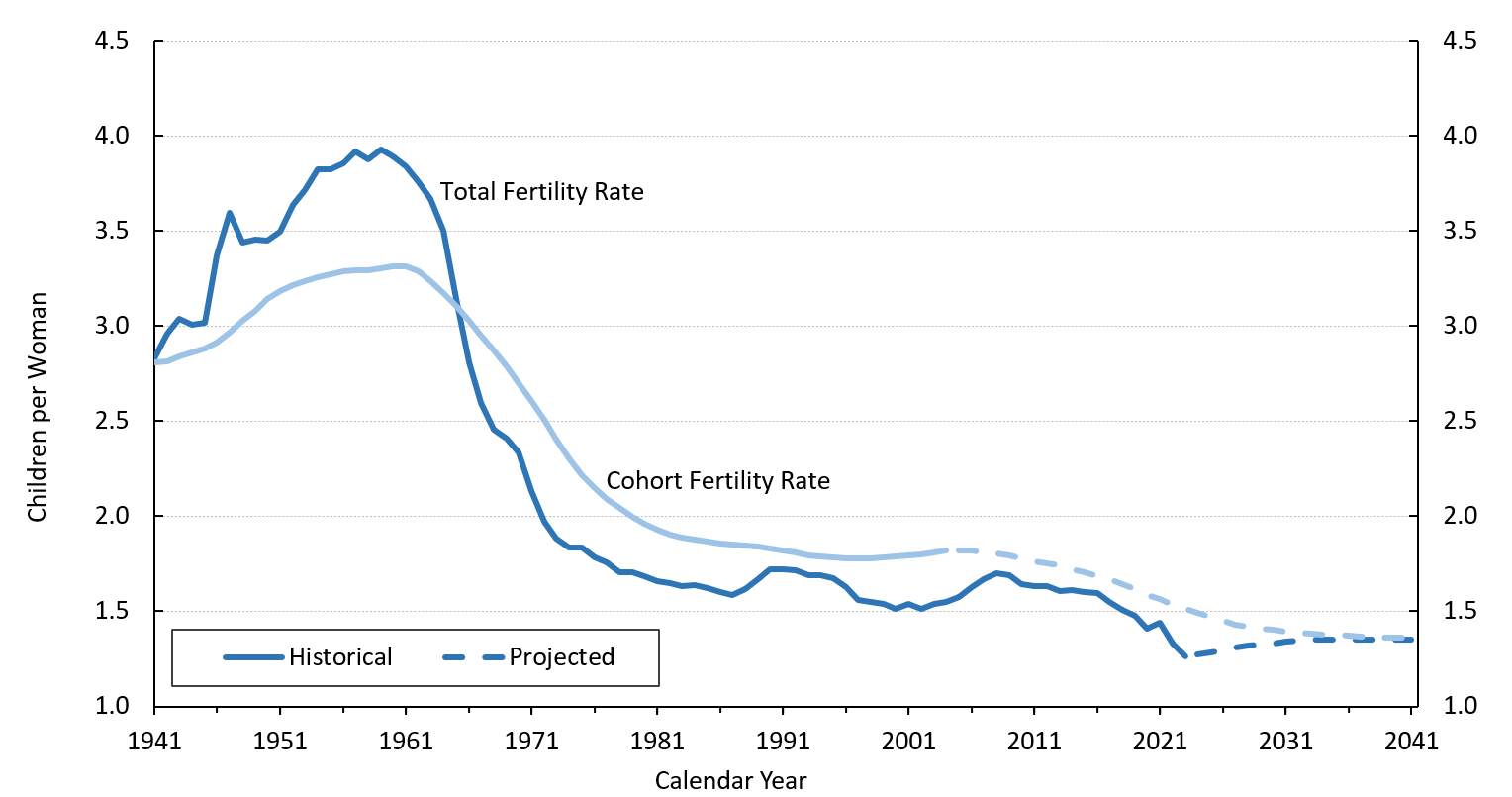
Chart 1 Footnotes
- Chart 1 Footnote 1
-
Cohort fertility rates are based on the age of a woman being 30 in a given calendar year. For instance, the cohort fertility rate for the year 2023 pertains to women born in 1993.
Chart 1 - Text version
| Year | Total Fertility Rates Historical | Total Fertility Rates Projected |
|---|---|---|
| 1941 | 2,831 | no data |
| 1942 | 2,962 | no data |
| 1943 | 3,040 | no data |
| 1944 | 3,008 | no data |
| 1945 | 3,017 | no data |
| 1946 | 3,373 | no data |
| 1947 | 3,594 | no data |
| 1948 | 3,440 | no data |
| 1949 | 3,455 | no data |
| 1950 | 3,451 | no data |
| 1951 | 3,498 | no data |
| 1952 | 3,637 | no data |
| 1953 | 3,715 | no data |
| 1954 | 3,823 | no data |
| 1955 | 3,826 | no data |
| 1956 | 3,854 | no data |
| 1957 | 3,920 | no data |
| 1958 | 3,875 | no data |
| 1959 | 3,928 | no data |
| 1960 | 3,893 | no data |
| 1961 | 3,838 | no data |
| 1962 | 3,755 | no data |
| 1963 | 3,668 | no data |
| 1964 | 3,500 | no data |
| 1965 | 3,145 | no data |
| 1966 | 2,811 | no data |
| 1967 | 2,595 | no data |
| 1968 | 2,457 | no data |
| 1969 | 2,409 | no data |
| 1970 | 2,336 | no data |
| 1971 | 2,130 | no data |
| 1972 | 1,971 | no data |
| 1973 | 1,883 | no data |
| 1974 | 1,837 | no data |
| 1975 | 1,833 | no data |
| 1976 | 1,783 | no data |
| 1977 | 1,756 | no data |
| 1978 | 1,706 | no data |
| 1979 | 1,706 | no data |
| 1980 | 1,686 | no data |
| 1981 | 1,658 | no data |
| 1982 | 1,646 | no data |
| 1983 | 1,634 | no data |
| 1984 | 1,637 | no data |
| 1985 | 1,621 | no data |
| 1986 | 1,603 | no data |
| 1987 | 1,587 | no data |
| 1988 | 1,615 | no data |
| 1989 | 1,668 | no data |
| 1990 | 1,721 | no data |
| 1991 | 1,721 | no data |
| 1992 | 1,714 | no data |
| 1993 | 1,688 | no data |
| 1994 | 1,690 | no data |
| 1995 | 1,673 | no data |
| 1996 | 1,628 | no data |
| 1997 | 1,561 | no data |
| 1998 | 1,552 | no data |
| 1999 | 1,541 | no data |
| 2000 | 1,511 | no data |
| 2001 | 1,537 | no data |
| 2002 | 1,511 | no data |
| 2003 | 1,541 | no data |
| 2004 | 1,551 | no data |
| 2005 | 1,576 | no data |
| 2006 | 1,626 | no data |
| 2007 | 1,668 | no data |
| 2008 | 1,701 | no data |
| 2009 | 1,690 | no data |
| 2010 | 1,645 | no data |
| 2011 | 1,630 | no data |
| 2012 | 1,632 | no data |
| 2013 | 1,609 | no data |
| 2014 | 1,612 | no data |
| 2015 | 1,603 | no data |
| 2016 | 1,594 | no data |
| 2017 | 1,550 | no data |
| 2018 | 1,510 | no data |
| 2019 | 1,477 | no data |
| 2020 | 1,411 | no data |
| 2021 | 1,440 | no data |
| 2022 | 1,329 | no data |
| 2023 | 1,263 | no data |
| 2024 | no data | 1,274 |
| 2025 | no data | 1,285 |
| 2026 | no data | 1,296 |
| 2027 | no data | 1,307 |
| 2028 | no data | 1,319 |
| 2029 | no data | 1,326 |
| 2030 | no data | 1,332 |
| 2031 | no data | 1,339 |
| 2032 | no data | 1,346 |
| 2033 | no data | 1,353 |
| 2034 | no data | 1,353 |
| 2035 | no data | 1,353 |
| 2036 | no data | 1,353 |
| 2037 | no data | 1,353 |
| 2038 | no data | 1,353 |
| 2039 | no data | 1,353 |
| 2040 | no data | 1,353 |
| 2041 | no data | 1,353 |
| Cohort turned 30 in | Cohort Fertility Rates Historical | Cohort Fertility Rates Projected |
|---|---|---|
| 1941 | 2,808 | no data |
| 1942 | 2,816 | no data |
| 1943 | 2,839 | no data |
| 1944 | 2,864 | no data |
| 1945 | 2,883 | no data |
| 1946 | 2,911 | no data |
| 1947 | 2,963 | no data |
| 1948 | 3,026 | no data |
| 1949 | 3,080 | no data |
| 1950 | 3,140 | no data |
| 1951 | 3,186 | no data |
| 1952 | 3,216 | no data |
| 1953 | 3,237 | no data |
| 1954 | 3,256 | no data |
| 1955 | 3,271 | no data |
| 1956 | 3,288 | no data |
| 1957 | 3,295 | no data |
| 1958 | 3,295 | no data |
| 1959 | 3,302 | no data |
| 1960 | 3,316 | no data |
| 1961 | 3,316 | no data |
| 1962 | 3,289 | no data |
| 1963 | 3,236 | no data |
| 1964 | 3,174 | no data |
| 1965 | 3,104 | no data |
| 1966 | 3,028 | no data |
| 1967 | 2,951 | no data |
| 1968 | 2,873 | no data |
| 1969 | 2,791 | no data |
| 1970 | 2,699 | no data |
| 1971 | 2,606 | no data |
| 1972 | 2,505 | no data |
| 1973 | 2,403 | no data |
| 1974 | 2,305 | no data |
| 1975 | 2,214 | no data |
| 1976 | 2,147 | no data |
| 1977 | 2,093 | no data |
| 1978 | 2,043 | no data |
| 1979 | 1,998 | no data |
| 1980 | 1,959 | no data |
| 1981 | 1,927 | no data |
| 1982 | 1,904 | no data |
| 1983 | 1,888 | no data |
| 1984 | 1,877 | no data |
| 1985 | 1,867 | no data |
| 1986 | 1,857 | no data |
| 1987 | 1,850 | no data |
| 1988 | 1,845 | no data |
| 1989 | 1,840 | no data |
| 1990 | 1,830 | no data |
| 1991 | 1,818 | no data |
| 1992 | 1,808 | no data |
| 1993 | 1,796 | no data |
| 1994 | 1,786 | no data |
| 1995 | 1,782 | no data |
| 1996 | 1,777 | no data |
| 1997 | 1,779 | no data |
| 1998 | 1,781 | no data |
| 1999 | 1,786 | no data |
| 2000 | 1,788 | no data |
| 2001 | 1,794 | no data |
| 2002 | 1,800 | no data |
| 2003 | 1,808 | no data |
| 2004 | 1,818 | no data |
| 2005 | no data | 1,822 |
| 2006 | no data | 1,820 |
| 2007 | no data | 1,812 |
| 2008 | no data | 1,805 |
| 2009 | no data | 1,793 |
| 2010 | no data | 1,780 |
| 2011 | no data | 1,765 |
| 2012 | no data | 1,754 |
| 2013 | no data | 1,740 |
| 2014 | no data | 1,723 |
| 2015 | no data | 1,705 |
| 2016 | no data | 1,687 |
| 2017 | no data | 1,670 |
| 2018 | no data | 1,645 |
| 2019 | no data | 1,616 |
| 2020 | no data | 1,588 |
| 2021 | no data | 1,564 |
| 2022 | no data | 1,536 |
| 2023 | no data | 1,512 |
| 2024 | no data | 1,491 |
| 2025 | no data | 1,470 |
| 2026 | no data | 1,451 |
| 2027 | no data | 1,430 |
| 2028 | no data | 1,417 |
| 2029 | no data | 1,409 |
| 2030 | no data | 1,401 |
| 2031 | no data | 1,394 |
| 2032 | no data | 1,389 |
| 2033 | no data | 1,384 |
| 2034 | no data | 1,380 |
| 2035 | no data | 1,376 |
| 2036 | no data | 1,373 |
| 2037 | no data | 1,369 |
| 2038 | no data | 1,366 |
| 2039 | no data | 1,363 |
| 2040 | no data | 1,363 |
| 2041 | no data | 1,363 |
Finally, in accordance with the average experience over the last 10, 20, and 25 years, the assumed ratio of male to female newborns is 1.053, which is the same as for the 31st CPP Actuarial Report.
B.3.3 Mortality
Although Canada Life Tables (CLT) for years 2020 to 2023 from Statistics Canada were available in December 2024, they were excluded from the analysis for purposes of setting long-term mortality rates. Mortality tables for these years reflect significant mortality increases related to COVID-19 and opioid-related deaths, which are assumed to be temporary. For reference, 2023 life expectancies at birth (without any assumed future mortality improvements) were lower than those in 2019 by 0.6 years for males and 0.4 years for females.
Long-term future mortality rates are therefore determined by applying assumed mortality improvement rates to Statistics Canada's 2019 CLT. According to the updated 2019 CLT released in December 2024 by Statistics Canada, life expectancies at birth in 2019 without any assumed future improvements in mortality for males and females in Canada were 80.1 and 84.3 years, respectively, compared to 80.3 and 84.4 years under the 31st CPP Actuarial Report. At age 65 in 2019, life expectancies for males and females, respectively, were 19.5 and 22.3 years according to Statistics Canada, compared to 19.6 and 22.4 years under the 31st CPP Actuarial Report.Footnote 9
The average annual mortality improvement rates experienced in Canada over the 15‑year period from 2004 to 2019 by age and sex were used as the starting point for projecting annual mortality improvement rates from 2020 onward. Improvement rates by age and sex for years 2020 to 2039 were determined by cubic interpolation between:
- the 15-year average improvement rates ending in 2019; and
- the assumed ultimate improvement rates described below in respect of the period 2039 and thereafter.
For the year 2039 and thereafter for Canada, the assumed ultimate annual rates of mortality improvement vary by age only and not by sex or calendar year. The assumed ultimate mortality improvement rates are derived using a combination of backward‑ and forward‑looking approaches. The analysis of the Canadian experience over the period from 1954 to 2019 was combined with an analysis of the possible drivers of future mortality improvements. Consideration was also given to benchmarks from peers as well as educational notes and research published by the Canadian Institute of Actuaries, including the most recent Mortality Improvements Research paper published in April 2024. Mortality improvement rates for males at most ages are currently higher than those for females but are assumed to decrease to the same level as female rates from 2039 onward. The mortality improvement rates for Quebec are assumed to be the same as for Canada.
The ultimate mortality improvement rate for both sexes for ages 0 to 89 is set at 1.0% per year from 2039 onward for Canada and Quebec. For ages above 89, the ultimate improvement rate is set to reduce from 0.6% for the age group 90‑94 to 0.2% for those aged 95 and older. For comparison, under the 31st Actuarial Report, the rate was set at 0.8%, 0.5%, and 0.2% for ages 0-89, 90-94, and 95 and older, respectively, from 2039 onward.
Once the projected mortality rates were calculated using the assumed mortality improvement rates described above, the projected mortality rates were replaced with the actual values for years 2020 to 2023 from the Statistics Canada CLT, and additional adjustments were then applied in order to reflect expected additional increases in mortality rates due to the COVID-19 pandemic as well as to account for the impact of the opioid crisis. No adjustment was applied for Quebec regarding the opioid crisis.
For the year 2024, the COVID-19 mortality adjustment factors by age group were determined using data on the number of COVID-19 deaths from both the Health Infobase of the Public Health Agency of Canada and Statistics Canada. These adjustment factors are phased out by 2026. The pandemic is therefore assumed to have a residual effect on mortality in 2024 and 2025, followed by an assumed full recovery and reversion to the projected unadjusted mortality rates for year 2026 and onward. The COVID-19 adjustments factors for 2024 and 2025 amount to overall increases in mortality rates of 1.5% and 0.5%, respectively.
Over the last decade, Canada has been faced with a significant increase in accidental drug poisoning deaths and the COVID-19 pandemic has exacerbated the issue. Opioid overdose is a subset of accidental drug poisoning deaths. It is more prevalent in the 20 to 49 age group and among men. Since 2021, there has been a plateau in the yearly opioid-related deaths. The duration and pace of the recovery remain highly uncertain. Thus, in order to reflect the impact of the opioid crisis in the future along with its uncertainty, the mortality rates for the age group 20 to 49 are projected as interpolated rates from the year 2023 actual mortality rates to the projected unadjusted 2039 mortality rates. This reflects the assumption that, over the next decade, the opioid crisis in Canada will subside gradually, due to several government initiatives to increase awareness and reduce opioid supply.
Table 41 shows the adjusted (2025), intermediate (2026 to 2038), and ultimate (2039+) assumed annual mortality improvement rates, including all assumed effects from COVID-19 and the opioid crisis, for Canada. The mortality improvement rates shown for the period 2026 to 2038 represent the average rates over that period.
| Age | Males | Females | ||||
|---|---|---|---|---|---|---|
| 2025 | 2026 to 2038Table 41 Footnote 1 | 2039+ | 2025 | 2026 to 2038Table 41 Footnote 1 | 2039+ | |
| 0 | 1.6 | 1.1 | 1.0 | 1.7 | 1.1 | 1.0 |
| 1-19 | 2.6 | 1.5 | 1.0 | 1.8 | 1.3 | 1.0 |
| 20-49 | 1.6 | 2.4 | 1.0 | 1.8 | 2.7 | 1.0 |
| 50-64 | 1.9 | 1.2 | 1.0 | 1.8 | 1.2 | 1.0 |
| 65-74 | 2.1 | 1.3 | 1.0 | 1.7 | 1.1 | 1.0 |
| 75-84 | 2.5 | 1.3 | 1.0 | 2.1 | 1.1 | 1.0 |
| 85-89 | 2.6 | 1.3 | 1.0 | 2.4 | 1.2 | 1.0 |
| 90-94 | 2.2 | 0.9 | 0.6 | 2.1 | 0.9 | 0.6 |
| 95+ | 1.3 | 0.3 | 0.2 | 1.3 | 0.4 | 0.2 |
|
Table 41 Footnotes
|
||||||
The resulting projected mortality rates in Table 42 indicate a continuous decrease in mortality rates over the long term. For example, the mortality rate at age 65 for males is expected to decrease from about 10 deaths per thousand people in 2025 to 6 deaths per thousand people by 2075. The gap in mortality rates between males and females at most ages is also expected to decrease over the projection period.
| Age | Males | Females | ||||||
|---|---|---|---|---|---|---|---|---|
| 2025 | 2050 | 2075 | 2100 | 2025 | 2050 | 2075 | 2100 | |
| 0 | 4.56 | 3.52 | 2.74 | 2.13 | 3.60 | 2.77 | 2.16 | 1.68 |
| 10 | 0.07 | 0.05 | 0.04 | 0.03 | 0.07 | 0.05 | 0.04 | 0.03 |
| 20 | 0.63 | 0.45 | 0.35 | 0.27 | 0.35 | 0.22 | 0.17 | 0.13 |
| 30 | 1.21 | 0.81 | 0.63 | 0.49 | 0.62 | 0.38 | 0.30 | 0.23 |
| 40 | 1.85 | 1.08 | 0.84 | 0.65 | 0.98 | 0.60 | 0.46 | 0.36 |
| 50 | 2.64 | 2.01 | 1.57 | 1.22 | 1.69 | 1.30 | 1.01 | 0.78 |
| 60 | 6.14 | 4.57 | 3.55 | 2.76 | 3.92 | 2.95 | 2.30 | 1.79 |
| 65 | 9.84 | 7.38 | 5.74 | 4.46 | 6.37 | 4.84 | 3.76 | 2.93 |
| 70 | 15.84 | 11.84 | 9.21 | 7.16 | 10.52 | 8.02 | 6.24 | 4.85 |
| 75 | 26.21 | 19.69 | 15.32 | 11.91 | 17.98 | 13.84 | 10.76 | 8.37 |
| 80 | 44.10 | 33.22 | 25.84 | 20.10 | 31.35 | 24.19 | 18.81 | 14.63 |
| 85 | 74.10 | 55.16 | 42.90 | 33.37 | 54.78 | 41.62 | 32.37 | 25.18 |
| 90 | 132.15 | 105.16 | 86.90 | 71.81 | 100.72 | 80.51 | 66.53 | 54.98 |
| 100 | 342.39 | 310.31 | 285.46 | 262.60 | 292.62 | 263.62 | 242.51 | 223.09 |
Chart 2 and Chart 3 show the historical and projected life expectancies at birth and age 65, respectively since the Plan's inception in 1966, based on each given year's mortality rates (i.e. without assumed future mortality improvements). Table 43 shows the projected Canadian life expectancies at various ages for the specified calendar years, also based on each given year's mortality rates (without future improvements). Table 44 is similar to Table 43, the only difference being that it takes into account the assumed mortality improvements after the specified calendar years (with future improvements).
Given the continuing trend in increased longevity, Table 44 is considered to be more realistic than Table 43, especially for the older ages. At the same time, the extended length of the projection period increases the uncertainty of the results presented in Table 44 for younger ages.
From 2025 to 2075, Canadian life expectancy at age 65 (with assumed future mortality improvements) is projected to grow from 21.6 to 25.1 years for males and from 24.1 to 27.3 years for females, as shown in Table 44.
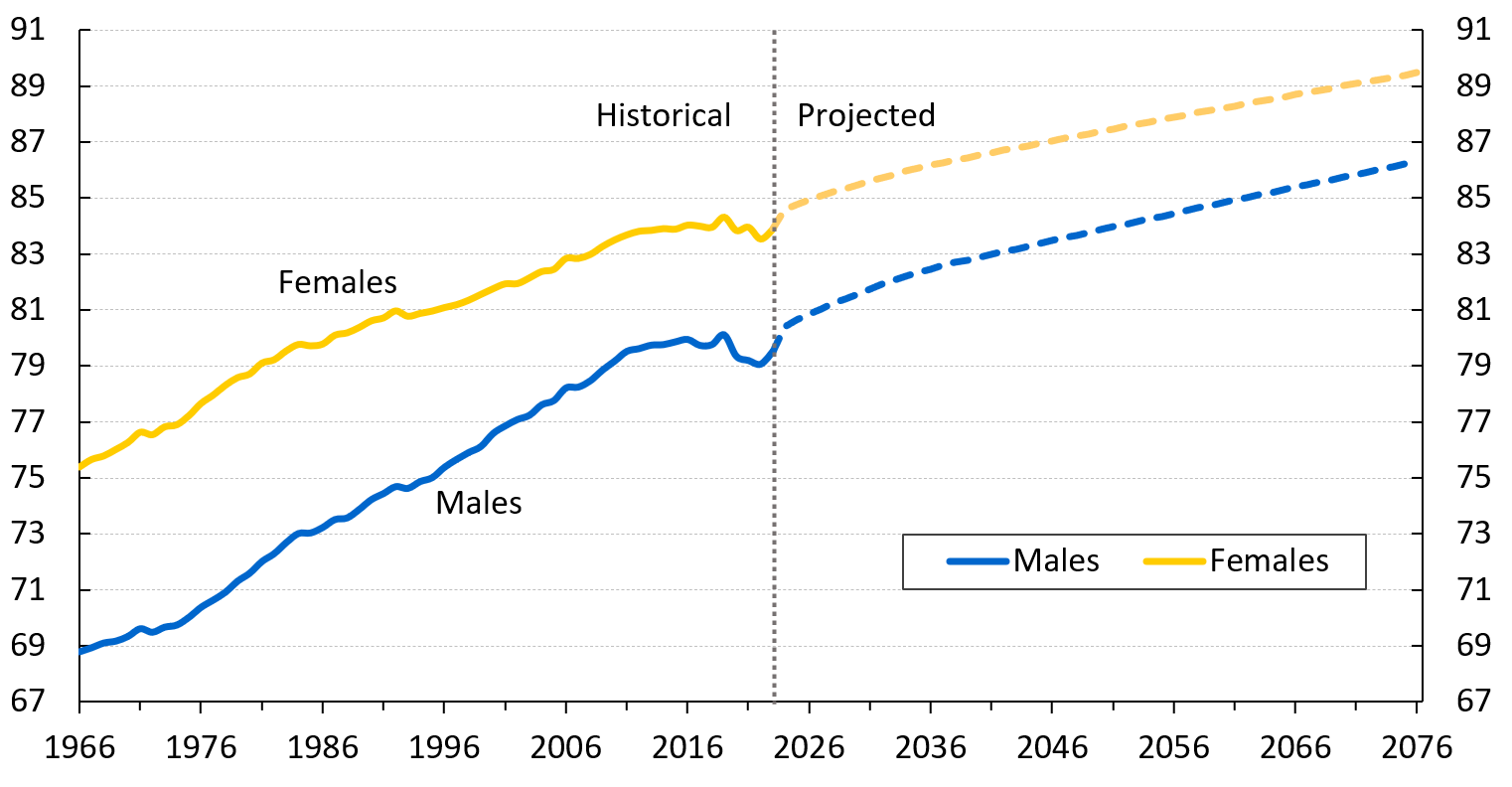
Table 2 Footnotes
- Table 2 Footnote 1
-
These are calendar year life expectancies based on the mortality rates of the given attained year.
Chart 2 - Text version
| Year | Males-historical | Males-projected | Females-historical | Females-projected |
|---|---|---|---|---|
| 1966 | 68.8 | no data | 75.4 | no data |
| 1967 | 68.9 | no data | 75.7 | no data |
| 1968 | 69.1 | no data | 75.8 | no data |
| 1969 | 69.2 | no data | 76.0 | no data |
| 1970 | 69.3 | no data | 76.3 | no data |
| 1971 | 69.6 | no data | 76.6 | no data |
| 1972 | 69.5 | no data | 76.6 | no data |
| 1973 | 69.7 | no data | 76.8 | no data |
| 1974 | 69.7 | no data | 76.9 | no data |
| 1975 | 70.0 | no data | 77.2 | no data |
| 1976 | 70.4 | no data | 77.7 | no data |
| 1977 | 70.6 | no data | 78.0 | no data |
| 1978 | 70.9 | no data | 78.3 | no data |
| 1979 | 71.3 | no data | 78.6 | no data |
| 1980 | 71.6 | no data | 78.7 | no data |
| 1981 | 72.0 | no data | 79.1 | no data |
| 1982 | 72.3 | no data | 79.2 | no data |
| 1983 | 72.7 | no data | 79.5 | no data |
| 1984 | 73.0 | no data | 79.8 | no data |
| 1985 | 73.0 | no data | 79.7 | no data |
| 1986 | 73.2 | no data | 79.8 | no data |
| 1987 | 73.5 | no data | 80.1 | no data |
| 1988 | 73.6 | no data | 80.2 | no data |
| 1989 | 73.9 | no data | 80.4 | no data |
| 1990 | 74.2 | no data | 80.6 | no data |
| 1991 | 74.4 | no data | 80.7 | no data |
| 1992 | 74.7 | no data | 81.0 | no data |
| 1993 | 74.6 | no data | 80.8 | no data |
| 1994 | 74.9 | no data | 80.9 | no data |
| 1995 | 75.0 | no data | 81.0 | no data |
| 1996 | 75.4 | no data | 81.1 | no data |
| 1997 | 75.7 | no data | 81.2 | no data |
| 1998 | 75.9 | no data | 81.4 | no data |
| 1999 | 76.1 | no data | 81.6 | no data |
| 2000 | 76.6 | no data | 81.8 | no data |
| 2001 | 76.9 | no data | 81.9 | no data |
| 2002 | 77.1 | no data | 82.0 | no data |
| 2003 | 77.2 | no data | 82.2 | no data |
| 2004 | 77.6 | no data | 82.4 | no data |
| 2005 | 77.8 | no data | 82.5 | no data |
| 2006 | 78.2 | no data | 82.8 | no data |
| 2007 | 78.2 | no data | 82.8 | no data |
| 2008 | 78.5 | no data | 83.0 | no data |
| 2009 | 78.9 | no data | 83.3 | no data |
| 2010 | 79.2 | no data | 83.5 | no data |
| 2011 | 79.5 | no data | 83.7 | no data |
| 2012 | 79.6 | no data | 83.8 | no data |
| 2013 | 79.7 | no data | 83.9 | no data |
| 2014 | 79.8 | no data | 83.9 | no data |
| 2015 | 79.9 | no data | 83.9 | no data |
| 2016 | 79.9 | no data | 84.0 | no data |
| 2017 | 79.7 | no data | 84.0 | no data |
| 2018 | 79.8 | no data | 84.0 | no data |
| 2019 | 80.1 | no data | 84.3 | no data |
| 2020 | 79.3 | no data | 83.8 | no data |
| 2021 | 79.2 | no data | 84.0 | no data |
| 2022 | 79.1 | no data | 83.5 | no data |
| 2023 | 79.5 | 79.5 | 83.9 | 83.9 |
| 2024 | no data | 80.4 | no data | 84.6 |
| 2025 | no data | 80.7 | no data | 84.8 |
| 2026 | no data | 80.9 | no data | 84.9 |
| 2027 | no data | 81.1 | no data | 85.1 |
| 2028 | no data | 81.2 | no data | 85.2 |
| 2029 | no data | 81.4 | no data | 85.3 |
| 2030 | no data | 81.6 | no data | 85.5 |
| 2031 | no data | 81.7 | no data | 85.6 |
| 2032 | no data | 81.9 | no data | 85.7 |
| 2033 | no data | 82.1 | no data | 85.8 |
| 2034 | no data | 82.2 | no data | 86.0 |
| 2035 | no data | 82.3 | no data | 86.1 |
| 2036 | no data | 82.5 | no data | 86.2 |
| 2037 | no data | 82.6 | no data | 86.3 |
| 2038 | no data | 82.7 | no data | 86.4 |
| 2039 | no data | 82.8 | no data | 86.4 |
| 2040 | no data | 82.9 | no data | 86.5 |
| 2041 | no data | 83.0 | no data | 86.6 |
| 2042 | no data | 83.1 | no data | 86.7 |
| 2043 | no data | 83.2 | no data | 86.8 |
| 2044 | no data | 83.3 | no data | 86.9 |
| 2045 | no data | 83.4 | no data | 87.0 |
| 2046 | no data | 83.5 | no data | 87.0 |
| 2047 | no data | 83.6 | no data | 87.1 |
| 2048 | no data | 83.7 | no data | 87.2 |
| 2049 | no data | 83.8 | no data | 87.3 |
| 2050 | no data | 83.9 | no data | 87.4 |
| 2051 | no data | 84.0 | no data | 87.5 |
| 2052 | no data | 84.1 | no data | 87.5 |
| 2053 | no data | 84.2 | no data | 87.6 |
| 2054 | no data | 84.3 | no data | 87.7 |
| 2055 | no data | 84.4 | no data | 87.8 |
| 2056 | no data | 84.4 | no data | 87.9 |
| 2057 | no data | 84.5 | no data | 88.0 |
| 2058 | no data | 84.6 | no data | 88.0 |
| 2059 | no data | 84.7 | no data | 88.1 |
| 2060 | no data | 84.8 | no data | 88.2 |
| 2061 | no data | 84.9 | no data | 88.3 |
| 2062 | no data | 85.0 | no data | 88.4 |
| 2063 | no data | 85.1 | no data | 88.4 |
| 2064 | no data | 85.2 | no data | 88.5 |
| 2065 | no data | 85.3 | no data | 88.6 |
| 2066 | no data | 85.4 | no data | 88.7 |
| 2067 | no data | 85.5 | no data | 88.8 |
| 2068 | no data | 85.6 | no data | 88.8 |
| 2069 | no data | 85.7 | no data | 88.9 |
| 2070 | no data | 85.8 | no data | 89.0 |
| 2071 | no data | 85.8 | no data | 89.1 |
| 2072 | no data | 85.9 | no data | 89.2 |
| 2073 | no data | 86.0 | no data | 89.2 |
| 2074 | no data | 86.1 | no data | 89.3 |
| 2075 | no data | 86.2 | no data | 89.4 |
| 2076 | no data | 86.3 | no data | 89.5 |
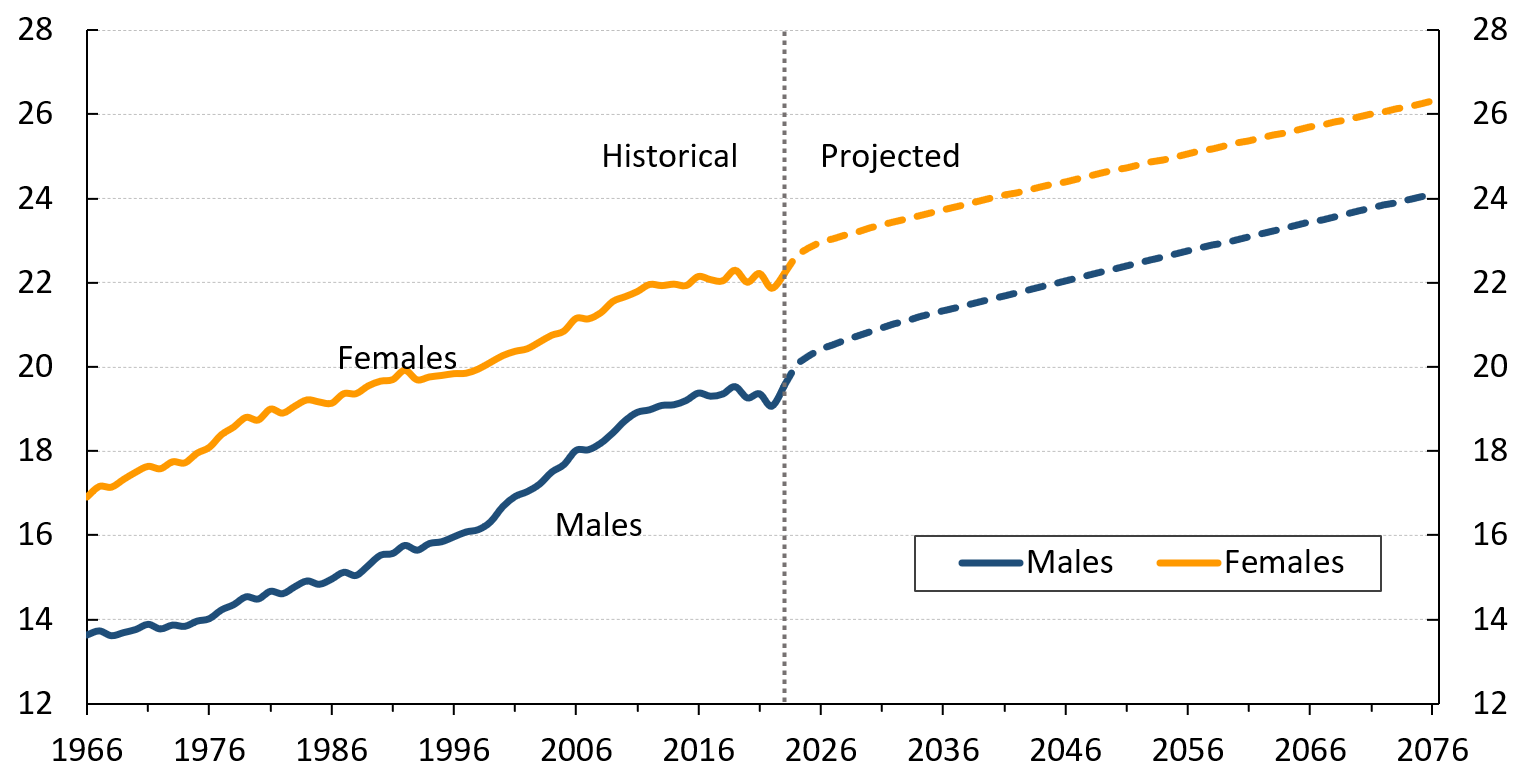
Chart 3 Footnotes
- Chart 3 Footnote 1
-
These are calendar year life expectancies based on the mortality rates of the given attained year.
Chart 3 - Text version
| Year | Males-historical | Males-projected | Females-historical | Females-projected |
|---|---|---|---|---|
| 1966 | 13.6 | no data | 16.9 | no data |
| 1967 | 13.7 | no data | 17.2 | no data |
| 1968 | 13.6 | no data | 17.1 | no data |
| 1969 | 13.7 | no data | 17.3 | no data |
| 1970 | 13.8 | no data | 17.5 | no data |
| 1971 | 13.9 | no data | 17.6 | no data |
| 1972 | 13.8 | no data | 17.6 | no data |
| 1973 | 13.9 | no data | 17.7 | no data |
| 1974 | 13.8 | no data | 17.7 | no data |
| 1975 | 14.0 | no data | 17.9 | no data |
| 1976 | 14.0 | no data | 18.1 | no data |
| 1977 | 14.2 | no data | 18.4 | no data |
| 1978 | 14.4 | no data | 18.6 | no data |
| 1979 | 14.5 | no data | 18.8 | no data |
| 1980 | 14.5 | no data | 18.7 | no data |
| 1981 | 14.7 | no data | 19.0 | no data |
| 1982 | 14.6 | no data | 18.9 | no data |
| 1983 | 14.8 | no data | 19.1 | no data |
| 1984 | 14.9 | no data | 19.2 | no data |
| 1985 | 14.8 | no data | 19.2 | no data |
| 1986 | 15.0 | no data | 19.1 | no data |
| 1987 | 15.1 | no data | 19.4 | no data |
| 1988 | 15.0 | no data | 19.4 | no data |
| 1989 | 15.3 | no data | 19.5 | no data |
| 1990 | 15.5 | no data | 19.7 | no data |
| 1991 | 15.6 | no data | 19.7 | no data |
| 1992 | 15.8 | no data | 19.9 | no data |
| 1993 | 15.6 | no data | 19.7 | no data |
| 1994 | 15.8 | no data | 19.8 | no data |
| 1995 | 15.9 | no data | 19.8 | no data |
| 1996 | 16.0 | no data | 19.8 | no data |
| 1997 | 16.1 | no data | 19.9 | no data |
| 1998 | 16.1 | no data | 20.0 | no data |
| 1999 | 16.3 | no data | 20.1 | no data |
| 2000 | 16.7 | no data | 20.3 | no data |
| 2001 | 16.9 | no data | 20.4 | no data |
| 2002 | 17.0 | no data | 20.4 | no data |
| 2003 | 17.2 | no data | 20.6 | no data |
| 2004 | 17.5 | no data | 20.8 | no data |
| 2005 | 17.7 | no data | 20.9 | no data |
| 2006 | 18.0 | no data | 21.2 | no data |
| 2007 | 18.0 | no data | 21.1 | no data |
| 2008 | 18.2 | no data | 21.3 | no data |
| 2009 | 18.4 | no data | 21.6 | no data |
| 2010 | 18.7 | no data | 21.7 | no data |
| 2011 | 18.9 | no data | 21.8 | no data |
| 2012 | 19.0 | no data | 22.0 | no data |
| 2013 | 19.1 | no data | 21.9 | no data |
| 2014 | 19.1 | no data | 22.0 | no data |
| 2015 | 19.2 | no data | 21.9 | no data |
| 2016 | 19.4 | no data | 22.2 | no data |
| 2017 | 19.3 | no data | 22.1 | no data |
| 2018 | 19.4 | no data | 22.1 | no data |
| 2019 | 19.5 | no data | 22.3 | no data |
| 2020 | 19.3 | no data | 22.0 | no data |
| 2021 | 19.4 | no data | 22.2 | no data |
| 2022 | 19.1 | no data | 21.9 | no data |
| 2023 | 19.5 | 19.5 | 22.2 | 22.2 |
| 2024 | no data | 20.1 | no data | 22.7 |
| 2025 | no data | 20.3 | no data | 22.8 |
| 2026 | no data | 20.4 | no data | 23.0 |
| 2027 | no data | 20.5 | no data | 23.0 |
| 2028 | no data | 20.6 | no data | 23.1 |
| 2029 | no data | 20.7 | no data | 23.2 |
| 2030 | no data | 20.8 | no data | 23.3 |
| 2031 | no data | 20.9 | no data | 23.4 |
| 2032 | no data | 21.0 | no data | 23.4 |
| 2033 | no data | 21.1 | no data | 23.5 |
| 2034 | no data | 21.2 | no data | 23.6 |
| 2035 | no data | 21.3 | no data | 23.7 |
| 2036 | no data | 21.3 | no data | 23.7 |
| 2037 | no data | 21.4 | no data | 23.8 |
| 2038 | no data | 21.5 | no data | 23.9 |
| 2039 | no data | 21.6 | no data | 23.9 |
| 2040 | no data | 21.6 | no data | 24.0 |
| 2041 | no data | 21.7 | no data | 24.1 |
| 2042 | no data | 21.8 | no data | 24.1 |
| 2043 | no data | 21.8 | no data | 24.2 |
| 2044 | no data | 21.9 | no data | 24.3 |
| 2045 | no data | 22.0 | no data | 24.3 |
| 2046 | no data | 22.1 | no data | 24.4 |
| 2047 | no data | 22.1 | no data | 24.5 |
| 2048 | no data | 22.2 | no data | 24.5 |
| 2049 | no data | 22.3 | no data | 24.6 |
| 2050 | no data | 22.3 | no data | 24.7 |
| 2051 | no data | 22.4 | no data | 24.7 |
| 2052 | no data | 22.5 | no data | 24.8 |
| 2053 | no data | 22.5 | no data | 24.9 |
| 2054 | no data | 22.6 | no data | 24.9 |
| 2055 | no data | 22.7 | no data | 25.0 |
| 2056 | no data | 22.8 | no data | 25.1 |
| 2057 | no data | 22.8 | no data | 25.1 |
| 2058 | no data | 22.9 | no data | 25.2 |
| 2059 | no data | 23.0 | no data | 25.2 |
| 2060 | no data | 23.0 | no data | 25.3 |
| 2061 | no data | 23.1 | no data | 25.4 |
| 2062 | no data | 23.2 | no data | 25.4 |
| 2063 | no data | 23.2 | no data | 25.5 |
| 2064 | no data | 23.3 | no data | 25.6 |
| 2065 | no data | 23.4 | no data | 25.6 |
| 2066 | no data | 23.4 | no data | 25.7 |
| 2067 | no data | 23.5 | no data | 25.8 |
| 2068 | no data | 23.6 | no data | 25.8 |
| 2069 | no data | 23.6 | no data | 25.9 |
| 2070 | no data | 23.7 | no data | 25.9 |
| 2071 | no data | 23.8 | no data | 26.0 |
| 2072 | no data | 23.8 | no data | 26.1 |
| 2073 | no data | 23.9 | no data | 26.1 |
| 2074 | no data | 24.0 | no data | 26.2 |
| 2075 | no data | 24.0 | no data | 26.2 |
| 2076 | no data | 24.1 | no data | 26.3 |
| Age | Males | Females | ||||
|---|---|---|---|---|---|---|
| 2025 | 2050 | 2075 | 2025 | 2050 | 2075 | |
| 0 | 80.7 | 83.9 | 86.2 | 84.8 | 87.4 | 89.4 |
| 10 | 71.1 | 74.2 | 76.5 | 75.1 | 77.7 | 79.6 |
| 20 | 61.2 | 64.3 | 66.6 | 65.3 | 67.8 | 69.7 |
| 30 | 51.7 | 54.7 | 56.9 | 55.5 | 57.9 | 59.8 |
| 40 | 42.4 | 45.2 | 47.2 | 45.9 | 48.2 | 50.0 |
| 50 | 33.3 | 35.7 | 37.7 | 36.5 | 38.6 | 40.3 |
| 60 | 24.4 | 26.7 | 28.5 | 27.2 | 29.2 | 30.8 |
| 65 | 20.3 | 22.3 | 24.0 | 22.8 | 24.7 | 26.2 |
| 70 | 16.4 | 18.2 | 19.8 | 18.6 | 20.3 | 21.8 |
| 75 | 12.8 | 14.4 | 15.8 | 14.7 | 16.3 | 17.6 |
| 80 | 9.6 | 11.0 | 12.1 | 11.2 | 12.5 | 13.6 |
| 85 | 6.9 | 7.9 | 8.8 | 8.1 | 9.2 | 10.0 |
| 90 | 4.7 | 5.3 | 5.9 | 5.6 | 6.2 | 6.8 |
| 100 | 2.2 | 2.4 | 2.5 | 2.5 | 2.7 | 2.9 |
|
Table 43 Footnotes
|
||||||
| Age | Males | Females | ||||
|---|---|---|---|---|---|---|
| 2025 | 2050 | 2075 | 2025 | 2050 | 2075 | |
| 0 | 87.8 | 89.9 | 91.8 | 91.0 | 92.8 | 94.4 |
| 10 | 77.4 | 79.5 | 81.4 | 80.7 | 82.5 | 84.0 |
| 20 | 66.6 | 68.8 | 70.8 | 70.0 | 71.9 | 73.5 |
| 30 | 56.1 | 58.4 | 60.4 | 59.5 | 61.4 | 63.0 |
| 40 | 45.8 | 48.0 | 50.0 | 49.0 | 50.9 | 52.6 |
| 50 | 35.8 | 37.8 | 39.8 | 38.7 | 40.6 | 42.3 |
| 60 | 26.1 | 28.0 | 29.8 | 28.8 | 30.6 | 32.2 |
| 65 | 21.6 | 23.4 | 25.1 | 24.1 | 25.7 | 27.3 |
| 70 | 17.3 | 19.0 | 20.6 | 19.6 | 21.1 | 22.6 |
| 75 | 13.5 | 15.0 | 16.3 | 15.4 | 16.8 | 18.1 |
| 80 | 10.0 | 11.3 | 12.5 | 11.7 | 12.9 | 14.0 |
| 85 | 7.1 | 8.1 | 9.0 | 8.4 | 9.3 | 10.2 |
| 90 | 4.8 | 5.4 | 6.0 | 5.7 | 6.3 | 6.9 |
| 100 | 2.2 | 2.4 | 2.5 | 2.5 | 2.7 | 2.9 |
|
Table 44 Footnotes
|
||||||
B.3.4 Net migration
Net migration refers to the number of immigrants less the number of net emigrants (i.e. the number of emigrants less the number of returning Canadians) plus the net increase in the number of non-permanent residents (NPR). Net migration is generally recognized as being a volatile component of population growth since it is subject to a variety of demographic, economic, social and political factors. In more recent years, it has been even more volatile.
The level of net migration for Canada as a percentage of the population from 2000 to 2015 has varied between 0.5% and 0.8%. In 2016, net migration began accelerating, surpassing 0.8% in part due to the introduction of the Express Entry system by the Government of Canada. By 2019, net migration reached 1.19% of the population. Since then, net migration has been more volatile. In 2020 and 2021, there was a significant decrease in net migration as a percentage of the population, with the rate dropping to 0.86% and 0.39%, respectively in 2020 and 2021. The COVID-19 pandemic led to border closures making travel between countries difficult, which negatively impacted migration. In 2022, 2023 and 2024, net migration increased to historically high levels of 1.68%, 2.83% and 2.88% of the population, respectively. This was due in particular to the removal of various pandemic-related safety measures, such as Canadian borders fully reopening in October 2022, along with efforts to fill job vacancies in key sectors of the labour market by the admittance of a large number of NPR.
The level of NPR as a percentage of the population has increased steadily but remained considerably below 5% for the years prior to the COVID-19 pandemic. Since 2021, the number of international students and temporary workers with permits under the International Mobility Program has grown substantially. They represent the two largest groups within NPR, accounting for more than three quarters of NPR in each of the past 10 years. By the end of 2024, the number of NPR reached unprecedented levels, representing 7.3% of the population. By contrast, based on the 20-year average ending in 2024, NPR represented 2.7% of the population.
To select the assumptions regarding the short-term and ultimate net migration rates, the components of net migration were analyzed separately by considering trends in the historical data as well as qualitative factors that could influence future trends. Consideration was also given to the federal government's short-term immigration targets and to long-term perspectives of various experts regarding levels of future immigration and non-permanent residents.
In the 2024 Annual Report to Parliament on Immigration, the Government of Canada released details on its Immigration Levels Plan for 2025 to 2027. The target numbers of new immigrants are set at 395,000 in 2025, 380,000 in 2026, and 365,000 in 2027. Also, the government announced, for the first time ever, short-term targets for the level of NPR, specifically: NPR inflows subject to targets set for students and workers to achieve an NPR level (as % of the population) of 5.0% by the end of 2026.
Considering the historical experience and the immigration plan of the government, immigration as a percentage of the population is assumed in the short term to decelerate but remain above pre-COVID-19 levels due to the continuing need to fill skill shortages in the labour market and maintain a growing population. In the long term, it is assumed that higher sustained immigration will be necessary to maintain population and economic growth, aligning with forecasts from other experts.
The immigration rate is expected to decrease from 1.12% of the population in 2024 to 0.96% in 2025, 0.92% in 2026, and 0.88% in 2027. After that, it is projected to gradually decrease to an ultimate rate of 0.82% by 2034. The ultimate rate of 0.82% corresponds to the 20-year average ending in 2024, which was selected to give some weight to generally higher levels of immigration observed since 2016 while still reflecting longer term historical trends.
The historical net emigration rate has been relatively stable since the late 2000s. The ultimate assumption for that component is based on an 8-year average ending in 2024 considering that Statistics Canada revised its methodology for reporting emigration data in 2017. The net emigration rate is expected to decrease slightly from 0.12% of the population in 2024 to 0.11% by 2026 and remain at that level thereafter.
Regarding the assumed level of NPR, current government NPR targets are short-term, and there is limited consensus among other experts on future NPR trends. To address the higher levels and volatility of the number of NPR in recent years, a new method was developed for this report to project the number of NPR separately from the rest of the population. For this purpose, an assumption is made for each year of the projection period regarding the level of NPR as a percentage of the population. The resulting annual changes in the number of NPR can then be determined and flow through the overall net migration rate.
The NPR assumption is divided into three periods. The first period reflects government targets ending in 2027. The second period addresses demographic aging up to 2035, with the NPR level assumed to reduce but remain elevated. The third period, ending in 2050, assumes the level of NPR will return to levels that are more in line with longer term historical averages. As such, the level of NPR as a percentage of the population is assumed to trend down linearly across these periods: from 7.3% observed in 2024, to 5% in 2026, 4.0% in 2035, and then to an ultimate rate of 2.5% in 2050, remaining at that level thereafter. The ultimate rate of 2.5% was selected to give some weight to recent higher levels of NPR, while still reflecting longer-term historical trends.
Based on the foregoing, the actual net migration rate in 2024 of 2.88% of the Canadian population is assumed to decrease to -0.34% in 2025 and -0.29% in 2026, and is then assumed to increase to 0.82% in 2027. Thereafter, the net migration rate is assumed to gradually transition to an ultimate level of 0.72% of the population in 2051 (as shown in Chart 4).
Although the net migration rate represents the combined effect of all migration components, the largest fluctuations in the early projection years shown in Chart 4 are due to the Government of Canada's short-term targets and the assumed changes in net migration components as percentages of the population. Thereafter, the assumed changes in the immigration rate and NPR levels result in a decrease in the net migration rate until 2050, after which the net migration rate stabilizes at 0.72%.
Chart 4 shows the net migration experience since 1972 and the projected rates starting in 2025.
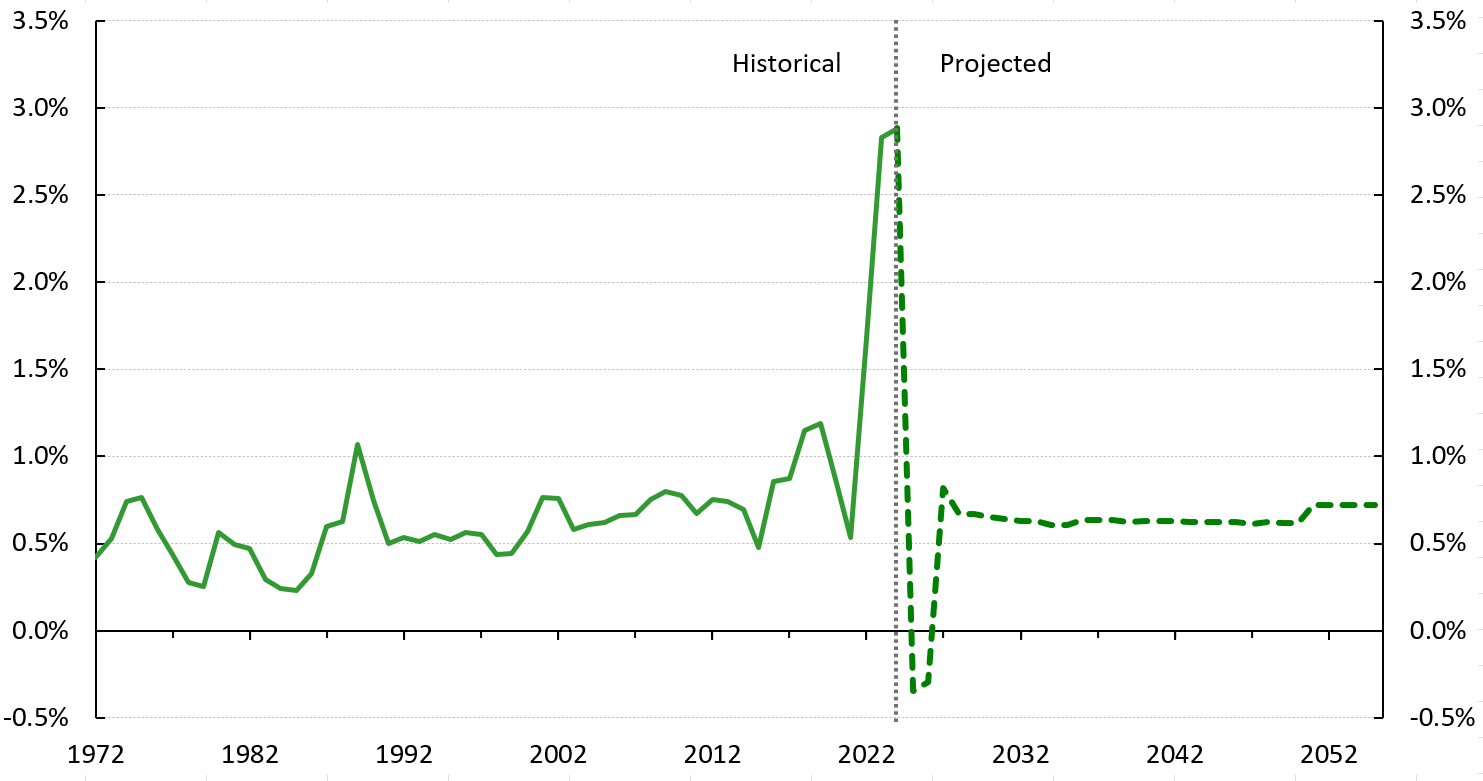
Chart 4 - Text version
| Year | Historical | Projected |
|---|---|---|
| 1972 | 0.42% | no data |
| 1973 | 0.53% | no data |
| 1974 | 0.74% | no data |
| 1975 | 0.76% | no data |
| 1976 | 0.58% | no data |
| 1977 | 0.44% | no data |
| 1978 | 0.28% | no data |
| 1979 | 0.25% | no data |
| 1980 | 0.56% | no data |
| 1981 | 0.49% | no data |
| 1982 | 0.47% | no data |
| 1983 | 0.29% | no data |
| 1984 | 0.24% | no data |
| 1985 | 0.23% | no data |
| 1986 | 0.33% | no data |
| 1987 | 0.60% | no data |
| 1988 | 0.63% | no data |
| 1989 | 1.07% | no data |
| 1990 | 0.75% | no data |
| 1991 | 0.50% | no data |
| 1992 | 0.54% | no data |
| 1993 | 0.51% | no data |
| 1994 | 0.55% | no data |
| 1995 | 0.52% | no data |
| 1996 | 0.57% | no data |
| 1997 | 0.55% | no data |
| 1998 | 0.44% | no data |
| 1999 | 0.45% | no data |
| 2000 | 0.57% | no data |
| 2001 | 0.76% | no data |
| 2002 | 0.76% | no data |
| 2003 | 0.58% | no data |
| 2004 | 0.61% | no data |
| 2005 | 0.62% | no data |
| 2006 | 0.66% | no data |
| 2007 | 0.67% | no data |
| 2008 | 0.75% | no data |
| 2009 | 0.80% | no data |
| 2010 | 0.77% | no data |
| 2011 | 0.67% | no data |
| 2012 | 0.75% | no data |
| 2013 | 0.74% | no data |
| 2014 | 0.70% | no data |
| 2015 | 0.48% | no data |
| 2016 | 0.86% | no data |
| 2017 | 0.87% | no data |
| 2018 | 1.15% | no data |
| 2019 | 1.19% | no data |
| 2020 | 0.86% | no data |
| 2021 | 0.53% | no data |
| 2022 | 1.68% | no data |
| 2023 | 2.83% | no data |
| 2024 | 2.88% | 2.88% |
| 2025 | no data | -0.34% |
| 2026 | no data | -0.29% |
| 2027 | no data | 0.82% |
| 2028 | no data | 0.67% |
| 2029 | no data | 0.67% |
| 2030 | no data | 0.65% |
| 2031 | no data | 0.64% |
| 2032 | no data | 0.63% |
| 2033 | no data | 0.63% |
| 2034 | no data | 0.61% |
| 2035 | no data | 0.61% |
| 2036 | no data | 0.64% |
| 2037 | no data | 0.63% |
| 2038 | no data | 0.63% |
| 2039 | no data | 0.62% |
| 2040 | no data | 0.63% |
| 2041 | no data | 0.63% |
| 2042 | no data | 0.63% |
| 2043 | no data | 0.63% |
| 2044 | no data | 0.63% |
| 2045 | no data | 0.62% |
| 2046 | no data | 0.62% |
| 2047 | no data | 0.61% |
| 2048 | no data | 0.62% |
| 2049 | no data | 0.62% |
| 2050 | no data | 0.62% |
| 2051 | no data | 0.72% |
| 2052 | no data | 0.72% |
| 2053 | no data | 0.72% |
| 2054 | no data | 0.72% |
| 2055 | no data | 0.72% |
For the Quebec population, the same net migration components of immigration, net emigration, and net increase in the level of NPR are considered. An additional component consisting of the net interprovincial migration for Quebec is also included. The level of NPR for Quebec is assumed to trend down linearly across the following periods: from 6.5% observed in 2024 to 4.5% in 2026, 3.5% in 2035, and then to an ultimate rate of 2.0% in 2050, remaining at that level thereafter. From 2026 onward, the assumed NPR level as a percentage of the Quebec population is 0.5 percentage points lower than the NPR level for Canada.
As a result of the component assumptions, the observed net migration rate of 2.31% for Quebec in 2024 is assumed to decrease gradually to an ultimate net migration rate of 0.45% in 2051 and thereafter.
For both Canada and Quebec, the distributions of immigrants, net emigrants, and NPR by age and sex used for the demographic projections are averaged over the historical 10-year period from 2010 to 2019 due to the significant volatility in more recent years.
B.3.5 Projected population and its characteristics
The historical and projected evolution of the Canada less Quebec population age distribution since the inception of the Plan is shown in Chart 5. One can easily observe that the triangular shape of the 1960s has become more rectangular over time. This is projected to continue and indicates an aging population. The chart also reveals that the number of people aged 85 and over is expected to increase dramatically over the coming decades.
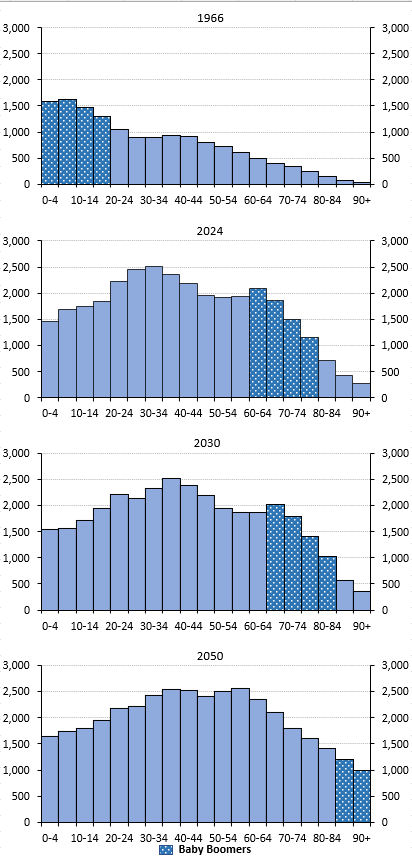
Chart 5 - Text version
| Age group | 1966 | 2024 | 2030 | 2050 |
|---|---|---|---|---|
| 0-4 | 1,585,423 | 1,453,400 | 1,533,759 | 1,648,968 |
| 5-9 | 1,630,472 | 1,682,666 | 1,555,366 | 1,733,588 |
| 10-14 | 1,479,183 | 1,738,169 | 1,711,058 | 1,791,104 |
| 15-19 | 1,306,941 | 1,833,192 | 1,942,638 | 1,955,472 |
| 20-24 | 1,042,168 | 2,225,552 | 2,211,419 | 2,170,890 |
| 25-29 | 899,017 | 2,454,435 | 2,130,378 | 2,206,589 |
| 30-34 | 897,837 | 2,507,255 | 2,333,711 | 2,415,147 |
| 35-39 | 929,325 | 2,353,747 | 2,509,701 | 2,532,014 |
| 40-44 | 920,538 | 2,177,962 | 2,380,616 | 2,527,702 |
| 45-49 | 801,523 | 1,955,335 | 2,186,976 | 2,397,048 |
| 50-54 | 730,747 | 1,920,284 | 1,940,614 | 2,504,680 |
| 55-59 | 602,941 | 1,936,326 | 1,873,639 | 2,557,793 |
| 60-64 | 494,436 | 2,083,055 | 1,869,544 | 2,344,682 |
| 65-69 | 401,997 | 1,853,839 | 2,018,225 | 2,091,529 |
| 70-74 | 330,969 | 1,495,809 | 1,792,882 | 1,789,359 |
| 75-79 | 238,561 | 1,154,329 | 1,406,961 | 1,607,524 |
| 80-84 | 143,973 | 717,442 | 1,024,694 | 1,401,849 |
| 85-89 | 63,212 | 420,863 | 557,220 | 1,196,531 |
| 90+ | 21,997 | 268,895 | 350,315 | 990,246 |
The population of Canada as at 1 July 2024 is 41.3 million, while the population of Canada less Quebec is 32.2 million. Table 45 and Table 46 present the projected populations of Canada and Canada less Quebec as at 1 July for selected age groups and years, while Chart 6 shows the evolution of the population of Canada less Quebec, split by ages groups 0 to 19, 20 to 64, and 65 and above, from 1975 to 2100. Table 47 shows the variations in the relative proportions of various age groups for Canada less Quebec throughout the projection period.
The proportion of people aged 65 and over for Canada less Quebec is expected to be 19.0% of the total population in 2025 and to increase significantly thereafter to 28.8% by 2100. The number of people aged 65 and older as a proportion of the number of people aged 20 to 64 also increases significantly over the same period, from a projected 31.6% in 2025 to 53.7% by 2100. This proportion affects the ratio of benefits to contributions under the CPP.
| Year | 0-17 | 18-69 | 70+ | 0-19 | 20-64 | 65+ | Total |
|---|---|---|---|---|---|---|---|
| 2025 | 7,527 | 28,082 | 5,597 | 8,552 | 24,571 | 8,083 | 41,206 |
| 2026 | 7,507 | 27,811 | 5,826 | 8,526 | 24,255 | 8,362 | 41,143 |
| 2027 | 7,513 | 27,960 | 6,061 | 8,554 | 24,351 | 8,629 | 41,534 |
| 2028 | 7,516 | 28,047 | 6,300 | 8,563 | 24,400 | 8,900 | 41,863 |
| 2029 | 7,523 | 28,130 | 6,535 | 8,568 | 24,464 | 9,157 | 42,188 |
| 2030 | 7,526 | 28,201 | 6,773 | 8,571 | 24,538 | 9,392 | 42,500 |
| 2031 | 7,526 | 28,267 | 7,010 | 8,576 | 24,641 | 9,586 | 42,803 |
| 2032 | 7,525 | 28,338 | 7,232 | 8,576 | 24,771 | 9,747 | 43,095 |
| 2033 | 7,521 | 28,404 | 7,456 | 8,574 | 24,910 | 9,897 | 43,381 |
| 2034 | 7,515 | 28,470 | 7,665 | 8,571 | 25,038 | 10,042 | 43,651 |
| 2035 | 7,514 | 28,547 | 7,852 | 8,564 | 25,166 | 10,184 | 43,914 |
| 2040 | 7,603 | 29,170 | 8,410 | 8,599 | 25,876 | 10,708 | 45,183 |
| 2045 | 7,756 | 29,835 | 8,722 | 8,762 | 26,423 | 11,128 | 46,313 |
| 2050 | 7,861 | 30,476 | 8,982 | 8,870 | 26,823 | 11,625 | 47,319 |
| 2055 | 7,972 | 31,157 | 9,375 | 8,993 | 27,286 | 12,225 | 48,504 |
| 2060 | 8,069 | 31,713 | 9,929 | 9,115 | 27,590 | 13,006 | 49,711 |
| 2065 | 8,163 | 32,140 | 10,690 | 9,230 | 28,093 | 13,671 | 50,993 |
| 2070 | 8,289 | 32,729 | 11,309 | 9,363 | 28,768 | 14,196 | 52,327 |
| 2075 | 8,449 | 33,471 | 11,740 | 9,536 | 29,267 | 14,856 | 53,659 |
| 2080 | 8,622 | 34,062 | 12,271 | 9,730 | 29,716 | 15,510 | 54,955 |
| 2085 | 8,790 | 34,624 | 12,798 | 9,922 | 30,223 | 16,066 | 56,211 |
| 2090 | 8,951 | 35,248 | 13,261 | 10,107 | 30,853 | 16,500 | 57,460 |
| 2095 | 9,110 | 35,994 | 13,656 | 10,290 | 31,456 | 17,013 | 58,760 |
| 2100 | 9,277 | 36,714 | 14,136 | 10,479 | 32,079 | 17,568 | 60,127 |
| Year | 0-17 | 18-69 | 70+ | 0-19 | 20-64 | 65+ | Total |
|---|---|---|---|---|---|---|---|
| 2025 | 5,879 | 22,077 | 4,226 | 6,698 | 19,368 | 6,116 | 32,182 |
| 2026 | 5,867 | 21,880 | 4,403 | 6,677 | 19,139 | 6,333 | 32,149 |
| 2027 | 5,879 | 22,021 | 4,583 | 6,705 | 19,234 | 6,544 | 32,483 |
| 2028 | 5,889 | 22,113 | 4,766 | 6,718 | 19,292 | 6,758 | 32,768 |
| 2029 | 5,904 | 22,203 | 4,947 | 6,731 | 19,359 | 6,963 | 33,054 |
| 2030 | 5,916 | 22,282 | 5,132 | 6,743 | 19,437 | 7,150 | 33,330 |
| 2031 | 5,925 | 22,358 | 5,317 | 6,757 | 19,535 | 7,307 | 33,600 |
| 2032 | 5,934 | 22,436 | 5,493 | 6,768 | 19,655 | 7,440 | 33,863 |
| 2033 | 5,940 | 22,512 | 5,672 | 6,777 | 19,780 | 7,567 | 34,123 |
| 2034 | 5,944 | 22,588 | 5,840 | 6,785 | 19,896 | 7,692 | 34,372 |
| 2035 | 5,951 | 22,675 | 5,990 | 6,788 | 20,013 | 7,815 | 34,615 |
| 2040 | 6,062 | 23,265 | 6,472 | 6,854 | 20,665 | 8,280 | 35,799 |
| 2045 | 6,211 | 23,900 | 6,768 | 7,022 | 21,227 | 8,628 | 36,878 |
| 2050 | 6,308 | 24,569 | 6,986 | 7,129 | 21,657 | 9,077 | 37,863 |
| 2055 | 6,416 | 25,237 | 7,343 | 7,247 | 22,103 | 9,647 | 38,997 |
| 2060 | 6,527 | 25,764 | 7,863 | 7,379 | 22,420 | 10,355 | 40,154 |
| 2065 | 6,642 | 26,192 | 8,539 | 7,514 | 22,883 | 10,976 | 41,374 |
| 2070 | 6,782 | 26,744 | 9,113 | 7,665 | 23,509 | 11,466 | 42,639 |
| 2075 | 6,944 | 27,445 | 9,517 | 7,843 | 24,020 | 12,044 | 43,907 |
| 2080 | 7,113 | 28,055 | 9,976 | 8,033 | 24,507 | 12,604 | 45,144 |
| 2085 | 7,276 | 28,654 | 10,417 | 8,221 | 25,040 | 13,087 | 46,347 |
| 2090 | 7,439 | 29,299 | 10,812 | 8,406 | 25,677 | 13,467 | 47,549 |
| 2095 | 7,604 | 30,046 | 11,153 | 8,594 | 26,276 | 13,933 | 48,803 |
| 2100 | 7,777 | 30,759 | 11,590 | 8,789 | 26,890 | 14,446 | 50,125 |
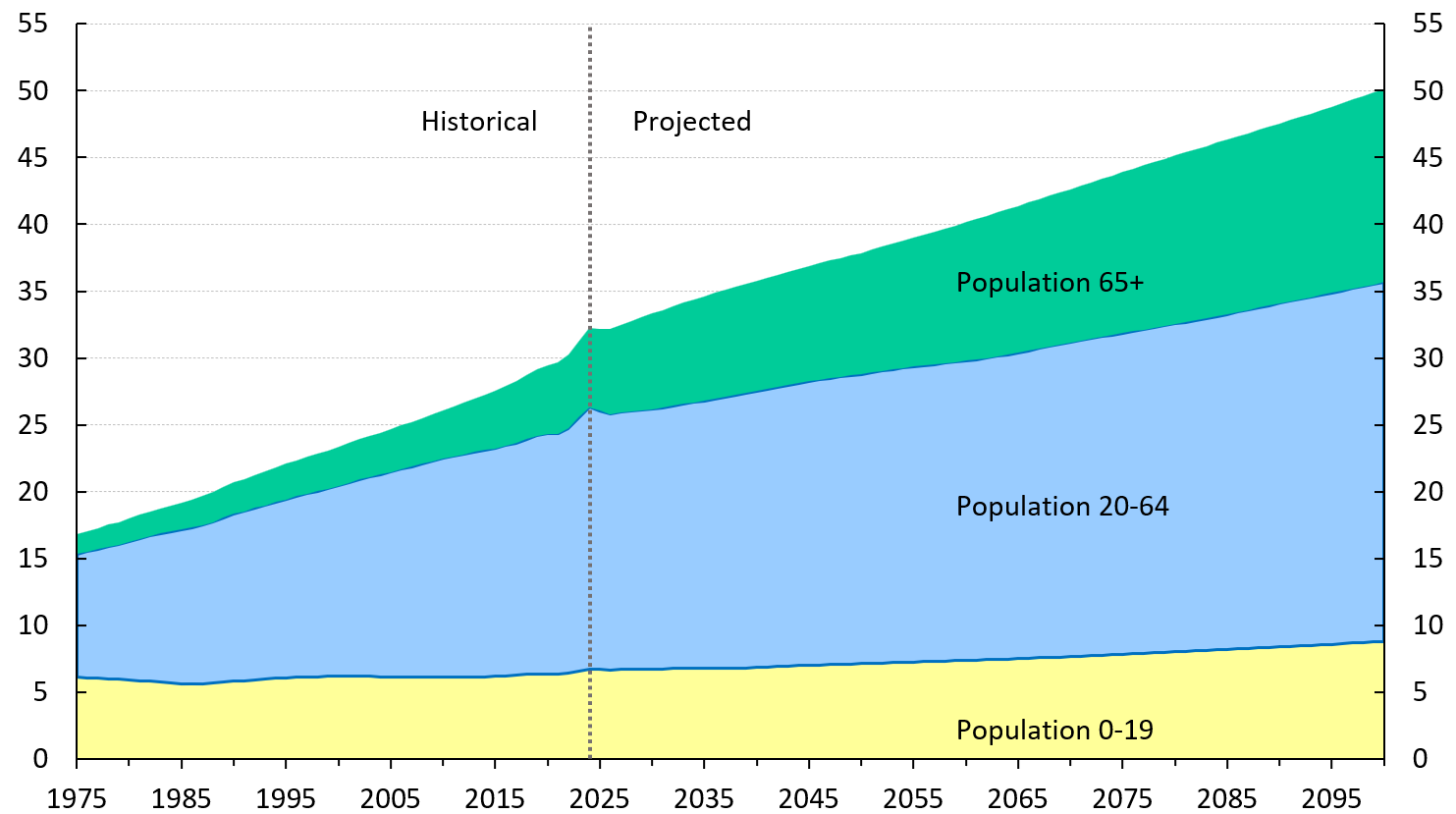
Chart 6 - Text version
| Year | Population 0-19 | Population 20-64 | Population 65+ |
|---|---|---|---|
| 1975 | 6,124,266 | 9,202,837 | 1,485,869 |
| 1976 | 6,093,541 | 9,425,810 | 1,533,696 |
| 1977 | 6,060,162 | 9,648,081 | 1,584,467 |
| 1978 | 6,016,339 | 9,870,769 | 1,635,636 |
| 1979 | 5,958,819 | 10,083,892 | 1,692,837 |
| 1980 | 5,915,814 | 10,342,644 | 1,751,212 |
| 1981 | 5,863,694 | 10,605,114 | 1,803,900 |
| 1982 | 5,820,851 | 10,863,114 | 1,852,346 |
| 1983 | 5,762,628 | 11,105,213 | 1,895,634 |
| 1984 | 5,701,591 | 11,329,606 | 1,944,636 |
| 1985 | 5,651,029 | 11,514,283 | 2,011,002 |
| 1986 | 5,628,904 | 11,684,398 | 2,078,806 |
| 1987 | 5,648,705 | 11,860,023 | 2,155,889 |
| 1988 | 5,689,656 | 12,042,425 | 2,222,589 |
| 1989 | 5,756,951 | 12,298,390 | 2,296,312 |
| 1990 | 5,819,878 | 12,507,303 | 2,366,971 |
| 1991 | 5,858,033 | 12,680,641 | 2,431,350 |
| 1992 | 5,921,059 | 12,848,876 | 2,491,319 |
| 1993 | 5,968,591 | 13,011,820 | 2,547,816 |
| 1994 | 6,023,769 | 13,184,442 | 2,600,049 |
| 1995 | 6,068,615 | 13,359,719 | 2,654,758 |
| 1996 | 6,115,933 | 13,537,128 | 2,710,260 |
| 1997 | 6,142,329 | 13,724,795 | 2,764,213 |
| 1998 | 6,164,880 | 13,879,517 | 2,814,841 |
| 1999 | 6,170,750 | 14,047,934 | 2,859,352 |
| 2000 | 6,182,011 | 14,240,897 | 2,905,871 |
| 2001 | 6,193,506 | 14,473,747 | 2,957,588 |
| 2002 | 6,194,146 | 14,713,041 | 3,010,707 |
| 2003 | 6,171,888 | 14,919,700 | 3,065,385 |
| 2004 | 6,154,769 | 15,125,770 | 3,122,785 |
| 2005 | 6,141,773 | 15,339,025 | 3,180,467 |
| 2006 | 6,131,397 | 15,550,972 | 3,256,923 |
| 2007 | 6,123,614 | 15,745,985 | 3,326,887 |
| 2008 | 6,133,050 | 15,943,285 | 3,409,349 |
| 2009 | 6,138,610 | 16,148,927 | 3,498,617 |
| 2010 | 6,137,594 | 16,347,832 | 3,590,997 |
| 2011 | 6,135,132 | 16,500,391 | 3,698,962 |
| 2012 | 6,138,910 | 16,661,476 | 3,853,257 |
| 2013 | 6,145,098 | 16,818,654 | 4,008,415 |
| 2014 | 6,161,538 | 16,972,084 | 4,152,909 |
| 2015 | 6,179,437 | 17,057,037 | 4,292,281 |
| 2016 | 6,235,545 | 17,206,934 | 4,443,288 |
| 2017 | 6,276,222 | 17,374,041 | 4,601,980 |
| 2018 | 6,326,500 | 17,592,308 | 4,766,861 |
| 2019 | 6,365,371 | 17,819,481 | 4,950,457 |
| 2020 | 6,384,998 | 17,956,395 | 5,136,150 |
| 2021 | 6,355,378 | 17,993,768 | 5,318,698 |
| 2022 | 6,449,686 | 18,302,914 | 5,510,150 |
| 2023 | 6,574,339 | 18,952,096 | 5,709,029 |
| 2024 | 6,707,427 | 19,613,951 | 5,911,177 |
| 2025 | 6,697,565 | 19,368,493 | 6,115,619 |
| 2026 | 6,677,318 | 19,139,297 | 6,332,869 |
| 2027 | 6,704,659 | 19,234,144 | 6,543,758 |
| 2028 | 6,717,951 | 19,292,143 | 6,758,361 |
| 2029 | 6,730,920 | 19,359,303 | 6,963,286 |
| 2030 | 6,742,821 | 19,436,599 | 7,150,298 |
| 2031 | 6,756,927 | 19,535,399 | 7,307,321 |
| 2032 | 6,767,920 | 19,654,978 | 7,440,222 |
| 2033 | 6,776,864 | 19,779,835 | 7,566,639 |
| 2034 | 6,784,635 | 19,895,804 | 7,691,862 |
| 2035 | 6,788,021 | 20,012,742 | 7,814,717 |
| 2036 | 6,792,224 | 20,136,091 | 7,935,104 |
| 2037 | 6,799,343 | 20,271,724 | 8,034,835 |
| 2038 | 6,811,850 | 20,409,882 | 8,121,475 |
| 2039 | 6,829,405 | 20,540,738 | 8,200,738 |
| 2040 | 6,853,652 | 20,664,937 | 8,279,921 |
| 2041 | 6,885,412 | 20,784,089 | 8,352,484 |
| 2042 | 6,917,614 | 20,904,625 | 8,419,319 |
| 2043 | 6,960,427 | 21,013,214 | 8,484,618 |
| 2044 | 6,994,952 | 21,121,630 | 8,553,512 |
| 2045 | 7,022,483 | 21,227,275 | 8,628,483 |
| 2046 | 7,047,280 | 21,326,370 | 8,709,292 |
| 2047 | 7,070,985 | 21,416,061 | 8,792,424 |
| 2048 | 7,092,187 | 21,502,438 | 8,882,599 |
| 2049 | 7,111,270 | 21,583,968 | 8,976,288 |
| 2050 | 7,129,133 | 21,656,545 | 9,077,038 |
| 2051 | 7,152,658 | 21,757,745 | 9,180,343 |
| 2052 | 7,176,036 | 21,859,521 | 9,282,228 |
| 2053 | 7,199,153 | 21,956,859 | 9,388,112 |
| 2054 | 7,222,742 | 22,038,918 | 9,508,556 |
| 2055 | 7,247,402 | 22,102,553 | 9,646,746 |
| 2056 | 7,273,044 | 22,162,872 | 9,788,287 |
| 2057 | 7,299,202 | 22,227,863 | 9,926,150 |
| 2058 | 7,325,643 | 22,292,347 | 10,066,251 |
| 2059 | 7,352,354 | 22,357,504 | 10,207,814 |
| 2060 | 7,379,120 | 22,419,853 | 10,354,659 |
| 2061 | 7,405,728 | 22,487,498 | 10,499,023 |
| 2062 | 7,432,187 | 22,570,698 | 10,630,726 |
| 2063 | 7,458,885 | 22,664,397 | 10,754,485 |
| 2064 | 7,486,096 | 22,770,173 | 10,868,283 |
| 2065 | 7,513,720 | 22,883,415 | 10,976,406 |
| 2066 | 7,541,740 | 23,013,896 | 11,068,707 |
| 2067 | 7,570,474 | 23,146,387 | 11,159,810 |
| 2068 | 7,600,445 | 23,272,551 | 11,257,225 |
| 2069 | 7,631,840 | 23,391,212 | 11,361,524 |
| 2070 | 7,664,600 | 23,509,140 | 11,465,561 |
| 2071 | 7,698,437 | 23,622,930 | 11,572,647 |
| 2072 | 7,733,145 | 23,729,496 | 11,685,762 |
| 2073 | 7,768,855 | 23,827,398 | 11,805,923 |
| 2074 | 7,805,488 | 23,923,842 | 11,925,706 |
| 2075 | 7,842,804 | 24,020,122 | 12,043,815 |
| 2076 | 7,880,580 | 24,119,505 | 12,157,040 |
| 2077 | 7,918,701 | 24,217,024 | 12,270,359 |
| 2078 | 7,956,964 | 24,313,374 | 12,383,207 |
| 2079 | 7,995,184 | 24,411,170 | 12,493,103 |
| 2080 | 8,033,370 | 24,506,637 | 12,603,828 |
| 2081 | 8,071,447 | 24,602,932 | 12,712,371 |
| 2082 | 8,109,312 | 24,703,112 | 12,815,921 |
| 2083 | 8,146,817 | 24,809,231 | 12,912,769 |
| 2084 | 8,183,966 | 24,921,438 | 13,003,017 |
| 2085 | 8,220,963 | 25,039,669 | 13,086,842 |
| 2086 | 8,257,929 | 25,164,981 | 13,163,456 |
| 2087 | 8,294,854 | 25,290,652 | 13,240,024 |
| 2088 | 8,331,720 | 25,426,384 | 13,307,331 |
| 2089 | 8,368,612 | 25,554,801 | 13,383,172 |
| 2090 | 8,405,631 | 25,677,133 | 13,466,720 |
| 2091 | 8,442,825 | 25,797,469 | 13,554,285 |
| 2092 | 8,480,188 | 25,918,431 | 13,643,617 |
| 2093 | 8,517,733 | 26,037,807 | 13,737,181 |
| 2094 | 8,555,518 | 26,156,849 | 13,833,826 |
| 2095 | 8,593,596 | 26,276,409 | 13,932,687 |
| 2096 | 8,631,995 | 26,396,953 | 14,033,192 |
| 2097 | 8,670,736 | 26,518,385 | 14,135,248 |
| 2098 | 8,709,854 | 26,640,681 | 14,238,603 |
| 2099 | 8,749,393 | 26,764,451 | 14,342,321 |
| 2100 | 8,789,390 | 26,890,018 | 14,445,747 |
| Year | 0-17 | 18-69 | 70+ | 0-19 | 20-64 | 65+ | Age 65 + as % of age 20-64 |
|---|---|---|---|---|---|---|---|
| 2025 | 18.3 | 68.6 | 13.1 | 20.8 | 60.2 | 19.0 | 31.6 |
| 2026 | 18.2 | 68.1 | 13.7 | 20.8 | 59.5 | 19.7 | 33.1 |
| 2027 | 18.1 | 67.8 | 14.1 | 20.6 | 59.2 | 20.1 | 34.0 |
| 2028 | 18.0 | 67.5 | 14.5 | 20.5 | 58.9 | 20.6 | 35.0 |
| 2029 | 17.9 | 67.2 | 15.0 | 20.4 | 58.6 | 21.1 | 36.0 |
| 2030 | 17.7 | 66.9 | 15.4 | 20.2 | 58.3 | 21.5 | 36.8 |
| 2031 | 17.6 | 66.5 | 15.8 | 20.1 | 58.1 | 21.7 | 37.4 |
| 2032 | 17.5 | 66.3 | 16.2 | 20.0 | 58.0 | 22.0 | 37.9 |
| 2033 | 17.4 | 66.0 | 16.6 | 19.9 | 58.0 | 22.2 | 38.3 |
| 2034 | 17.3 | 65.7 | 17.0 | 19.7 | 57.9 | 22.4 | 38.7 |
| 2035 | 17.2 | 65.5 | 17.3 | 19.6 | 57.8 | 22.6 | 39.0 |
| 2040 | 16.9 | 65.0 | 18.1 | 19.1 | 57.7 | 23.1 | 40.1 |
| 2045 | 16.8 | 64.8 | 18.4 | 19.0 | 57.6 | 23.4 | 40.6 |
| 2050 | 16.7 | 64.9 | 18.4 | 18.8 | 57.2 | 24.0 | 41.9 |
| 2055 | 16.5 | 64.7 | 18.8 | 18.6 | 56.7 | 24.7 | 43.6 |
| 2060 | 16.3 | 64.2 | 19.6 | 18.4 | 55.8 | 25.8 | 46.2 |
| 2065 | 16.1 | 63.3 | 20.6 | 18.2 | 55.3 | 26.5 | 48.0 |
| 2070 | 15.9 | 62.7 | 21.4 | 18.0 | 55.1 | 26.9 | 48.8 |
| 2075 | 15.8 | 62.5 | 21.7 | 17.9 | 54.7 | 27.4 | 50.1 |
| 2080 | 15.8 | 62.1 | 22.1 | 17.8 | 54.3 | 27.9 | 51.4 |
| 2085 | 15.7 | 61.8 | 22.5 | 17.7 | 54.0 | 28.2 | 52.3 |
| 2090 | 15.6 | 61.6 | 22.7 | 17.7 | 54.0 | 28.3 | 52.4 |
| 2095 | 15.6 | 61.6 | 22.9 | 17.6 | 53.8 | 28.5 | 53.0 |
| 2100 | 15.5 | 61.4 | 23.1 | 17.5 | 53.6 | 28.8 | 53.7 |
|
Table 47 Footnotes
|
|||||||
Table 48 shows the projected components of population growth, which is defined as the projected number of births plus net migrants less the projected number of deaths, for Canada less Quebec from 2025 to 2100. For Canada less Quebec, the number of births is projected to exceed deaths until 2036. Thereafter, all population growth is expected to come from migration.
The population of Canada less Quebec is projected to decline by about 0.2% in 2025 and 0.1% in 2026, followed by an increase of 1.0% in 2027. Population growth is then projected to slowly decrease to about 0.6% by the early 2040s and around 0.5% by 2080. The population of Canada less Quebec is projected to reach 50.1 million by 2100.
| Year | Population 1st July | Births | Net migrants | Deaths | Change in population | Annual % change | ||
|---|---|---|---|---|---|---|---|---|
| 20-64 | 65+ | Total | ||||||
| 2025 | 32,182 | 289 | (102) | 238 | (51) | (1.3) | 3.5 | (0.2) |
| 2026 | 32,149 | 293 | (83) | 242 | (32) | (1.2) | 3.6 | (0.1) |
| 2027 | 32,483 | 294 | 286 | 248 | 333 | 0.5 | 3.3 | 1.0 |
| 2028 | 32,768 | 298 | 241 | 253 | 286 | 0.3 | 3.3 | 0.9 |
| 2029 | 33,054 | 300 | 244 | 259 | 285 | 0.3 | 3.0 | 0.9 |
| 2030 | 33,330 | 302 | 239 | 265 | 276 | 0.4 | 2.7 | 0.8 |
| 2031 | 33,600 | 303 | 238 | 271 | 270 | 0.5 | 2.2 | 0.8 |
| 2032 | 33,863 | 303 | 237 | 277 | 263 | 0.6 | 1.8 | 0.8 |
| 2033 | 34,123 | 304 | 240 | 284 | 260 | 0.6 | 1.7 | 0.8 |
| 2034 | 34,372 | 305 | 235 | 291 | 249 | 0.6 | 1.7 | 0.7 |
| 2035 | 34,615 | 305 | 236 | 297 | 243 | 0.6 | 1.6 | 0.7 |
| 2040 | 35,799 | 310 | 251 | 333 | 228 | 0.6 | 1.0 | 0.6 |
| 2045 | 36,878 | 318 | 256 | 365 | 208 | 0.5 | 0.9 | 0.6 |
| 2050 | 37,863 | 321 | 260 | 389 | 191 | 0.3 | 1.1 | 0.5 |
| 2055 | 38,997 | 324 | 306 | 404 | 226 | 0.3 | 1.5 | 0.6 |
| 2060 | 40,154 | 331 | 315 | 410 | 236 | 0.3 | 1.4 | 0.6 |
| 2065 | 41,374 | 340 | 324 | 414 | 249 | 0.5 | 1.0 | 0.6 |
| 2070 | 42,639 | 347 | 333 | 426 | 255 | 0.5 | 0.9 | 0.6 |
| 2075 | 43,907 | 355 | 342 | 446 | 252 | 0.4 | 1.0 | 0.6 |
| 2080 | 45,144 | 363 | 351 | 470 | 244 | 0.4 | 0.9 | 0.5 |
| 2085 | 46,347 | 371 | 359 | 491 | 239 | 0.5 | 0.6 | 0.5 |
| 2090 | 47,549 | 378 | 368 | 504 | 243 | 0.5 | 0.6 | 0.5 |
| 2095 | 48,803 | 387 | 377 | 508 | 256 | 0.5 | 0.7 | 0.5 |
| 2100 | 50,125 | 397 | 387 | 515 | 269 | 0.5 | 0.7 | 0.5 |
|
Table 48 Footnotes
|
||||||||
B.4 Economic assumptions
The list of assumptions required to project the various economic indices, as well as CPP contributions and expenditures is quite extensive. The following sections cover the main assumptions.
The economic outlook rests on the assumed evolution of the labour market, that is, labour force participation, employment, unemployment, inflation, and the increase in average employment earnings. Rates of return on CPP assets reflect the financial markets and are part of the investment assumptions described in section B.6 of this appendix. All of these factors must be considered together and form part of an overall economic perspective.
B.4.1 Labour market
Chart 7 shows the main components of the labour market that are used to determine the number of earners and contributors by age, sex, and calendar year.
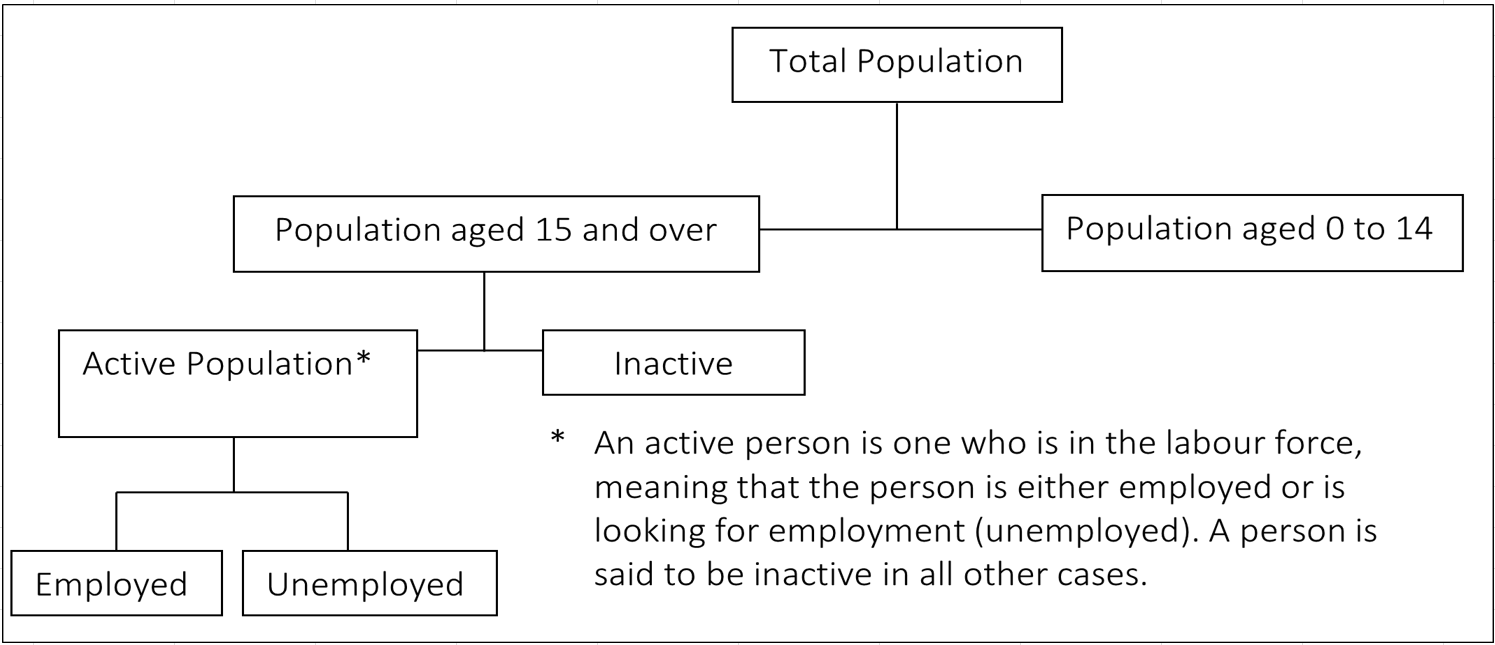
Chart 7 - Text version
Flow chart showing the main components of the labour market that are used to determine the number of earners and contributors by age, sex, and calendar year.
The top box is the total population. This box splits into two boxes, the first one is the population aged 15 and over and the second box is the population 0 to 14.
The box of the population aged 15 and over is then split into two boxes, the first box is the active population (or labour force), which represents those who are either employed or looking for employment. The second box is the inactive population.
The active population box is split into two boxes. The first box is for the employed and the second box is for the unemployed.
The number of earners is based on the number of employed and is defined as the number of persons who had earnings during a given calendar year. The earners become contributors if they have earnings during the year above the Year's Basic Exemption (YBE) and they are between the ages of 18 and 70.
The proportion of earners and contributors assumptions (described in this section and section B.5.1) rely on the projected active population of this report. These assumptions apply as well to working retirement beneficiaries.
B.4.1.1 Active population (Canada)
Table 49 to Table 51 provide projections of the active and employed populations and associated labour force participation, employment, and unemployment rates for Canada.
| Year | PopulationTable 49 Footnote 1 | Active population | Employed | ||||||
|---|---|---|---|---|---|---|---|---|---|
| Males | Females | Total | Males | Females | Total | Males | Females | Total | |
| 2025 | 16,884 | 17,102 | 33,986 | 11,707 | 10,438 | 22,144 | 10,848 | 9,746 | 20,594 |
| 2026 | 16,821 | 17,108 | 33,929 | 11,597 | 10,390 | 21,988 | 10,784 | 9,731 | 20,514 |
| 2027 | 17,003 | 17,299 | 34,301 | 11,695 | 10,493 | 22,188 | 10,911 | 9,857 | 20,768 |
| 2028 | 17,152 | 17,463 | 34,615 | 11,769 | 10,579 | 22,348 | 11,017 | 9,967 | 20,985 |
| 2029 | 17,298 | 17,627 | 34,926 | 11,845 | 10,668 | 22,513 | 11,089 | 10,051 | 21,140 |
| 2030 | 17,441 | 17,787 | 35,228 | 11,921 | 10,756 | 22,677 | 11,159 | 10,134 | 21,293 |
| 2031 | 17,579 | 17,942 | 35,521 | 12,000 | 10,848 | 22,847 | 11,233 | 10,221 | 21,454 |
| 2032 | 17,710 | 18,091 | 35,802 | 12,084 | 10,944 | 23,028 | 11,312 | 10,311 | 21,623 |
| 2033 | 17,835 | 18,235 | 36,070 | 12,168 | 11,041 | 23,209 | 11,391 | 10,403 | 21,793 |
| 2034 | 17,950 | 18,369 | 36,319 | 12,247 | 11,134 | 23,381 | 11,465 | 10,490 | 21,955 |
| 2035 | 18,058 | 18,497 | 36,555 | 12,322 | 11,228 | 23,550 | 11,535 | 10,578 | 22,113 |
| 2040 | 18,561 | 19,092 | 37,653 | 12,611 | 11,502 | 24,113 | 11,805 | 10,837 | 22,642 |
| 2045 | 19,026 | 19,630 | 38,657 | 12,868 | 11,742 | 24,611 | 12,047 | 11,063 | 23,110 |
| 2050 | 19,438 | 20,105 | 39,542 | 13,058 | 11,927 | 24,985 | 12,224 | 11,236 | 23,461 |
| 2055 | 19,955 | 20,636 | 40,591 | 13,296 | 12,146 | 25,442 | 12,447 | 11,444 | 23,890 |
| 2060 | 20,509 | 21,186 | 41,695 | 13,530 | 12,368 | 25,898 | 12,666 | 11,652 | 24,318 |
| 2065 | 21,085 | 21,762 | 42,847 | 13,789 | 12,608 | 26,397 | 12,909 | 11,877 | 24,786 |
| 2070 | 21,665 | 22,355 | 44,019 | 14,081 | 12,863 | 26,944 | 13,183 | 12,118 | 25,301 |
| 2075 | 22,225 | 22,942 | 45,167 | 14,362 | 13,104 | 27,466 | 13,446 | 12,345 | 25,791 |
| 2080 | 22,767 | 23,510 | 46,276 | 14,628 | 13,336 | 27,963 | 13,695 | 12,563 | 26,258 |
| 2085 | 23,293 | 24,059 | 47,352 | 14,906 | 13,582 | 28,488 | 13,955 | 12,795 | 26,750 |
| 2090 | 23,824 | 24,605 | 48,430 | 15,206 | 13,848 | 29,054 | 14,237 | 13,045 | 27,282 |
| 2095 | 24,387 | 25,174 | 49,561 | 15,524 | 14,127 | 29,651 | 14,534 | 13,308 | 27,842 |
| 2100 | 24,978 | 25,767 | 50,745 | 15,846 | 14,409 | 30,255 | 14,836 | 13,574 | 28,410 |
|
Table 49 Footnotes
|
|||||||||
| Year | Labour force participation rate | Employment rate | Unemployment rate | ||||||
|---|---|---|---|---|---|---|---|---|---|
| Males | Females | Total | Males | Females | Total | Males | Females | Total | |
| 2025 | 69.3 | 61.0 | 65.2 | 64.3 | 57.0 | 60.6 | 7.3 | 6.6 | 7.0 |
| 2026 | 68.9 | 60.7 | 64.8 | 64.1 | 56.9 | 60.5 | 7.0 | 6.3 | 6.7 |
| 2027 | 68.8 | 60.7 | 64.7 | 64.2 | 57.0 | 60.5 | 6.7 | 6.1 | 6.4 |
| 2028 | 68.6 | 60.6 | 64.6 | 64.2 | 57.1 | 60.6 | 6.4 | 5.8 | 6.1 |
| 2029 | 68.5 | 60.5 | 64.5 | 64.1 | 57.0 | 60.5 | 6.4 | 5.8 | 6.1 |
| 2030 | 68.3 | 60.5 | 64.4 | 64.0 | 57.0 | 60.4 | 6.4 | 5.8 | 6.1 |
| 2031 | 68.3 | 60.5 | 64.3 | 63.9 | 57.0 | 60.4 | 6.4 | 5.8 | 6.1 |
| 2032 | 68.2 | 60.5 | 64.3 | 63.9 | 57.0 | 60.4 | 6.4 | 5.8 | 6.1 |
| 2033 | 68.2 | 60.6 | 64.3 | 63.9 | 57.0 | 60.4 | 6.4 | 5.8 | 6.1 |
| 2034 | 68.2 | 60.6 | 64.4 | 63.9 | 57.1 | 60.5 | 6.4 | 5.8 | 6.1 |
| 2035 | 68.2 | 60.7 | 64.4 | 63.9 | 57.2 | 60.5 | 6.4 | 5.8 | 6.1 |
| 2040 | 67.9 | 60.2 | 64.0 | 63.6 | 56.8 | 60.1 | 6.4 | 5.8 | 6.1 |
| 2045 | 67.6 | 59.8 | 63.7 | 63.3 | 56.4 | 59.8 | 6.4 | 5.8 | 6.1 |
| 2050 | 67.2 | 59.3 | 63.2 | 62.9 | 55.9 | 59.3 | 6.4 | 5.8 | 6.1 |
| 2055 | 66.6 | 58.9 | 62.7 | 62.4 | 55.5 | 58.9 | 6.4 | 5.8 | 6.1 |
| 2060 | 66.0 | 58.4 | 62.1 | 61.8 | 55.0 | 58.3 | 6.4 | 5.8 | 6.1 |
| 2065 | 65.4 | 57.9 | 61.6 | 61.2 | 54.6 | 57.8 | 6.4 | 5.8 | 6.1 |
| 2070 | 65.0 | 57.5 | 61.2 | 60.8 | 54.2 | 57.5 | 6.4 | 5.8 | 6.1 |
| 2075 | 64.6 | 57.1 | 60.8 | 60.5 | 53.8 | 57.1 | 6.4 | 5.8 | 6.1 |
| 2080 | 64.2 | 56.7 | 60.4 | 60.2 | 53.4 | 56.7 | 6.4 | 5.8 | 6.1 |
| 2085 | 64.0 | 56.5 | 60.2 | 59.9 | 53.2 | 56.5 | 6.4 | 5.8 | 6.1 |
| 2090 | 63.8 | 56.3 | 60.0 | 59.8 | 53.0 | 56.3 | 6.4 | 5.8 | 6.1 |
| 2095 | 63.7 | 56.1 | 59.8 | 59.6 | 52.9 | 56.2 | 6.4 | 5.8 | 6.1 |
| 2100 | 63.4 | 55.9 | 59.6 | 59.4 | 52.7 | 56.0 | 6.4 | 5.8 | 6.1 |
| Age group | Males | Females | ||||||
|---|---|---|---|---|---|---|---|---|
| 2025 | 2035 | 2050 | 2075 | 2025 | 2035 | 2050 | 2075 | |
| 15-19 | 46.7 | 52.0 | 52.0 | 52.0 | 49.1 | 54.0 | 54.0 | 54.0 |
| 20-24 | 77.2 | 80.0 | 80.0 | 80.0 | 76.1 | 78.0 | 78.0 | 78.0 |
| 25-29 | 89.5 | 92.0 | 92.0 | 92.0 | 86.3 | 89.0 | 89.0 | 89.0 |
| 30-34 | 93.2 | 94.0 | 94.0 | 94.0 | 85.3 | 87.0 | 87.0 | 87.0 |
| 35-39 | 93.6 | 94.0 | 94.0 | 94.0 | 84.6 | 88.0 | 88.0 | 88.0 |
| 40-44 | 93.4 | 94.0 | 94.0 | 94.0 | 86.0 | 89.0 | 89.0 | 89.0 |
| 45-49 | 92.3 | 93.0 | 93.0 | 93.0 | 86.4 | 89.0 | 89.0 | 89.0 |
| 50-54 | 90.5 | 91.0 | 91.0 | 91.0 | 83.5 | 87.0 | 87.0 | 87.0 |
| 55-59 | 83.1 | 84.0 | 84.0 | 84.0 | 73.7 | 76.0 | 76.0 | 76.0 |
| 60-64 | 65.4 | 66.0 | 66.0 | 66.0 | 51.8 | 53.0 | 53.0 | 53.0 |
| 65-69 | 35.1 | 37.0 | 37.0 | 37.0 | 24.0 | 26.0 | 26.0 | 26.0 |
| 70 and over | 11.5 | 13.0 | 13.0 | 13.0 | 5.8 | 6.0 | 6.0 | 6.0 |
| 55-69 | 61.3 | 63.0 | 63.9 | 62.9 | 49.6 | 52.0 | 52.9 | 52.1 |
| 55 and over | 41.4 | 37.9 | 39.4 | 36.6 | 30.8 | 28.0 | 28.8 | 26.9 |
| 18-69 | 81.0 | 83.1 | 82.5 | 82.1 | 73.5 | 76.9 | 76.3 | 75.9 |
| 15 and over | 69.3 | 68.2 | 67.2 | 64.6 | 61.0 | 60.7 | 59.3 | 57.1 |
Despite the recent increases in immigration and projected long-term net migration inflow, the population is still expected to age over the projection period. Given that labour force participation rates are progressively lower for age groups over 50, the aging of the population will result in a larger proportion of the population in age groups with lower participation rates, and thus will decrease the overall participation rate throughout the projection period.
For the purpose of projecting the participation rates, the projection period has been divided into two periods: 2025 to 2035 and from 2035 onward. From 2025 to 2035, the projected participation rates are based on an analysis of historical data and expected trends for each age group and sex. From 2035 onward, the participation rates are held constant. This long-term assumption combined with a slower growth in the working-age population relative to the older age groups results in a rate of growth of approximately 0.4% for the Canadian active population (that is, the labour force) after 2035.
Some examples of the main trends that are taken into account in developing the projected participation rates are discussed below, namely, the narrowing of the male-female gap, longer working lives, and employment opportunities stemming from demographic shifts.
The overall labour force participation rates in Canada (the active population expressed as a proportion of the population aged 15 and over) from 1976 to 2024 clearly show a narrowing of the gap between male and female rates. Although the increase in participation rates of females aged 18 to 69 has slowed down since the mid-2000s, the increase was significant over the previous decades.
In 1976, overall male labour force participation (ages 15 and over) was about 78% compared to only 46% for females, which represents a gap of 32%. This gap has narrowed to 8.5% in 2024 (participation rates of 69.7% for males, 61.2% for females). It is assumed that females will continue to narrow the gap in participation rates but at a slower pace, with the gap gradually reducing to about 7.5% by 2035 (68.2% for males vs. 60.7% for females). A part of this reduction comes from an assumed sustained impact on the female labour force due to the Canada-Wide Early Learning and Child Care plan.
Although the participation rates of older age groups are lower compared to younger groups, the trend towards longer working lives is expected to continue, and as such, it is assumed that there will be further increases in participation rates for older age groups. Continued trends in increasing flexibility in work arrangements, the projected continued increases in life expectancy, and possible insufficient retirement savings are assumed to encourage older workers to delay their retirement and exit the labour force at a later age.
The participation rates for those aged 55 to 59 are assumed to increase from 83.1% to 84.0% for males and from 73.7% to 76.0% for females over the period 2025 to 2050. Over the same period, the participation rates for those aged 60 to 64 are assumed to increase from 65.4% to 66.0% and from 51.8% to 53.0% for males and females, respectively, and the participation rates for those aged 65 to 69 are assumed to increase from 35.1% to 37.0% and from 24.0% to 26.0% for males and females, respectively.
In addition to the assumed future increase in participation rates of women and older workers, as well as an assumed continued reliance on skilled immigrant workers, it is expected that there will be upward pressure on labour force participation rates as the working-age population expands at a slower pace than the older sector of the population. The participation rates for all age groups are thus expected to increase due to the attractive employment opportunities resulting from the demographic shift as the population ages.
Although the participation rates of both men and women and all age groups are expected to increase over the projection period from their 2024 levels, these increases in participation rates are not sufficient to offset the projected decrease in the overall participation rate (ages 15 and over) due to the demographic shift from population aging.
B.4.1.2 Employment (Canada)
In Canada, the annual job creation rate (i.e. the change in the number of persons employed) has been on average about 1.6% since 1976. However, this rate has varied over time. It is assumed that the job creation rate will be -0.7% in 2025, -0.4% in 2026, 1.2% in 2027, 1.0% in 2028, 0.7% in 2029, and then trend lower thereafter.
The job creation rate is associated with the variation in assumed unemployment rates as well as Canada's labour force growth rate. The unemployment rate is assumed to increase from 6.3% in 2024 to 7.0% in 2025, 6.7% in 2026, and 6.4% in 2027, before reaching its ultimate rate of 6.1% in 2028. These rates are based on recent experience and various economic forecasts.
The negative job creation rate in 2025 and 2026 coincides with the projected decrease in the Canadian population attributable to the decrease in the level of NPR as well as the initial assumed increase in unemployment. The rebound in the job creation date from 2027 onward is associated with the decreasing unemployment rate as well as the projected return to growth in the Canadian population.
Over the long term, the job creation rate is projected to be the same as the labour force growth of 0.4%. This reflects the ultimate assumption for the unemployment rate of 6.1% for year 2028 and thereafter.
Table 52 shows the projected number of employed persons and the employment rate for those aged 18 to 69, in Canada.
| Year | Population (thousands) | Employed (thousands) | Employment rate (%) | |||
|---|---|---|---|---|---|---|
| Males | Females | Males | Females | Males | Females | |
| 2025 | 14,185 | 13,897 | 10,349 | 9,354 | 73.0 | 67.3 |
| 2026 | 14,017 | 13,794 | 10,266 | 9,329 | 73.2 | 67.6 |
| 2027 | 14,092 | 13,868 | 10,369 | 9,440 | 73.6 | 68.1 |
| 2028 | 14,131 | 13,916 | 10,452 | 9,538 | 74.0 | 68.5 |
| 2029 | 14,169 | 13,961 | 10,504 | 9,611 | 74.1 | 68.8 |
| 2030 | 14,201 | 14,000 | 10,554 | 9,684 | 74.3 | 69.2 |
| 2031 | 14,230 | 14,037 | 10,607 | 9,759 | 74.5 | 69.5 |
| 2032 | 14,260 | 14,077 | 10,666 | 9,841 | 74.8 | 69.9 |
| 2033 | 14,289 | 14,115 | 10,727 | 9,923 | 75.1 | 70.3 |
| 2034 | 14,318 | 14,153 | 10,783 | 10,003 | 75.3 | 70.7 |
| 2035 | 14,353 | 14,195 | 10,840 | 10,083 | 75.5 | 71.0 |
| 2040 | 14,652 | 14,517 | 11,091 | 10,335 | 75.7 | 71.2 |
| 2045 | 14,974 | 14,861 | 11,312 | 10,544 | 75.5 | 71.0 |
| 2050 | 15,281 | 15,196 | 11,475 | 10,708 | 75.1 | 70.5 |
| 2055 | 15,617 | 15,540 | 11,670 | 10,901 | 74.7 | 70.1 |
| 2060 | 15,887 | 15,826 | 11,849 | 11,089 | 74.6 | 70.1 |
| 2065 | 16,083 | 16,057 | 12,041 | 11,290 | 74.9 | 70.3 |
| 2070 | 16,371 | 16,358 | 12,276 | 11,512 | 75.0 | 70.4 |
| 2075 | 16,743 | 16,727 | 12,511 | 11,723 | 74.7 | 70.1 |
| 2080 | 17,039 | 17,024 | 12,724 | 11,920 | 74.7 | 70.0 |
| 2085 | 17,322 | 17,301 | 12,949 | 12,131 | 74.8 | 70.1 |
| 2090 | 17,641 | 17,607 | 13,199 | 12,361 | 74.8 | 70.2 |
| 2095 | 18,018 | 17,976 | 13,468 | 12,607 | 74.7 | 70.1 |
| 2100 | 18,381 | 18,333 | 13,736 | 12,854 | 74.7 | 70.1 |
B.4.1.3 Labour market (Canada less Quebec)
Given that the CPP covers the labour force in all provinces except Quebec, labour market assumptions were developed for Quebec, and the results for Canada less Quebec were derived. Table 53 and Table 54 show the projected active population, number of employed, and labour force participation rates for Canada less Quebec.
| Year | PopulationTable 53 Footnote 1 | Active population | Employed | ||||||
|---|---|---|---|---|---|---|---|---|---|
| Males | Females | Total | Males | Females | Total | Males | Females | Total | |
| 2025 | 13,146 | 13,365 | 26,511 | 9,166 | 8,158 | 17,324 | 8,466 | 7,587 | 16,054 |
| 2026 | 13,100 | 13,377 | 26,477 | 9,089 | 8,130 | 17,219 | 8,431 | 7,591 | 16,022 |
| 2027 | 13,250 | 13,537 | 26,787 | 9,174 | 8,222 | 17,396 | 8,556 | 7,712 | 16,268 |
| 2028 | 13,374 | 13,679 | 27,053 | 9,241 | 8,301 | 17,542 | 8,656 | 7,816 | 16,472 |
| 2029 | 13,498 | 13,820 | 27,318 | 9,310 | 8,381 | 17,692 | 8,720 | 7,892 | 16,613 |
| 2030 | 13,619 | 13,959 | 27,578 | 9,380 | 8,462 | 17,842 | 8,785 | 7,968 | 16,754 |
| 2031 | 13,737 | 14,095 | 27,833 | 9,451 | 8,546 | 17,997 | 8,852 | 8,047 | 16,899 |
| 2032 | 13,852 | 14,227 | 28,079 | 9,527 | 8,634 | 18,161 | 8,923 | 8,130 | 17,053 |
| 2033 | 13,962 | 14,356 | 28,318 | 9,603 | 8,723 | 18,326 | 8,995 | 8,214 | 17,208 |
| 2034 | 14,064 | 14,478 | 28,542 | 9,676 | 8,809 | 18,484 | 9,063 | 8,294 | 17,357 |
| 2035 | 14,161 | 14,594 | 28,756 | 9,745 | 8,897 | 18,642 | 9,128 | 8,377 | 17,504 |
| 2040 | 14,622 | 15,141 | 29,763 | 10,021 | 9,159 | 19,180 | 9,386 | 8,624 | 18,010 |
| 2045 | 15,069 | 15,655 | 30,724 | 10,280 | 9,402 | 19,681 | 9,629 | 8,852 | 18,481 |
| 2050 | 15,477 | 16,122 | 31,599 | 10,482 | 9,597 | 20,079 | 9,818 | 9,036 | 18,854 |
| 2055 | 15,966 | 16,631 | 32,598 | 10,711 | 9,813 | 20,524 | 10,032 | 9,240 | 19,272 |
| 2060 | 16,483 | 17,152 | 33,635 | 10,934 | 10,026 | 20,960 | 10,240 | 9,441 | 19,681 |
| 2065 | 17,017 | 17,693 | 34,710 | 11,176 | 10,255 | 21,432 | 10,468 | 9,656 | 20,124 |
| 2070 | 17,558 | 18,250 | 35,808 | 11,453 | 10,505 | 21,958 | 10,727 | 9,891 | 20,619 |
| 2075 | 18,087 | 18,808 | 36,895 | 11,731 | 10,751 | 22,482 | 10,988 | 10,123 | 21,111 |
| 2080 | 18,602 | 19,354 | 37,956 | 12,003 | 10,993 | 22,996 | 11,243 | 10,351 | 21,594 |
| 2085 | 19,103 | 19,884 | 38,987 | 12,286 | 11,247 | 23,533 | 11,508 | 10,590 | 22,098 |
| 2090 | 19,608 | 20,410 | 40,018 | 12,587 | 11,514 | 24,101 | 11,789 | 10,841 | 22,630 |
| 2095 | 20,143 | 20,956 | 41,099 | 12,899 | 11,791 | 24,690 | 12,082 | 11,102 | 23,184 |
| 2100 | 20,707 | 21,528 | 42,235 | 13,216 | 12,071 | 25,287 | 12,379 | 11,366 | 23,745 |
|
Table 53 Footnotes
|
|||||||||
| Age group | Males | Females | ||||||
|---|---|---|---|---|---|---|---|---|
| 2025 | 2035 | 2050 | 2075 | 2025 | 2035 | 2050 | 2075 | |
| 15-19 | 44.4 | 51.0 | 51.1 | 51.1 | 46.1 | 52.4 | 52.6 | 52.7 |
| 20-24 | 76.8 | 79.5 | 79.5 | 79.6 | 75.3 | 77.2 | 77.3 | 77.3 |
| 25-29 | 89.6 | 92.0 | 92.0 | 92.0 | 85.6 | 88.5 | 88.5 | 88.6 |
| 30-34 | 93.2 | 94.0 | 94.0 | 94.0 | 84.4 | 86.5 | 86.5 | 86.6 |
| 35-39 | 93.6 | 94.0 | 94.0 | 94.0 | 83.8 | 87.5 | 87.5 | 87.6 |
| 40-44 | 93.5 | 94.0 | 94.0 | 94.0 | 85.0 | 88.5 | 88.5 | 88.6 |
| 45-49 | 92.2 | 93.0 | 93.0 | 93.0 | 85.5 | 88.5 | 88.5 | 88.6 |
| 50-54 | 90.6 | 91.0 | 91.0 | 91.0 | 82.9 | 86.7 | 86.8 | 86.8 |
| 55-59 | 83.1 | 84.0 | 84.0 | 84.0 | 73.3 | 76.0 | 76.0 | 76.0 |
| 60-64 | 65.3 | 66.0 | 66.0 | 66.0 | 52.3 | 53.5 | 53.5 | 53.5 |
| 65-69 | 36.4 | 38.2 | 38.1 | 38.0 | 24.8 | 27.1 | 27.0 | 26.9 |
| 70 and over | 11.9 | 13.3 | 13.3 | 13.2 | 6.1 | 6.3 | 6.3 | 6.2 |
| 55-69 | 61.8 | 63.3 | 64.5 | 63.3 | 50.2 | 52.4 | 53.6 | 52.6 |
| 55 and over | 42.1 | 38.4 | 40.3 | 36.9 | 31.5 | 28.5 | 29.5 | 27.2 |
| 18-69 | 81.2 | 83.2 | 82.6 | 82.2 | 73.2 | 76.7 | 76.1 | 75.8 |
| 15 and over | 69.7 | 68.8 | 67.7 | 64.9 | 61.0 | 61.0 | 59.5 | 57.2 |
B.4.1.4 Number of earners (Canada less Quebec)
The number of earners for any given year, namely anyone who had employment earnings during the year, is always more than the employed population and sometimes even close to the labour force because it includes all individuals who had earnings at any time during the year, whereas the employed population only indicates the average number of employed in any given year.
The projected number of earners is obtained by regressions based on a highly correlated historical relationship between the number of employed persons and the number of earners over periods within years 1998 to 2022. Table 55 shows the projected average number of employed persons and the projected number and proportion of earners (relative to the population) aged 18 to 69, for Canada less Quebec. The projected number and proportion of earners shown in Table 55 pertain to all earners, including those who are CPP retirement beneficiaries. The effect of CPP retirement beneficiaries with earnings, (i.e. working beneficiaries), is discussed more in detail in section B.7.5 of this appendix.
| Year | Population (thousands) | Employed (thousands) | Earners (thousands) | Proportion of earners (earners as % of population) | ||||
|---|---|---|---|---|---|---|---|---|
| Males | Females | Males | Females | Males | Females | Males | Females | |
| 2025 | 11,127 | 10,950 | 8,088 | 7,290 | 8,941 | 8,214 | 80.4 | 75.0 |
| 2026 | 11,004 | 10,877 | 8,039 | 7,285 | 8,912 | 8,230 | 81.0 | 75.7 |
| 2027 | 11,074 | 10,947 | 8,143 | 7,394 | 9,061 | 8,379 | 81.8 | 76.5 |
| 2028 | 11,116 | 10,997 | 8,224 | 7,487 | 9,185 | 8,510 | 82.6 | 77.4 |
| 2029 | 11,157 | 11,046 | 8,273 | 7,554 | 9,240 | 8,585 | 82.8 | 77.7 |
| 2030 | 11,193 | 11,089 | 8,321 | 7,621 | 9,293 | 8,660 | 83.0 | 78.1 |
| 2031 | 11,228 | 11,130 | 8,371 | 7,690 | 9,347 | 8,737 | 83.3 | 78.5 |
| 2032 | 11,263 | 11,173 | 8,426 | 7,764 | 9,407 | 8,818 | 83.5 | 78.9 |
| 2033 | 11,297 | 11,214 | 8,482 | 7,840 | 9,465 | 8,900 | 83.8 | 79.4 |
| 2034 | 11,332 | 11,256 | 8,535 | 7,913 | 9,521 | 8,979 | 84.0 | 79.8 |
| 2035 | 11,372 | 11,302 | 8,589 | 7,988 | 9,576 | 9,060 | 84.2 | 80.2 |
| 2040 | 11,659 | 11,606 | 8,830 | 8,228 | 9,824 | 9,316 | 84.3 | 80.3 |
| 2045 | 11,969 | 11,930 | 9,051 | 8,438 | 10,063 | 9,551 | 84.1 | 80.1 |
| 2050 | 12,292 | 12,276 | 9,227 | 8,612 | 10,267 | 9,758 | 83.5 | 79.5 |
| 2055 | 12,620 | 12,617 | 9,417 | 8,803 | 10,491 | 9,984 | 83.1 | 79.1 |
| 2060 | 12,873 | 12,891 | 9,587 | 8,985 | 10,681 | 10,187 | 83.0 | 79.0 |
| 2065 | 13,070 | 13,123 | 9,769 | 9,178 | 10,875 | 10,400 | 83.2 | 79.3 |
| 2070 | 13,336 | 13,408 | 9,991 | 9,394 | 11,118 | 10,643 | 83.4 | 79.4 |
| 2075 | 13,685 | 13,760 | 10,224 | 9,610 | 11,381 | 10,891 | 83.2 | 79.1 |
| 2080 | 13,988 | 14,067 | 10,447 | 9,818 | 11,628 | 11,127 | 83.1 | 79.1 |
| 2085 | 14,289 | 14,365 | 10,682 | 10,037 | 11,886 | 11,372 | 83.2 | 79.2 |
| 2090 | 14,617 | 14,682 | 10,935 | 10,271 | 12,168 | 11,636 | 83.2 | 79.3 |
| 2095 | 14,994 | 15,052 | 11,203 | 10,516 | 12,466 | 11,915 | 83.1 | 79.2 |
| 2100 | 15,353 | 15,406 | 11,469 | 10,762 | 12,761 | 12,193 | 83.1 | 79.1 |
B.4.2 Annual increase in prices (inflation rate)
The increase in prices (inflation rate) assumption is needed to determine the Pension Index for any given calendar year. It is also used in the determination of the annual nominal increase in average employment earnings, the YMPE, YAMPE, and the nominal rates of return on investments.
Price increases, as measured by changes in the Consumer Price Index (CPI), fluctuate through time. Since the mid-1950s, the trend was generally upward through the early 1980s and then generally downward until the introduction of the inflation-control targets in the early 1990s, at which point inflation began to stabilize. The average annual increases in the CPI over the 50, 20 and 10-year periods ending in 2024 were 3.7%, 2.2% and 2.5%, respectively.
On December 13, 2021, the Bank of Canada and the Government renewed their commitment to keep inflation between 1% and 3% with a target at the mid-point of 2% until the end of 2026.Footnote 10
They further noted that the Bank will use the flexibility of the 1% to 3% control range to actively seek the maximum sustainable level of employment to an extent that is consistent with keeping medium-term inflation expectations at 2%.
Despite the mid-point target of 2%, inflation, as measured by changes in the CPI, tends to fluctuate from year to year. For instance, supply disruptions during the COVID-19 outbreak, global imbalances in supply and demand, and pent-up demand following the lifting of restrictions in 2021 and 2022, as well as the war in Ukraine that commenced in February 2022, contributed to upward pressure on prices, resulting in inflation peaking at 8.1% in June 2022. As the pandemic became more manageable, fiscal stimulus diminished, and demand and supply returned to equilibrium, the inflation rate gradually aligned with the Bank's target. The inflation rate reached the target of 2% in August 2024. Price increase continued falling, reaching 1.8% in December 2024 partly due to the temporary GST/HST holidays on certain goods and services, which began on December 14, 2024. On an annual basis, the average inflation rate in 2024 was 2.4%.
The inflation rate in Canada is assumed to be 2.2% for 2025, decreasing to 2.1% in 2026 and returning to the 2% target by 2027. These assumed price increases are based on short-term forecasts from various economistsFootnote 11 as well as the expectation that the Bank of Canada and federal Government will continue to renew the inflation target at 2.0% and that the Bank of Canada will be successful in keeping inflation at its mid-point target in the long term.
B.4.3 Real wage increases
Two wage measure are used in this report: the average annual earnings (AAE) and the average weekly earnings (AWE). The assumed increase in AAE is used to project the total employment earnings of CPP contributors, while the assumed increase in AWE is used to project the increase in the YMPE from one year to the next.
It should be noted that the historical AAE is based on administrative data, which includes a cap of $99,999 on employment earnings per employer. As average employment earnings have grown over time, the given employment earnings cap somewhat skews the full extent of AAE growth. This skewing effect will increase over time as the proportion of earners with earnings above the cap continues to grow. As well, although the cap is still above both the YMPE and YAMPE ($71,300 and $81,200 in 2025, respectively), the cap is projected to fall below the YAMPE within 10 years.
The effects of the $99,999 employment earnings cap per employer in the administrative data did not significantly affect the setting of the best-estimate assumptions or the results in this 32nd CPP Actuarial Report. However, as employment earnings grow over time, the earnings cap will present difficulties in setting the best-estimate assumptions regarding earnings. Furthermore, once the cap falls below the YAMPE, this will affect the results shown in the CPP actuarial reports.
The average difference between the real growth in AWE and AAE has been relatively small over the period 1966 to 2023. However, over shorter time periods, real AAE and real AWE can grow at different paces, especially in times of economic expansions and slowdowns. In times of economic slowdown, the AWE generally increases at a faster pace than the AAE, and the reverse occurs in times of economic expansion. This is because during economic slowdowns, individuals with lower earnings tend to lose their jobs, which increases the AWE (proportionally higher earners remain in the labour force and people work less weeks during the year). The reverse holds true in times of economic expansion, i.e. low earners get rehired and people work more weeks during the year.
For this report, increases in the real AAE and real AWE are assumed to be the same over the entire projection period, and are referred to as real wage increases. The real wage increase can be measured using the difference between the increases in the nominal average wage and the CPI. In this case, the nominal average wage is defined as the ratio of the total nominal earnings to total civilian employment in the Canadian economy as a whole.
The relationship between real wages and the labour markets and overall economy is complex. In general, real wages are subject to downward pressure as the demand for workers decreases. On the other hand, one could expect upward pressure on wages if the size of the labour force fails to keep pace with a growing economy.
For this report, it is assumed that real wages will grow at an annual rate of 0.8% from the year 2025 onward. For comparison, under the 31st CPP Actuarial Report, real wages were assumed to increase by 0.9% per year over the long term.
The real wage increase is related to the growth in total labour productivity plus the growth of various factors, as shown in Table 56. More detail on each factor is provided below the table.
| 1961-2023 Average | 2000-2023 Average | 2010-2023 Average | Ultimate assumption | |
|---|---|---|---|---|
| Labour productivity growth | 1.51 | 0.79 | 0.76 | 0.95 |
| + Compensation ratio growth | (0.09) | (0.01) | (0.01) | 0.00 |
| + Earnings ratio growth | (0.15) | (0.07) | (0.02) | (0.05) |
| + Average hours worked growth | (0.31) | (0.26) | (0.13) | (0.10) |
| + Price differential growth | 0.09 | 0.14 | (0.01) | 0.00 |
| Real wage increase | 1.05 | 0.59 | 0.59 | 0.80 |
|
Table 56 Footnotes
|
||||
Labour productivity in the above table is defined as the ratio of the real Gross Domestic Product (GDP) to total hours worked in the Canadian economy. As shown in Table 56, growth in labour productivity has decreased since the 1960s. However, long-term productivity is expected to increase as a result of continued technological advancements, government productivity boosting policies, and increases in capital stock investments. At the same time, a labour force reliance on immigration for future labour force growth and lower gains from increases in skills and education levels are expected to moderate productivity growth.
In addition, labour productivity could be affected by the timing and pace of Canada's transition to a green economy. There is substantial uncertainty surrounding the effect of this transition on the composition of Canada's economy.
Based on the foregoing, a labour productivity growth of 0.95 is assumed for the long term.
The compensation ratio is the ratio of the total compensation received by workers to the nominal GDP, thereby reflecting the extent to which changes in productivity are shared between capital and labour. While the ratio fluctuated during the last 25 years ending in 2023, it is assumed that there will be no change in the compensation ratio over the long term.
The earnings ratio is the ratio of total workers' earnings to total compensation. Changes in the earnings ratio reflect changes in the compensation structure offered to employees. The historical average decline in the earnings ratio of 0.15% per year from 1961 to 2023 has been primarily due to the faster growth in supplementary labour income, such as employer contributions to pension plans, health benefit plans, the CPP, and the Employment Insurance program, compared to earnings. Given that a significant portion of the historical decrease in the earnings ratio can be explained by the increase in CPP contributions resulting from the increase in the contribution rate from 3.6% in 1986 to 9.9% in 2003, the earnings ratio is not expected to decline as fast as it has in the past. However, it is expected that the cost of health programs will continue to increase in the future and exert downward pressure on the earnings ratio. Based on the foregoing, it is assumed that the long-term earnings ratio will decline by 0.05% per year.
The average hours worked is defined as the ratio of total hours worked to total employment in the Canadian economy. There was a decrease in the average hours worked between 1961 and 2023. In the future, the assumed steady increases in productivity and the higher participation rates of older workers, who generally work fewer hours, could continue to apply negative pressure on the average hours worked. It is assumed that in the long term, the average hours worked will decline by 0.10% per year.
Finally, the price differential or "labour's terms of trade" is the ratio of the GDP deflator (defined as the ratio of nominal to real GDP) to the CPI. Including this ratio is necessary because labour productivity is expressed in real terms by using real GDP, while current dollar earnings are converted to real earnings using the CPI. While the ratio has fluctuated in the past, it is assumed that the price differential will remain stable without change over the long term.
B.4.4 Average annual earnings, total earnings, and pensionable earnings
Average annual earnings are projected by taking into account past and expected structural demographic and labour market changes as well as the narrowing of the gap between average male and female employment earnings. As part of these projections, the average annual earnings of working beneficiaries are also taken into account. The ratio of female to male average employment earnings stood at about 48% in 1966 and was 81% in 2022. This ratio is projected to increase to 88% by 2050. Table 57 shows the projected average annual earnings by age group and sex for selected years.
| Age group | Males | Females | ||||
|---|---|---|---|---|---|---|
| 2025 | 2050 | 2075 | 2025 | 2050 | 2075 | |
| 20-24 | 32,700 | 63,600 | 126,000 | 27,000 | 54,100 | 109,200 |
| 25-29 | 53,000 | 102,200 | 201,700 | 45,600 | 92,200 | 186,300 |
| 30-34 | 64,900 | 123,800 | 242,700 | 51,700 | 106,600 | 216,700 |
| 35-39 | 70,800 | 134,600 | 263,900 | 56,200 | 116,100 | 236,400 |
| 40-44 | 73,100 | 139,100 | 273,200 | 60,100 | 123,200 | 250,400 |
| 45-49 | 74,500 | 141,800 | 278,700 | 61,900 | 126,600 | 256,800 |
| 50-54 | 73,500 | 140,000 | 275,300 | 61,200 | 124,900 | 253,700 |
| 55-59 | 68,200 | 129,400 | 254,300 | 56,200 | 115,400 | 234,300 |
| 60-64 | 59,500 | 111,800 | 221,500 | 46,600 | 98,400 | 201,900 |
| 65-69 | 44,100 | 84,300 | 167,500 | 33,200 | 72,600 | 149,600 |
| All ages | 60,600 | 117,300 | 230,400 | 49,800 | 103,800 | 210,700 |
Total earnings are the product of average earnings and the number of earners. Table 58 shows the projected average earnings and number of earners for each sex, the resulting total earnings, and the annual percentage increase in total earnings for Canada less Quebec. The annual increase in total earnings is projected to be 2.3% in 2025 and is set to reach an ultimate value of about 3.3%. This nominal increase comprises an ultimate inflation rate of 2.0%, real wage growth of 0.8%, and employed population growth for the age group 18 to 69 of 0.5%.
| Year | Average annual earnings ($) | Earners (thousands) | Total earnings ($ million) | Annual increase in total earnings (%) | ||
|---|---|---|---|---|---|---|
| Males | Females | Males | Females | |||
| 2025 | 60,600 | 49,800 | 8,941 | 8,214 | 951,176 | 2.3 |
| 2026 | 62,300 | 51,400 | 8,912 | 8,230 | 977,974 | 2.8 |
| 2027 | 63,900 | 52,900 | 9,061 | 8,379 | 1,022,890 | 4.6 |
| 2028 | 65,600 | 54,600 | 9,185 | 8,510 | 1,066,861 | 4.3 |
| 2029 | 67,300 | 56,200 | 9,240 | 8,585 | 1,104,797 | 3.6 |
| 2030 | 69,100 | 57,900 | 9,293 | 8,660 | 1,143,892 | 3.5 |
| 2031 | 70,900 | 59,700 | 9,347 | 8,737 | 1,184,551 | 3.6 |
| 2032 | 72,800 | 61,500 | 9,407 | 8,818 | 1,227,167 | 3.6 |
| 2033 | 74,700 | 63,400 | 9,465 | 8,900 | 1,271,234 | 3.6 |
| 2034 | 76,700 | 65,300 | 9,521 | 8,979 | 1,316,390 | 3.6 |
| 2035 | 78,700 | 67,200 | 9,576 | 9,060 | 1,363,271 | 3.6 |
| 2040 | 89,900 | 77,800 | 9,824 | 9,316 | 1,607,423 | 3.3 |
| 2045 | 102,600 | 89,900 | 10,063 | 9,551 | 1,891,129 | 3.3 |
| 2050 | 117,300 | 103,800 | 10,267 | 9,758 | 2,216,592 | 3.2 |
| 2055 | 134,100 | 119,700 | 10,491 | 9,984 | 2,601,988 | 3.2 |
| 2060 | 153,400 | 138,100 | 10,681 | 10,187 | 3,044,557 | 3.2 |
| 2065 | 175,600 | 159,100 | 10,875 | 10,400 | 3,563,487 | 3.2 |
| 2070 | 201,100 | 183,100 | 11,118 | 10,643 | 4,184,605 | 3.3 |
| 2075 | 230,400 | 210,700 | 11,381 | 10,891 | 4,917,140 | 3.3 |
| 2080 | 264,200 | 242,200 | 11,628 | 11,127 | 5,767,565 | 3.2 |
| 2085 | 303,300 | 278,100 | 11,886 | 11,372 | 6,767,992 | 3.3 |
| 2090 | 348,200 | 319,300 | 12,168 | 11,636 | 7,952,072 | 3.3 |
| 2095 | 399,800 | 366,600 | 12,466 | 11,915 | 9,350,941 | 3.3 |
| 2100 | 459,000 | 420,800 | 12,761 | 12,193 | 10,987,955 | 3.3 |
The average pensionable earnings by age, sex, and calendar year correspond to the average portion of individual employment earnings below the YMPE for a cohort of earners earning more than the YBE. The average pensionable earnings are determined using average annual earnings and distributions of earners and earnings. For the additional CPP, the same methodology as mentioned above applies, but the average portion of individual employment earnings used goes up to the YAMPE.
In 2025, the YMPE and YBE are respectively $71,300 and $3,500. The YAMPE is set at 114% of the YMPE in 2025 and thereafter, as per the CPP statute. The YAMPE thus equals $81,200 in 2025. The YMPE and the YAMPE are increased annually based on the average weekly wages and salaries in Canada as published by Statistics Canada. The projected average pensionable earnings by age and sex for selected years up to the YMPE and YAMPE are shown in Table 59 and Table 60, respectively.
| Age group | Males | Females | ||||
|---|---|---|---|---|---|---|
| 2025 | 2050 | 2075 | 2025 | 2050 | 2075 | |
| 20-24 | 33,300 | 63,100 | 123,000 | 28,500 | 55,000 | 108,800 |
| 25-29 | 47,700 | 91,800 | 180,300 | 43,500 | 85,500 | 169,400 |
| 30-34 | 53,700 | 104,100 | 204,600 | 46,800 | 92,700 | 184,200 |
| 35-39 | 56,300 | 109,500 | 215,700 | 49,100 | 97,500 | 194,000 |
| 40-44 | 57,300 | 111,600 | 220,200 | 51,200 | 101,700 | 202,500 |
| 45-49 | 57,900 | 112,900 | 223,000 | 52,200 | 103,800 | 206,700 |
| 50-54 | 57,600 | 112,100 | 221,200 | 51,900 | 103,000 | 205,100 |
| 55-59 | 55,200 | 106,700 | 209,700 | 49,300 | 97,400 | 193,200 |
| 60-64 | 51,800 | 98,600 | 193,000 | 44,900 | 88,900 | 175,500 |
| 65-69 | 47,300 | 89,700 | 174,600 | 39,500 | 79,100 | 156,300 |
| All ages | 51,100 | 99,500 | 195,200 | 45,300 | 90,300 | 179,000 |
| YMPE | 71,300 | 142,700 | 284,600 | 71,300 | 142,700 | 284,600 |
| All ages / YMPE | 0.72 | 0.70 | 0.69 | 0.64 | 0.63 | 0.63 |
| Age group | Males | Females | ||||
|---|---|---|---|---|---|---|
| 2025 | 2050 | 2075 | 2025 | 2050 | 2075 | |
| 20-24 | 34,000 | 64,300 | 125,400 | 28,800 | 55,700 | 110,100 |
| 25-29 | 50,300 | 96,500 | 189,400 | 45,200 | 89,100 | 176,800 |
| 30-34 | 57,800 | 111,500 | 219,000 | 49,400 | 98,200 | 195,400 |
| 35-39 | 61,100 | 118,400 | 233,000 | 52,200 | 104,000 | 207,300 |
| 40-44 | 62,400 | 121,100 | 238,800 | 54,700 | 108,800 | 217,000 |
| 45-49 | 63,100 | 122,800 | 242,200 | 55,800 | 111,100 | 221,600 |
| 50-54 | 62,700 | 121,700 | 239,900 | 55,400 | 110,100 | 219,700 |
| 55-59 | 59,800 | 115,100 | 226,100 | 52,300 | 103,600 | 205,800 |
| 60-64 | 55,800 | 105,900 | 207,100 | 47,200 | 94,000 | 185,900 |
| 65-69 | 50,700 | 96,100 | 186,900 | 41,300 | 83,200 | 164,400 |
| All ages | 54,900 | 106,800 | 209,300 | 47,800 | 95,600 | 190,000 |
| YAMPE | 81,200 | 162,600 | 324,400 | 81,200 | 162,600 | 324,400 |
| All ages / YAMPE | 0.68 | 0.66 | 0.65 | 0.59 | 0.59 | 0.59 |
B.5 Contributions
Contributions are determined by multiplying together the number of contributors, average contributory earnings, and the contribution rate. Contributions are determined separately for the base and additional Plans to account for the different contributory earnings (as of 2024) and different contribution rates of the two components of the CPP. The number of contributors is the same since a contributor to the additional Plan is necessarily a contributor to the base Plan.
B.5.1 Proportion of contributors
In order to be considered a contributor to the CPP in any given calendar year, one must have employment earnings exceeding the YBE. Accordingly, the proportion of contributors (in respect of the populationFootnote 12) is determined by multiplying the proportion of the population who are earners by the proportion of earners earning more than the YBE. This last proportion is determined for each age, sex, and calendar year by expressing the YBE as a percentage of average employment earnings and using distributions of earners and their earnings. The proportion of contributors is adjusted to reflect working beneficiaries. Table 61 presents the proportion of contributors by selected age groups and years for males and females.
| Age group | Males | Females | ||||
|---|---|---|---|---|---|---|
| 2025 | 2050 | 2075 | 2025 | 2050 | 2075 | |
| 20-24 | 78.8 | 83.7 | 85.6 | 78.0 | 83.4 | 85.6 |
| 25-29 | 84.5 | 91.3 | 91.6 | 81.3 | 89.2 | 90.0 |
| 30-34 | 86.0 | 90.6 | 91.4 | 79.1 | 85.7 | 87.2 |
| 35-39 | 86.4 | 90.4 | 90.8 | 79.1 | 86.2 | 87.2 |
| 40-44 | 85.3 | 89.0 | 89.8 | 80.3 | 86.8 | 87.9 |
| 45-49 | 84.4 | 88.0 | 88.1 | 80.3 | 86.0 | 86.5 |
| 50-54 | 84.1 | 87.6 | 88.4 | 78.3 | 85.2 | 86.3 |
| 55-59 | 77.3 | 81.2 | 81.9 | 69.9 | 75.5 | 76.6 |
| 60-64 | 61.0 | 65.8 | 67.0 | 50.7 | 56.0 | 57.4 |
| 65-69 | 28.9 | 32.8 | 32.9 | 21.2 | 25.9 | 26.2 |
| All ages | 76.0 | 80.6 | 81.0 | 70.0 | 76.3 | 77.1 |
B.5.2 Total contributory earnings
Contributory earnings for each given age, sex, and year are calculated as the product of the proportion of contributors, average contributory earnings, and the corresponding population. Average contributory earnings are determined for each age, sex, and year by subtracting the YBE from the average pensionable earnings shown in Table 59 and Table 60. Total contributory earnings for each year are obtained by summing contributory earnings for each age and sex in that year.
Total contributory earnings are then adjusted upward to take into account the non-refundable portion of employer contributions arising generally in respect of (1) employees with multiple employers during a given year, and (2) employees earning less than the YBE during a given year, including those who only work part of a year. The amount of non-refundable employer contributions increases total CPP contributions, which translates into higher underlying contributory earnings. As such, contributory earnings are adjusted only for the purpose of determining the correct amount of contributions, and not for the determination of benefits.
The records of earnings from Service Canada, statistics on contributors from the "The CPP & OAS Stats Book 2024", published by ESDC, and information from the Canada Revenue Agency on base CPP contribution refunds were used to project the adjustments to contributory earnings up to the YMPE and YAMPE. The adjustment for earnings up to the YMPE is projected to be 1.54% in 2025 and decrease to 1.49% over the projection period to account for the YBE being frozen at $3,500. The adjustment for earnings up to YAMPE is projected to be 1.50% in 2025 and decreases to 1.45% over the projection period also to account for the YBE being frozen at $3,500.
Annual contributions are equal to the product of adjusted contributory earnings and the contribution rates set by law. For the base Plan, the statutory contribution has been 9.9% since 2003. For the additional Plan, the statutory first additional contribution rate is 2.0% as of 2023 (phased in starting in 2019) and the statutory second additional contribution rate is 8.0% as of 2024. Table 62 and Table 63 present information on the total adjusted contributory earnings for pensionable earnings up to the YMPE and YAMPE, respectively.
| Year | Unadjusted average contributory earnings ($) | YMPE ($) | Contributors (thousands) | Total adjusted contributory earnings ($ million) | Annual increase in total adjusted contributory earnings (%) | ||
|---|---|---|---|---|---|---|---|
| Males | Females | Males | Females | ||||
| 2025 | 47,600 | 41,800 | 71,300 | 8,454 | 7,660 | 733,218 | 3.2 |
| 2026 | 49,100 | 43,100 | 73,400 | 8,435 | 7,685 | 756,595 | 3.2 |
| 2027 | 50,500 | 44,500 | 75,600 | 8,587 | 7,837 | 794,101 | 5.0 |
| 2028 | 51,900 | 45,800 | 77,700 | 8,713 | 7,971 | 829,989 | 4.5 |
| 2029 | 53,400 | 47,200 | 79,900 | 8,773 | 8,053 | 861,449 | 3.8 |
| 2030 | 54,900 | 48,600 | 82,100 | 8,830 | 8,130 | 893,245 | 3.7 |
| 2031 | 56,400 | 50,100 | 84,400 | 8,892 | 8,216 | 927,034 | 3.8 |
| 2032 | 58,000 | 51,600 | 86,800 | 8,961 | 8,306 | 962,880 | 3.9 |
| 2033 | 59,700 | 53,100 | 89,200 | 9,031 | 8,398 | 999,736 | 3.8 |
| 2034 | 61,400 | 54,700 | 91,700 | 9,097 | 8,487 | 1,037,774 | 3.8 |
| 2035 | 63,100 | 56,300 | 94,300 | 9,162 | 8,578 | 1,077,475 | 3.8 |
| 2040 | 72,600 | 65,100 | 108,200 | 9,441 | 8,875 | 1,282,894 | 3.5 |
| 2045 | 83,600 | 75,200 | 124,300 | 9,700 | 9,143 | 1,521,171 | 3.4 |
| 2050 | 96,000 | 86,800 | 142,700 | 9,909 | 9,372 | 1,790,525 | 3.2 |
| 2055 | 110,200 | 100,000 | 163,800 | 10,134 | 9,615 | 2,108,774 | 3.3 |
| 2060 | 126,500 | 115,200 | 188,000 | 10,325 | 9,835 | 2,475,330 | 3.2 |
| 2065 | 145,300 | 132,600 | 215,900 | 10,548 | 10,078 | 2,912,278 | 3.3 |
| 2070 | 166,900 | 152,600 | 247,900 | 10,818 | 10,348 | 3,435,340 | 3.4 |
| 2075 | 191,700 | 175,500 | 284,600 | 11,088 | 10,610 | 4,047,374 | 3.3 |
| 2080 | 220,200 | 201,800 | 326,700 | 11,345 | 10,861 | 4,759,241 | 3.3 |
| 2085 | 253,000 | 231,800 | 375,100 | 11,616 | 11,122 | 5,599,158 | 3.3 |
| 2090 | 290,600 | 266,200 | 430,600 | 11,911 | 11,402 | 6,594,010 | 3.3 |
| 2095 | 333,900 | 305,800 | 494,400 | 12,214 | 11,690 | 7,766,468 | 3.3 |
| 2100 | 383,500 | 351,200 | 567,600 | 12,511 | 11,975 | 9,137,861 | 3.3 |
| Year | Unadjusted average contributory earnings ($) | YAMPE ($) | Contributors (thousands) | Total adjusted contributory earnings ($ million) | Annual increase in total adjusted contributory earnings (%) | ||
|---|---|---|---|---|---|---|---|
| Males | Females | Males | Females | ||||
| 2025 | 51,400 | 44,300 | 81,200 | 8,454 | 7,660 | 785,603 | 6.6 |
| 2026 | 53,000 | 45,700 | 83,600 | 8,435 | 7,685 | 810,564 | 3.2 |
| 2027 | 54,600 | 47,200 | 86,100 | 8,587 | 7,837 | 850,528 | 4.9 |
| 2028 | 56,100 | 48,600 | 88,500 | 8,713 | 7,971 | 888,952 | 4.5 |
| 2029 | 57,700 | 50,100 | 91,000 | 8,773 | 8,053 | 922,518 | 3.8 |
| 2030 | 59,300 | 51,600 | 93,500 | 8,830 | 8,130 | 956,490 | 3.7 |
| 2035 | 68,100 | 59,800 | 107,500 | 9,162 | 8,578 | 1,153,601 | 3.8 |
| 2040 | 78,300 | 69,100 | 123,300 | 9,441 | 8,875 | 1,372,546 | 3.5 |
| 2045 | 90,000 | 79,900 | 141,700 | 9,700 | 9,143 | 1,627,057 | 3.4 |
| 2050 | 103,300 | 92,100 | 162,600 | 9,909 | 9,372 | 1,914,255 | 3.2 |
| 2055 | 118,500 | 106,200 | 186,700 | 10,134 | 9,615 | 2,254,253 | 3.3 |
| 2060 | 136,000 | 122,300 | 214,300 | 10,325 | 9,835 | 2,645,624 | 3.2 |
| 2065 | 156,200 | 140,900 | 246,100 | 10,548 | 10,078 | 3,111,705 | 3.3 |
| 2070 | 179,300 | 162,100 | 282,600 | 10,818 | 10,348 | 3,669,825 | 3.4 |
| 2080 | 236,400 | 214,300 | 372,400 | 11,345 | 10,861 | 5,082,501 | 3.3 |
| 2090 | 311,900 | 282,700 | 490,800 | 11,911 | 11,402 | 7,039,690 | 3.3 |
| 2100 | 411,600 | 372,900 | 647,000 | 12,511 | 11,975 | 9,753,888 | 3.3 |
B.6 Investment assumptions
The total assets of the CPP at the end of any given year throughout the projection period are determined by adding the total assets at the end of the previous year to the projected investment income and contribution revenues of the given year, and then subtracting the projected benefits and operating expenses of the given year.
B.6.1 Net assets as at 31 December 2024
The actual value of the base CPP assets on a market-value accrual basis as at 31 December 2024 was $651 billion. This amount comprises the CPP Account ($204 million) and the assets invested by the CPPIB ($646 billion), and is further adjusted by the amounts receivable ($5 billion) minus amounts payable ($715 million).
The actual value of the additional CPP assets on a market-value accrual basis as at 31 December 2024 was $54 billion. This amount comprises the Additional CPP Account ($52 million) and the assets invested by CPPIB ($53 billion), and is further adjusted by the amounts receivable ($805 million) minus amounts payable ($9 million).
The CPP Account and Additional CPP Account were established in respect of the base Plan and additional Plan to record the contributions, interest, pensions, other benefits, and operating expenses. The two accounts also record the amounts transferred to and received from the CPPIB. The receivables include the contributions due but not yet deposited into the accounts, benefit overpayments, and net transfers between the CPP and the QPP for dual contributors. The amounts payable include operating expenses, pensions and other benefits, as well as amounts due to the Canada Revenue Agency (CRA). Benefit and operating expenditures are described in detail in sections B.7 and B.8, respectively of this appendix.
Table 64 reconciles the assets of the base CPP and additional CPP as at 31 December 2024.
| Base CPP | Additional CPP | |
|---|---|---|
| CPP Account and Additional CPP Account | 204 | 52 |
| Assets invested by CPPIB | 646,165 | 53,391 |
| Subtotal CPP Account and invested assets by CPPIB | 646,369 | 53,443 |
| Plus amounts receivable | ||
| Contributions | 4,609 | 747 |
| Benefit overpayments | 238 | 39 |
| Net transfers due from QPP | 116 | 19 |
| Minus amounts payable | 715 | 9 |
| Net CPP assets | 650,616 | 54,237 |
B.6.2 Investment strategy and two-pool structure
The CPPIB invests funds according to its own investment policies. For the purpose of this 32ndCPP Actuarial Report, the CPP invested assets have been grouped into three broad categories:
- Equities, consisting of public and private equities;
- Fixed income securities, consisting of fixed income (marketable bonds and non-marketable bonds), credit, and cash; and
- Real assets.
The foundation of the CPPIB's investment strategy is a two-asset portfolio called the "reference portfolio". Footnote 13 This portfolio sets how much risk the CPPIB is willing to take in accordance with its mandate. The reference portfolio comprises a global equity benchmark and a Canadian government nominal bonds benchmark. The higher the equity share, the higher the associated risk.
Recognizing the distinct natures of the base and additional CPP, the CPPIB approved a different reference portfolio for each component of the Plan. The reference portfolio applicable to the base CPP as at 31 December 2024 is maintained at 85% global equity and 15% Canadian government nominal bonds, whereas, the reference portfolio applicable to the additional CPP as at 31 December 2024 is maintained at 55% global equity and 45% Canadian government nominal bonds.
In order to invest the base and additional CPP funds according to their respective reference portfolios, the CPPIB designed a two-pool investment structure. The base CPP's actual assets as of 31 December 2024 constitute the Core pool and are invested according to the base CPP's investment policy. The additional CPP assets are invested in two pools: the Core pool and the Supplementary pool. The Supplementary pool solely comprises fixed income securities and credit. The share of the additional CPP's assets invested in each of the Core and Supplementary pools is determined such that the overall level of risk of the additional CPP is consistent with its reference portfolio. Chart 8 presents a schematic of the two-pool investment structure for the CPP invested assets.
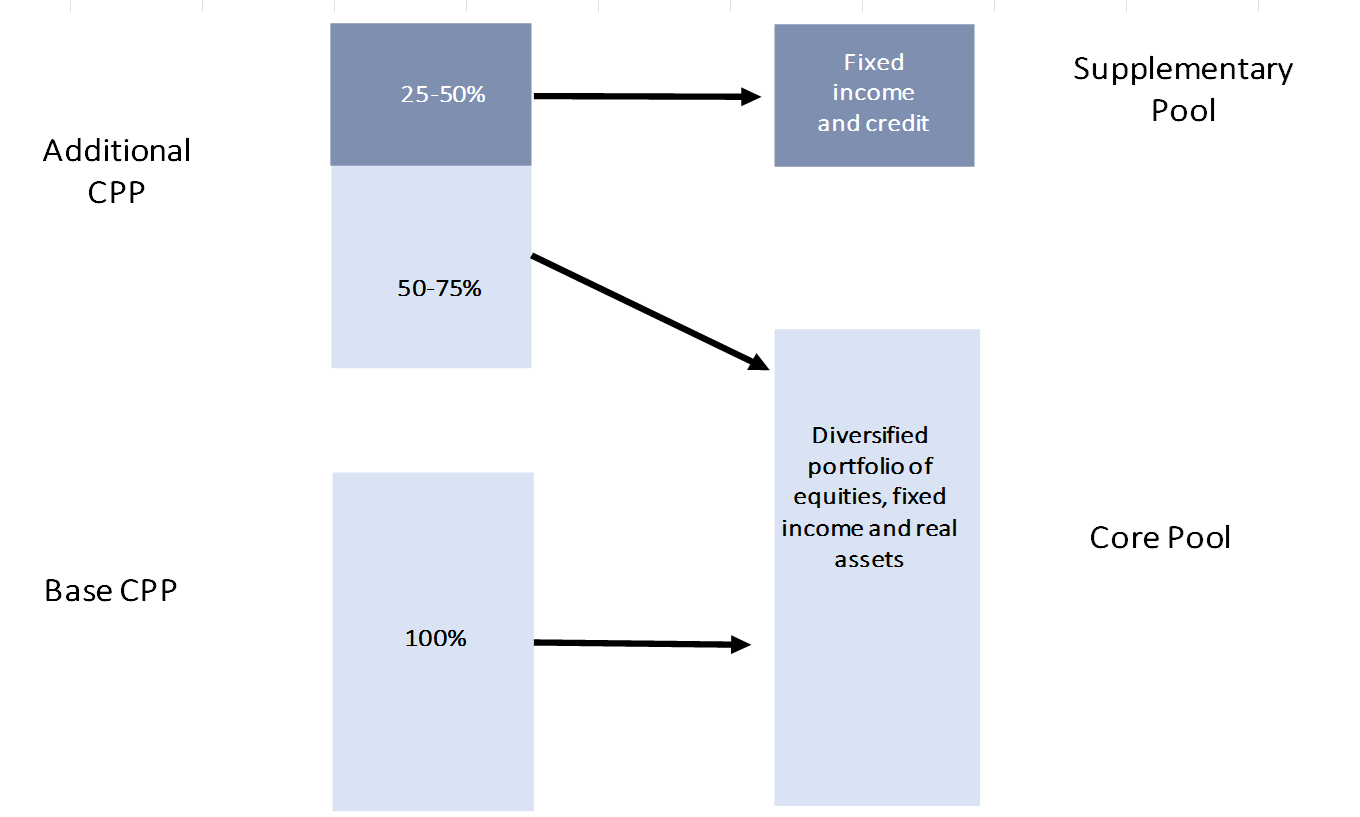
Chart 8 - Text version
Flow chart showing a schematic of the two-pool investment structure for the CPP invested assets.
On the top left, for the additional CPP, two stacked boxes represent a proportion of 50 to 75% for the bottom box and a proportion of 25 to 50% for the top box. The top box points to another box representing 100% fixed income and designated as the Supplementary Pool. The bottom box is pointing to another box representing a diversified portfolio of equities, fixed income and real assets, together designated as the Core Pool.
On the bottom left, for the base CPP, one box represents a proportion of 100%. That box points to the box designated as the Core Pool.
The CPPIB diversifies its holdings and thus sources of returns, while respecting the risk level of its reference portfolios. As a result, the base and additional CPP assets are invested in several types of assets. The portfolios capturing that diversification are called the strategic portfolios. The CPPIB uses the strategic portfolios to express its long-term goal for allocating assets by asset classes and geographic regions. In its Fiscal 2025 Annual Report, the CPPIB signaled its intention to continue increasing the CPP Fund's exposure to fixed income as part of their 2026 strategy.Footnote 14
As at 31 December 2024, the asset mix of the base CPP consisted of 54% equities, 25% fixed income securities, and 21% real assets, while the asset mix of the additional CPP consisted of 34% equities, 52% fixed income securities, and 14% real assets. Table 65 further categorizes the actual assets under the CPPIB management into the asset classes identified at the beginning of this section, which correspond to the strategic portfolios' asset classes.
| Plan | Equity | Fixed income securities | Real assets | ||||
|---|---|---|---|---|---|---|---|
| Public equities | Private equities | Marketable bonds | Non-marketable bonds | Credit | CashTable 65 Footnote 1 | ||
| Base | 28 | 25 | 31 | 2 | 14 | (22) | 21 |
| Additional | 18 | 16 | 50 | 0 | 16 | (14) | 14 |
|
Table 65 Footnotes
|
|||||||
B.6.3 Investment income
In general, investment income from a given asset within a portfolio is the product of the market value of that asset and its projected nominal rate of return (which is obtained by adding the applicable projected real rate of return, as described in section B.6.4 below, to the projected inflation rate).
The investment income of the CPP is based on the assumed real rate of return applicable to each type of asset, projected inflation, and the projected asset mix and cash flows. In addition, the assumed real rate of return at the portfolio level includes an allowance for rebalancing and diversification (discussed in section B.6.5). Investment income is also adjusted downward to recognize investment expenses (discussed in section B.6.6).
B.6.4 Real rates of return
Real rates of return are required for the projection of revenue arising from investment income. They are assumed for each year of the projection period and for each of the main asset classes in which CPP assets are invested. All real rates of return described in this section are shown before reduction for assumed investment expenses and allowance for rebalancing and diversification.
The real rates of return were developed by looking at historical returns (expressed in Canadian dollars) and adjusting the returns upward or downward to reflect potential future trends and expectations that differ from the past. Consideration was also given to forecasts from other relevant experts. Both public market data and customized benchmarks prepared by the CPPIB were used to analyze the historical experience.
Future currency variations will impact the real rates of return over the projection period, creating gains and losses. However, as the projection period is over 75 years, these gains and losses are expected to offset each other over time. Thus, it is assumed that currency variations will have no impact on the real rates of return.
B.6.4.1 Fixed income securities
As at 31 December 2024, the CPPIB had 25% of the Core pool invested in fixed income securities, split between fixed income, credit, and cash (which includes leverage). Fixed income in the Core pool can be further divided into a non-marketable bond portfolio composed of bonds with various terms to maturity, representing loans made to the provinces, and a marketable bond portfolio consisting of foreign sovereign bonds and some domestic federal and provincial bonds. As of 1 January 2019, the CPPIB started investing part of the additional CPP's contributions in a Supplementary pool composed of fixed income securities and credit. In the case of the Supplementary pool, the fixed income comprises domestic federal and provincial bonds and developed market sovereign bonds.
B.6.4.1.1 Canadian fixed income
The nominal yield on long-term Government of Canada bonds is set for each year in the projection period. The real yield on long-term federal bonds is equal to the nominal yields less the assumed rate of inflation. The real yield on long-term Canadian federal bonds as at 31 December 2024 is 0.97% and is assumed to gradually increase to 2.0% by 2036 and remain at that level.
The real yields for long-term provincial bonds, as well as for federal and provincial bonds of shorter maturities (mid and short), are based on the real yield on long-term federal bonds adjusted based on long-term historical spreads. The initial spreads over the real yield on federal long-term bonds are based on spreads prevailing as at 31 December 2024 and reflect the current economic environment. Since the long-term federal bond yield is assumed to increase between 2025 and 2036 and only stabilize at the end of 2036, bond returns are lower for the first ten years of the projection.
For the core and supplementary pool marketable bond portfolios, the yields are determined in relation to yields for Canadian federal universe bonds. The yield for Canadian federal universe bonds is assumed to be represented by a diversified portfolio of Canadian federal bonds. The assumed average maturities of federal and provincial bonds are estimated based on market data at the beginning of 2025 and are assumed to remain constant throughout the projection period. The average maturity is set at 7.4 years for the Canadian federal bonds and 14.1 years for provincial bonds. The ultimate real yields on the Canadian federal bonds and provincial bonds are 1.3% and 2.2%, respectively.
B.6.4.1.2 Non-marketable bond portfolio and rollover rates (loans to provinces, core pool)
The non-marketable bond portfolio at the end of 2024 represented 2% of Core CPP assets. The provinces are allowed to roll over at maturity for a further 20-year term any bonds that were purchased prior to the 1997 CPP amendments (that came into effect on 1 January 1998). In lieu of exercising their statutory rollover right, an agreement between the provinces and the CPPIB permits each province to repay a bond and contract a replacement bond or bonds for a term of at least five years, with a total principal amount not exceeding the principal amount of the maturing bond and total successive terms of not more than 30 years. During the 20-year period 2005 to 2024, 76% of provincial bonds available for rollover were rolled over at or before maturity. The rollover proportion increases to 100% when considering the five-year period from 2020 to 2024. Using this rollover experience, it is assumed that the rollover rate will be 100% for 2025 and thereafter. The last non-marketable bond is expected to mature in 2049.
On the basis of the average short-, medium-, and long-term experience of the spread between the annual yields on federal and provincial bonds, the current outlook of the economy, and data on rollovers since 2000, a spread over the federal long-term yield was determined for each province. The initial spreads on rollover bonds are set at the actual market spreads at the end of 2024 for provincial bonds issued by the given province. The ultimate spreads, applicable from 2036 onward, are set at the average spreads of provincial bonds issued by a given province during the period 2000 to 2023. The weighted long-term average spread for all provinces is approximately 75 basis points. Therefore, an ultimate annual real yield of approximately 2.8% for provincial rollover bonds is assumed for 2036 and thereafter.
The real rate of return of the non-marketable bond portfolio is calculated by taking into consideration any coupon payments made throughout the year, as well as the change in the market value of the portfolio due to changes in the assumed yield rates and in the term to maturity of each bond. Coupons paid and redemption values of bonds at maturity are assumed to be reinvested in the marketable bond portfolio.
B.6.4.1.3 Marketable bond portfolio (core pool)
The Core pool's marketable bond portfolio consists mainly of foreign sovereign bonds (developed market and emerging market). As at 31 December 2024, the Core pool is composed of 13% Canadian bonds, 82% developed market sovereign bonds and 5% emerging market bonds, and it is expected to stay at that level over the projection period. Consistent with the last report (31st CPP Actuarial Report), it is assumed that corporate bond holdings of the CPPIB are part of the credit asset class (discussed in the subsequent section).
The returns for developed market sovereign bonds are derived from a blend of projected sovereign yields for the Euro Zone, the United States, the United Kingdom, Australia, and Asia. Based on historical data and forward-looking forecasts, the foreign sovereign yields are assumed to be 10 basis points lower than the projected yields of Canadian federal universe bonds. Thus, the ultimate real return for the developed market sovereign bonds is assumed to be 1.2%.
The returns for emerging market sovereign bonds are derived from a blend of projected local currency long term sovereign yields for Brazil, China, India, Indonesia, and Mexico.
These sovereign yields are obtained by adding a spread of 148 basis points to the projected yields of Canadian federal universe bonds. The ultimate real return for the emerging market sovereign bonds is assumed to be 2.8%.
The assumed ultimate real rate of return of the Core pool marketable bond portfolio is 1.4%.
B.6.4.1.4 marketable bond portfolio (supplementary pool)
The initial composition is based on data as of 31 December 2024 provided by the CPPIB, and consists of 41% Canadian federal, 35% provincial, and 24% developed markets sovereign bonds. The ultimate composition is based on information provided by the CPPIB, and is assumed to be 18% Canadian federal, 15% provincial, and 67% developed markets sovereign bonds.
The ultimate yields on the Canadian federal bonds, provincial bonds and developed markets sovereign bonds are 1.3%, 2.2% and 1.2% respectively. The ultimate real rate of return for the supplementary marketable bonds is therefore assumed to be 1.4%.
B.6.4.1.5 Credit (core and supplementary)
The credit asset class includes investments in corporate bonds, private debt, and private real estate debt. At the end of 2024, the CPPIB had approximately 14% of the base CPP and 16% of the additional CPP net assets invested in this asset class.
For the purpose of this report, the expected real rate of return on credit is the weighted average of the assumed returns on investment-grade (IG) and high yield (HY) global bonds, with the weights reflecting the risk characteristics of the CPPIB's actual holdings. The ultimate real return from 2036 onward is assumed to be 2.2% on the global IG portfolio and 3.8% on the global HY portfolio.
Both the Core and Supplementary pools allocate investments across IG and HY global bonds. According to data provided by CPPIB, the Core pool currently consists of approximately 18% IG and 82% HY bonds, while the Supplementary pool is fully allocated to HY bonds. These allocations are expected to gradually align with their long-term targets of 15% IG / 85% HY for the Core pool and 58% IG / 42% HY for the Supplementary pool by the year 2036.
For the Core pool, the ultimate real rate of return on credit assets is assumed to be 3.5% from 2036 onward. The assumed ultimate real rate of return for the Supplementary pool credit assets is 2.9% from 2036 onward.
B.6.4.1.6 CPP account, additional CPP account, and cash
The CPP Account is established in the accounts of Canada to record the transactions of the base Plan and amounts transferred to and from the CPPIB in respect of the base Plan. The balance in the CPP Account serves as a flow-through account with investments solely in short-term securities.
Similar to the CPP Account, the Additional CPP Account is a flow-through account that records the transactions of the additional Plan and amounts transferred to and from the CPPIB in respect of the additional Plan. The ultimate real rate of return on cash is assumed to be 0.5%.
The CPPIB uses financial leverage as part of its investment strategy. Financial leverage in the context of portfolio management consists of borrowing money to invest in other assets with the expectation that the borrowing cost will be less than the return on the assets purchased. As at 31 December 2024, CPPIB's external debt and financing liability represented about 22% of its Core pool net assets. Similar to the previous actuarial report, there is an explicit recognition in this report for the amount of leverage in the asset allocation. The ultimate borrowing cost related to financial leverage is assumed to be 1.0%, which corresponds to the ultimate real rate of return on cash of 0.5% plus a premium of 0.5%.
B.6.4.2 Equity
The CPP assets invested in equities are currently diversified among public and private equities and across various geographies. In the derivation of the real rates of return for these equity investments, consideration was given to expected dividend yields, expected growth of the underlying economies and long-term risk premiums for various markets and geographies. No distinction is made between realized and unrealized capital gains. Public as well as custom equity benchmarks provided by the CPPIB were considered in the derivation of real rates of return for equities.
B.6.4.2.1 Public equities
Public equities comprise developed and emerging markets publicly traded equities. Various elements contribute to the return on an equity investment such as earnings, income paid to shareholders, fluctuation in valuation, and exchange rates for non-Canadian investments.
Over long periods, valuation changes and currency fluctuations are not expected to contribute significantly to the return on broad equity markets. Therefore, it is assumed that expectations regarding income and earnings growth are sufficient to project future equity returns, with additional adjustments for the riskiness of emerging market equities.
The income return derived from dividend and buyback yields on developed market equities is expected to be 3.1%. This is based on historical income return from dividend and buyback yields for developed market equities, adjusted to reflect current and expected economic environments. Growth in earnings is proxied using GDP growth per capita for developed markets; and it is expected to add 0.9% to the overall real return of developed market equities.
Hence, the expected real return on developed market equities is 4.0%, while due to their additional risk, emerging market equities are assumed to yield an additional 1.0%.
The portfolio assumes an ultimate allocation of approximately 85% to developed market equities and 15% to emerging market equities. The ultimate real rate of return for public equities is then projected to be 4.2%.
B.6.4.2.2 Private equities
Compared to public equities, private equities are less liquid, and their management necessitates a higher degree of expertise. Private equities may also provide institutional investors the opportunity to invest at an earlier stage in the development of a company, which translates into additional risk and greater potential returns. As a result, the return structure of private equities is different compared to public equities. Private equities are expected to generate an additional return in exchange for the additional illiquidity risk and complex management.
In general, private investments have grown in popularity over the last decade. This increase in demand has not necessarily been matched by an increase in supply. Valuations are high and a significant amount of capital is waiting to be allocated at attractive prices. As more and more investors around the globe compete for private placements, it is assumed that the additional return from investing in private equities compared to public equities will be lower than historical levels.
Private equities are assumed to have a premium of 1.1% over developed market equities. In consequence, the ultimate real rate of return on private equities is projected to be 5.1%.
B.6.4.3 Real assets
Real assets comprise global investments in real estate, infrastructure, and sustainable energy assets. The expected real rate of return on real assets is the weighted average returns of the three subclasses.
The returns on real estate assets are derived from two components: income returns and capital growth. Each component references historical data and forward-looking adjustments which consider multiple factors such as real estate demand evolution, risk premium compression and projected per capita GDP growth rate. It is assumed the income return will be 3.1% while the growth assumption component is set at 0.9%, bringing the real return assumption for the real estate asset class to 4.0% throughout the projection period.
Like real estate, infrastructure returns are composed of income return and capital growth components. The income return component is set at 3.0% and the capital growth assumption, proxied by the projected per capita GDP growth rate is 0.9%. This yields a stable projection of 3.9% real return for infrastructure assets.
The sustainable energy group is a relatively new type of asset class for which the historical data on returns is limited. Therefore, the expected return for this asset class is assumed to be a weighted average of real estate and infrastructure, with weights determined by the CPPIB's allocations to those classes. The expected real return for sustainable energy assets is 3.9%.
Collectively, the ultimate real rate of return on real assets is projected to be 3.9%.
B.6.4.4 Summary of real rates of return by asset type
Table 66 summarizes the assumed real rates of return by asset type throughout the projection period, before any allowance for rebalancing and diversification and reduction for investment expenses. The rebalancing and diversification allowance is presented at the portfolio level in Table 67 for the base CPP and Table 69 for the additional CPP, while the reduction for investment expenses and resulting real and nominal portfolio returns are presented in Table 70 and Table 71.
It is important to recognize that rates of return for most assets are volatile. The real rates of return presented in Table 66 represent expected trends and assumed levels of returns to be obtained over a long horizon. As such, limited emphasis should be put on individual projection years.
| Year | Equity | Fixed income securities | Real assets | ||||||
|---|---|---|---|---|---|---|---|---|---|
| Public equities | Private equities | Marketable bonds (Core) | Marketable bonds (Supplementary) | Non-marketable bonds | Credit (Core) | Credit (Supplementary) | Cash | ||
| 2025 | 4.2 | 5.1 | 1.0 | 1.0 | 2.5 | 3.6 | 2.7 | 0.5 | 3.9 |
| 2026 | 4.2 | 5.1 | 1.1 | 1.0 | 1.7 | 3.7 | 2.9 | 0.3 | 3.9 |
| 2027 | 4.2 | 5.1 | 1.3 | 1.3 | 1.7 | 3.7 | 2.8 | 0.4 | 3.9 |
| 2028 | 4.2 | 5.1 | 1.3 | 1.3 | 2.0 | 3.7 | 2.7 | 0.5 | 3.9 |
| 2029 | 4.2 | 5.1 | 1.4 | 1.4 | 2.1 | 3.6 | 2.6 | 0.5 | 3.9 |
| 2030 | 4.2 | 5.1 | 1.4 | 1.5 | 2.4 | 3.6 | 2.6 | 0.5 | 3.9 |
| 2031 | 4.2 | 5.1 | 1.4 | 1.4 | 2.4 | 3.6 | 2.7 | 0.5 | 3.9 |
| 2032 | 4.2 | 5.1 | 1.4 | 1.4 | 2.4 | 3.6 | 2.7 | 0.5 | 3.9 |
| 2033 | 4.2 | 5.1 | 1.4 | 1.4 | 2.4 | 3.6 | 2.8 | 0.5 | 3.9 |
| 2034 | 4.2 | 5.1 | 1.4 | 1.4 | 2.2 | 3.6 | 2.8 | 0.5 | 3.9 |
| 2035 | 4.2 | 5.1 | 1.4 | 1.4 | 2.0 | 3.6 | 2.9 | 0.5 | 3.9 |
| 2040 | 4.2 | 5.1 | 1.4 | 1.4 | 1.3 | 3.5 | 2.9 | 0.5 | 3.9 |
| 2042+ | 4.2 | 5.1 | 1.4 | 1.4 | 0.8 | 3.5 | 2.9 | 0.5 | 3.9 |
B.6.5 Asset allocation and expected portfolio rates of return
This report provides projections of over 75 years. As such, long-term asset mix assumptions are required for the base and additional CPP. The long-term asset mix assumptions are consistent with the principles of the CPPIB's current investment framework. For the base CPP, the long-term asset mix is based on the assumption that the level of risk will gradually reduce over time. For the additional CPP, the long-term asset mix is based on the assumption that the level of risk will remain stable over time. More information is provided in the next sections.
For both the base and additional Plans, the expected portfolio real rates of return include an allowance for rebalancing and diversification of the assets. This allowance takes into account the beneficial effect of periodically rebalancing a diversified portfolio to maintain the desired relative assets allocation by asset classes. In other words, the expected return of a portfolio is greater than the weighted average of the expected return of its components. The size of the allowance depends on the asset mix and the risk characteristics of the individual assets.
B.6.5.1 Base CPP
As the base CPP continues to mature, the ratio of contributors to beneficiaries is projected to decrease, and the proportion of investment income required to pay benefits is projected to increase. Starting in 2031, it is expected that contributions will be insufficient to cover all expenditures, and that a portion of investment income will be required to cover expenditures. The portion of investment income required to pay expenditures will be small at the beginning but is projected to increase over time. In addition, due to strong investment performance, the base CPP has become more sensitive to investment experience. The importance of investment income as a source of revenue has therefore grown for the base CPP, and is expected to continue to grow over time.
Consistent with the principles of the CPPIB's investment framework, it is assumed that the level of risk of the base CPP investment portfolio will decrease over time as reliance on investment income increases. As mentioned, the CPPIB sets its risk levels through its reference portfolios and diversifies its holdings while respecting the risk levels of its reference portfolios.
The methodology for setting the ultimate asset mix for the base CPP therefore involves setting an assumption for the reference portfolio in the future in terms of the equity/debt ratio and building a portfolio with the same risk level (volatility) as this reference portfolio.
For this report, it is assumed that the risk level of the CPPIB's current portfolio will gradually move to the risk level of a reference portfolio that is comprised of 70% equity and 30% fixed income by 2042. The volatility of this reference portfolio, as measured by the one-year standard deviation, is 10.7%.
The initial level of risk is based on the CPPIB's actual portfolio as at 31 December 2024 with an estimated one-year standard deviation of 12.1%. Therefore, the portfolio volatility is assumed to gradually decrease from 12.1% as at the valuation date to 10.7% by 2042.
Table 67 presents the projected asset allocation, the expected volatility of the portfolio, and the expected portfolio real rate of return before investment expenses for the base Plan. The assumed total real rate of return includes an allowance for rebalancing and diversification. At the portfolio level, this allowance is assumed to add 0.45% to the real rate of return annually over the projection period.
| Year | Equity | Fixed income securities | Real assets | Expected long-term volatility | Total real rate of returnTable 67 Footnote 1,Table 67 Footnote 2 | ||||
|---|---|---|---|---|---|---|---|---|---|
| Public equities | Private equities | Marketable bonds | Non-marketable bonds | Credit | Cash | ||||
| 2025 | 28 | 25 | 31 | 2 | 14 | (22) | 21 | 12.1 | 4.39 |
| 2026 | 28 | 25 | 32 | 2 | 14 | (22) | 21 | 12.1 | 4.47 |
| 2027 | 28 | 25 | 32 | 2 | 14 | (22) | 21 | 12.1 | 4.50 |
| 2028 | 28 | 25 | 31 | 2 | 14 | (21) | 21 | 11.9 | 4.47 |
| 2029 | 27 | 25 | 31 | 1 | 14 | (19) | 21 | 11.8 | 4.45 |
| 2030 | 27 | 24 | 31 | 1 | 14 | (18) | 20 | 11.6 | 4.41 |
| 2031 | 26 | 24 | 31 | 1 | 14 | (17) | 20 | 11.5 | 4.39 |
| 2032 | 26 | 24 | 31 | 1 | 14 | (16) | 20 | 11.4 | 4.37 |
| 2033 | 25 | 24 | 30 | 1 | 14 | (15) | 20 | 11.3 | 4.34 |
| 2034 | 25 | 24 | 30 | 1 | 14 | (15) | 20 | 11.2 | 4.33 |
| 2035 | 25 | 24 | 30 | 1 | 15 | (14) | 20 | 11.2 | 4.31 |
| 2040 | 24 | 23 | 30 | 0 | 15 | (11) | 19 | 10.9 | 4.24 |
| 2042+ | 23 | 23 | 30 | 0 | 15 | (10) | 19 | 10.7 | 4.20 |
|
Table 67 Footnotes
|
|||||||||
B.6.5.2 Additional CPP
The additional CPP assets are invested in both the Core and Supplementary pools. The share of the additional CPP assets invested in each pool is selected to match the desired level of risk of the additional CPP's reference portfolio. To increase the total portfolio risk of the additional CPP, a higher allocation to the Core pool would be selected. Similarly, a lower allocation to the Core pool would lower the total portfolio risk for the additional Plan.
Consistent with the principles of the CPPIB's investment framework, it is assumed that the level of risk of the additional CPP will be kept constant over the projection period at a level corresponding to the current CPPIB reference portfolio of about 55% equity and 45% fixed income with an estimated volatility of 8.3%.
During the first few projection years, this level of risk is obtained by investing 64% of the additional CPP assets in the Core pool and 36% in the Supplementary pool. Because the level of risk of the Core pool investments is expected to decrease gradually, a higher share of the additional CPP assets is expected to be allocated to the Core pool to maintain the additional CPP portfolio volatility at 8.3%. It is assumed that 74% of the additional CPP assets will be allocated to the Core pool for the year 2042 and thereafter.
Table 68 presents the projected allocations of the additional CPP to the Core pool and the Supplementary pool, broken down by fixed income and credit asset classes. It is expected that the Supplementary pool will continue to be invested at 80% in fixed income and 20% in credit.
Table 69 presents the projected asset allocation, the expected volatility, and the expected real rate of return before investment expenses for the additional CPP. The assumed total real rate of return includes an allowance for rebalancing and diversification. At the portfolio level, this allowance is assumed to add 0.45% to the real rate of return annually over the projection period.
| Year | Core pool allocation | Supplementary pool allocation | |
|---|---|---|---|
| Marketable bonds | Credit | ||
| 2025 | 64 | 29 | 7 |
| 2026 | 65 | 29 | 7 |
| 2027 | 64 | 29 | 7 |
| 2028 | 65 | 28 | 7 |
| 2029 | 66 | 28 | 7 |
| 2030 | 66 | 27 | 7 |
| 2031 | 67 | 26 | 7 |
| 2032 | 68 | 26 | 6 |
| 2033 | 69 | 25 | 6 |
| 2034 | 70 | 24 | 6 |
| 2035 | 71 | 24 | 6 |
| 2040 | 73 | 21 | 5 |
| 2042+ | 74 | 21 | 5 |
| Year | Equity | Fixed income securities | Real assets | Expected long-term volatility | Total real rate of returnTable 69 Footnote 1,Table 69 Footnote 2 | ||||
|---|---|---|---|---|---|---|---|---|---|
| Public equities | Private equities | Marketable bonds | Non-marketable bonds | Credit | Cash | ||||
| 2025 | 18 | 16 | 50 | 0 | 16 | (14) | 14 | 8.3 | 3.45 |
| 2026 | 18 | 16 | 50 | 0 | 16 | (14) | 14 | 8.3 | 3.51 |
| 2027 | 18 | 16 | 50 | 0 | 16 | (14) | 14 | 8.3 | 3.61 |
| 2028 | 18 | 16 | 50 | 0 | 16 | (13) | 14 | 8.3 | 3.62 |
| 2029 | 18 | 16 | 49 | 0 | 16 | (13) | 14 | 8.3 | 3.64 |
| 2030 | 18 | 16 | 48 | 0 | 16 | (12) | 14 | 8.3 | 3.64 |
| 2031 | 18 | 16 | 48 | 0 | 16 | (11) | 14 | 8.3 | 3.64 |
| 2032 | 18 | 16 | 47 | 0 | 16 | (11) | 14 | 8.3 | 3.65 |
| 2033 | 18 | 17 | 47 | 0 | 16 | (11) | 14 | 8.3 | 3.65 |
| 2034 | 18 | 17 | 46 | 0 | 16 | (10) | 14 | 8.3 | 3.66 |
| 2035 | 18 | 17 | 46 | 0 | 16 | (10) | 14 | 8.3 | 3.66 |
| 2040 | 17 | 17 | 44 | 0 | 16 | (8) | 14 | 8.3 | 3.68 |
| 2042+ | 17 | 17 | 43 | 0 | 16 | (7) | 14 | 8.3 | 3.67 |
|
Table 69 Footnotes
|
|||||||||
B.6.6 Investment expenses
The CPPIB's total investment expenses consist of operating expenses, transaction costs, and investment management fees. Over the last three fiscal years, total investment expenses have averaged approximately 1.05% of total assets, ranging from 0.97% to 1.15%. The majority of those investment expenses were incurred through active management decisions. Considering how total investment expenses evolved over the last decade, it is assumed that, going forward, total investment expenses of the CPPIB will be 1.00% of the Core pool assets.
Active management is implemented to generate excess returns (after reduction for active management expenses). Thus, the additional returns from a successful active management program should equal at least the cost incurred to pursue active management. For the purpose of this report and in accordance with the Canadian Institute of Actuaries' guidance regarding the determination of best-estimate discount rates, it is assumed that the additional returns generated by active management will equal the additional expenses incurred from active management. These expenses are assumed to be the difference between total investment expenses and the assumed expenses that would be incurred for the passive management of the portfolios.
It is assumed that investment expenses of 0.18% would be incurred to passively manage the Core pool. Since the base CPP assets are invested only in the Core pool, the assumed investment expenses from passive management for the base CPP are 0.18%, and the resulting investment expenses for active management are 0.82%.
The passive management investment expenses from the Supplementary pool are assumed to be 0.01%. It is further assumed that there are no active management expenses associated with the Supplementary pool. The investment expenses of the additional CPP will depend on how much of the fund is invested in the Core pool versus the Supplementary pool, and the investment expenses associated with each of these pools. For year 2042 and thereafter, it is assumed that 74% of additional Plan assets are invested in the Core pool and 26% are invested in the Supplementary pool. Such allocation of the additional Plan results in total investment expenses for the additional Plan being 0.75% of total additional CPP assets (invested in both the Core and Supplementary pools), and the overall investment expenses from passive management related to the additional CPP being ultimately 0.14%. The investment expenses from active management for the additional CPP are therefore 0.61%.
The following section shows the overall rates of return on CPP assets net of investment expenses for the base and additional CPP.
B.6.7 Overall rates of return on base and additional CPP assets
The best-estimate real rates of return on total assets for each of the base and additional Plans are derived from the weighted average assumed real rates of return on all types of assets, using the assumed asset mix proportions as weights. The best-estimate real rates of return are further adjusted to incorporate an allocation for rebalancing and diversification. In addition, the best-estimate real rates of return are increased to reflect additional returns due to active management and reduced to reflect all investment expenses. The projected nominal returns are the sum of the assumed levels of inflation and real returns. The ultimate net rates of return are shown in Table 70.
| Base CPP | Additional CPP | |||
|---|---|---|---|---|
| Nominal | Real | Nominal | Real | |
| Weighted average rate of return (before investment expenses) | 6.20 | 4.20 | 5.67 | 3.67 |
| Additional rate of return due to active management | 0.82 | 0.82 | 0.61 | 0.61 |
| Total weighted average rates of return before investment expenses | 7.02 | 5.02 | 6.28 | 4.28 |
| Expected investment expenses | ||||
| Expenses due to passive management | (0.18) | (0.18) | (0.14) | (0.14) |
| Additional expenses due to active management | (0.82) | (0.82) | (0.61) | (0.61) |
| Total expected investment expenses | (1.00) | (1.00) | (0.75) | (0.75) |
| Ultimate rate of return after investment expenses | 6.02 | 4.02 | 5.53 | 3.53 |
The resulting nominal and real rates of return for selected projection years are shown in Table 71. The projected average annual real rates of return over the next 75 years are 4.05% for the base CPP and 3.53% for the additional CPP.
| Year | Base CPP | Additional CPP | ||
|---|---|---|---|---|
| Nominal | Real | Nominal | Real | |
| 2025 | 6.41 | 4.21 | 5.51 | 3.31 |
| 2026 | 6.39 | 4.29 | 5.47 | 3.37 |
| 2027 | 6.32 | 4.32 | 5.47 | 3.47 |
| 2028 | 6.29 | 4.29 | 5.48 | 3.48 |
| 2029 | 6.27 | 4.27 | 5.50 | 3.50 |
| 2030 | 6.23 | 4.23 | 5.50 | 3.50 |
| 2031 | 6.21 | 4.21 | 5.50 | 3.50 |
| 2032 | 6.19 | 4.19 | 5.51 | 3.51 |
| 2033 | 6.16 | 4.16 | 5.51 | 3.51 |
| 2034 | 6.15 | 4.15 | 5.52 | 3.52 |
| 2035 | 6.13 | 4.13 | 5.53 | 3.53 |
| 2040 | 6.06 | 4.06 | 5.54 | 3.54 |
| 2042+ | 6.02 | 4.02 | 5.53 | 3.53 |
| Average over: | ||||
| 2025 to 2029 | 6.34 | 4.28 | 5.49 | 3.43 |
| 2025 to 2034 | 6.26 | 4.23 | 5.50 | 3.47 |
| 2025 to 2099 | 6.06 | 4.05 | 5.53 | 3.53 |
While the ultimate real rate of return for the base CPP of 4.02% has stayed at the same level when compared to the previous valuation, the additional CPP ultimate real rate of return of 3.53% is 9 basis points lower compared to the previous valuation due to a higher allocation to fixed income and lower allocation to credit to reflect more recent information from the CPPIB on the composition of the Supplementary pool.
For the base CPP, the 75-year (2025-2099) average annual real rate of return on investments of 4.05% is 4 basis points higher compared to the 31st CPP Actuarial Report average for the same period. This increase is mainly due to higher assumed use of leverage over a longer transition period to the ultimate asset mix, as well as a higher interest rate environment leading to higher fixed income returns for the years prior to 2036.
For the additional CPP, the 75-year (2025-2099) average annual real rate of return on investments of 3.53% is 4 basis points lower compared to the 31st CPP Actuarial Report average for the same period. This is due to the higher allocation to fixed income and lower allocation to credit.
B.7 Benefit expenditures
B.7.1 Benefits payable as at 31 December 2024 and projected benefits
The number of base and additional CPP beneficiaries in pay and average monthly benefits payable as at 31 December 2024 are shown in Table 72.
| Benefit type | Number of beneficiaries in pay (in thousands) | Average monthly benefit ($) | ||
|---|---|---|---|---|
| Males | Females | Males | Females | |
| Retirement | 2,905 | 3,207 | 833 | 624 |
| Post-retirement benefit | 1,112 | 967 | 66 | 54 |
| Survivor - aged less than 65 | 46 | 148 | 473 | 544 |
| Survivor - aged 65 and over | 211 | 802 | 162 | 407 |
| DisabilityTable 72 Footnote 2 | 131 | 171 | 1,188 | 1,106 |
| Benefit type (base CPP only) | Number of beneficiaries in pay (in thousands) | Average monthly benefit ($) |
|---|---|---|
| Males and females | Males and females | |
| Orphan | 60 | 294 |
| Disabled contributor's child | 67 | 294 |
Table 72 Footnotes
- Table 72 Footnote 1
-
The figures in the tables refer to ESDC monthly statistics except for the post-retirement benefit figures, which are estimated by the OCA.
- Table 72 Footnote 2
-
The figures given in the table for the disability benefit refer to the disability pension.
The approach used in this report to project future benefits paid is based on deterministic projections using grouped data. The amount of benefit expenditures is determined by taking into account the administrative agreement established in section 58(1) and 58(2) of the Canada Pension Plan Regulations between the CPP and the QPP for beneficiaries who had contributed to both plans.
The retirement, survivor, disability, and children's benefit expenditures for each year following the year of benefit take-up for a given age, sex, and cohort is computed as the product of:
- benefit expenditures in the year of take-up (described in this appendix);
- the probability of survival from the age at benefit take-up to the attained age;
- the rules regarding combined retirement and survivor benefits and combined disability and survivor benefits, as applicable; and
- the Pension Index, which recognizes the annual inflation adjustment to benefits each 1 January following benefit emergence.
The amounts of the benefits payable during any given calendar year are then obtained by simply summing the annual expenditures applicable for the year as described above, in respect of all age and sex cohorts having emerged in the given and all previous calendar years. The projected number of beneficiaries and amounts of benefit expenditures for the base and additional Plans are shown in various tables in the Results sections 5 and 6 of this report.
All projections of base CPP benefits start from the year 1966 instead of the beginning of the current projection period (2025). This is done for the following reasons:
- The valuation methodology can be validated for the historical period up to the valuation year (1966 to 2024) by comparing the projected values (contributions, benefits, beneficiaries, etc.) with actual experience. Based on this comparison, calibration factors of actual to projected historical experience are obtained, which are then used for the future projections of the different types of benefits. For example, the average values of the calibration factors for retirement benefit experience for those starting their pension between ages 60 and 65 are 0.98 for males and 0.95 for females.
- The projection of benefits already in pay as at the valuation date (31 December 2024) is fully integrated with the projection of benefits emerging after that date, thus ensuring full consistency between past experience and the future.
Benefits from the additional Plan have started to be paid out during the calendar year of 2022. As such, there was limited experience to create calibration factors specific for the additional Plan. Therefore, the same calibration factors developed for the base Plan projected benefits are assumed to apply to the additional Plan projected benefits except in the case of the additional retirement benefits, where microsimulation was used to estimate the calibration factors. As experience develops for the additional Plan, more precise calibration factors for each type of benefit will be determined separately for that CPP component.
B.7.2 Benefit eligibility rates
As described in Appendix - A (Summary of Plan Provisions) of this report, eligibility for benefits varies according to the type of benefit. The eligibility rules for the survivor benefit are the same as for the death benefit. The eligibility rules for base CPP benefits determine eligibility for additional CPP benefits.
Benefit eligibility rates (as a percentage of the Canada less Quebec population) for retirement, disability, and death/survivor benefits are projected using regression formulas that were developed to closely reproduce historical eligibility rates observed over the period 1966 to 2023 from CPP records of earnings data provided by ESDC. The projected eligibility rates take into account the applicable eligibility rules for each type of benefit, the proportion of contributors, and the length of the contributory period for existing and future earners. In addition, for this 32nd CPP Actuarial Report, an improvement to the retirement benefit eligibility rates methodology was made to reflect the impact of non-permanent residents (NPR) on retirement eligibility. This adjustment to retirement eligibility rates is linked to the assumption on the evolution of the number of NPR as a percentage of the population. Table 73 shows the resulting eligibility rates for the various benefit types by sex and age for selected years.
The retirement eligibility rates for some ages and years are greater than 100% due to individuals who contributed to the CPP and then left the country with no further information available as to their status. Since these individuals are not counted in the population, the retirement eligibility rates can be higher than 100%.
| Year | Retirement benefit eligibility rate at age 65 | Survivor/Death benefit eligibility rate at age 65 | Survivor/Death benefit eligibility rate at ages 20-64 | Disability benefit eligibility rate at ages 20-64Table 73 Footnote 1 | Post-retirement disability benefit eligibility rate at ages 60-64Table 73 Footnote 2 | |||||
|---|---|---|---|---|---|---|---|---|---|---|
| Males | Females | Males | Females | Males | Females | Males | Females | Males | Females | |
| 2025 | 101.1 | 98.2 | 97.7 | 79.1 | 77.9 | 70.0 | 71.7 | 65.7 | 51.5 | 45.8 |
| 2026 | 100.6 | 98.1 | 97.2 | 79.7 | 78.1 | 70.6 | 72.4 | 66.3 | 51.3 | 45.4 |
| 2027 | 100.2 | 97.9 | 96.9 | 80.2 | 77.9 | 71.0 | 72.0 | 66.3 | 51.2 | 45.5 |
| 2028 | 99.9 | 97.8 | 96.7 | 80.6 | 77.9 | 71.4 | 72.5 | 66.8 | 51.5 | 45.6 |
| 2029 | 99.5 | 97.7 | 96.6 | 81.1 | 79.3 | 72.0 | 73.7 | 67.9 | 51.2 | 45.4 |
| 2030 | 99.1 | 97.4 | 96.4 | 81.4 | 79.9 | 72.5 | 74.9 | 69.0 | 51.7 | 45.9 |
| 2031 | 98.8 | 97.3 | 96.2 | 81.8 | 79.8 | 72.6 | 75.4 | 69.6 | 51.6 | 45.8 |
| 2032 | 98.7 | 97.3 | 96.0 | 82.1 | 79.7 | 72.8 | 75.7 | 70.1 | 51.5 | 45.8 |
| 2033 | 98.8 | 97.5 | 95.9 | 82.3 | 79.9 | 73.1 | 76.2 | 70.6 | 52.1 | 46.3 |
| 2034 | 98.9 | 97.7 | 95.8 | 82.6 | 81.0 | 73.5 | 76.8 | 71.2 | 52.1 | 46.4 |
| 2035 | 99.2 | 98.0 | 95.7 | 82.8 | 81.4 | 73.9 | 77.0 | 71.6 | 51.7 | 46.1 |
| 2040 | 100.5 | 99.5 | 95.3 | 83.6 | 82.7 | 75.2 | 77.8 | 72.7 | 52.4 | 47.2 |
| 2045 | 101.6 | 101.0 | 95.3 | 84.3 | 83.9 | 76.2 | 78.0 | 73.1 | 52.5 | 47.4 |
| 2050 | 103.0 | 102.6 | 95.5 | 84.9 | 84.8 | 76.9 | 77.9 | 73.1 | 52.5 | 47.6 |
| 2055 | 108.7 | 108.4 | 95.9 | 85.5 | 85.3 | 77.2 | 79.1 | 74.4 | 51.0 | 46.1 |
| 2060 | 107.8 | 107.5 | 96.2 | 86.1 | 85.7 | 77.5 | 79.5 | 74.9 | 51.3 | 46.4 |
| 2065 | 107.2 | 106.7 | 96.6 | 86.6 | 86.0 | 77.8 | 80.0 | 75.4 | 51.9 | 47.0 |
| 2070 | 106.5 | 106.1 | 96.9 | 87.0 | 86.3 | 78.0 | 80.0 | 75.4 | 52.1 | 47.2 |
| 2075 | 105.3 | 104.9 | 97.2 | 87.3 | 86.6 | 78.3 | 80.1 | 75.5 | 52.3 | 47.4 |
| 2080 | 104.6 | 104.2 | 97.4 | 87.5 | 86.8 | 78.4 | 80.2 | 75.6 | 52.3 | 47.3 |
| 2085 | 104.4 | 103.9 | 97.6 | 87.7 | 86.9 | 78.6 | 80.4 | 75.9 | 52.4 | 47.6 |
| 2090 | 104.7 | 104.3 | 97.8 | 87.9 | 87.1 | 78.7 | 80.4 | 75.9 | 52.4 | 47.6 |
| 2095 | 104.4 | 104.1 | 98.0 | 88.0 | 87.3 | 78.8 | 80.5 | 76.0 | 52.5 | 47.7 |
| 2100 | 104.6 | 104.3 | 98.0 | 88.1 | 87.4 | 78.9 | 80.6 | 76.1 | 52.6 | 47.8 |
|
Table 73 Footnotes
|
||||||||||
B.7.3 Average earnings-related benefits
B.7.3.1 Base CPP
To determine base CPP benefits, the valuation model first calculates an average earnings-related benefit for all individuals born in a given calendar year, for each sex, and all relevant ages. This average earnings-related benefit is dependent on four main components:
- Average pensionable earnings, adjusted for benefit computation purposes,Footnote 15 relative to the YMPE;
- Average proportion of contributors adjusted for benefit computation purposesFootnote 16;
- 25% of the MPEA for the attained year; and
- the number of years in the elapsed contributory period at the attained age.
The base CPP average earnings-related benefit is then further adjusted to take into account certain provisions of the CPP statute as applicable:
- Disability exclusion: the period during which an individual received a CPP disability pension is excluded from the contributory period;
- Child-rearing provision (exclusion): the period during which an individual was caring for a child younger than age 7 is excluded from the contributory period if earnings during the child-rearing period were sufficiently low;
- Post-65 drop-out: earnings of contributors over age 65, who are not yet retirement beneficiaries, may replace earnings before age 65 if those earnings are lower;
- General drop-out provision (exclusion): 17% of the lowest earnings months up to a maximum of about 8 years may be dropped from the contributory period.
The average base CPP earnings-related benefit is used in the calculation of the total emerging base CPP earnings‑related benefit expenditures for a given calendar year, each sex, and all relevant ages.
Table 74 shows the resulting projected average earnings-related benefits for the base CPP as a percentage of the maximum base CPP earnings-related benefits at ages 60 and 65 by sex and year of birth for various cohorts of contributors. The average base CPP earnings-related benefit at age 65 as a percentage of the maximum is lower than at age 60 since those who take their benefit at age 65 have a longer contributory period (producing lower career average earnings) and an historical lower earnings profile than those who take an early benefit at age 60.
The gap in earnings-related benefits as a percentage of the maximum benefit for males compared to females is expected to decrease over time due to the assumed reduction in the male-female earnings gap as well as the assumed relative increases in the participation rates of female participants.
| Year of birth | Males | Females | ||
|---|---|---|---|---|
| Age 60 | Age 65 | Age 60 | Age 65 | |
| 1950 | 79 | 65 | 59 | 52 |
| 1955 | 79 | 65 | 63 | 53 |
| 1960 | 74 | 64 | 59 | 54 |
| 1965 | 67 | 60 | 54 | 52 |
| 1970 | 68 | 60 | 56 | 52 |
| 1975 | 69 | 61 | 57 | 54 |
| 1980 | 69 | 61 | 58 | 54 |
| 1985 | 70 | 61 | 59 | 55 |
| 1990 | 69 | 60 | 60 | 56 |
| 1995 | 69 | 60 | 60 | 56 |
| 2000 | 70 | 61 | 62 | 58 |
| 2005 | 70 | 61 | 62 | 58 |
| 2010 | 70 | 61 | 62 | 58 |
| 2015 | 70 | 61 | 62 | 58 |
| 2020 | 70 | 61 | 62 | 58 |
| 2025 | 70 | 61 | 62 | 58 |
| 2030 | 70 | 61 | 62 | 58 |
| 2035 | 70 | 61 | 62 | 58 |
B.7.3.2 Additional CPP
For the additional CPP, the valuation model also calculates an average earnings-related benefit based on contributors' highest earnings over forty years for all persons of a birth cohort for each calendar year, sex, and all relevant ages. This average earnings-related additional benefit is dependent on five main components:
- Average additional pensionable earnings, adjusted for benefit computation purposes,Footnote 17 relative to the YMPE;
- Average proportion of contributors adjusted for benefit computation purposesFootnote 18;
- First additional benefit calculated as 8.33% of the MPEA to increase the overall Plan's replacement rate to 33.33% of the MPEA;
- Second additional benefit calculated as 33.33% of 14% of the MPEA to increase coverage to 114% of the MPEA; and
- the fixed contributory period of 40 years.
The additional CPP average earnings-related benefit is then further adjusted to take into account certain provisions of the CPP statute as applicable:
- Disability drop-in: individuals who became disabled in 2019 or later will have imputed income assigned to those disability periods; and
- Child-rearing provision (drop-in): an imputed income may be assigned to periods of caring for children younger than age 7 on or after 1 January 2019.
The average additional CPP earnings-related benefit is used in the calculation of the total emerging additional CPP earnings‑related benefit expenditures for a given calendar year, each sex, and all relevant ages.
Table 75 shows the resulting projected average additional CPP earnings-related benefits as a percentage of the maximum additional CPP earnings-related benefits at ages 60 and 65 by sex and year of birth for various cohorts of contributors. The maximum additional benefit is the maximum benefit for both parts of the additional CPP, that is, below the YMPE and from the YMPE up to YAMPE, combined together.
The average additional CPP earnings-related benefit for males at age 65 as a percentage of the maximum is higher than at age 60 due to the longer contributory periods, which is beneficial in the context of the additional CPP's fixed forty years contributory period.
The additional earnings-related benefits as a percentage of the maximum are expected to generally increase over time for both males and females, since contributory periods are projected to increase relative to the fixed forty years. The gap between male and female average earnings-related benefits as a percentage of the maximum is relatively stable throughout the projection period.
| Year of birth | Males | Females | ||
|---|---|---|---|---|
| Age 60 | Age 65 | Age 60 | Age 65 | |
| 1965 | 5 | 9 | 4 | 7 |
| 1970 | 10 | 15 | 8 | 12 |
| 1975 | 17 | 21 | 15 | 17 |
| 1980 | 24 | 27 | 21 | 23 |
| 1985 | 31 | 34 | 26 | 29 |
| 1990 | 37 | 40 | 32 | 34 |
| 1995 | 42 | 45 | 36 | 39 |
| 2000 | 46 | 47 | 40 | 41 |
| 2005 | 45 | 47 | 40 | 41 |
| 2010 | 45 | 47 | 40 | 41 |
| 2015 | 44 | 47 | 40 | 41 |
| 2020 | 45 | 47 | 40 | 42 |
| 2025 | 44 | 46 | 40 | 41 |
| 2030 | 44 | 47 | 40 | 42 |
| 2035 | 44 | 47 | 40 | 42 |
B.7.4 Retirement benefit expenditures
Retirement benefit expenditures result from retirement pensions and post-retirement benefits paid under the base and additional CPP. The retirement benefits paid under both components of the CPP are earnings-related. The total retirement benefit payable is the sum of the base and additional pensions and post-retirement benefit amounts.
B.7.4.1 Retirement pension
New retirement pension expenditures are determined for each age from 60 to 70, sex, and calendar year of emergence starting from 1967. Total new retirement pensions are calculated as the product of:
- the population;
- the retirement pension eligibility rate;
- the retirement pension take-up rate;
- the actuarial adjustment factor for early or late pension take-up; and
- the average earnings-related benefit previously described.
B.7.4.2 Retirement Pension Take-up Rates
The projected retirement pension take-up rates (more simply referred to as retirement rates) by age, sex, and calendar year are determined by considering the assumed future work patterns of earners aged 60 and over and the corresponding CPP experience from 1967 to 2024. The sex-distinct take-up rate for a given age and year corresponds to the number of emerging (new) retirement beneficiaries divided by the total number of people eligible for a retirement pension. The same retirement rates for the base CPP apply to the additional CPP.
The unreduced pension age under the Canada Pension Plan is 65. Since 1987, a person can choose to receive a reduced retirement pension as early as age 60 or an increased pension if deferred beyond age 65. This provision has had the overall effect of lowering the average age at pension take-up. In 1986, the average age at pension take-up was 65.2 compared to an average age of 62.7 over the decade ending in 2019. However, recent data suggest a reversal of this trend, with individuals increasingly opting to retire later. In 2024, the average age at pension take-up was 64.0 for males and 63.8 for females.
Chart 9 and Chart 10 present the evolution of the retirement rates at age 60, 65 and 70 for males and females, respectively.
Since 2012, the age 60 retirement rates have continually decreased, while age 65 retirement rates have mostly stabilized. Age 70 take-up rates have been low in the past but have increased in recent years. Part of this increase can be attributed to the auto-enrolment provision at age 70 that was enacted in 2019, but the steady increase since then indicates a broader shift toward later retirement.
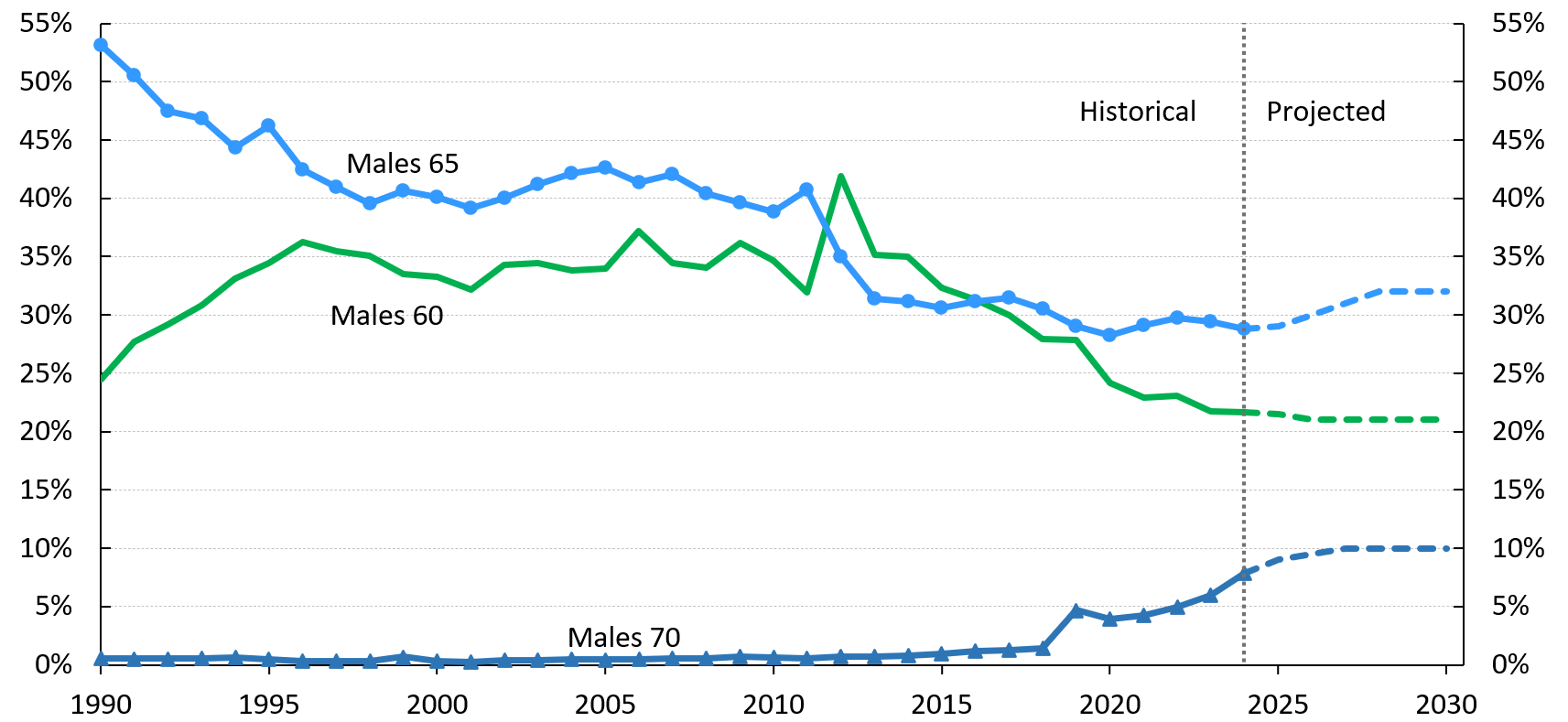
Chart 9 - Text version
| Year | Males 60 | Males 65 | Males 70 | |||
|---|---|---|---|---|---|---|
| Historical | Projected | Historical | Projected | Historical | Projected | |
| 1990 | 24.46% | no data | 53.16% | no data | 0.54% | no data |
| 1991 | 27.68% | no data | 50.51% | no data | 0.51% | no data |
| 1992 | 29.20% | no data | 47.50% | no data | 0.51% | no data |
| 1993 | 30.82% | no data | 46.84% | no data | 0.55% | no data |
| 1994 | 33.10% | no data | 44.37% | no data | 0.61% | no data |
| 1995 | 34.44% | no data | 46.21% | no data | 0.46% | no data |
| 1996 | 36.27% | no data | 42.43% | no data | 0.32% | no data |
| 1997 | 35.49% | no data | 40.96% | no data | 0.33% | no data |
| 1998 | 35.09% | no data | 39.55% | no data | 0.29% | no data |
| 1999 | 33.55% | no data | 40.66% | no data | 0.67% | no data |
| 2000 | 33.28% | no data | 40.08% | no data | 0.29% | no data |
| 2001 | 32.19% | no data | 39.16% | no data | 0.25% | no data |
| 2002 | 34.28% | no data | 40.01% | no data | 0.40% | no data |
| 2003 | 34.45% | no data | 41.19% | no data | 0.40% | no data |
| 2004 | 33.80% | no data | 42.15% | no data | 0.49% | no data |
| 2005 | 34.00% | no data | 42.60% | no data | 0.43% | no data |
| 2006 | 37.18% | no data | 41.38% | no data | 0.49% | no data |
| 2007 | 34.46% | no data | 42.03% | no data | 0.53% | no data |
| 2008 | 34.04% | no data | 40.41% | no data | 0.59% | no data |
| 2009 | 36.21% | no data | 39.65% | no data | 0.74% | no data |
| 2010 | 34.66% | no data | 38.87% | no data | 0.66% | no data |
| 2011 | 31.93% | no data | 40.76% | no data | 0.55% | no data |
| 2012 | 41.88% | no data | 34.98% | no data | 0.74% | no data |
| 2013 | 35.18% | no data | 31.42% | no data | 0.72% | no data |
| 2014 | 34.97% | no data | 31.18% | no data | 0.75% | no data |
| 2015 | 32.35% | no data | 30.64% | no data | 0.93% | no data |
| 2016 | 31.34% | no data | 31.17% | no data | 1.20% | no data |
| 2017 | 29.99% | no data | 31.48% | no data | 1.29% | no data |
| 2018 | 27.90% | no data | 30.51% | no data | 1.38% | no data |
| 2019 | 27.84% | no data | 29.04% | no data | 4.67% | no data |
| 2020 | 24.14% | no data | 28.23% | no data | 3.92% | no data |
| 2021 | 22.90% | no data | 29.11% | no data | 4.22% | no data |
| 2022 | 23.04% | no data | 29.71% | no data | 4.95% | no data |
| 2023 | 21.71% | no data | 29.43% | no data | 5.94% | no data |
| 2024 | 21.66% | 21.66% | 28.82% | 28.82% | 7.83% | 7.83% |
| 2025 | no data | 21.50% | no data | 29.00% | no data | 9.00% |
| 2026 | no data | 21.00% | no data | 30.00% | no data | 9.50% |
| 2027 | no data | 21.00% | no data | 31.00% | no data | 10.00% |
| 2028 | no data | 21.00% | no data | 32.00% | no data | 10.00% |
| 2029 | no data | 21.00% | no data | 32.00% | no data | 10.00% |
| 2030 | no data | 21.00% | no data | 32.00% | no data | 10.00% |
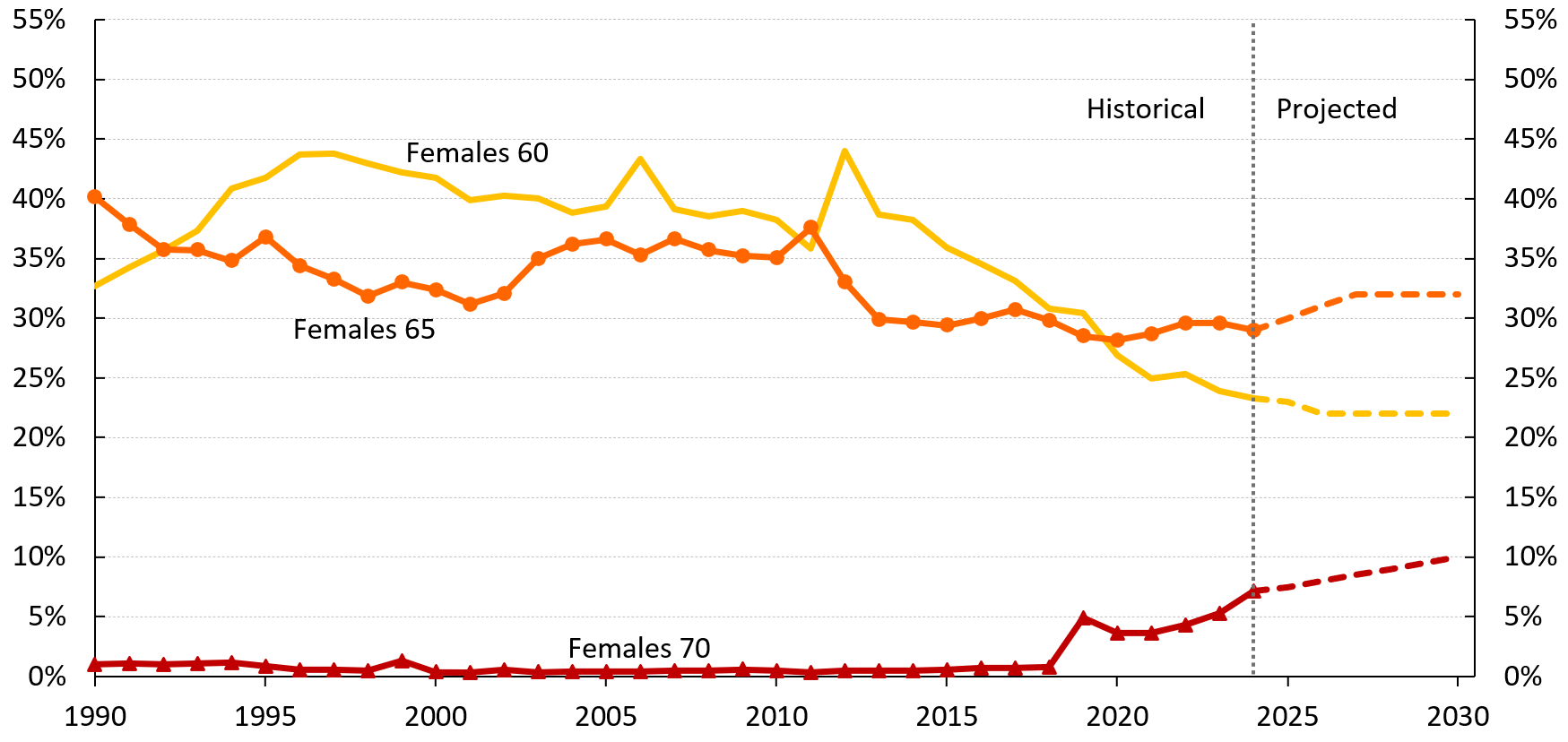
Chart 10 - Text version
| Year | Females 60 | Females 65 | Females 70 | |||
|---|---|---|---|---|---|---|
| Historical | Projected | Historical | Projected | Historical | Projected | |
| 1990 | 32.64% | no data | 40.20% | no data | 0.99% | no data |
| 1991 | 34.24% | no data | 37.83% | no data | 1.09% | no data |
| 1992 | 35.70% | no data | 35.73% | no data | 0.99% | no data |
| 1993 | 37.36% | no data | 35.71% | no data | 1.05% | no data |
| 1994 | 40.85% | no data | 34.81% | no data | 1.15% | no data |
| 1995 | 41.76% | no data | 36.78% | no data | 0.83% | no data |
| 1996 | 43.69% | no data | 34.41% | no data | 0.54% | no data |
| 1997 | 43.81% | no data | 33.30% | no data | 0.58% | no data |
| 1998 | 42.95% | no data | 31.85% | no data | 0.50% | no data |
| 1999 | 42.17% | no data | 33.01% | no data | 1.32% | no data |
| 2000 | 41.78% | no data | 32.36% | no data | 0.37% | no data |
| 2001 | 39.86% | no data | 31.15% | no data | 0.31% | no data |
| 2002 | 40.25% | no data | 32.09% | no data | 0.54% | no data |
| 2003 | 40.03% | no data | 34.98% | no data | 0.37% | no data |
| 2004 | 38.80% | no data | 36.17% | no data | 0.42% | no data |
| 2005 | 39.32% | no data | 36.62% | no data | 0.40% | no data |
| 2006 | 43.35% | no data | 35.33% | no data | 0.40% | no data |
| 2007 | 39.10% | no data | 36.62% | no data | 0.49% | no data |
| 2008 | 38.55% | no data | 35.71% | no data | 0.45% | no data |
| 2009 | 39.00% | no data | 35.21% | no data | 0.59% | no data |
| 2010 | 38.24% | no data | 35.10% | no data | 0.46% | no data |
| 2011 | 35.81% | no data | 37.59% | no data | 0.33% | no data |
| 2012 | 43.97% | no data | 33.07% | no data | 0.46% | no data |
| 2013 | 38.65% | no data | 29.92% | no data | 0.46% | no data |
| 2014 | 38.22% | no data | 29.69% | no data | 0.47% | no data |
| 2015 | 35.92% | no data | 29.40% | no data | 0.52% | no data |
| 2016 | 34.53% | no data | 29.97% | no data | 0.70% | no data |
| 2017 | 33.10% | no data | 30.72% | no data | 0.72% | no data |
| 2018 | 30.82% | no data | 29.85% | no data | 0.78% | no data |
| 2019 | 30.40% | no data | 28.50% | no data | 4.92% | no data |
| 2020 | 26.87% | no data | 28.14% | no data | 3.62% | no data |
| 2021 | 24.97% | no data | 28.73% | no data | 3.62% | no data |
| 2022 | 25.31% | no data | 29.63% | no data | 4.33% | no data |
| 2023 | 23.89% | no data | 29.58% | no data | 5.27% | no data |
| 2024 | 23.31% | 23.31% | 29.03% | 29.03% | 7.19% | 7.19% |
| 2025 | no data | 23.00% | no data | 30.00% | no data | 7.50% |
| 2026 | no data | 22.00% | no data | 31.00% | no data | 8.00% |
| 2027 | no data | 22.00% | no data | 32.00% | no data | 8.50% |
| 2028 | no data | 22.00% | no data | 32.00% | no data | 9.00% |
| 2029 | no data | 22.00% | no data | 32.00% | no data | 9.50% |
| 2030 | no data | 22.00% | no data | 32.00% | no data | 10.00% |
The assumptions for retirement rates are informed by experience and recent trends. The assumptions at key ages are described below and Table 76 shows the ultimate retirement rates for all ages 60 to 70.
Age 60: Retirement rates have steadily declined since peaking in 2012 (42% for males and 44% for females). By 2024, they dropped to historic lows (22% for males and 23% for females). The rates are assumed decrease slightly and stabilize at 21% for males and 22% for females by 2026.
Age 65: Retirement rates have remained stable at around 30% for both sexes and are projected to increase slightly to 32% by 2027.
Age 70: Retirement rates increased significantly, especially since auto-enrolment was enacted in 2019. In 2018, rates were 2% for males and 1% for females. By 2024, the rates exceeded 7% for both sexes, and this upward trend is assumed to continue, leveling off at 10% by 2030.
All other ages: Slight upward trends have been observed at older ages and are assumed to persist over the next few years. For younger ages, the rates have been relatively stable and are projected to continue at similar levels throughout the projection period.
Table 76 shows the projected retirement rates by age for both males and females. The assumed ultimate retirement rates result in projected average ages at retirement pension take-up in 2031 of 64.3 for both males and females.
| Age | Males | Females |
|---|---|---|
| 60 | 21 | 22 |
| 61 | 4 | 4 |
| 62 | 4 | 4 |
| 63 | 4 | 4 |
| 64 | 10 | 10 |
| 65 | 32 | 32 |
| 66 | 5 | 4 |
| 67 | 4 | 4 |
| 68 | 3 | 3 |
| 69 | 3 | 3 |
| 70 | 10 | 10 |
| Total | 100 | 100 |
B.7.4.3 Projected new retirement pensions
Table 77 and Table 78 show the projected number of new retirement beneficiaries and their projected average base and additional monthly retirement pensions by sex. New additional average retirement pensions are quite low in the early years due to the few years of additional contributions. These averages are projected to grow rapidly as the number of years of contributions to the additional CPP increases.
| Year | Number of new retirement beneficiaries | Average monthly retirement pension | ||||
|---|---|---|---|---|---|---|
| Males | Females | Total | Males ($) | Females ($) | All ($) | |
| 2025 | 181,700 | 183,700 | 365,400 | 850 | 690 | 770 |
| 2026 | 186,200 | 188,200 | 374,400 | 890 | 730 | 810 |
| 2027 | 190,700 | 194,500 | 385,200 | 940 | 770 | 860 |
| 2028 | 193,500 | 197,300 | 390,700 | 970 | 810 | 890 |
| 2029 | 191,900 | 198,200 | 390,000 | 1,010 | 840 | 920 |
| 2030 | 189,400 | 197,600 | 387,100 | 1,030 | 870 | 950 |
| 2031 | 185,300 | 194,400 | 379,800 | 1,060 | 890 | 970 |
| 2032 | 180,400 | 190,400 | 370,800 | 1,090 | 920 | 1,000 |
| 2033 | 179,400 | 190,000 | 369,400 | 1,120 | 950 | 1,030 |
| 2034 | 179,000 | 190,600 | 369,600 | 1,140 | 980 | 1,060 |
| 2035 | 179,800 | 191,500 | 371,300 | 1,170 | 1,000 | 1,080 |
| 2040 | 182,100 | 194,100 | 376,200 | 1,340 | 1,160 | 1,250 |
| 2045 | 200,300 | 211,100 | 411,300 | 1,520 | 1,340 | 1,430 |
| 2050 | 230,200 | 239,200 | 469,400 | 1,740 | 1,550 | 1,640 |
| 2055 | 261,000 | 267,000 | 528,000 | 2,000 | 1,820 | 1,910 |
| 2060 | 264,400 | 270,400 | 534,700 | 2,340 | 2,140 | 2,240 |
| 2065 | 252,500 | 262,600 | 515,100 | 2,720 | 2,500 | 2,610 |
| 2070 | 256,200 | 267,500 | 523,600 | 3,090 | 2,860 | 2,970 |
| 2075 | 267,300 | 279,200 | 546,400 | 3,540 | 3,290 | 3,410 |
| 2080 | 272,300 | 285,500 | 557,800 | 4,080 | 3,800 | 3,930 |
| 2085 | 273,400 | 287,100 | 560,400 | 4,680 | 4,370 | 4,520 |
| 2090 | 280,500 | 293,800 | 574,300 | 5,350 | 5,000 | 5,170 |
| 2095 | 289,900 | 302,900 | 592,800 | 6,140 | 5,750 | 5,940 |
| 2100 | 297,400 | 310,500 | 607,900 | 7,060 | 6,620 | 6,840 |
| Year | Number of new retirement beneficiaries | Average monthly retirement pension | ||||
|---|---|---|---|---|---|---|
| Males | Females | Total | Males ($) | Females ($) | All ($) | |
| 2025 | 145,600 | 136,100 | 281,700 | 20 | 20 | 20 |
| 2026 | 151,900 | 142,400 | 294,300 | 30 | 20 | 30 |
| 2027 | 158,000 | 150,400 | 308,500 | 40 | 30 | 30 |
| 2028 | 162,500 | 155,900 | 318,500 | 50 | 40 | 40 |
| 2029 | 163,800 | 160,000 | 323,700 | 60 | 50 | 50 |
| 2030 | 167,300 | 167,200 | 334,500 | 70 | 60 | 60 |
| 2031 | 169,300 | 172,200 | 341,500 | 80 | 70 | 70 |
| 2032 | 170,000 | 176,000 | 346,000 | 100 | 80 | 90 |
| 2033 | 174,200 | 182,800 | 357,000 | 110 | 90 | 100 |
| 2034 | 177,300 | 188,500 | 365,800 | 120 | 100 | 110 |
| 2035 | 178,600 | 189,900 | 368,500 | 140 | 110 | 120 |
| 2040 | 182,100 | 194,100 | 376,200 | 230 | 190 | 210 |
| 2045 | 200,300 | 211,100 | 411,300 | 340 | 280 | 310 |
| 2050 | 230,200 | 239,200 | 469,400 | 480 | 400 | 440 |
| 2055 | 261,000 | 267,000 | 528,000 | 650 | 550 | 600 |
| 2060 | 264,400 | 270,400 | 534,700 | 850 | 730 | 790 |
| 2065 | 252,500 | 262,600 | 515,100 | 1,020 | 880 | 950 |
| 2070 | 256,200 | 267,500 | 523,600 | 1,160 | 1,020 | 1,090 |
| 2075 | 267,300 | 279,200 | 546,400 | 1,330 | 1,170 | 1,250 |
| 2080 | 272,300 | 285,500 | 557,800 | 1,530 | 1,350 | 1,440 |
| 2085 | 273,400 | 287,100 | 560,400 | 1,760 | 1,560 | 1,660 |
| 2090 | 280,500 | 293,800 | 574,300 | 2,010 | 1,790 | 1,890 |
| 2095 | 289,900 | 302,900 | 592,800 | 2,310 | 2,060 | 2,180 |
| 2100 | 297,400 | 310,500 | 607,900 | 2,650 | 2,370 | 2,510 |
B.7.4.4 Retirement beneficiaries mortality
Projections of retirement pensions in pay require applying survival probabilities to retirement beneficiaries. The mortality rates of CPP retirement beneficiaries used in the projections vary by age, sex, and calendar year.
The mortality rates were developed based on CPP retirement beneficiaries' mortality experience for the year 2023 and the mortality improvement assumptions for the general population in this report. The resulting projected mortality rates and life expectancies of retirement beneficiaries are shown in Table 79 and Table 80.
| Age | Males | Females | ||||||
|---|---|---|---|---|---|---|---|---|
| 2025 | 2050 | 2075 | 2100 | 2025 | 2050 | 2075 | 2100 | |
| 60 | 6.3 | 4.7 | 3.7 | 2.8 | 3.5 | 2.7 | 2.1 | 1.6 |
| 65 | 11.2 | 8.4 | 6.5 | 5.1 | 6.8 | 5.1 | 4.0 | 3.1 |
| 70 | 16.2 | 12.2 | 9.4 | 7.3 | 10.2 | 7.7 | 6.0 | 4.7 |
| 75 | 25.6 | 19.3 | 15.0 | 11.6 | 17.5 | 13.5 | 10.5 | 8.2 |
| 80 | 44.2 | 33.4 | 25.9 | 20.2 | 31.2 | 24.1 | 18.8 | 14.6 |
| 85 | 75.8 | 56.6 | 44.0 | 34.2 | 55.1 | 41.9 | 32.6 | 25.4 |
| 90 | 137.1 | 109.3 | 90.3 | 74.6 | 105.4 | 84.3 | 69.7 | 57.6 |
| Age | Males | Females | ||||||
|---|---|---|---|---|---|---|---|---|
| 2025 | 2050 | 2075 | 2100 | 2025 | 2050 | 2075 | 2100 | |
| 60 | 25.8 | 27.8 | 29.6 | 31.2 | 28.7 | 30.5 | 32.1 | 33.5 |
| 65 | 21.3 | 23.2 | 24.9 | 26.4 | 24.0 | 25.6 | 27.2 | 28.6 |
| 70 | 17.2 | 18.9 | 20.4 | 21.9 | 19.5 | 21.0 | 22.5 | 23.8 |
| 75 | 13.3 | 14.8 | 16.2 | 17.5 | 15.3 | 16.7 | 18.0 | 19.2 |
| 80 | 9.9 | 11.1 | 12.3 | 13.4 | 11.5 | 12.7 | 13.8 | 14.9 |
| 85 | 6.9 | 7.9 | 8.8 | 9.6 | 8.2 | 9.2 | 10.0 | 10.9 |
| 90 | 4.6 | 5.2 | 5.8 | 6.3 | 5.5 | 6.1 | 6.7 | 7.3 |
|
Table 80 Footnotes
|
||||||||
B.7.5 Post-retirement benefit expenditures
Post-retirement benefits are paid to retirement beneficiaries who continue to work and contribute to the Plan. Post-retirement benefits are payable under both the base and additional CPP.
Working beneficiaries younger than 65 are required along with their employers to contribute, whereas contributions are voluntary once reaching age 65 (up to age 69). Employers of those working beneficiaries opting to contribute are required to also contribute. The post-retirement contributions paid in a year are applied toward providing post-retirement benefits in the following years. Post-retirement benefits are described in more detail in Appendix - A - Summary of plan provisions.
Table 81 presents the CPP working beneficiaries who contribute to the CPP as a proportion of retirement beneficiaries in the year of and years following pension take-up, by age and sex. These proportions are assumed to remain constant over the entire projection period.
In the year of retirement pension take-up, contributions are first applied toward maximizing the base and additional retirement pensions, with remaining contributions then applied toward a post-retirement benefit. This affects the proportion of working beneficiaries who contribute toward a post-retirement benefit in the year of pension take-up.
The figures in Table 81 reflect that not all working beneficiaries contribute to the CPP, due to the following:
- having earnings less than the YBE, and
- opting out of contributing between the ages of 65 and 69.
| Age | Year of retirement pension take-up | After year of retirement pension take-up | ||
|---|---|---|---|---|
| Males | Females | Males | Females | |
| 60 | 40 | 30 | 0 | 0 |
| 61 | 50 | 35 | 78 | 65 |
| 62 | 45 | 35 | 56 | 47 |
| 63 | 45 | 35 | 50 | 42 |
| 64 | 45 | 35 | 49 | 37 |
| 65 | 19 | 14 | 42 | 32 |
| 66 | 47 | 38 | 28 | 21 |
| 67 | 43 | 38 | 21 | 17 |
| 68 | 43 | 33 | 17 | 13 |
| 69 | 38 | 33 | 13 | 10 |
In order to project the contributions of working beneficiaries, assumptions are required with respect to their average contributory earnings (i.e. average earnings between the YBE and YAMPE on which contributions are made). For both males and females, the average contributory earnings of working beneficiaries for years after the year of retirement pension take-up are assumed to be between 20% and 35% lower than the contributory earnings of contributors who are not working beneficiaries, depending on the age and sex. The resulting average annual contributory earnings of working beneficiaries up to the YMPE and YAMPE are presented, respectively, in Table 82 and Table 83.
| Year | Below age 65 | Age 65 and above | ||
|---|---|---|---|---|
| Males | Females | Males | Females | |
| 2025 | 43,100 | 34,300 | 40,400 | 31,300 |
| 2026 | 44,300 | 35,400 | 41,600 | 32,100 |
| 2027 | 45,200 | 36,300 | 42,700 | 33,000 |
| 2028 | 46,200 | 37,400 | 43,800 | 33,900 |
| 2029 | 47,300 | 38,600 | 45,000 | 34,900 |
| 2030 | 48,700 | 40,100 | 46,100 | 35,900 |
| 2031 | 49,800 | 41,100 | 47,100 | 36,900 |
| 2032 | 50,800 | 42,100 | 48,000 | 37,900 |
| 2033 | 51,700 | 42,900 | 48,900 | 38,800 |
| 2034 | 52,700 | 43,800 | 49,900 | 39,900 |
| 2035 | 53,800 | 44,700 | 51,000 | 41,100 |
| 2040 | 61,400 | 51,300 | 58,000 | 47,400 |
| 2045 | 71,100 | 59,900 | 67,200 | 55,400 |
| 2050 | 83,600 | 71,300 | 78,600 | 65,600 |
| 2055 | 98,000 | 84,300 | 91,800 | 77,400 |
| 2060 | 113,600 | 98,400 | 106,000 | 90,100 |
| 2065 | 129,000 | 111,800 | 120,400 | 102,700 |
| 2070 | 146,800 | 127,400 | 137,600 | 117,600 |
| 2075 | 169,500 | 147,500 | 158,600 | 136,100 |
| 2080 | 194,700 | 169,700 | 182,100 | 156,800 |
| 2085 | 222,900 | 194,100 | 208,400 | 179,600 |
| 2090 | 255,300 | 222,200 | 238,900 | 205,900 |
| 2095 | 294,200 | 256,100 | 275,100 | 237,300 |
| 2100 | 338,200 | 294,300 | 316,100 | 272,800 |
| Year | Below age 65 | Age 65 and above | ||
|---|---|---|---|---|
| Males | Females | Males | Females | |
| 2025 | 45,900 | 35,300 | 43,000 | 32,200 |
| 2026 | 47,100 | 36,400 | 44,300 | 33,100 |
| 2027 | 48,000 | 37,300 | 45,400 | 34,000 |
| 2028 | 49,000 | 38,400 | 46,500 | 34,800 |
| 2029 | 50,200 | 39,600 | 47,700 | 35,800 |
| 2030 | 51,700 | 41,200 | 48,900 | 36,900 |
| 2031 | 52,800 | 42,200 | 49,900 | 37,900 |
| 2032 | 53,800 | 43,100 | 50,900 | 38,900 |
| 2033 | 54,700 | 43,900 | 51,800 | 39,800 |
| 2034 | 55,700 | 44,700 | 52,800 | 40,800 |
| 2035 | 56,800 | 45,600 | 54,000 | 42,000 |
| 2040 | 64,600 | 52,300 | 61,400 | 48,400 |
| 2045 | 75,000 | 61,200 | 71,100 | 56,700 |
| 2050 | 88,400 | 73,300 | 83,400 | 67,500 |
| 2055 | 104,000 | 87,300 | 97,600 | 80,000 |
| 2060 | 120,800 | 102,100 | 112,800 | 93,300 |
| 2065 | 136,800 | 115,700 | 127,800 | 106,100 |
| 2070 | 155,500 | 131,600 | 145,900 | 121,300 |
| 2075 | 179,500 | 152,700 | 168,300 | 140,700 |
| 2080 | 206,300 | 175,700 | 193,200 | 162,000 |
| 2085 | 236,000 | 200,900 | 220,900 | 185,500 |
| 2090 | 270,100 | 229,700 | 253,100 | 212,600 |
| 2095 | 311,400 | 265,000 | 291,600 | 245,100 |
| 2100 | 357,900 | 304,500 | 335,100 | 281,700 |
Table 84 shows the projected number of working beneficiaries with their contributions and resulting post-retirement benefits by year. Contributions and benefits are split between the base and additional CPP. Total contributions from working beneficiaries are projected to be about $2.8 billion in 2025 and $6.6 billion in 2050. Total post-retirement benefits payable are projected to be about $1.8 billion in 2025 and $8.1 billion in 2050.
The projected number of working beneficiaries who contribute, their earnings, and contributions are reflected in all other tables in this report that present contributors, earnings, and contributions projections, unless otherwise indicated. Similarly, the post-retirement benefits are presented in combination with retirement benefits as total retirement expenditures in all other tables in this report where expenditures are shown by type of benefit, unless otherwise indicated.
| Year | Number of contributing working beneficiaries (thousands) | Base CPP | Additional CPP | ||
|---|---|---|---|---|---|
| Contributions ($ million) | Post-retirement benefits ($ million) | Contributions ($ million) | Post-retirement benefits ($ million) | ||
| 2025 | 625 | 2,246 | 1,564 | 551 | 189 |
| 2026 | 624 | 2,305 | 1,738 | 565 | 241 |
| 2027 | 620 | 2,346 | 1,918 | 574 | 299 |
| 2028 | 614 | 2,379 | 2,101 | 581 | 365 |
| 2029 | 608 | 2,417 | 2,290 | 588 | 435 |
| 2030 | 607 | 2,483 | 2,461 | 605 | 506 |
| 2031 | 599 | 2,512 | 2,634 | 611 | 579 |
| 2032 | 591 | 2,534 | 2,807 | 614 | 654 |
| 2033 | 582 | 2,548 | 2,977 | 614 | 728 |
| 2034 | 576 | 2,577 | 3,144 | 619 | 802 |
| 2035 | 573 | 2,627 | 3,308 | 630 | 876 |
| 2040 | 588 | 3,080 | 4,114 | 736 | 1,266 |
| 2045 | 647 | 3,942 | 4,927 | 946 | 1,696 |
| 2050 | 742 | 5,303 | 5,907 | 1,288 | 2,211 |
| 2055 | 851 | 7,140 | 7,295 | 1,752 | 2,866 |
| 2060 | 890 | 8,660 | 9,259 | 2,134 | 3,718 |
| 2065 | 857 | 9,486 | 11,599 | 2,321 | 4,696 |
| 2070 | 873 | 11,048 | 14,172 | 2,690 | 5,752 |
| 2075 | 923 | 13,489 | 17,206 | 3,292 | 6,992 |
| 2080 | 951 | 15,980 | 20,787 | 3,900 | 8,456 |
| 2085 | 959 | 18,450 | 24,835 | 4,492 | 10,104 |
| 2090 | 988 | 21,802 | 29,392 | 5,298 | 11,949 |
| 2095 | 1,034 | 26,274 | 34,916 | 6,394 | 14,187 |
| 2100 | 1,060 | 30,953 | 41,683 | 7,532 | 16,935 |
B.7.6 Disability benefit expenditures
Disability expenditures result from disability benefits paid under the base and additional CPP.
Under the base CPP, disability benefits consist of the disability pension and the post-retirement disability benefit. The base CPP disability pension consists of both a flat-rate and earnings-related benefit. The post-retirement disability benefit is equal to the flat-rate benefit.
Under the additional CPP, disability benefits consist only of the additional disability pension, which is an earnings-related benefit. Eligibility for the additional disability pension follows from eligibility for the base disability pension. There is no post-retirement disability benefit payable under the additional CPP.
B.7.6.1 Disability pension
New disability pension expenditures are determined by age and sex for each year starting in 1970 as the product of:
- the population;
- the disability eligibility rate;
- the disability incidence rate; and
- the average annual amount of the benefit.
The disability incidence rates equal the ratio of the number of new disability beneficiaries by age and sex to the respective eligible populations.
The value of the emerging disability earnings-related benefit by age and sex is equal to the sum of 75% of the average retirement earnings-related benefits for the base and additional Plans.
B.7.6.2 Disability incidence rates
Chart 11 shows the historical disability incidence rates for the CPP disability pension, and Table 85 provides the assumed ultimate disability incidence rates for the disability pension (base and additional CPP) and post-retirement disability benefit (base CPP).
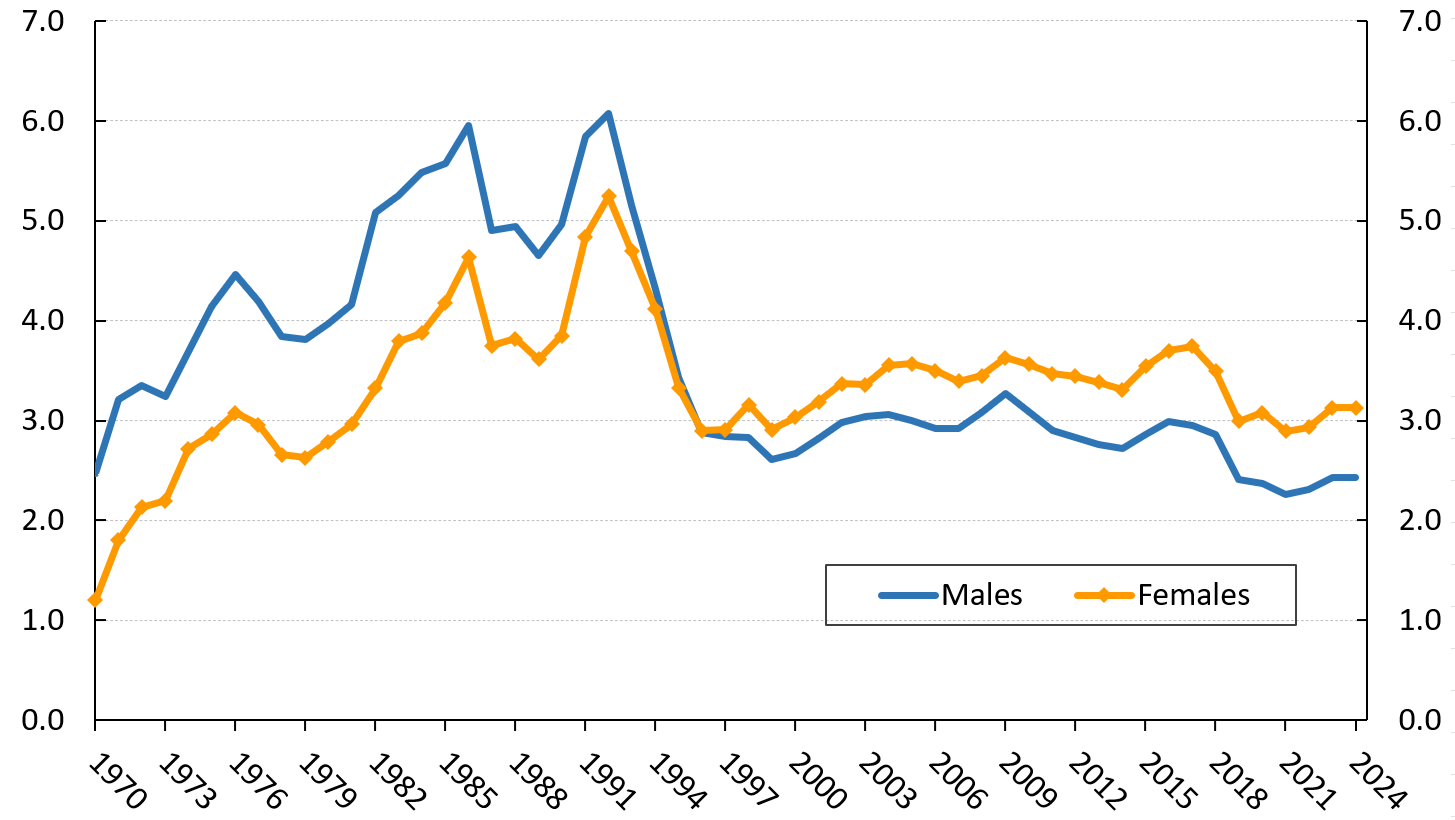
Chart 11 Footnotes
- Chart 11 Footnote 1
-
The disability incidence rates for 2023 and 2024 were smoothed to reflect the large number of cases in 2024 attributable to efforts by ESDC to catch up on a backlog of pre-2024 cases.
Chart 11 - Text version
| Year | Males | Females |
|---|---|---|
| 1970 | 2.47 | 1.20 |
| 1971 | 3.21 | 1.80 |
| 1972 | 3.35 | 2.13 |
| 1973 | 3.24 | 2.20 |
| 1974 | 3.70 | 2.72 |
| 1975 | 4.14 | 2.86 |
| 1976 | 4.46 | 3.08 |
| 1977 | 4.19 | 2.96 |
| 1978 | 3.84 | 2.66 |
| 1979 | 3.81 | 2.63 |
| 1980 | 3.97 | 2.79 |
| 1981 | 4.16 | 2.96 |
| 1982 | 5.09 | 3.33 |
| 1983 | 5.26 | 3.79 |
| 1984 | 5.48 | 3.87 |
| 1985 | 5.57 | 4.18 |
| 1986 | 5.95 | 4.63 |
| 1987 | 4.91 | 3.75 |
| 1988 | 4.94 | 3.82 |
| 1989 | 4.66 | 3.62 |
| 1990 | 4.96 | 3.85 |
| 1991 | 5.84 | 4.84 |
| 1992 | 6.08 | 5.25 |
| 1993 | 5.15 | 4.69 |
| 1994 | 4.31 | 4.12 |
| 1995 | 3.43 | 3.33 |
| 1996 | 2.88 | 2.90 |
| 1997 | 2.84 | 2.91 |
| 1998 | 2.84 | 3.16 |
| 1999 | 2.61 | 2.91 |
| 2000 | 2.67 | 3.04 |
| 2001 | 2.82 | 3.19 |
| 2002 | 2.98 | 3.37 |
| 2003 | 3.04 | 3.36 |
| 2004 | 3.06 | 3.55 |
| 2005 | 3.00 | 3.57 |
| 2006 | 2.92 | 3.50 |
| 2007 | 2.92 | 3.39 |
| 2008 | 3.08 | 3.45 |
| 2009 | 3.28 | 3.63 |
| 2010 | 3.09 | 3.57 |
| 2011 | 2.90 | 3.47 |
| 2012 | 2.83 | 3.44 |
| 2013 | 2.76 | 3.39 |
| 2014 | 2.72 | 3.31 |
| 2015 | 2.86 | 3.54 |
| 2016 | 2.99 | 3.70 |
| 2017 | 2.96 | 3.74 |
| 2018 | 2.87 | 3.49 |
| 2019 | 2.41 | 2.99 |
| 2020 | 2.37 | 3.08 |
| 2021 | 2.26 | 2.89 |
| 2022 | 2.31 | 2.93 |
| 2023 | 2.43 | 3.13 |
| 2024 | 2.43 | 3.13 |
It can be seen from Chart 11 that the incidence rate for new CPP disability cases (i.e. the number of new cases as a proportion of the eligible population) generally increased from 1970 to the early 1990s. The annual rate of change in incidence rates was particularly acute between 1989 and the recession of the early 1990s. After reaching a peak in 1992, disability incidence rates then declined rapidly during the 1990s.
The decline after 1992 reflects the economic recovery that occurred following the 1990-91 recession. As well, beginning in 1994, the CPP administration initiated a range of measures designed to effectively manage the growing pressure on the disability program. Since the mid-1990s, the rates remained relatively stable until 2018 and then decreased overall.
The historical analysis recognized that since 1996, females have consistently exhibited higher disability incidence rates (DIRs) than males, with the gap generally widening over time. Over the ten-year period ending in 2024, the average difference between female and male rates was about 0.70.
To inform the assumptions, population-standardized DIR averages over periods ranging from three to twenty years ending in 2024 were analysed. This analysis took into account the persistent female-male differential. Data from recent years indicated that disability incidence rates were not significantly impacted by the COVID-19 pandemic.
Further analysis considered trends by cause of disability, particularly the increasing prominence of mental health-related cases. While the relative weight of mental health disabilities has grown in recent years, this is largely attributed to declines in other disability causes. Mental health-related disability incidence has otherwise remained relatively steady, aside from an uptick observed from the mid- to late 2010s. Notably, mental health cases are more common among younger individuals, while the overall DIR is primarily influenced by rates at older ages.
To better understand the observed downward trends in recent years, a trend analysis by age group was also performed. Most age groups showed stable DIRs over time, but the 55 to 59 and 60 to 64 age groups—the two with historically the highest rates—have experienced significant declines since 2004.
Taking all of these elements into account, the ultimate aggregate DIRs based on the 2024 standardized eligible population were set at 2.70 for males and 3.40 for females (per thousand eligible). These aggregate rates are then distributed by age based on the 2024 historical distribution, and applied to projected eligible populations. Given that the 2024 aggregate DIRs are 2.63 for males and 3.46 for females, it is assumed that the ultimate values will be reached gradually over a five-year period, ending in 2029.
B.7.6.3 Post-retirement disability incidence rates
The base CPP post-retirement disability benefit came into effect in 2019 and applies only to early retirement beneficiaries (before age 65) who become disabled.
For this 32nd CPP Actuarial Report, initial benefit data regarding post-retirement disability benefits were available, as provided by ESDC. The assumed post-retirement disability incidence rates by age and sex were derived based on the data for years 2019 to 2021 along with historical records of earnings data of early retirement beneficiaries.
It is projected that, in 2029, the overall disability incidence rates in respect of the post-retirement disability benefit for early retirement beneficiaries will be 12.4 per 1,000 eligible males and 13.0 per 1,000 eligible females. As more experience data regarding post-retirement disability benefits become available, the assumptions for the incidence rates will be revised accordingly for future CPP actuarial reports.
The post-retirement disability incidence rates are shown in Table 85.
| Age | Disability pension | Post-retirement disability benefit | ||
|---|---|---|---|---|
| Males | Females | Males | Females | |
| 25 | 0.3 | 0.4 | N/A Not applicable | N/A Not applicable |
| 30 | 0.6 | 0.8 | N/A Not applicable | N/A Not applicable |
| 35 | 0.8 | 1.2 | N/A Not applicable | N/A Not applicable |
| 40 | 1.3 | 1.9 | N/A Not applicable | N/A Not applicable |
| 45 | 2.1 | 3.0 | N/A Not applicable | N/A Not applicable |
| 50 | 3.3 | 4.5 | N/A Not applicable | N/A Not applicable |
| 55 | 6.0 | 7.4 | N/A Not applicable | N/A Not applicable |
| 60 | 9.4 | 10.1 | 0.0 | 0.0 |
| 61 | 9.6 | 10.1 | 12.4 | 13.1 |
| 62 | 9.6 | 10.1 | 12.4 | 13.1 |
| 63 | 9.6 | 10.0 | 12.4 | 13.0 |
| 64 | 9.6 | 10.0 | 12.4 | 13.0 |
| All ages | 2.7 | 3.4 | 12.4 | 13.0 |
|
Table 85 Footnotes
|
||||
B.7.6.4 Projected new disability benefits
Table 86 shows the projected number of new disability beneficiaries for the disability pension (which comprises both base and additional CPP amounts) and the base CPP post-retirement disability benefit. Table 87 shows the projected average new base and additional disability pensions and the post-retirement disability benefits by sex and year.
| Year | Disability pensionTable 86 Footnote 1 | Post-retirement disability benefitTable 86 Footnote 2 | ||||
|---|---|---|---|---|---|---|
| Males | Females | TotalTable 86 Footnote 3 | Males | Females | TotalTable 86 Footnote 3 | |
| 2025 | 18,500 | 21,600 | 40,000 | 1,500 | 1,600 | 3,000 |
| 2026 | 18,500 | 21,500 | 40,000 | 1,500 | 1,500 | 3,000 |
| 2027 | 18,500 | 21,500 | 40,000 | 1,400 | 1,400 | 2,900 |
| 2028 | 18,700 | 21,700 | 40,400 | 1,400 | 1,400 | 2,700 |
| 2029 | 19,000 | 21,900 | 41,000 | 1,300 | 1,300 | 2,600 |
| 2030 | 19,300 | 22,300 | 41,500 | 1,300 | 1,300 | 2,500 |
| 2031 | 19,400 | 22,500 | 41,900 | 1,200 | 1,300 | 2,500 |
| 2032 | 19,500 | 22,800 | 42,300 | 1,300 | 1,300 | 2,500 |
| 2033 | 19,800 | 23,100 | 42,900 | 1,300 | 1,300 | 2,600 |
| 2034 | 20,100 | 23,500 | 43,600 | 1,300 | 1,300 | 2,600 |
| 2035 | 20,400 | 23,900 | 44,200 | 1,300 | 1,300 | 2,500 |
| 2040 | 22,000 | 25,700 | 47,700 | 1,300 | 1,300 | 2,700 |
| 2045 | 23,600 | 27,300 | 50,900 | 1,500 | 1,500 | 3,000 |
| 2050 | 24,600 | 28,400 | 52,900 | 1,700 | 1,700 | 3,400 |
| 2055 | 24,900 | 28,900 | 53,800 | 1,900 | 1,900 | 3,800 |
| 2060 | 24,800 | 29,300 | 54,100 | 1,800 | 1,900 | 3,700 |
| 2065 | 25,500 | 30,200 | 55,800 | 1,700 | 1,800 | 3,500 |
| 2070 | 26,500 | 31,300 | 57,800 | 1,900 | 1,900 | 3,800 |
| 2075 | 27,000 | 32,000 | 59,000 | 1,900 | 2,000 | 3,900 |
| 2080 | 27,400 | 32,500 | 60,000 | 2,000 | 2,000 | 4,000 |
| 2085 | 28,100 | 33,400 | 61,500 | 1,900 | 2,000 | 3,900 |
| 2090 | 29,000 | 34,300 | 63,300 | 2,000 | 2,100 | 4,100 |
| 2095 | 29,700 | 35,100 | 64,800 | 2,100 | 2,200 | 4,300 |
| 2100 | 30,400 | 36,000 | 66,400 | 2,100 | 2,200 | 4,400 |
|
Table 86 Footnotes
|
||||||
| Year | Average monthly disability pension, base CPP | Average monthly disability pension, additional CPP | Post-retirement disability benefit (flat-rate), base CPP | ||||
|---|---|---|---|---|---|---|---|
| Males | Females | Total | Males | Females | Total | ||
| 2025 | 1,200 | 1,120 | 1,160 | 30 | 20 | 30 | 600 |
| 2026 | 1,230 | 1,150 | 1,190 | 40 | 30 | 30 | 610 |
| 2027 | 1,270 | 1,190 | 1,220 | 50 | 40 | 40 | 620 |
| 2028 | 1,300 | 1,220 | 1,260 | 60 | 50 | 50 | 640 |
| 2029 | 1,340 | 1,260 | 1,290 | 70 | 60 | 70 | 650 |
| 2030 | 1,370 | 1,290 | 1,330 | 80 | 70 | 70 | 660 |
| 2031 | 1,410 | 1,320 | 1,360 | 90 | 80 | 80 | 680 |
| 2032 | 1,440 | 1,360 | 1,400 | 100 | 90 | 90 | 690 |
| 2033 | 1,480 | 1,390 | 1,430 | 120 | 100 | 100 | 700 |
| 2034 | 1,520 | 1,430 | 1,470 | 130 | 110 | 120 | 720 |
| 2035 | 1,560 | 1,470 | 1,510 | 140 | 120 | 130 | 730 |
| 2040 | 1,760 | 1,670 | 1,710 | 210 | 180 | 190 | 810 |
| 2045 | 1,980 | 1,900 | 1,940 | 300 | 250 | 270 | 890 |
| 2050 | 2,230 | 2,150 | 2,190 | 390 | 330 | 360 | 980 |
| 2055 | 2,510 | 2,420 | 2,460 | 490 | 410 | 440 | 1,090 |
| 2060 | 2,840 | 2,750 | 2,790 | 580 | 480 | 530 | 1,200 |
| 2065 | 3,220 | 3,110 | 3,160 | 660 | 550 | 600 | 1,330 |
| 2070 | 3,630 | 3,520 | 3,570 | 760 | 640 | 690 | 1,460 |
| 2075 | 4,100 | 3,970 | 4,030 | 870 | 740 | 800 | 1,620 |
| 2080 | 4,630 | 4,500 | 4,560 | 1,000 | 850 | 920 | 1,780 |
| 2085 | 5,240 | 5,090 | 5,160 | 1,140 | 970 | 1,050 | 1,970 |
| 2090 | 5,930 | 5,760 | 5,830 | 1,310 | 1,120 | 1,210 | 2,170 |
| 2095 | 6,710 | 6,510 | 6,600 | 1,510 | 1,290 | 1,390 | 2,400 |
| 2100 | 7,590 | 7,370 | 7,480 | 1,730 | 1,480 | 1,590 | 2,650 |
B.7.6.5 Disability benefit termination rates
All emerging disability benefits (disability pensions and post-retirement disability benefits) are projected by age and sex for each future year until termination of disability (due to recovery, death, or attainment of age 65). The projected disability termination rates presented in Table 88 apply by age, sex, and duration of disability (i.e. the period of being in receipt of a disability benefit) on an attained calendar year basis. The average graduated experience over the 15-year period 2008 to 2022 is used to produce base year rates for 2022. The base year termination rates are then projected for 2023 and thereafter for males and females, by age of disability onset, and duration of disability using assumed recovery and mortality improvement rates.
Recovery improvement rates are assumed to trend to an ultimate level of 0% by 2029 (i.e. recovery rates are assumed to be constant after 2029), and mortality improvement rates of disability beneficiaries are assumed to trend to an ultimate level of 1.0% by the same year.
| Age | Males - 2025 | Females - 2025 | ||||||||||
|---|---|---|---|---|---|---|---|---|---|---|---|---|
| 1st Year | 2nd Year | 3rd Year | 4th Year | 5th Year | 6 Year and more | 1st Year | 2nd Year | 3rd Year | 4th Year | 5th Year | 6 year and more | |
| 30 | 39 | 65 | 58 | 52 | 52 | 37 | 35 | 50 | 60 | 47 | 45 | 35 |
| 40 | 38 | 59 | 47 | 44 | 37 | 29 | 28 | 45 | 41 | 37 | 28 | 26 |
| 50 | 49 | 66 | 55 | 40 | 38 | 27 | 30 | 50 | 45 | 33 | 25 | 20 |
| 60 | 58 | 69 | 56 | 47 | 39 | 0 | 37 | 49 | 42 | 31 | 29 | 0 |
| Age | Males - 2035 | Females - 2035 | ||||||||||
|---|---|---|---|---|---|---|---|---|---|---|---|---|
| 1st Year | 2nd Year | 3rd Year | 4th Year | 5th Year | 6 Year and more | 1st Year | 2nd Year | 3rd Year | 4th Year | 5th Year | 6 year and more | |
| 30 | 36 | 63 | 56 | 51 | 52 | 37 | 33 | 47 | 59 | 47 | 45 | 36 |
| 40 | 34 | 57 | 46 | 43 | 37 | 28 | 26 | 42 | 40 | 37 | 28 | 27 |
| 50 | 44 | 61 | 52 | 38 | 36 | 26 | 26 | 46 | 44 | 32 | 25 | 20 |
| 60 | 51 | 63 | 53 | 44 | 36 | 0 | 32 | 45 | 40 | 29 | 27 | 0 |
Table 88 Footnotes
- Table 88 Footnote 1
-
Assumed termination rates for all disability benefits (disability pensions and post-retirement disability benefits).
B.7.7 Survivor pension expenditures
Survivor expenditures result from survivor's benefits paid under the base and additional CPP. Under both components of the CPP, the survivor's pension changes form at age 65.
Under the base CPP, the survivor's pension payable to individuals younger than 65 consists of a flat-rate and earnings-related benefit. At ages 65 and older, the pension payable is earnings-related. The additional survivor's pension payable takes the same form as the base survivor's pension, except that the additional survivor's pension is strictly earnings-related with no flat-rate benefit payable.
B.7.7.1 New survivor's pension
New survivor pension expenditures are determined by age and sex for each year starting in 1968 as the product of:
- the number of deaths in the population;
- the survivor eligibility rate;
- the probability of being married or in a common-law union at the time of death;
- the spouses age distribution;
- the average annual amount of the benefit (flat-rate and earnings-related benefits); and
- if applicable, the appropriate factor taking into account the base CPP earnings-related benefit limits that apply to combined survivor-disability and combined survivor-retirement pensions.
For each age and sex, the actual proportions of contributors married or in a common‑law relationship at the time of death are determined from benefit statistics. Analysis of historical data from 2012 to 2024 shows an upward trend in the average age of surviving spouses at the time of their partner's death. It was also observed that the average age at first marriage has increased over time by approximately 0.8 years every five years.
The observed demographic shifts, together with further adjustments for younger and older ages, are used to determine the assumed proportions of contributors married or in a common-law relationship at the time of death, with assumed ultimate proportions applicable from the year 2026 onward. These proportions account for benefits payable to same-sex couples.
As of 1 January 2025, couples who separate and who apply for a credit split (as described in Appendix - A of this report) are no longer eligible to later receive a survivor pension upon the death of either partner. No adjustment was made to the assumed proportions regarding the amendment as doing so would not have a material impact on the assumption. The assumed proportions of contributors married or in a common-law relationship at the time of death are shown in Table 89.
| Age | Males | Females |
|---|---|---|
| 20 | 2 | 4 |
| 30 | 20 | 24 |
| 40 | 39 | 48 |
| 50 | 52 | 58 |
| 60 | 55 | 58 |
| 70 | 61 | 52 |
| 80 | 68 | 37 |
| 90 | 55 | 14 |
The value of the emerging earnings-related survivor benefit is equal to 37.5% or 60% of the average retirement earnings-related benefit, depending on whether the surviving spouse or common-law partner is under age 65 or aged 65 or older, respectively. It is further adjusted to account for the fact that eligibility rules are more stringent for survivor benefits than for retirement benefits.
The projected numbers of new base and additional survivor beneficiaries by age (below 65, and 65 and older) are shown in Table 90 and Table 91, respectively. The projected average monthly survivor pensions of emerging (new) benefits for the base and additional CPP by age and sex are shown in Table 92 and Table 93, respectively.
| Year | Under 65 | 65 and over | All ages | ||||||
|---|---|---|---|---|---|---|---|---|---|
| Males | Females | TotalTable 90 Footnote 1 | Males | Females | TotalTable 90 Footnote 1 | Males | Females | TotalTable 90 Footnote 1 | |
| 2025 | 5,500 | 16,700 | 22,200 | 20,500 | 53,800 | 74,200 | 25,900 | 70,500 | 96,400 |
| 2026 | 5,400 | 16,500 | 21,900 | 21,300 | 55,400 | 76,700 | 26,700 | 71,900 | 98,600 |
| 2027 | 5,400 | 16,300 | 21,700 | 22,000 | 57,200 | 79,300 | 27,400 | 73,600 | 100,900 |
| 2028 | 5,300 | 16,200 | 21,500 | 22,700 | 59,100 | 81,800 | 28,100 | 75,300 | 103,300 |
| 2029 | 5,300 | 16,200 | 21,500 | 23,400 | 60,900 | 84,400 | 28,700 | 77,100 | 105,800 |
| 2030 | 5,200 | 16,000 | 21,200 | 24,100 | 62,800 | 86,900 | 29,300 | 78,800 | 108,200 |
| 2031 | 5,200 | 15,800 | 21,000 | 24,800 | 64,700 | 89,400 | 29,900 | 80,500 | 110,400 |
| 2032 | 5,100 | 15,600 | 20,700 | 25,400 | 66,500 | 91,900 | 30,500 | 82,100 | 112,600 |
| 2033 | 5,100 | 15,400 | 20,500 | 26,000 | 68,400 | 94,400 | 31,000 | 83,800 | 114,800 |
| 2034 | 5,000 | 15,400 | 20,400 | 26,500 | 70,200 | 96,700 | 31,600 | 85,600 | 117,200 |
| 2035 | 5,000 | 15,300 | 20,300 | 27,100 | 71,900 | 99,000 | 32,100 | 87,200 | 119,300 |
| 2040 | 5,000 | 15,000 | 20,100 | 29,100 | 79,300 | 108,400 | 34,100 | 94,300 | 128,400 |
| 2045 | 5,100 | 15,100 | 20,200 | 30,100 | 83,700 | 113,800 | 35,200 | 98,800 | 134,000 |
| 2050 | 5,100 | 15,300 | 20,300 | 30,400 | 85,800 | 116,200 | 35,500 | 101,100 | 136,600 |
| 2055 | 5,000 | 15,300 | 20,300 | 30,600 | 86,800 | 117,400 | 35,500 | 102,100 | 137,700 |
| 2060 | 4,800 | 15,200 | 20,000 | 30,900 | 87,800 | 118,700 | 35,700 | 103,000 | 138,700 |
| 2065 | 4,700 | 14,800 | 19,500 | 31,500 | 90,500 | 122,000 | 36,200 | 105,300 | 141,500 |
| 2070 | 4,600 | 14,500 | 19,100 | 32,300 | 95,200 | 127,500 | 36,900 | 109,700 | 146,600 |
| 2075 | 4,500 | 14,200 | 18,700 | 33,000 | 100,800 | 133,800 | 37,500 | 115,000 | 152,500 |
| 2080 | 4,400 | 13,800 | 18,200 | 33,400 | 105,600 | 138,900 | 37,700 | 119,400 | 157,100 |
| 2085 | 4,300 | 13,400 | 17,700 | 33,400 | 108,400 | 141,900 | 37,700 | 121,900 | 159,600 |
| 2090 | 4,100 | 13,100 | 17,200 | 33,300 | 109,200 | 142,500 | 37,400 | 122,300 | 159,700 |
| 2095 | 4,000 | 12,800 | 16,800 | 33,100 | 109,300 | 142,500 | 37,200 | 122,100 | 159,300 |
| 2100 | 3,900 | 12,500 | 16,400 | 33,000 | 110,900 | 143,900 | 37,000 | 123,400 | 160,400 |
|
Table 90 Footnotes
|
|||||||||
| Year | Under 65 | 65 and over | All ages | ||||||
|---|---|---|---|---|---|---|---|---|---|
| Males | Females | TotalTable 91 Footnote 1 | Males | Females | TotalTable 91 Footnote 1 | Males | Females | TotalTable 91 Footnote 1 | |
| 2025 | 4,600 | 13,200 | 17,700 | 5,700 | 8,700 | 14,400 | 10,300 | 21,900 | 32,200 |
| 2026 | 4,600 | 13,300 | 17,900 | 6,400 | 10,300 | 16,700 | 11,100 | 23,500 | 34,600 |
| 2027 | 4,700 | 13,400 | 18,100 | 7,200 | 12,100 | 19,300 | 11,900 | 25,500 | 37,300 |
| 2028 | 4,700 | 13,500 | 18,200 | 8,000 | 14,100 | 22,100 | 12,700 | 27,600 | 40,300 |
| 2029 | 4,700 | 13,700 | 18,400 | 8,800 | 16,200 | 25,100 | 13,500 | 30,000 | 43,500 |
| 2030 | 4,800 | 13,900 | 18,700 | 9,800 | 18,700 | 28,600 | 14,600 | 32,700 | 47,300 |
| 2031 | 4,800 | 14,100 | 18,900 | 10,900 | 21,400 | 32,400 | 15,700 | 35,500 | 51,200 |
| 2032 | 4,800 | 14,200 | 19,100 | 12,100 | 24,300 | 36,400 | 16,900 | 38,500 | 55,400 |
| 2033 | 4,900 | 14,400 | 19,300 | 13,300 | 27,400 | 40,700 | 18,200 | 41,800 | 59,900 |
| 2034 | 5,000 | 14,600 | 19,500 | 14,400 | 30,500 | 44,900 | 19,300 | 45,100 | 64,400 |
| 2035 | 5,000 | 14,600 | 19,500 | 15,500 | 33,700 | 49,200 | 20,400 | 48,300 | 68,700 |
| 2040 | 5,000 | 14,700 | 19,800 | 20,700 | 51,000 | 71,800 | 25,700 | 65,800 | 91,500 |
| 2045 | 5,100 | 15,000 | 20,100 | 24,900 | 66,900 | 91,800 | 29,900 | 81,900 | 111,900 |
| 2050 | 5,100 | 15,200 | 20,300 | 27,700 | 77,300 | 105,000 | 32,800 | 92,500 | 125,300 |
| 2055 | 5,000 | 15,300 | 20,300 | 29,400 | 83,100 | 112,500 | 34,300 | 98,400 | 132,800 |
| 2060 | 4,800 | 15,200 | 20,000 | 30,500 | 86,600 | 117,100 | 35,300 | 101,800 | 137,100 |
| 2065 | 4,700 | 14,800 | 19,500 | 31,400 | 90,200 | 121,700 | 36,100 | 105,000 | 141,200 |
| 2070 | 4,600 | 14,500 | 19,100 | 32,300 | 95,200 | 127,500 | 36,900 | 109,600 | 146,500 |
| 2075 | 4,500 | 14,200 | 18,700 | 33,000 | 100,800 | 133,800 | 37,500 | 115,000 | 152,500 |
| 2080 | 4,400 | 13,800 | 18,200 | 33,400 | 105,600 | 138,900 | 37,700 | 119,400 | 157,100 |
| 2085 | 4,300 | 13,400 | 17,700 | 33,400 | 108,400 | 141,900 | 37,700 | 121,900 | 159,600 |
| 2090 | 4,100 | 13,100 | 17,200 | 33,300 | 109,200 | 142,500 | 37,400 | 122,300 | 159,700 |
| 2095 | 4,000 | 12,800 | 16,800 | 33,100 | 109,300 | 142,500 | 37,200 | 122,100 | 159,300 |
| 2100 | 3,900 | 12,500 | 16,400 | 33,000 | 110,900 | 143,900 | 37,000 | 123,400 | 160,400 |
|
Table 91 Footnotes
|
|||||||||
| Year | Under 65 | 65 and over | ||||
|---|---|---|---|---|---|---|
| Males | Females | All | Males | Females | All | |
| 2025 | 460 | 530 | 510 | 170 | 370 | 310 |
| 2026 | 470 | 540 | 520 | 190 | 380 | 330 |
| 2027 | 480 | 550 | 530 | 200 | 390 | 330 |
| 2028 | 500 | 560 | 550 | 210 | 400 | 340 |
| 2029 | 510 | 580 | 560 | 220 | 410 | 360 |
| 2030 | 520 | 590 | 570 | 230 | 420 | 360 |
| 2031 | 540 | 600 | 590 | 240 | 430 | 370 |
| 2032 | 550 | 620 | 600 | 250 | 430 | 380 |
| 2033 | 570 | 630 | 610 | 260 | 440 | 390 |
| 2034 | 580 | 650 | 630 | 270 | 460 | 400 |
| 2035 | 600 | 660 | 640 | 280 | 470 | 420 |
| 2040 | 680 | 740 | 730 | 340 | 520 | 470 |
| 2045 | 770 | 840 | 820 | 410 | 590 | 540 |
| 2050 | 870 | 950 | 930 | 480 | 660 | 610 |
| 2055 | 990 | 1,070 | 1,050 | 550 | 740 | 690 |
| 2060 | 1,120 | 1,200 | 1,180 | 640 | 830 | 780 |
| 2065 | 1,270 | 1,360 | 1,340 | 740 | 950 | 900 |
| 2070 | 1,440 | 1,540 | 1,520 | 870 | 1,080 | 1,030 |
| 2075 | 1,630 | 1,740 | 1,720 | 1,010 | 1,240 | 1,180 |
| 2080 | 1,840 | 1,970 | 1,940 | 1,170 | 1,420 | 1,360 |
| 2085 | 2,090 | 2,230 | 2,200 | 1,350 | 1,630 | 1,560 |
| 2090 | 2,370 | 2,530 | 2,490 | 1,560 | 1,870 | 1,800 |
| 2095 | 2,680 | 2,870 | 2,820 | 1,800 | 2,140 | 2,060 |
| 2100 | 3,040 | 3,250 | 3,200 | 2,080 | 2,460 | 2,370 |
| Year | Under 65 | 65 and over | ||||
|---|---|---|---|---|---|---|
| Males | Females | All | Males | Females | All | |
| 2025 | 9 | 9 | 9 | 4 | 2 | 3 |
| 2026 | 12 | 13 | 13 | 5 | 3 | 4 |
| 2027 | 16 | 16 | 16 | 7 | 4 | 5 |
| 2028 | 20 | 20 | 20 | 8 | 4 | 6 |
| 2029 | 23 | 24 | 24 | 9 | 5 | 7 |
| 2030 | 26 | 27 | 27 | 10 | 6 | 8 |
| 2031 | 30 | 31 | 31 | 12 | 7 | 9 |
| 2032 | 34 | 35 | 35 | 13 | 9 | 10 |
| 2033 | 38 | 40 | 39 | 15 | 10 | 11 |
| 2034 | 42 | 44 | 44 | 16 | 11 | 13 |
| 2035 | 47 | 49 | 49 | 18 | 13 | 14 |
| 2040 | 72 | 79 | 77 | 29 | 23 | 25 |
| 2045 | 100 | 120 | 110 | 47 | 39 | 42 |
| 2050 | 130 | 160 | 150 | 75 | 68 | 70 |
| 2055 | 170 | 210 | 200 | 110 | 110 | 110 |
| 2060 | 210 | 260 | 250 | 170 | 180 | 170 |
| 2065 | 240 | 310 | 290 | 230 | 260 | 250 |
| 2070 | 280 | 370 | 350 | 300 | 360 | 340 |
| 2075 | 320 | 430 | 400 | 390 | 470 | 450 |
| 2080 | 370 | 490 | 460 | 480 | 590 | 560 |
| 2085 | 430 | 560 | 530 | 570 | 730 | 690 |
| 2090 | 490 | 650 | 610 | 680 | 860 | 820 |
| 2095 | 560 | 740 | 700 | 790 | 1,010 | 960 |
| 2100 | 650 | 850 | 800 | 910 | 1,160 | 1,100 |
|
Table 93 Footnotes
|
||||||
B.7.7.2 Survivor beneficiaries mortality
All survivor pensions emerging by year, age, and sex of the surviving spouse or common-law partner are projected to each subsequent year using the assumed survivor mortality rates, which reflect the higher mortality of widows and widowers compared to that of the general population.
To determine the assumed mortality rates for CPP survivor beneficiaries, mortality experience from the period 2017-2021 are analyzed by age and sex. These observed survivor mortality rates are smoothed and adjusted using credibility-weighted formulas. The smoothed and adjusted rates are then compared to the corresponding mortality rates by age and sex of the general CPP population (Canada less Quebec) to produce relative mortality ratios (Rx). These ratios capture how survivor beneficiaries' mortality differs from that of the broader population. The Rx values are then used as scaling factors for projections, i.e. the Rx values are applied to the projected general population mortality rates to derive the projected mortality rates for survivor beneficiaries.
Table 94 and Table 95 show, respectively, the projected mortality rates of survivor beneficiaries and the resulting projected life expectancies of survivor beneficiaries by age and sex.
| Age | Males | Females | ||||||
|---|---|---|---|---|---|---|---|---|
| 2025 | 2050 | 2075 | 2100 | 2025 | 2050 | 2075 | 2100 | |
| 60 | 9.2 | 6.8 | 5.3 | 4.1 | 5.9 | 4.5 | 3.5 | 2.7 |
| 65 | 15.0 | 11.2 | 8.7 | 6.8 | 9.0 | 6.8 | 5.3 | 4.1 |
| 70 | 22.3 | 16.7 | 12.9 | 10.0 | 13.8 | 10.5 | 8.2 | 6.4 |
| 75 | 33.7 | 25.4 | 19.7 | 15.3 | 22.1 | 17.0 | 13.2 | 10.3 |
| 80 | 54.0 | 40.8 | 31.7 | 24.6 | 35.3 | 27.3 | 21.2 | 16.5 |
| 85 | 88.5 | 66.1 | 51.3 | 39.9 | 59.0 | 44.8 | 34.9 | 27.2 |
| 90 | 148.4 | 118.3 | 97.8 | 80.8 | 107.0 | 85.6 | 70.7 | 58.4 |
| Age | Males | Females | ||||||
|---|---|---|---|---|---|---|---|---|
| 2025 | 2050 | 2075 | 2100 | 2025 | 2050 | 2075 | 2100 | |
| 60 | 23.9 | 26.0 | 28.0 | 29.9 | 27.4 | 29.4 | 31.1 | 32.7 |
| 65 | 19.7 | 21.7 | 23.5 | 25.2 | 22.9 | 24.7 | 26.4 | 27.9 |
| 70 | 15.8 | 17.6 | 19.3 | 20.8 | 18.7 | 20.3 | 21.9 | 23.3 |
| 75 | 12.3 | 13.8 | 15.3 | 16.7 | 14.8 | 16.2 | 17.6 | 18.9 |
| 80 | 9.2 | 10.4 | 11.7 | 12.8 | 11.2 | 12.5 | 13.6 | 14.7 |
| 85 | 6.5 | 7.5 | 8.4 | 9.3 | 8.1 | 9.1 | 10.0 | 10.8 |
| 90 | 4.5 | 5.1 | 5.6 | 6.2 | 5.5 | 6.1 | 6.7 | 7.3 |
|
Table 95 Footnotes
|
||||||||
B.7.8 Death benefit expenditures
Death benefits are flat-rate, lump sum amounts that are payable only under the base CPP. There are no death benefits under the additional Plan. The eligibility rules for the death benefits are the same as for survivor benefits.
As of 1 January 2019, the basic death benefit is a flat-rate amount of $2,500. Effective 1 January 2025, a top-up death benefit equal to $2,500 for a total death benefit of $5,000 is payable to the estate of contributors who die before receiving any retirement or disability benefit and who are not married or in a common-law relationship at the time of death.
Table 96 shows the projected number of death benefits.
| Year | Males | Females | TotalTable 96 Footnote 2 |
|---|---|---|---|
| 2025 | 107,300 | 77,700 | 185,000 |
| 2026 | 109,400 | 79,900 | 189,300 |
| 2027 | 111,800 | 83,000 | 194,800 |
| 2028 | 114,500 | 86,000 | 200,500 |
| 2029 | 117,400 | 89,200 | 206,500 |
| 2030 | 120,000 | 92,300 | 212,400 |
| 2031 | 122,700 | 95,600 | 218,300 |
| 2032 | 125,400 | 98,800 | 224,300 |
| 2033 | 128,100 | 102,200 | 230,400 |
| 2034 | 131,100 | 105,700 | 236,800 |
| 2035 | 133,900 | 109,200 | 243,100 |
| 2040 | 147,300 | 127,200 | 274,500 |
| 2045 | 157,200 | 143,000 | 300,200 |
| 2050 | 163,200 | 154,400 | 317,700 |
| 2055 | 166,700 | 161,400 | 328,100 |
| 2060 | 168,600 | 164,600 | 333,200 |
| 2065 | 171,800 | 167,000 | 338,900 |
| 2070 | 178,600 | 172,200 | 350,800 |
| 2075 | 188,600 | 181,100 | 369,800 |
| 2080 | 199,400 | 191,900 | 391,300 |
| 2085 | 208,100 | 201,800 | 409,900 |
| 2090 | 212,900 | 208,100 | 421,000 |
| 2095 | 214,700 | 211,100 | 425,800 |
| 2100 | 218,200 | 214,700 | 432,900 |
|
Table 96 Footnotes
|
|||
B.7.9 Children's benefit expenditures
Children's benefits are flat-rate amounts that are payable only under the base CPP. There are no children's benefits under the additional Plan. The benefit amount payable to orphans and to children of disabled contributors is the same.
The number of disabled contributor's child and orphan benefits emerging each year starting in 1970 and 1968, respectively, are determined by the projected number of children of new disability and/or survivor beneficiaries, based on the assumed fertility rates. The resulting number of emerging child beneficiaries by age, sex, and calendar year are thereafter projected from one year to the next, incorporating the following reasons for termination of benefits:
- attainment of age 25 by the child;
- ceasing full‑time or part-time attendance at school while over age 18; and
- regarding disabled contributor's child benefits only, termination (by reason of recovery or death) of the parent's disability benefits.
As of 1 January 2019, eligible children of early retirees who are deemed disabled and meet disability eligibility requirements receive the child's benefit. As of 1 January 2025, eligibility for the disabled contributor's child's benefit continues after the disabled parent reaches age 65. As well, as of 1 January 2025, a dependent child aged 18 to 24, who attends school part-time, is eligible to receive 50% of the benefit paid to full-time students.
Table 97 shows the projected number of new children's benefits by type and year.
| Year | Disabled contributor's childTable 97 Footnote 1 | Orphans | TotalTable 97 Footnote 2 |
|---|---|---|---|
| 2025 | 14,100 | 9,500 | 23,600 |
| 2026 | 14,200 | 9,400 | 23,600 |
| 2027 | 14,400 | 9,200 | 23,600 |
| 2028 | 14,600 | 9,100 | 23,700 |
| 2029 | 15,000 | 9,100 | 24,100 |
| 2030 | 15,300 | 9,000 | 24,300 |
| 2031 | 15,500 | 8,700 | 24,300 |
| 2032 | 15,700 | 8,500 | 24,200 |
| 2033 | 15,900 | 8,400 | 24,200 |
| 2034 | 16,100 | 8,300 | 24,400 |
| 2035 | 16,200 | 8,200 | 24,500 |
| 2040 | 16,900 | 8,000 | 24,900 |
| 2045 | 17,600 | 8,000 | 25,600 |
| 2050 | 18,200 | 8,000 | 26,100 |
| 2055 | 18,700 | 7,800 | 26,500 |
| 2060 | 19,200 | 7,600 | 26,800 |
| 2065 | 19,700 | 7,400 | 27,200 |
| 2070 | 20,200 | 7,200 | 27,500 |
| 2075 | 20,600 | 7,000 | 27,700 |
| 2080 | 21,100 | 6,800 | 28,000 |
| 2085 | 21,700 | 6,700 | 28,300 |
| 2090 | 22,200 | 6,500 | 28,700 |
| 2095 | 22,800 | 6,300 | 29,100 |
| 2100 | 23,300 | 6,200 | 29,500 |
|
Table 97 Footnotes
|
|||
B.8 Operating expenses
The operating expenses of the CPP have historically arisen from different sources, including ESDC, the CRA, Public Services and Procurement Canada, the Office of the Superintendent of Financial Institutions Canada, the Department of Finance Canada, and the CPPIB. For the purpose of this 32nd CPP Actuarial Report, operating expenses of the CPPIB are included in the investment expenses assumptions for the base and additional CPP, as discussed in section B.6.6 of this report. Thus, the following discussion focuses exclusively on operating expenses incurred by government departments and agencies, the majority of which are attributable to ESDC and the CRA.
In the calendar year 2024, operating expenses for the base and additional Plans (other than the CPPIB) amounted to about $761 million and $269 million, respectively, for a total of approximately $1 billion. The base and additional Plan operating expenses equal, respectively, 0.082% and 0.029% of total employment earnings, for a total of 0.111% of total employment earnings in 2024.
Based on actual expenses for years 2022 to 2024 along with estimates provided by ESDC for years 2025 and 2026, the annual total operating expenses for both the base and additional CPP are on average close to 0.105% of total annual employment earnings over the period 2022-2026. It is assumed that total operating expenses (excluding the CPPIB) will decline linearly from 0.111% of total employment earnings in 2024 to 0.105% of total employment earnings by 2026 and remain at that level thereafter.
Based on information provided by ESDC, it is assumed that operating expenses will be allocated as 73% to the base Plan and 27% to the additional Plan, and that this allocation of expenses will be reached by 2026 and remain constant thereafter. As such, the base Plan operating expenses as a percentage of total employment earnings are projected to decrease from 0.082% in 2024 to 0.077% by 2026, while those for the additional Plan are projected to decrease from 0.029% to 0.028% over the same period. Both percentages are assumed to remain stable beyond 2026.
Table 98 and Table 99 show the projected total operating expenses for the base CPP and additional CPP, respectively, as a percentage of total employment earnings.
| Year | Operating expenses ($ million) | Total employment earnings ($ million)Table 98 Footnote 2 | Operating expenses as % of total employment earnings (%) |
|---|---|---|---|
| 2025 | 754 | 951,176 | 0.079 |
| 2026 | 750 | 977,974 | 0.077 |
| 2027 | 784 | 1,022,890 | 0.077 |
| 2028 | 818 | 1,066,861 | 0.077 |
| 2029 | 847 | 1,104,797 | 0.077 |
| 2030 | 877 | 1,143,892 | 0.077 |
| 2031 | 908 | 1,184,551 | 0.077 |
| 2032 | 941 | 1,227,167 | 0.077 |
| 2033 | 974 | 1,271,234 | 0.077 |
| 2034 | 1,009 | 1,316,390 | 0.077 |
| 2035 | 1,045 | 1,363,271 | 0.077 |
| 2040 | 1,232 | 1,607,423 | 0.077 |
| 2045 | 1,450 | 1,891,129 | 0.077 |
| 2050 | 1,699 | 2,216,592 | 0.077 |
| 2055 | 1,994 | 2,601,988 | 0.077 |
| 2060 | 2,334 | 3,044,557 | 0.077 |
| 2065 | 2,731 | 3,563,487 | 0.077 |
| 2070 | 3,207 | 4,184,605 | 0.077 |
| 2075 | 3,769 | 4,917,140 | 0.077 |
| 2080 | 4,421 | 5,767,565 | 0.077 |
| 2085 | 5,188 | 6,767,992 | 0.077 |
| 2090 | 6,095 | 7,952,072 | 0.077 |
| 2095 | 7,167 | 9,350,941 | 0.077 |
| 2100 | 8,422 | 10,987,955 | 0.077 |
|
Table 98 Footnotes
|
|||
| Year | Operating expenses ($ million) | Total employment earnings ($ million)Table 99 Footnote 2 | Operating expenses as % of total employment earnings (%) |
|---|---|---|---|
| 2025 | 273 | 951,176 | 0.029 |
| 2026 | 277 | 977,974 | 0.028 |
| 2027 | 290 | 1,022,890 | 0.028 |
| 2028 | 302 | 1,066,861 | 0.028 |
| 2029 | 313 | 1,104,797 | 0.028 |
| 2030 | 324 | 1,143,892 | 0.028 |
| 2031 | 336 | 1,184,551 | 0.028 |
| 2032 | 348 | 1,227,167 | 0.028 |
| 2033 | 360 | 1,271,234 | 0.028 |
| 2034 | 373 | 1,316,390 | 0.028 |
| 2035 | 386 | 1,363,271 | 0.028 |
| 2040 | 456 | 1,607,423 | 0.028 |
| 2045 | 536 | 1,891,129 | 0.028 |
| 2050 | 628 | 2,216,592 | 0.028 |
| 2055 | 738 | 2,601,988 | 0.028 |
| 2060 | 863 | 3,044,557 | 0.028 |
| 2065 | 1,010 | 3,563,487 | 0.028 |
| 2070 | 1,186 | 4,184,605 | 0.028 |
| 2075 | 1,394 | 4,917,140 | 0.028 |
| 2080 | 1,635 | 5,767,565 | 0.028 |
| 2085 | 1,919 | 6,767,992 | 0.028 |
| 2090 | 2,254 | 7,952,072 | 0.028 |
| 2095 | 2,651 | 9,350,941 | 0.028 |
| 2100 | 3,115 | 10,987,955 | 0.028 |
|
Table 99 Footnotes
|
|||
Appendix - C – Financing the Canada Pension Plan
C.1 Historical and legislative background
The retirement system in Canada has been designed as a three-tier system. First, the Old Age Security (OAS) program provides a minimum floor benefit based on age and residence in Canada. Second, the CPP and QPP cover most individuals with employment earnings. Finally, individuals may be covered by registered pension plans (RPPs) as well as pooled registered pension plans (PRPPs), and can invest in individual registered retirement savings plans (RRSPs) and tax-free savings accounts (TFSAs) to supplement their retirement income.
Each tier is financed using a different approach: the OAS program is financed through general tax revenues on a pay-as-you-go basis, the CPP and QPP each consist of base and additional plans, which are, respectively, partially and fully funded based on contributions on employment earnings, and RPPs, PRPPs, RRSPs, and TFSAs are intended to be fully funded. The variety in both the sources and methods of financing enables the Canadian retirement income system to be more resilient to changes in demographic, economic, and investment conditions compared to systems that are less varied in their provision of retirement income.
The CPP was initially established as a pay-as-you-go plan with a small reserve fund worth about two years of benefits. At the time of the Plan's inception, demographic, economic, and investment conditions were characterized by a younger population (higher fertility rates and lower life expectancies), rapid growth in wages and labour force participation, and low rates of return on investments. These conditions made prefunding the Plan unattractive and pay-as-you-go financing more appropriate. Growth in total earnings of the workforce and thus contributions were sufficient to cover growing expenditures without requiring large increases in the contribution rate. The Plan's assets were invested primarily in long-term non-marketable securities of provincial governments at lower than market rates, thus providing the provinces with a relatively inexpensive source of capital to develop needed infrastructure.
However, changing conditions over time, including lower birth rates, increased life expectancies, and lower real wage growth led to increasing Plan costs. These factors, in combination with higher market returns, made fuller funding more attractive and appropriate. By the mid-1980s, the net cash flow (contributions less expenditures) had turned negative, and part of the Plan's investment income was required to meet the shortfall. The shortfall continued to grow, which eventually caused the assets of the reserve fund to start to fall by the mid-1990s.
In the December 1993 (15th) Actuarial Report on the CPP, the Chief Actuary projected that the pay-as-you-go contribution rate (expenditures as a percentage of contributory earnings) would increase to 14.2% by 2030. It was further projected that if changes were not made to the Plan, the reserve fund would be exhausted by 2015. The Chief Actuary identified five factors responsible for the increasing costs of the Plan, namely: lower birth rates, higher life expectancies than projected, the effect of the early 1990s recession on the proportions of earners and average employment earnings, benefit enrichments, and increased numbers of Canadians claiming disability benefits for longer periods.
In response to these developments, amendments were made in 1998 to gradually increase the level of CPP funding by increasing contribution rates over the short term, reducing the growth of benefits over the long term, and investing net cash flows in the private markets through the CPPIB to achieve higher rates of return. It was also decided that any future increases to benefits or additions of new benefits under the Plan should be fully funded. The reform package agreed to by the federal and provincial governments in 1997 thus included significant changes to the Plan's financing provisions:
- The introduction of steady‑state funding to replace pay-as-you-go financing in order to build a reserve of assets and stabilize the ratio of assets to expenditures over time. Investment income on this pool of assets is projected to help pay benefits as the large cohort of baby boomers retires. This refers to paragraph 113.1(4)(c) of the Canada Pension Plan.
- The introduction of full funding that requires that changes to the CPP that increase benefits or add new benefits be fully funded, i.e. that their costs be paid as the benefits are earned and that any costs associated with benefits that have already been earned but not paid for must be amortized and paid for over a defined period of time consistent with common actuarial practice. This refers to paragraph 113.1(4)(e) of the Canada Pension Plan.
Both of the financing objectives (steady-state and full funding) were introduced to improve fairness across generations and improve the financial long-term sustainability of the base Plan. The move to steady-state funding eases some of the contribution burden on future generations, while under full funding each generation that will receive benefit enrichments is more likely to pay for such enrichments in full so that the associated costs are not passed on to future generations.
The steady-state and any full funding contribution rates in respect of the base CPP are determined by the Chief Actuary in accordance with subparagraphs 115(1.1)(c)(i) and (ii) of the Canada Pension Plan and the prescribed regulations (discussed below).
In 2016, the federal and provincial governments agreed to expand the CPP by creating the additional CPP.
The full funding of the additional CPP is a result of the 1997 reforms to the Plan, specifically the requirement to fully fund any increased or new benefits. In accordance with paragraph 113.1(4)(d) of the Canada Pension Plan, the additional retirement, survivor, and disability benefits provided by the additional Plan are to be financed by additional contribution rates that (i) are no lower than the lowest constant rates that can be maintained over the foreseeable future, and (ii) result in projected revenues (contributions and investment income) that are sufficient to fully pay the projected expenditures of the additional CPP over the long term.
The rates referred to in paragraph 113.1(4)(d) of the CPP statute are the first and second additional minimum contribution rates (FAMCR, SAMCR), which apply, respectively, to the first and second tiers of the additional CPP. The AMCRs are determined by the Chief Actuary in accordance with paragraphs 115(1.1)(d) and (e) of the Canada Pension Plan and the prescribed regulations (discussed below). The AMCRs are calculated before and after accounting for any future increase in benefits or new benefits in accordance with the full funding requirements of paragraph 113.1(4)(e) of the CPP statute.
The regulations setting out the calculation of contribution rates for the base and additional CPP are the Calculation of Contribution Rates Regulations, 2021.
C.2 Calculation of base and additional minimum contribution rates
C.2.1 Base CPP
The financing objective of the base Plan is stated in the CPP statute in terms of the steady-state contribution rate and full funding rate for any increased or new benefits. The minimum contribution rate for the base CPP is the sum of the steady-state contribution rate and full funding rate as described below.
C.2.1.1 Steady-state contribution rate
The steady-state contribution rate calculation is specifically defined in the Calculation of Contribution Rates Regulations, 2021 as the lowest level contribution rate, applicable after the end of the review period, to the nearest 0.01% that results in the projected assets/expenditures (A/E) ratio of the base Plan being the same in the 10th and 60th years following the end of the review period. For this report, the end of the review period is 2027. Therefore, the steady-state contribution rate is applicable for the year 2028 and thereafter, and the relevant years for the determination of the steady-state contribution rate are 2037 and 2087. The corresponding A/E ratio for those years is determined to be 10.9, and the steady-state contribution rate, which is rounded to the nearest 0.01%, is determined to be 9.18% for the year 2028 and thereafter for this report.
The steady-state contribution rate is calculated separately from the full funding rate for any increased or new benefits.
C.2.1.2 Full funding rate for increased or new benefits
Subparagraph 115(1.1)(c)(ii) and paragraph 115(1.1)(f) of the CPP statute require the Chief Actuary to specify in the report a contribution rate in respect of any increased or new benefits for the base CPP in accordance with the requirements of paragraph 113.1(4)(e). The amendments to the Canada Pension Plan introduced under the Budget Implementation Act, 2018, No. 1, which received Royal Assent on 21 June 2018, include amendments in respect of the base CPP that required the application of 113.1(4)(e). These amendments are described in the 29th CPP Actuarial Report.Footnote 19
The amendments under the Budget Implementation Act, 2018, No. 1 invoked the full funding requirement for the base Plan (and also affected the AMCRs of the additional Plan, discussed below in section C.2.2). The temporary and permanent full funding contribution rate calculations for the base CPP are defined in the Calculation of Contribution Rates Regulations, 2021.
The effect of the amendments under the Budget Implementation Act, 2018, No. 1 on the long-term financial states of the base and additional CPP were first evaluated in the 29th CPP Actuarial Report, then were re-evaluated for the 30th and 31st CPP Actuarial Reports and now for this 32nd CPP Actuarial Report. The amendments made to the Canada Pension Plan under the Budget Implementation Act, 2024, No. 1 were determined not to require separate full funding and thus are financed entirely by the steady-state contribution rate.
On the basis of this report, the full funding rates for the base CPP in respect of the amendments under the Budget Implementation Act, 2018, No. 1 were determined as follows.
C.2.1.2.1 Temporary full funding rate
Since amended base CPP survivor, disability, and death benefits that came into pay after 1 January 2019 are based on contributors' CPP participation both before and after the effective date of the amendments, there is a portion of the projected increase in liabilities that relates to Plan participation prior to the effective date. The increase in liabilities for Plan participation prior to 2019 is determined as at the year following the triennial review period, or as at the effective date of the amendments if later. The triennial review period in respect of this report is 2025 to 2027. As such, this increase in liabilities is calculated as the present value as at 1 January 2028 of the projected increase in base CPP expenditures relating to Plan participation prior to 2019 and is estimated at $1.7 billion.
The net accumulated assets in respect of the past unfunded liabilities are determined at the end of year 2027 based on the:
- projected increase in expenditures relating to Plan participation prior to 2019 over the years 2019 to 2027, and
- contributions calculated using the temporary full funding rates of the prior (29th, 30th, and 31st) reports over the same period.
These net accumulated assets are equal to $919 million as at 31 December 2027.
The temporary full funding contribution rate for the period 2028 to 2033 in respect of the increase in liabilities relating to Plan participation prior to 2019 is determined to be 0.0161%. This temporary full funding rate is equal to the ratio of:
- the difference of the increase in liabilities and the net accumulated assets to
- the present value as at 1 January 2028 of contributory earnings over the period 2028 through 2033.
The amortization of the past unfunded liabilities was initially over the 15-year period 2019-2033 in the 29th CPP Actuarial Report. As the valuation date of this 32nd CPP Actuarial Report is nine years later than the valuation date of the 29th Report, the remaining amortization period is the 6-year period 2028 to 2033. The amortization periods under the 29th Report up to this 32nd Report are consistent with common actuarial practice, as provided in the legislation.
C.2.1.2.2 Permanent full funding rate
The increase in liabilities for Plan participation on or after 1 January 2019 is determined as at the year following the triennial review period, or as at the effective date of the amendments if later.
As such, the increased liabilities due to the base CPP amendments in respect of participation on or after 1 January 2019 is determined as at 1 January 2028 and are estimated to be $3.4 billion, and the corresponding net accumulated assets are estimated to be $145 million as at 31 December 2027. The difference between these liabilities and assets is fully funded with a permanent contribution rate of 0.0103%.
C.2.1.2.3 Total full funding rates
The sum of the temporary full funding rate in respect of participation prior to 2019 and permanent full funding rate in respect of participation from 2019 onward is 0.0263% (0.0161% plus 0.0103%) for the period 2028 to 2033 and 0.0103% for year 2034 and thereafter. The rounded full funding rate is 0.03% for the period 2028 to 2033 and 0.01% for year 2034 and thereafter. The calculations and results are summarized in Table 100.
The Chief Actuary will review the full funding rates on a periodic basis to account for actual experience and any change in assumptions.
| Component | Variable representation | Value |
|---|---|---|
| Present value of contributory earnings (2028 to 2033) as at 31 December 2027 | (A)Table 100 Footnote 1 | $4,558 billion |
| Increase in liabilities due to participation prior to effective date (1 January 2019) as at 31 December 2027 | (B)Table 100 Footnote 2 | $1,651 million |
| Net accumulated assets over period 2019 to 2027 in respect of participation prior to 2019 as at 31 December 2027 | (C)Table 100 Footnote 3 | $919 million |
| Temporary full funding rate for 2028 to 2033 in respect of participation prior to 2019 as at 31 December 2027 | (D) = [(B) − (C)] / (A) | 0.0161% |
| Present value of contributory earnings (2028+) as at 31 December 2027 | (E)Table 100 Footnote 1 | $31,811 billion |
| Increase in liabilities due to participation on or after effective date (1 January 2019) as at 31 December 2027 | (F)Table 100 Footnote 2 | $3,418 million |
| Net accumulated assets over period 2019-2027 for participation from 2019 onward as at 31 December 2027 | (G)Table 100 Footnote 3 | $145 million |
| Permanent full funding rate (2028+), before rounding | (H) = [(F) − (G)] / (E) | 0.0103% |
| Sum of permanent full funding rate (2028+) and temporary full funding rate (2028 to 2033 in respect of pre-2019 participation), before rounding | (I) = (D) + (H) | 0.0263% |
| Sum of permanent full funding rate (2028+) and temporary full funding rate (2028 to 2033 in respect of pre-2019 participation), after rounding | (I) after rounding as per regulations | 0.03% |
| Permanent full funding rate (2028+), after rounding | (H) after rounding as per regulations | 0.01% |
|
Table 100 Footnotes
|
||
C.2.1.3 Minimum contribution rate
The minimum contribution rate (MCR) is the sum of the rounded steady-state contribution rate and the rounded full funding rate. For this report, the MCR is determined to be 9.21% for years 2028 to 2033 and 9.19% for 2034 and thereafter. This compares to the MCR under the 31st CPP Actuarial Report of 9.56% for years 2025 to 2033 and 9.54% for 2034 and thereafter. The MCR will be recalculated for the next triennial actuarial report to be prepared as at 31 December 2027. It may also be recalculated at any other date to reflect the cost impact of any proposed amendments to the CPP statute.
As the MCR determined for this 32nd CPP Actuarial Report is less than the statutory contribution rate of 9.9%, the insufficient rates provisions in subsections 113.1(11.05) to (11.15) of the CPP statute do not apply. Therefore, in the absence of specific action by the federal and provincial Finance Ministers, the statutory contribution rate will remain at 9.9% for the year 2025 and thereafter as scheduled.
C.2.2 Additional CPP
The financing objective of the additional Plan is stated in the CPP statute in terms of the first and second additional minimum contribution rates (FAMCR and SAMCR) that must be determined before and after taking into account the full funding of any increased or new additional benefits.
C.2.2.1 Additional minimum contribution rates
The AMCRs are defined specifically in the Calculation of Contribution Rates Regulations, 2021 as the lowest level contribution rates, applicable after the end of the review period, to the nearest 0.0001 percentage points, such that the following conditions are met:
- the present value of projected additional open group obligations is less than or equal to the projected additional assets and present value of projected additional contributions (open group assets);
- the projected assets/expenditures (A/E) ratio of the additional Plan is the same in the 50th and 60th years following the end of the review period, but no earlier than in the years 2088 and 2098, respectively; and
- the SAMCR equals the FAMCR multiplied by the ratio of the earnings replacement rate of the second tier of the additional Plan to the replacement rate of the first tier (33.33% / 8.33%, which equals 4 (rounded)).
In regard to the first condition above, an open group is defined as one that includes all current and future participants of a plan, where the plan is considered to be ongoing into the future, that is, over an extended time horizon. This means that future contributions of current and new participants and their associated benefits are included in order to determine whether current assets and future contributions will be sufficient to pay for all future expenditures.
To determine the open group assets of the additional Plan, future additional contributions (using additional minimum contribution rates) of current and future contributors are projected using the best-estimate assumptions of this report. In order to determine their present value, the projected additional contributions are discounted using the assumed nominal rate of return on the additional CPP assets. This present value is added to the invested assets of the additional Plan to obtain the total open group assets.
To determine the actuarial obligations of the additional Plan on an open group basis, future additional expenditures with respect to current and future additional CPP participants are projected using the best-estimate assumptions of this report. The open group actuarial obligations are then the present value of these projected additional expenditures discounted using the assumed nominal rate of return on additional CPP assets.
The AMCRs, which fully fund the additional CPP, are determined taking into account the amendments in respect of the additional Plan, as introduced under the Budget Implementation Act, 2018, No. 1, mentioned earlier. These amendments are described in the 29th CPP Actuarial Report.Footnote 19
Table 101 shows that the AMCRs satisfy the first condition above. The table shows that, as at 31 December 2024, the additional CPP open group assets are projected to be 104.3% of the open group actuarial obligations. There are $54 billion invested additional CPP assets as at 31 December 2024, and the total open group assets are equal to the current invested assets plus the present value of future additional contributions of current and future participants of the Plan. The open group actuarial obligations are equal to the sum of the present value of future additional benefits for current and future participants of the additional CPP and the benefits in pay, which amounts to $912 billion as at 31 December 2024. The net result is an actuarial excess of $39 billion as at 31 December 2024.
| Balance sheet item | As at 31 December 2024 |
|---|---|
| Current assets | 54.2 |
| Future contributions | 896.5 |
| Total assets (a) | 950.7 |
| Actuarial obligations (b)Table 101 Footnote 1 | 911.6 |
| Asset Excess (shortfall) (a) – (b) | 39.1 |
| Assets as percentage of obligations (a)/(b) | 104.3% |
|
Table 101 Footnotes
|
|
For this report, the A/E ratio should be the same in 2088 and 2098, and the corresponding A/E ratio for those years is equal to 24.5.
The current triennial review period of the CPP is 2025 to 2027. During the review period, the statutory additional contribution rates apply. The statutory first additional contribution rate, in respect of earnings between the YBE and YMPE, is 2.0%, and the statutory second additional contribution rate, in respect of earnings between the YMPE and the YAMPE, is 8.0%.
The FAMCR and SAMCR are applicable for the year 2028 and thereafter. The FAMCR and SAMCR are rounded to the nearest 0.01% and are determined for this report to be 2.01% and 8.04% for 2028 and thereafter.
As the AMCRs determined for this report do not deviate materially from the statutory additional contribution rates, the default provisions of the Additional Canada Pension Plan Sustainability Regulations do not apply. Therefore, in the absence of specific action by the federal and provincial governments, the statutory first and second additional contribution rates will remain at 2.0% and 8.0%, respectively, for 2025 and thereafter as scheduled.
C.3 Evolution of assets to expenditures ratios
An important measure of the base and additional Plans' financial states is the ratio of assets at the end of one year to the expenditures of the next year (the A/E ratio).
C.3.1 Base CPP
As can be seen in Chart 12, under the statutory contribution rate of 9.9%, the A/E ratio for the base Plan is projected to be 9.7 in 2025 and then increases to 14.1 by 2050 and to 20.7 by 2100.
As the statutory rate of 9.9% is greater than the MCR of 9.21% for years 2028 to 2033 and 9.19% thereafter, the A/E ratios under the statutory rate are higher than the ratios under the MCR. The A/E ratios under the MCR for year 2028 and thereafter are shown in Chart 12 for comparison. The ratios under the MCR in years 2037 and 2087 are nearly equal, at a value of about 10.9, as indicated in the chart. This is because the years 2037 and 2087 are the target years for the steady-state contribution rate of 9.18%, under which the A/E ratios are equal for those years at a value of 10.9.
There is a projected initial slowdown in the growth of the A/E ratio until the early 2030s under the statutory rate of 9.9%. This is caused by the retirement of the baby boom generation, which increases the cash outflows of the Plan. The existence of a large pool of assets enables the base Plan to absorb the increased outflow and maintain the contribution rate at 9.9%.
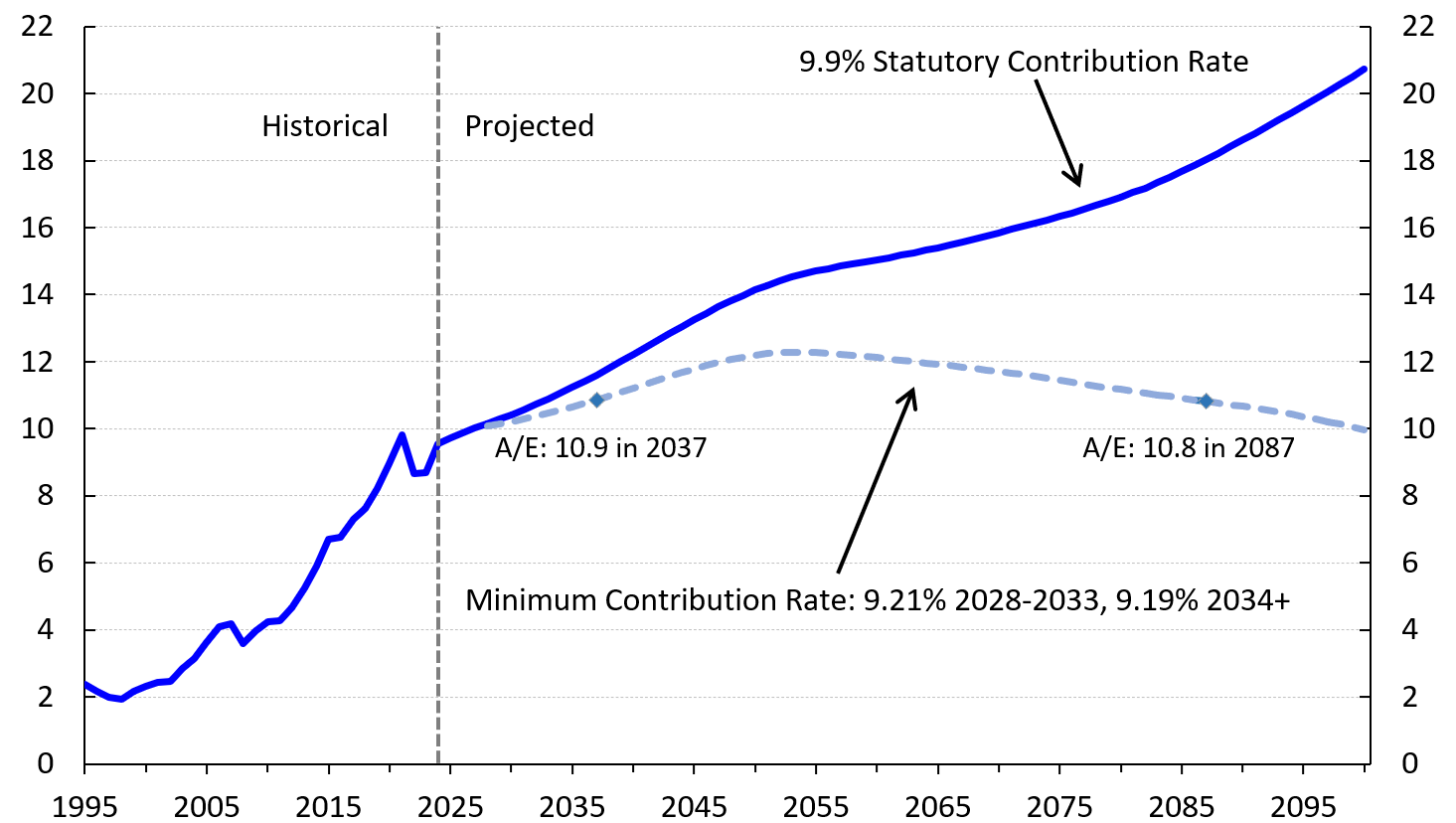
Chart 12 - Text version
| Year | 9.9% Statutory Contribution Rate A/E | Minimum Contribution Rate A/E |
|---|---|---|
| 1995 | 2.37 | no data |
| 1996 | 2.16 | no data |
| 1997 | 1.99 | no data |
| 1998 | 1.94 | no data |
| 1999 | 2.17 | no data |
| 2000 | 2.32 | no data |
| 2001 | 2.43 | no data |
| 2002 | 2.47 | no data |
| 2003 | 2.84 | no data |
| 2004 | 3.15 | no data |
| 2005 | 3.62 | no data |
| 2006 | 4.10 | no data |
| 2007 | 4.20 | no data |
| 2008 | 3.60 | no data |
| 2009 | 3.96 | no data |
| 2010 | 4.23 | no data |
| 2011 | 4.27 | no data |
| 2012 | 4.66 | no data |
| 2013 | 5.26 | no data |
| 2014 | 5.91 | no data |
| 2015 | 6.70 | no data |
| 2016 | 6.76 | no data |
| 2017 | 7.30 | no data |
| 2018 | 7.61 | no data |
| 2019 | 8.22 | no data |
| 2020 | 8.95 | no data |
| 2021 | 9.81 | no data |
| 2022 | 8.67 | no data |
| 2023 | 8.68 | no data |
| 2024 | 9.55 | no data |
| 2025 | 9.73 | no data |
| 2026 | 9.87 | no data |
| 2027 | 10.02 | no data |
| 2028 | 10.15 | 10.08 |
| 2029 | 10.29 | 10.15 |
| 2030 | 10.42 | 10.21 |
| 2031 | 10.57 | 10.29 |
| 2032 | 10.72 | 10.37 |
| 2033 | 10.88 | 10.45 |
| 2034 | 11.05 | 10.55 |
| 2035 | 11.23 | 10.65 |
| 2036 | 11.42 | 10.75 |
| 2037 | 11.61 | 10.87 |
| 2038 | 11.81 | 10.98 |
| 2039 | 12.01 | 11.10 |
| 2040 | 12.21 | 11.21 |
| 2041 | 12.42 | 11.33 |
| 2042 | 12.63 | 11.45 |
| 2043 | 12.84 | 11.57 |
| 2044 | 13.04 | 11.68 |
| 2045 | 13.24 | 11.79 |
| 2046 | 13.44 | 11.89 |
| 2047 | 13.63 | 11.98 |
| 2048 | 13.81 | 12.07 |
| 2049 | 13.98 | 12.14 |
| 2050 | 14.13 | 12.19 |
| 2051 | 14.27 | 12.24 |
| 2052 | 14.40 | 12.27 |
| 2053 | 14.52 | 12.29 |
| 2054 | 14.62 | 12.29 |
| 2055 | 14.70 | 12.28 |
| 2056 | 14.77 | 12.26 |
| 2057 | 14.85 | 12.23 |
| 2058 | 14.91 | 12.20 |
| 2059 | 14.98 | 12.16 |
| 2060 | 15.04 | 12.12 |
| 2061 | 15.11 | 12.08 |
| 2062 | 15.18 | 12.04 |
| 2063 | 15.25 | 12.00 |
| 2064 | 15.32 | 11.96 |
| 2065 | 15.40 | 11.92 |
| 2066 | 15.49 | 11.88 |
| 2067 | 15.58 | 11.84 |
| 2068 | 15.66 | 11.80 |
| 2069 | 15.75 | 11.75 |
| 2070 | 15.85 | 11.71 |
| 2071 | 15.94 | 11.66 |
| 2072 | 16.04 | 11.61 |
| 2073 | 16.13 | 11.56 |
| 2074 | 16.23 | 11.50 |
| 2075 | 16.33 | 11.45 |
| 2076 | 16.43 | 11.39 |
| 2077 | 16.54 | 11.33 |
| 2078 | 16.65 | 11.28 |
| 2079 | 16.77 | 11.22 |
| 2080 | 16.90 | 11.17 |
| 2081 | 17.04 | 11.11 |
| 2082 | 17.18 | 11.06 |
| 2083 | 17.34 | 11.01 |
| 2084 | 17.50 | 10.96 |
| 2085 | 17.67 | 10.91 |
| 2086 | 17.84 | 10.86 |
| 2087 | 18.03 | 10.82 |
| 2088 | 18.22 | 10.77 |
| 2089 | 18.41 | 10.72 |
| 2090 | 18.61 | 10.67 |
| 2091 | 18.81 | 10.61 |
| 2092 | 19.01 | 10.55 |
| 2093 | 19.22 | 10.49 |
| 2094 | 19.43 | 10.43 |
| 2095 | 19.63 | 10.36 |
| 2096 | 19.84 | 10.29 |
| 2097 | 20.06 | 10.21 |
| 2098 | 20.28 | 10.13 |
| 2099 | 20.50 | 10.05 |
| 2100 | 20.72 | 9.97 |
C.3.2 Additional CPP
As shown in Chart 13, under the statutory additional contribution rates of 2.0% (phased in over 2019-2023) and 8.0% (as of 2024), the A/E ratio of the additional CPP increased significantly during the early years of the additional Plan and is projected to remain high as assets rapidly accumulate and benefit expenditures are low. As the additional Plan matures and benefit expenditures increase, the A/E ratio decreases and stabilizes at a level of about 24 by the mid-2080s. The A/E ratio under the AMCRs, also shown in Chart 13, is projected to be slightly higher than under the statutory rates, since the AMCRs are slightly higher than the statutory rates. The target years of 2088 and 2098, which are used in the determination of the AMCRs, are marked in the chart, and the corresponding A/E ratio is 24.5.
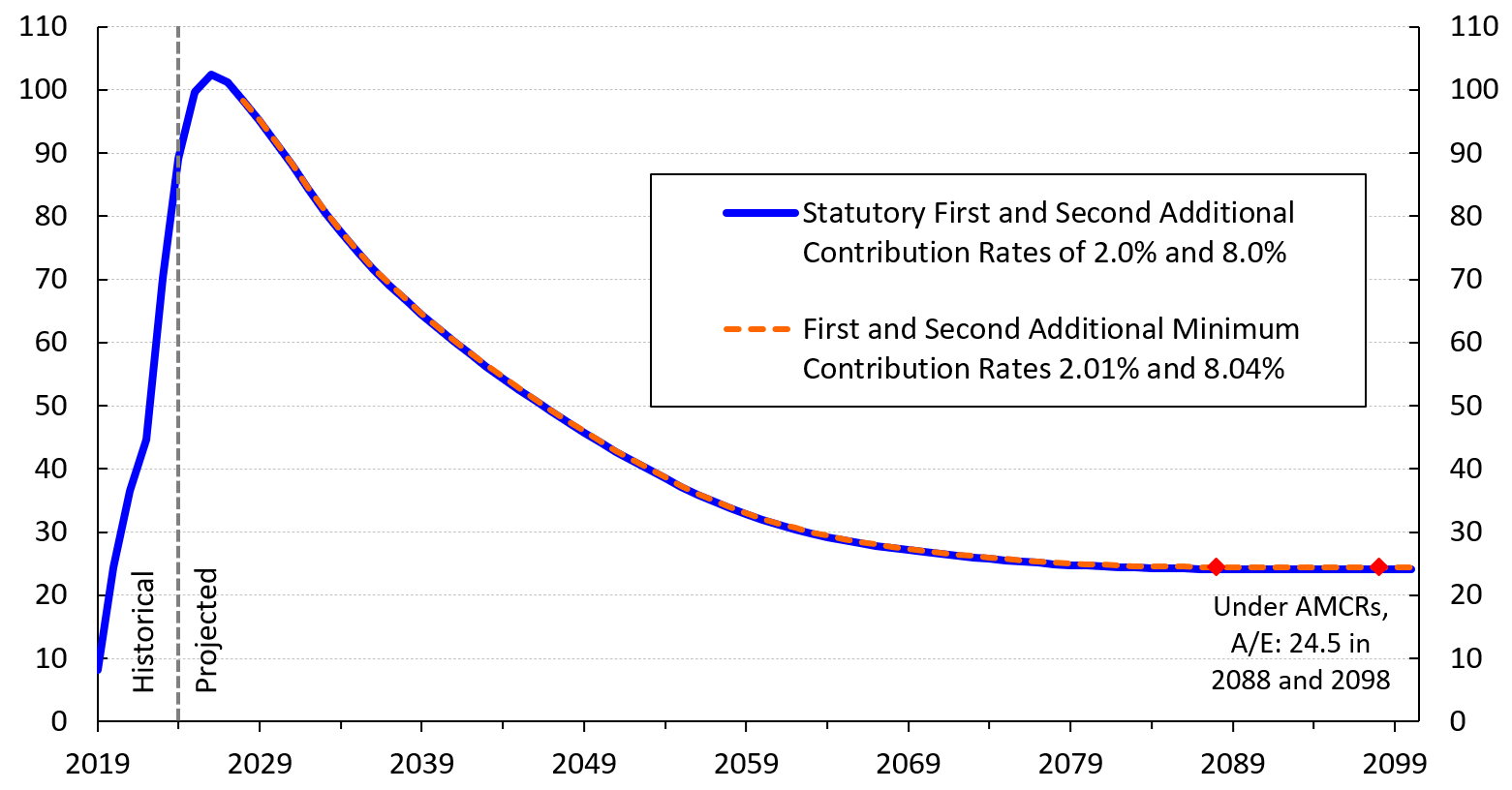
Chart 13 Footnotes
- Chart 13 Footnote 1
-
The statutory first additional contribution rate of 2.0% was phased in over the five-year period 2019-2023 and applies to earnings between the YBE and YMPE. The statutory second additional contribution rate of 8.0% is effective as of 2024 and applies to earnings between the YMPE and YAMPE.
Chart 13 - Text version
| Year | Statutory First and Second Additional Contribution Rates 2.0% / 8.0% A/E | First and Second Additional Minimum Contribution Rates 2.01% / 8.04% A/E |
|---|---|---|
| 2019 | 8.13 | no data |
| 2020 | 24.47 | no data |
| 2021 | 36.58 | no data |
| 2022 | 44.59 | no data |
| 2023 | 70.30 | no data |
| 2024 | 89.06 | no data |
| 2025 | 99.67 | no data |
| 2026 | 102.38 | no data |
| 2027 | 101.19 | no data |
| 2028 | 98.28 | 98.35 |
| 2029 | 95.11 | 95.23 |
| 2030 | 91.60 | 91.76 |
| 2031 | 87.99 | 88.17 |
| 2032 | 84.30 | 84.50 |
| 2033 | 80.70 | 80.91 |
| 2034 | 77.36 | 77.58 |
| 2035 | 74.34 | 74.56 |
| 2036 | 71.58 | 71.81 |
| 2037 | 69.06 | 69.29 |
| 2038 | 66.68 | 66.91 |
| 2039 | 64.39 | 64.62 |
| 2040 | 62.19 | 62.42 |
| 2041 | 60.10 | 60.33 |
| 2042 | 58.10 | 58.33 |
| 2043 | 56.18 | 56.40 |
| 2044 | 54.30 | 54.53 |
| 2045 | 52.48 | 52.70 |
| 2046 | 50.72 | 50.94 |
| 2047 | 49.03 | 49.24 |
| 2048 | 47.38 | 47.59 |
| 2049 | 45.77 | 45.98 |
| 2050 | 44.18 | 44.39 |
| 2051 | 42.65 | 42.86 |
| 2052 | 41.20 | 41.41 |
| 2053 | 39.81 | 40.02 |
| 2054 | 38.46 | 38.66 |
| 2055 | 37.14 | 37.34 |
| 2056 | 35.92 | 36.12 |
| 2057 | 34.79 | 34.99 |
| 2058 | 33.76 | 33.95 |
| 2059 | 32.79 | 32.99 |
| 2060 | 31.92 | 32.11 |
| 2061 | 31.13 | 31.32 |
| 2062 | 30.42 | 30.62 |
| 2063 | 29.79 | 29.99 |
| 2064 | 29.23 | 29.42 |
| 2065 | 28.72 | 28.92 |
| 2066 | 28.27 | 28.47 |
| 2067 | 27.86 | 28.06 |
| 2068 | 27.48 | 27.69 |
| 2069 | 27.13 | 27.34 |
| 2070 | 26.81 | 27.03 |
| 2071 | 26.52 | 26.73 |
| 2072 | 26.24 | 26.46 |
| 2073 | 25.98 | 26.20 |
| 2074 | 25.74 | 25.96 |
| 2075 | 25.51 | 25.74 |
| 2076 | 25.30 | 25.54 |
| 2077 | 25.11 | 25.36 |
| 2078 | 24.94 | 25.19 |
| 2079 | 24.79 | 25.04 |
| 2080 | 24.65 | 24.91 |
| 2081 | 24.54 | 24.80 |
| 2082 | 24.44 | 24.71 |
| 2083 | 24.36 | 24.64 |
| 2084 | 24.29 | 24.58 |
| 2085 | 24.24 | 24.53 |
| 2086 | 24.20 | 24.50 |
| 2087 | 24.17 | 24.48 |
| 2088 | 24.15 | 24.47 |
| 2089 | 24.14 | 24.46 |
| 2090 | 24.12 | 24.46 |
| 2091 | 24.12 | 24.46 |
| 2092 | 24.11 | 24.46 |
| 2093 | 24.10 | 24.47 |
| 2094 | 24.10 | 24.47 |
| 2095 | 24.09 | 24.47 |
| 2096 | 24.08 | 24.47 |
| 2097 | 24.06 | 24.47 |
| 2098 | 24.05 | 24.47 |
| 2099 | 24.04 | 24.46 |
| 2100 | 24.03 | 24.46 |
C.4 Open group balance sheets under the statutory contribution rates
The base and additional CPP balance sheets presented in this section are prepared using an open group approach and the statutory contribution rates of each component. The open group balance sheet methodology is described earlier, in section C.2.2.1 of this appendix.
The choice of the methodology used to produce a social security system's balance sheet needs to be consistent with the financing objectives of the system.
The base CPP is partially funded. Partially funded plans like the base CPP represent a social contract where, in any given year, current contributors allow the use of their contributions to pay current beneficiaries' benefits. This social contract grants current and former contributors a stake in the future contributions of others. As such, the proper assessment of the financial sustainability of partially funded plans by means of their balance sheets should reflect these claims. The open group approach to the balance sheet does account explicitly for these claims by considering the benefits and contributions of both current and future participants.
As discussed in section C.2.1.3, the prescribed financing objectives of the base CPP are stated in terms of the MCR, which is determined using future projections of revenues and expenditures that consider both current and future CPP participants. In other words, the prescribed financing objectives of the base CPP rely on open group projections.
The additional CPP is a fully funded plan. However, as discussed in section C.2.2.1, the prescribed financing objectives of the additional CPP are stated in terms of the AMCRs which are determined using open group projections.
The actuarial balance sheets of the base and additional Plans under their respective statutory rates are complementary to the MCR and AMCRs in assessing the long-term financial sustainability of the two components of the CPP. That is to say that although the key prescribed financial measures for evaluating the components of the CPP are the MCR and AMCRs, specifically, their adequacy and stability over time, other indicators such as the open group balance sheets under the statutory rates could be used in combination with the minimum rates to assess the sustainability of the base and additional Plans.
C.4.1 Base CPP
The actuarial position of the base Plan as at 31 December 2024 and 31 December 2030 under the open group approach and the statutory contribution rate of 9.9% is presented in Table 102. The open group actuarial assets and obligations of the base CPP are determined similarly as for the additional CPP, as described earlier in section C.2.2.1, but using the base CPP projected contributions and expenditures and the expected rate of return on base CPP assets as a discount rate. To obtain the asset excess (shortfall) of the base CPP, the base Plan's actuarial obligations are deducted from the open group assets at the valuation date.Footnote 20
| Balance sheet item | As at 31 December 2024 | As at 31 December 2030 |
|---|---|---|
| Current assets | 650.6 | 962.8 |
| Future contributions | 2,827.7 | 3,517.3 |
| Total assets (a) | 3,478.3 | 4,480.1 |
| Actuarial obligations (b)Table 102 Footnote 1 | 3,322.5 | 4,261.7 |
| Asset excess (shortfall) (a) – (b) | 155.9 | 218.3 |
| Assets as percentage of obligations (a)/(b) | 104.7% | 105.1% |
|
Table 102 Footnotes
|
||
C.4.2 Additional CPP
The prescribed regulations set out the determination of the ratio of the actuarial assets to obligations of the additional Plan on an open group basis in order to determine the AMCRs as described earlier in section C.2.2.1. In this section, the open group additional CPP balance sheet is prepared under the statutory additional contribution rates.Footnote 21
The actuarial position of the additional Plan as at 31 December 2024 under the open group approach and additional minimum contribution rates is presented in Table 101. The figures shown in Table 101 differ from those shown below in Table 103 since different contribution rates are used. The statutory additional contribution rates are used for Table 103, whereas the AMCRs are used for Table 101.
To obtain the asset excess (shortfall) of the additional Plan, the additional Plan's actuarial obligations are deducted from the open group assets at the valuation date. As shown in Table 103, the ratio of the additional Plan's assets to its obligations using the statutory additional contribution rates is determined for this report to be 103.8% as at 31 December 2024 and 102.7% as at 31 December 2030.
| Balance sheet item | As at 31 December 2024 | As at 31 December 2030 |
|---|---|---|
| Current assets | 54.2 | 213.7 |
| Future contributions | 892.3 | 1,089.1 |
| Total assets (a) | 946.5 | 1,302.8 |
| Actuarial obligations (b)Table 103 Footnote 1 | 911.6 | 1,269.1 |
| Asset excess (shortfall) (a) – (b) | 35.0 | 33.8 |
| Assets as percentage of obligations (a)/(b) | 103.8% | 102.7% |
|
Table 103 Footnotes
|
||
Appendix - D – Detailed reconciliation with previous triennial report
D.1 Base CPP
The results presented in this report differ from those previously projected for a variety of reasons. Differences between the actual experience for 2022 through 2024 and that projected in the 31st CPP Actuarial Report for the same period were addressed in the Reconciliation with Previous Triennial Report – Base CPP section 7.1 of this report. Since historical results provide the starting point for the projections shown in this report, these differences have an effect on the projections. This section provides more details on the impact of the experience update and changes in the assumptions and methodology.
A reconciliation of the change in the MCR of 9.56% for years 2025 to 2033 and 9.54% thereafter, as presented in the 31st CPP Actuarial Report, to the MCR of 9.21% for years 2028 to 2033 and 9.19% thereafter determined for this report is provided in Table 104.
This report reflects a number of improvements made to the methodology used in previous reports. The main methodology changes were related to improvements in modeling non-permanent residents (NPR). The overall impact from the changes in methodology decreases the MCR by about 0.11 percentage points.
The experience over the period 2022 to 2024 was better than anticipated overall, which lowered the MCR. In particular:
- The main contributing factor for the decrease in the MCR was better than expected investment experience, which lowers the MCR by 0.21 percentage points.
- Higher than anticipated growth in total employment earnings, mainly as a result of higher than anticipated net migration, decreases the MCR by 0.03 percentage points.
- Overall lower than expected benefit expenditures, mainly due to lower retirement benefits resulting from lower than assumed take-up rates over the intervaluation period, as well as lower than expected operating expenses, decreases the MCR by 0.03 percentage points.
Changes made to the key best-estimate assumptions since the previous triennial report were outlined in Table 1 of section 4 of this report. The effects of these changes on the MCR are also shown in Table 104 and are summarized below.
- The assumed total fertility rates are lower than those assumed in the previous triennial report, and as such, increase the MCR by 0.22 percentage points.
- The higher mortality improvement rates assumed for this report increase the MCR by 0.08 percentage points. However, other changes in mortality assumptions, including the initial lower mortality rates due to Statistics Canada's data revision, reduce the MCR by 0.06 percentage points.
- The assumed level of net migration excluding NPR is higher over the projection period than in the previous triennial report, and this decreases the MCR by 0.15 percentage points. In addition, changes to the assumption on the level of NPR as a percentage of the population result in a decrease in the MCR of 0.07 percentage points.
- The changes to the labour market assumptions result in an increase to the MCR of 0.05 percentage points.
- The decrease in the real wage growth assumption increases the MCR by 0.04 percentage points.
- Several changes were made in respect of real rates of return assumptions compared to the previous triennial report. These changes include a different initial and ultimate asset mix, and different ultimate rates of return for certain asset classes. These changes decrease the MCR by 0.07 percentage points.
- Changes in retirement benefit-related assumptions increase the MCR by 0.08 percentage points.
- Changes to the disability benefit assumptions decrease the MCR by 0.03 percentage points.
Some other assumptions, which are described in Appendix - B, were also changed. Overall, the changes in these other assumptions had the effect of decreasing the MCR by 0.03 percentage points.
A progression of the MCR over time based on the steady-state contribution rate target years of future triennial valuation reports and using the best-estimate assumptions of this report is shown in Table 15 of the Results – Base CPP section 5.5 of this report. As shown in that table, the MCR is projected to remain relatively stable over time.
| Steady-state rate | Full funding | MCR | |||
|---|---|---|---|---|---|
| 2028-2033 | 2034+ | 2028-2033 | 2034+ | ||
| 31st CPP Actuarial Report - after rounding | 9.53 | 0.03 | 0.01 | 9.56 | 9.54 |
| 31st CPP Actuarial Report - before rounding | 9.526 | 0.0346 | 0.009 | 9.560 | 9.535 |
| I. Improvements in methodology | (0.111) | 0.000 | 0.001 | (0.111) | (0.110) |
| II. Experience update (2022-2024) | |||||
| Demographic | (0.009) | 0.001 | 0.000 | (0.007) | (0.009) |
| Economic | (0.025) | 0.000 | 0.000 | (0.025) | (0.025) |
| Benefits | (0.029) | (0.008) | 0.000 | (0.037) | (0.029) |
| Investments | (0.214) | 0.001 | 0.000 | (0.214) | (0.214) |
| Subtotal: | (0.277) | (0.006) | 0.000 | (0.283) | (0.277) |
| III. Changes in assumptions | |||||
| Fertility | 0.219 | 0.000 | 0.000 | 0.219 | 0.219 |
| Mortality | 0.015 | 0.002 | 0.000 | 0.017 | 0.015 |
| Net migration | (0.218) | (0.001) | 0.000 | (0.219) | (0.218) |
| Labour market | 0.051 | (0.001) | (0.002) | 0.050 | 0.049 |
| Price increases | 0.000 | 0.000 | 0.000 | 0.000 | 0.000 |
| Real wage increase | 0.039 | 0.000 | 0.000 | 0.040 | 0.040 |
| Real rates of return | (0.070) | 0.000 | 0.000 | (0.071) | (0.070) |
| Retirement | 0.077 | 0.000 | 0.001 | 0.077 | 0.078 |
| Disability | (0.032) | 0.001 | 0.001 | (0.031) | (0.031) |
| Other assumptions | (0.032) | (0.001) | 0.000 | (0.032) | (0.032) |
| Subtotal: | 0.050 | 0.000 | 0.000 | 0.049 | 0.050 |
| IV. Others (Change in funding targets from 2034-2084 to 2037-2087) | (0.007) | (0.002) | 0.000 | (0.009) | (0.007) |
| Total of I to IV | (0.346) | (0.008) | 0.001 | (0.354) | (0.345) |
| Rates before rounding | 9.180 | 0.026 | 0.010 | 9.206 | 9.190 |
| Rounded rate, in accordance with the Calculation of Contribution Rates Regulations, 2021 | 9.18 | 0.03 | 0.01 | 9.21 | 9.19 |
| 32nd CPP Actuarial Report | 9.18 | 0.03 | 0.01 | 9.21 | 9.19 |
|
Table 104 Footnotes
|
|||||
D.2 Additional CPP
Differences between the actual experience for 2022 through 2024 and that projected in the 31st CPP Actuarial Report for the same period were addressed in the Reconciliation with Previous Triennial Reports –Additional CPP section 0 of this report. Since historical results provide the starting point for the projections shown in this report, these differences have an effect on the projections. This section provides more details on the impact of the experience update and changes in the assumptions and methodology.
A reconciliation of the change in the FAMCR of 1.97% and SAMCR of 7.88%, as presented in the 31st CPP Actuarial Report, to the FAMCR of 2.01% and SAMCR of 8.04% for this report is provided in Table 105.
The experience over the period 2022 to 2024 was better than anticipated overall, which lowered the AMCRs. The main contributing factor was better than expected investment experience, which lowered the FAMCR and SAMCR by 0.01 and 0.04 percentage points, respectively.
Changes made to the key best-estimate assumptions since the previous triennial report were outlined in Table 1 of section 4 of this report. The main effects of these changes on the AMCRs are also shown in Table 105 and are summarized below.
- The higher mortality improvement rates assumed for this report increase the FAMCR and SAMCR by 0.037 and 0.148 percentage points, respectively. However, other changes in mortality assumptions, including the initial lower mortality rates due to Statistics Canada's data revision, reduce the FAMCR and SAMCR by 0.009 and 0.036 percentage points, respectively.
- The decrease in the real wage growth assumption causes the FAMCR and SAMCR to decrease by 0.031 percentage points and 0.124 percentage points, respectively. The AMCRs decrease instead of increasing as for the base plan MCR due to the different financing approaches.
- Several changes were made in respect of real rates of return assumptions compared to the previous triennial report. These changes include a different initial and ultimate asset mix to reflect more recent information from the CPPIB on the composition of the Supplementary pool, and different ultimate rates of return for certain asset classes. These changes increase the FAMCR and SAMCR by 0.049 percentage points and 0.197 percentage points, respectively.
- Changes in retirement benefit-related assumptions increased the FAMCR and SAMCR by 0.025 and 0.098 percentage points, respectively.
Some other assumptions, which are described in Appendix - B, were also changed but had small impacts.
A progression of the AMCRs over time based on the AMCR target years of future triennial valuation reports and using the best-estimate assumptions of this report is shown in Table 26 of this report. As shown in that table, the AMCRs are projected to remain relatively stable over time.
| First additional minimum contribution rate | Second additional minimum contribution rate | |
|---|---|---|
| 31st CPP Actuarial Report - after rounding | 1.97 | 7.88 |
| 31st CPP Actuarial Report - before rounding | 1.970 | 7.879 |
| I. Improvements in methodology | 0.004 | 0.014 |
| II. Experience update (2022-2024) | ||
| Demographic | (0.004) | (0.016) |
| Economic | (0.004) | (0.018) |
| Benefits | (0.002) | (0.008) |
| Investments | (0.010) | (0.040) |
| Subtotal: | (0.020) | (0.082) |
| III. Changes in assumptions | ||
| Fertility | (0.011) | (0.044) |
| Mortality | 0.028 | 0.112 |
| Net migration | 0.009 | 0.037 |
| Labour market | (0.006) | (0.026) |
| Price increases | 0.000 | 0.000 |
| Real wage increase | (0.031) | (0.124) |
| Real rates of return | 0.049 | 0.197 |
| Retirement | 0.025 | 0.098 |
| Disability | 0.001 | 0.003 |
| Other assumptions | (0.006) | (0.025) |
| Subtotal: | 0.057 | 0.229 |
| Total of I to III | 0.041 | 0.162 |
| Rates before rounding | 2.010 | 8.041 |
| Rounded rates, in accordance with the Calculation of Contribution Rates Regulations, 2021 | 2.01 | 8.04 |
| 32nd CPP Actuarial Report | 2.01 | 8.04 |
|
Table 105 Footnotes
|
||
Appendix - E – Uncertainty of results
E.1 Introduction
This actuarial report on the Canada Pension Plan is based on the projection of its revenues and expenditures for both of its components, the base and additional CPP, over a long period of time. The information required by statute, which is presented in the Results sections 5 and 6 of this report, has been derived using best-estimate assumptions regarding future demographic, economic, and investment trends. Given the length of the projection period and the number of assumptions required, it is unlikely that actual future experience will develop precisely in accordance with the best-estimate projections.
The inherent uncertainty of the projections is amplified in the current global context. Emerging and evolving trends such as the impacts of climate change, shifting geopolitical dynamics, evolving trade policies, and rapid technological advancements introduce significant variability into economic, demographic, and investment outlooks.
The objective of this section of the report is to illustrate the sensitivity of the financial states of the base and additional Plans to changes in the future demographic, economic, and investment outlooks.
For the additional CPP, there is a stronger link between contributions paid by individuals and the benefits they will receive. As a result, while some assumptions regarding factors such as fertility, migration, and labour force participation affect the cash flows and amount of assets of the additional Plan, they, in general, do not have a major impact on the AMCRs. In comparison, these assumptions could have a significant impact on the MCR of the base CPP. Other assumptions have a more significant impact on the AMCRs for the additional CPP, such as the real rate of return. This again is attributable to the different financing approaches of the base and additional CPP.
Section E.2 examines the sensitivity of the base and additional CPP MCRs to intervaluation investment experience, while section E.3 presents sensitivity tests on individual long-term assumptions that are derived based on judgment or stochastic modeling techniques. Next, sections E.4 builds on the individual sensitivity tests performed in section E.3 by combining various assumptions of the individual tests to create scenarios of higher and lower long-term economic growth. The combination of the individual sensitivity test assumptions is not intended to represent probable scenarios, but rather to illustrate the potential high-level impacts from different economic environments. Finally, section E.5 makes use of scenario analysis to illustrate certain risks that are relevant in the current context. Since the additional CPP is still in its early stages, it focuses on the base CPP only. These scenarios are prepared for illustration purposes only and are not meant to represent forecasts or predictions.
E.2 Sensitivity to intervaluation investment experience
E.2.1 Context
The assets of the CPP are invested by the CPPIB through a diversified portfolio that respects the risk limits of its reference portfolios. More information on how the CPPIB invests assets of the base and additional CPP according to their respective reference portfolios can be found in Appendix - B.
In settings its risk targets and making investment decisions, the CPPIB adopts a long-term approach. However, given the level of risk reflected in the CPPIB's portfolios, short-term returns can be volatile and affect the starting value of assets used to calculate the MCRs and AMCRs every three years. The starting value of assets, and therefore the intervaluation investment experience, can have a significant impact on the Plan's MCRs.
The purpose of this section is to highlight the sensitivity of the Plan's MRCs to intervaluation investment experience.
E.2.2 Base CPP
Table 106 shows what the MCR of this report would have been based on different levels of assets as at 31 December 2024, while maintaining the same best-estimate assumptions. It is meant to provide a simple illustration of the sensitivity of the MCR to the starting value of assets.
Based on the actual assets as at 31 December 2024 of $651 billion, the MCR for year 2034 and thereafter is 9.19%. However, if assets as at 31 December 2024 had been 10% lower, the MCR would have increased by 0.21 percentage points to 9.40%, and if they had been 10% higher, the MCR would have decreased by 0.22 percentage points to 8.97%. Assets would have had to be at least 33% lower for the MCR to be above the statutory rate of 9.9%.
| Level | Assets (billion $) | Average nominal return, 2022-2024 (%) | MCR at 31 December 2024 (%)Table 106 Footnote 1 | Difference with actual (%) |
|---|---|---|---|---|
| 20% lower | 520 | (2.6) | 9.62 | 0.43 |
| 10% lower | 586 | 1.4 | 9.40 | 0.21 |
| Actual | 651 | 4.9 | 9.19 | 0.00 |
| 10% higher | 716 | 8.4 | 8.97 | (0.22) |
| 20% higher | 781 | 11.6 | 8.76 | (0.43) |
|
Table 106 Footnotes
|
||||
Even though the base CPP relies more heavily on contributions than on investment income, the MCR can change significantly from one valuation to the next due to investment experience alone. The sensitivity to investment returns for the base CPP has increased since the 31st CPP Actuarial Report due to stronger than expected investment performance.
To put the variability in the MCR due to intervaluation investment experience into context, a stochastic analysis of investment returns was performed. It is used to determine the distribution of the MCR as a function of intervaluation investment experience. For this purpose, 10,000 paths of returns were generated and probability distributions of the resulting MCR were determined.
It is projected using the assumed asset allocation and correlations between asset classes, as well as the standard deviations and expected returns for each asset class.
Based on the best-estimate assumptions of this report and as shown in Table 15, the MCR at the next valuation as at 31 December 2027 is expected to be 9.19% for year 2034 and after. Table 107 presents the estimated probability of the MCR as at 31 December 2027 falling into certain ranges based on the stochastic projection of investment returns during the three-year intervaluation period 2025-2027. All other assumptions are in line with the best-estimate assumptions of this report.
| MCR at 31 December 2027Table 107 Footnote 1 | Probability |
|---|---|
| Less than 8.84 | 22 |
| 8.84 - 9.03 | 15 |
| 9.04 - 9.34 | 28 |
| 9.35 - 9.54 | 15 |
| 9.55 - 9.9 | 15 |
| Above 9.9 | 5 |
|
Table 107 Footnotes
|
|
Based on the results, there is a 72% probability that the MCR at the next valuation as at 31 December 2027 will have a difference of more than 15 percentage points relative to the best-estimate MCR of 9.19% (i.e. MCR outside of the 9.04% to 9.34% range) due to investment experience alone.
Given the current level of the MCR, the probability of the MCR exceeding the statutory rate of 9.9% at the next valuation as at 31 December 2027 is low at only 5%.
E.2.3 Additional CPP
Since the additional CPP is still in its early years, the intervaluation investment experience doesn't currently have a material impact on the AMCRs.
However, given its financing approach and the fact that the additional CPP assets are expected to grow rapidly over the next decades, investment experience is expected to eventually become one of the main drivers behind additional Plan surpluses or deficits. The impact of investment experience on the AMCRs will therefore become more pronounced over time.
This subsection illustrates sensitivities similar to those presented in the previous subsection on the base CPP, but instead focuses on dates in the future when the additional Plan will be more mature. For this purpose, dates of 31 December 2045 and 31 December 2048 were selected, which are close to thirty years after the introduction of the additional Plan.
Table 108 shows the estimated impact on the FAMCR of different levels of assets as at 31 December 2045, while maintaining all other assumptions in line with the best-estimate assumptions of this report. As the SAMCR is four times the value of the FAMCR, the table shows only the FAMCR.
Based on the best-estimate assumptions of this report, the additional CPP assets as at 31 December 2045 are expected to be $1,005 billion, and the FAMCR as at 31 December 2045 is expected to be 2.02%. However, if assets as at 31 December 2045 were 10% lower, the FAMCR would increase by 0.11 percentage points to 2.13%. If starting assets as at 31 December 2045 were 10% higher, the FAMCR would decrease by 0.11 percentage points to 1.91%.
Compared to Table 106 in the previous subsection, on a relative basis, the additional Plan is much more sensitive to the level of assets than the base CPP. For example, assets that are 20% lower result in a relative increase of 4.7% in the base CPP MCR (9.19% to 9.62%) compared to a relative increase of 11.1% for the additional CPP FAMCR (2.02% to 2.25%). This is line with the additional Plan's financing approach that relies more heavily on investment income than the base CPP.
| Level | Assets (billion $) | Average nominal return, 2043-2045 (%) | FAMCR at 31 December 2045 (%)Table 108 Footnote 1 | Difference with best-estimate (%) |
|---|---|---|---|---|
| 20% lower | 804 | (2.3) | 2.25 | 0.23 |
| 10% lower | 905 | 1.8 | 2.13 | 0.11 |
| Best-estimate | 1,005 | 5.5 | 2.02 | 0.00 |
| 10% higher | 1,106 | 9.1 | 1.91 | (0.11) |
| 20% higher | 1,206 | 12.4 | 1.80 | (0.23) |
|
Table 108 Footnotes
|
||||
For the additional CPP, investment experience could cause the AMCRs to deviate from their statutory rates of 2.0% and 8.0% into various ranges. As per the Additional Canada Pension Plan Sustainability Regulations, the FAMCR may fall between 1.7% and 2.2% without requiring immediate action from 2024 to 2038. From 2039 onward, this "No Action Required" range is reduced to between 1.8% and 2.1%. The corresponding ranges for the SAMCR are those of the FAMCR with the boundary values multiplied by four.
As the additional Plan assets are relatively low over the intervaluation period 2025-2027, it is unlikely that short-term investment experience would cause the AMCRs to fall outside the "No Action Required" ranges prescribed by the proposed Additional Canada Pension Plan Sustainability Regulations. However, as mentioned previously, the impact of intervaluation investment experience will become more important as the plan matures.
To put this into context, a stochastic analysis similar to the one described in the previous subsection on the base CPP was performed. As mentioned above, based on the best-estimate assumptions of this report, the FAMCR as at 31 December 2045 is expected to be 2.02%. The FAMCR in the following valuation report as at 31 December 2048 is also expected to be 2.02%, but it could deviate from this level due to the 2046-2048 investment experience alone. Based on the stochastic analysis, the probability of the FAMCR as at 31 December 2048 falling outside the 1.8% to 2.1% range due to investment experience during the 2046-2048 period is 51%. As the best-estimate FAMCR as at 31 December 2045 exceeds the statutory rate, there is a 30% probability of the FAMCR as at 31 December 2048 being above 2.1%, which is greater than the 21% probability of it being below 1.80%.
| FAMCR at 31 December 2048Table 109 Footnote 1 | Probability |
|---|---|
| Below 1.70 | 10 |
| 1.70 to 1.79 | 11 |
| 1.80 to 2.10 | 49 |
| 2.11 to 2.20 | 13 |
| Above 2.20 | 17 |
|
Table 109 Footnotes
|
|
E.3 Individual sensitivity tests
The key best-estimate assumptions used for the projections in this report are described in Appendix - B. Individual sensitivity tests have been performed that consist of projecting the financial states of the base and additional CPP using alternative individual assumptions to illustrate a reasonable range of how experience could vary from the best-estimate projections. The individual results cannot simply be combined, because a change in any one particular assumption may have an impact on other assumptions to varying degrees.
All individual sensitivity tests, except the one for the real rates of return, are deterministic and are based on judgment. The tests for the real rates of return for the base and additional CPP are developed using a stochastic approach. The ranges analyzed for each assumption are described below.
The sensitivity tests were performed by varying most of the key assumptions individually and by keeping the remaining assumptions at their best-estimate levels. Each sensitivity test was categorized as either a lower-cost scenario or a higher-cost scenario. In the lower-cost scenarios for the base and additional CPP, the alternative assumptions have the effect of reducing the MCR and AMCRs. Conversely, the assumptions for the higher-cost scenarios for each component of the CPP increase the minimum contribution rates. It should also be noted that for both the base and additional Plans, once the lower- and higher-cost assumptions reach their ultimate values, they are held constant for the rest of the 75-year projection period, and both components of the CPP are assumed to remain in their current forms.
It is possible that a lower-cost scenario for the base CPP may be a higher-cost scenario for the additional CPP, and vice versa. This is the case, for example, for the real wage increase test. The opposite effects for the base and additional CPP are attributable to the different financing approaches of the two components.
The different financing approaches also mean that the relative sensitivity of changing a given assumption can differ between the base CPP and additional CPP. For example, although investment income is an important source of revenue for both components of the CPP, the additional CPP relies more heavily on investment income than the base CPP and is therefore more sensitive to the assumption on the real rate of return on investments. The base CPP on the other hand is more sensitive to changes in fertility and migration.
Table 110 summarizes the alternative assumptions used in the individual sensitivity tests. It is followed by a brief discussion of these tests.
| Assumptions | Lower cost | Best-estimate | Higher cost |
|---|---|---|---|
| Total fertility rateTable 110 Footnote 1 | 1.65 | 1.35 | 1.05 |
| Mortality: Canadian life expectancy at age 65 in 2050 with future improvements - males | 20.8 | 23.4 | 25.9 |
| Mortality: Canadian life expectancy at age 65 in 2050 with future improvements - females | 23.2 | 25.7 | 28.1 |
| Net migration rateTable 110 Footnote 1,Table 110 Footnote 2 | 0.92% | 0.72% | 0.52% |
| and non-permanent residents level | 4% | 2.5% | 1% |
| Rate of increase in prices | 3.0% | 2.0% | 1.0% |
| Real wage increase - base CPP | 1.4% | 0.8% | 0.2% |
| Real wage increase - additional CPP | 0.2% | 0.8% | 1.4% |
| 75-year average real rate of return - base CPP | 5.65% | 4.05% | 2.45% |
| 75-year average real rate of return - additional CPP | 4.73% | 3.53% | 2.33% |
| CPP disability incidence rates (per 1,000 eligible) - malesTable 110 Footnote 1 | 1.70 | 2.70 | 3.70 |
| CPP disability incidence rates (per 1,000 eligible) - femalesTable 110 Footnote 1 | 2.40 | 3.40 | 4.40 |
|
Table 110 Footnotes
|
|||
The following provides some description on the selection of assumptions for lower- and higher-cost scenarios.
- Fertility Rates: This test is presented only for the base CPP. Experience of all ten provinces was used to generate the lower- and higher-cost scenarios over the projection period.
- Mortality Rates: Under the lower‑cost scenario, mortality is assumed to improve at a slower rate than under the best‑estimate scenario, with ultimate values of the mortality improvement rates gradually reduced to 0% for all ages in 2039. Under the higher-cost scenario, mortality is assumed to improve at a faster pace than under the best-estimate scenario with the ultimate mortality improvement rates being doubled compared to their best‑estimate values.
- Net Migration Rates and Non-Permanent Residents Levels: This test is presented only for the base CPP. For the lower-cost assumption, the ultimate net migration rate is assumed to increase by 0.20 percentage points while the ultimate level of non-permanent residents as a percentage of population is assumed to increase to 4.0%. For the higher-cost assumption, the ultimate net migration rate is assumed to decrease by 0.20 percentage points while the ultimate level of non-permanent residents as a percentage of population is assumed to decrease to 1.0%. The lower-cost and higher-cost assumptions were selected by analyzing historical data and trends.
- Price Increases: Price increases affect nominal wages, nominal returns, and pension indexation. The higher-cost and lower-cost assumptions are selected to represent the lower and upper bounds of the 1% to 3% inflation-control target range of the Bank of Canada and federal Government.
- Real Wage Increases: Analysis of different periods of both high and low real wage growth within Canada as well as the experience of other countries were used to generate the lower- and higher-cost scenarios.
- Real Rate of Return on Investments: These tests were developed using a stochastic approach. For both CPP components, the lower and higher-cost assumptions represent the ranges such that the averages of the projected rates of return over 75 years for the base and additional Plans will be within these ranges with 80% probability. These ranges differ for the base and additional Plans, since they are based on different asset allocations.
- Disability Incidence Rates: These tests are presented only for the base CPP. As well, the tests mainly affect the disability pension and not the post-retirement disability benefit or disabled contributor's child's benefit, which have no significant impacts on the base CPP. Based on the disability incidence rate experience since the mid-1990s, lower- and higher-cost scenarios over a 75-year projection period for the Plan were generated.
E.3.1 Results for the base CPP
Under each sensitivity test, the contribution rate for the base CPP was projected to follow the current statutory rate of 9.9% through 2027, and a new MCR for the base Plan was determined for 2028 and thereafter. Table 111 summarizes the base Plan MCR and pay-as-you-go rates under each of the sensitivity tests.
| Assumption | Scenario | Minimum contribution rateTable 111 Footnote 1 | Change in MCR relative to best-estimate | Pay-as-you-go rates | |
|---|---|---|---|---|---|
| 2028 | 2065 | ||||
| All | Best-estimate | 9.19 | 0.00 | 9.58 | 12.73 |
| Total fertility rate | Lower cost | 8.92 | −0.27 | 9.58 | 11.96 |
| Higher cost | 9.48 | 0.29 | 9.58 | 13.63 | |
| Mortality rates | Lower cost | 8.63 | −0.56 | 9.58 | 12.08 |
| Higher cost | 9.69 | 0.50 | 9.59 | 13.31 | |
| Net migration rate | Lower cost | 8.85 | −0.34 | 9.58 | 11.51 |
| Higher cost | 9.54 | 0.35 | 9.58 | 14.16 | |
| Price increases | Lower cost | 8.97 | −0.22 | 9.50 | 12.39 |
| Higher cost | 9.44 | 0.25 | 9.67 | 13.14 | |
| Real wage increase | Lower cost | 9.07 | −0.12 | 9.39 | 11.63 |
| Higher cost | 9.32 | 0.13 | 9.79 | 14.00 | |
| Real rate of return on investments | Lower cost | 7.10 | −2.09 | 9.58 | 12.73 |
| Higher cost | 11.38 | 2.19 | 9.58 | 12.73 | |
| Disability incidence rates | Lower cost | 8.96 | −0.23 | 9.54 | 12.46 |
| Higher cost | 9.42 | 0.23 | 9.62 | 13.00 | |
|
Table 111 Footnotes
|
|||||
Given how the alternative scenarios were developed, it is difficult to draw conclusions about their relative sensitivities by comparing them with each other. However, it can be seen that the real rate of return assumption can have a significant impact on the base Plan MCR. If the average annual real rate of return over the next 75 years is assumed to be 5.65% instead of the best-estimate of 4.05%, then the MCR decreases to 7.10%. However, if the average annual real rate of return over the next 75 years is assumed to be 2.45%, then the MCR increases to 11.38%. In addition, the base CPP is more sensitive to investment returns compared to the corresponding sensitivity analysis under the 31st CPP Actuarial Report when comparing the MCR spread between the higher-cost and lower-cost scenarios.
Furthermore, a decrease of 100 basis points in the assumed average annual 75-year nominal rate of return would result in the MCR increasing to 10.54%, which on a relative basis, is 15% higher than under the best-estimate assumption. An increase of 100 basis points would result in the MCR decreasing to 7.88%, which on a relative basis, is 14% lower than under the best-estimate assumption.
The net migration rate sensitivities in Table 111 also include the impact from changing the future level of NPR as a percentage of the population. Changing the net migration rate excluding changes to the NPR assumption results in a MCR of 8.96% for the lower-cost scenario and 9.43% for the higher-cost scenario. Adding the changes to the NPR assumption results in a MCR of 8.85% for the lower cost-scenario and 9.54% for the higher-cost scenario as shown in Table 111.
Unlike the MCR, the pay-as-you-go rates are not affected by the assumed rates of returns on investments. For all other assumptions, the MCR and pay-as-you-go rates tend to move in the same direction.
E.3.2 Results for additional CPP
As for the base Plan, under each scenario, the contribution rates for the additional Plan were projected to follow the current schedule of rates through 2027, and new AMCRs were determined for 2028 and thereafter. Table 112 summarizes the additional Plan AMCRs under each of the scenarios.
| Assumption | Scenario | First additional minimum contribution rate (FAMCR)Table 112 Footnote 1 | Second additional minimum contribution rate (SAMCR)Table 112 Footnote 1 | Change in AMCRs relative to best-estimate |
|---|---|---|---|---|
| All | Best-estimate | 2.01 | 8.04 | -no data |
| Mortality rates | Lower cost | 1.76 | 7.04 | (0.25) and (1.00) |
| Higher cost | 2.21 | 8.84 | 0.20 and 0.80 | |
| Price increases | Lower cost | 1.98 | 7.92 | (0.03) and (0.12) |
| Higher cost | 2.05 | 8.20 | 0.04 and 0.16 | |
| Real wage increase | Lower cost | 1.80 | 7.20 | (0.21) and (0.84) |
| Higher cost | 2.24 | 8.96 | 0.23 and 0.92 | |
| Real rate of return on investments | Lower cost | 1.33 | 5.32 | (0.68) and (2.72) |
| Higher cost | 2.97 | 11.88 | 0.96 and 3.84 | |
|
Table 112 Footnotes
|
||||
When comparing with the results from the base CPP, on a relative basis, the AMCRs are significantly more sensitive to changes in mortality, real wage, and investment assumptions than the base CPP MCR. On the other hand, the AMCRs are not very sensitive to changes in fertility rates and net migration rates, and for that reason are not shown.
The differences in relative sensitivities between the AMCRs and the base CPP MCR, as well as the opposite impacts of changing the real wage increase assumption, are due to the different financing approaches of each component of the Plan, as explained at the beginning of this section.
Given how the alternative scenarios were developed, it is difficult to draw conclusions about their relative sensitivities by comparing them with each other. However, it can be seen that the real rate of return assumption can have a significant impact on the AMCRs. If an average annual real rate of return of 4.73% is assumed over a 75-year projection period instead of the best-estimate of 3.53%, then the FAMCR decreases to 1.33% and the SAMCR to 5.32%. On the other hand, if an average annual real rate of return of 2.33% is assumed over the period, then the FAMCR increases to 2.97% and the SAMCR to 11.88%.
Furthermore, a decrease of 100 basis points in the assumed average annual 75-year nominal rate of return would result in the FAMCR and SAMCR increasing to 2.78% and 11.12% respectively, which on a relative basis is 38% higher than under the best-estimate assumption. An increase of 100 basis points would result in the FAMCR and SAMCR decreasing to 1.43% and 5.72% respectively, which on a relative basis is 29% lower than under the best-estimate assumption.
E.4 Higher and lower economic growth
While the best-estimate assumptions in this report reflect sustained moderate economic growth in the future, there is significant uncertainty and volatility surrounding the economic environment. Many factors could lead to long-term economic growth in Canada being different than assumed under the best-estimate scenario. These factors could stem from both domestic and global forces, including geopolitical conflicts, health crises, extreme weather events due to climate change, the timing and pace of transition to a green economy, the pace of technological advances and innovation, shifts in global trade dynamics between protectionism and globalisation, as well as demographic pressures from an aging population.
Given the high level of uncertainty, scenarios of higher and lower economic growth were considered in this report. These alternative economic growth scenarios are constructed using a combination of individual assumptions, specifically, the labour market assumptions and the real wage growth assumption.
In respect of the labour market, employment levels are reflected in the actuarial projection model through the assumptions made regarding labour force participation and job creation rates by year, age and sex. These rates vary not only with the rate of unemployment, but also reflect the trend of increased female participation rates and trends in the workforce attachment patterns of older workers.
Under the best-estimate scenario, the job creation rate assumption is determined on the basis of expected moderate economic growth and an unemployment rate (ages 15+) that is projected to increase from 6.3% in 2024 to 7.0% in 2025, and then decrease to 6.7% in 2026, reaching an ultimate level of 6.1% by 2028. Furthermore, the participation rates for all age groups are expected to increase due in part to the projected growth in labour force participation rates of women and continuing trends toward longer working lives. Under the best-estimate scenario, the participation rate of those aged 18 to 69 for Canada is expected to increase from 77.3% in 2025 to 80.0% in 2035.
From 2030, the retirement benefit take-up rates at age 60 are assumed to be 21% and 22% for males and females, respectively, while at age 65, the rates are assumed to be 32% for both sexes, and at age 70, the rates are assumed to be 10% for both sexes. These rates result in projected average ages at retirement pension take-up in 2030 of 64.3 for both males and females.
The best-estimate assumption for the real wage increase is assumed to be 0.8% in 2025 and onward. The ultimate real wage increase assumption together with the price increase assumption of 2.0% leads to an ultimate nominal wage increase of 2.8% for 2027 and thereafter.
E.4.1 Higher economic growth
For this higher economic growth scenario, the job creation rate is assumed to increase at a faster pace than under the best-estimate scenario, resulting in an unemployment rate of 4.1% in 2030 and thereafter. In addition, the assumed ultimate participation rates in 2035 are set to increase to higher levels than the best estimates, and the assumed ultimate gap between male and female participation rates in 2035 for those aged 18 to 69 is set equal to 3.1% as opposed to 6.1% under the best-estimate scenario. This results in an overall participation rate of 85.1%.
The lower unemployment rate and higher participation rate are assumed to encourage individuals to ask for their CPP retirement pension at a later age. Therefore, by 2045, retirement pension take-up rates at age 60 are assumed to gradually decrease to levels that are about 20 percentage points lower than the best estimates, i.e. to 2.0% and 3.0% for males and females, respectively. This results in an increase in the projected average age at retirement pension take-up for both sexes combined, from 64.3 years to 65.3 years in 2050. The proportions of working beneficiaries were adjusted to reflect the shift in retirement pension take-up to later ages.
In addition to the assumed changes in the labour market, the real wage increase is assumed to be 1.4% as opposed to 0.8% under the best-estimate scenario. The higher economic growth scenario results in total employment earnings in 2035 being about 16% higher compared to the best estimate.
E.4.2 Lower economic growth
For this lower economic growth scenario, the job creation rate is assumed to increase at a slower pace than the best estimate, resulting in an unemployment rate of 8.1% in 2030 and thereafter. In addition, male and female participation rates by age group are assumed to remain constant at their 2024 levels. This results in an overall participation rate of 77.8% for those aged 18 to 69 in 2035.
The higher unemployment rate and lower participation rate are assumed to encourage individuals to ask for their CPP retirement pension at an earlier age. Therefore, retirement pension take-up rates at age 60 are assumed to gradually increase to levels in 2044 that are about 20 percentage points higher than the best estimates, i.e. to 41% and 42% for males and females, respectively. This results in a decrease in the projected average age at retirement pension take-up for both sexes combined, from 64.3 years to 63.3 years in 2050. The proportions of working beneficiaries were adjusted to reflect the shift in retirement pension take-up to earlier ages.
In addition to the assumed changes in the labour market, the real wage increase assumption is assumed to be 0.2% compared to 0.8% under the best-estimate scenario. The lower economic growth scenario results in total employment earnings in 2035 being about 11% lower compared to the best estimate.
E.4.3 Results
Table 113 presents a summary of the assumptions and results used in the sensitivity analysis of economic growth and the resulting minimum contribution rates.
The base Plan MCR is 8.88% under the higher economic growth scenario and 9.58% under the lower economic growth scenario. The impact on the additional Plan AMCRs is opposite to that for the base Plan MCR. Under the higher economic growth scenario, the FAMCR and SAMCR increase, respectively, to 2.37% and 9.48%, while under the lower economic growth scenario, the FAMCR and SAMCR decrease, respectively, to 1.73% and 6.92%.
The AMCRs move in the opposite direction compared to the base Plan MCR due to the differing effects of the real wage increase assumption on the base and additional Plans, which is attributable to their different financing approaches.
| Canada | Higher economic growth | Best-estimate | Lower economic growth |
|---|---|---|---|
| Participation rate (age group 18-69) (2035) | 85.1% | 80.0% | 77.8% |
| Unemployment rate (15+) (Ultimate) | 4.1% | 6.1% | 8.1% |
| Average CPP retirement benefit take-up age (Ultimate) | 65.3 years | 64.3 years | 63.3 years |
| Real wage increase (Ultimate) | 1.4% | 0.8% | 0.2% |
| Minimum contribution rate (MCR)Table 113 Footnote 1 | 8.88% | 9.19% | 9.58% |
| Additional minimum contribution rates (AMCRs)Table 113 Footnote 2 | 2.37% and 9.48% | 2.01% and 8.04% | 1.73% and 6.92% |
|
Table 113 Footnotes
|
|||
E.5 Scenario analysis
As mentioned, long-term actuarial projections are inherently uncertain, and this uncertainty is amplified in the current global context. This section focuses on assessing and illustrating risks that are relevant in the current context. It illustrates the potential impacts on the base CPP MCR of changes in the future earnings distribution, of an acute economic event scenario, as well as of hypothetical transition scenarios to a green economy. Since the additional CPP is still at its early stages, this section focuses on the base CPP only. The section is not meant to represent forecasts or predictions and should be interpreted with caution.
E.5.1 Change in earners and earnings distributions
E.5.1.1 Context
The earners and earnings distributions have an impact on the amounts of contributions paid to the CPP, and eventually the amounts of benefits paid. The best-estimate scenario assumes a stable distribution of earners and earnings by level over time. In particular, the same nominal wage increase (real wage increase plus inflation) is applied to all earners independent of their level of earnings.
In the future, the pattern of increase in earnings by level may change as the profile of the labour force evolves. New technologies, automatization, immigration patterns, population aging, and evolving skills requirements are among the factors that could influence earnings and earners distributions in the future, which could in turn affect future CPP cashflows and the MCR. Depending on the dynamics, the changes could exert downward or upward pressure on the MCR.
As such, scenarios were developed for this report to illustrate the potential impact of changing the distributions of earners and earnings over time by applying different salary increases by age and level of earnings. For this purpose, different wage increases are assumed until 2055. After 2055, uniform wage increases in line with the best-estimate assumption are applied.
Two scenarios were developed:
- One where changes to the profile of the labour force would result in better work opportunities (i.e. higher wage increases) for middle earners at the expense of higher earners; and
- One where changes to the profile of the labour force would result in better work opportunities (i.e. higher wage increases) for higher earners at the expense of middle earners.
More information on the scenarios and how earners were classified is provided below.
At the time of writing this report, it is not possible to estimate if and how the changing circumstances could influence earnings and earners distributions. The scenarios were therefore developed for illustration purposes and are not meant to be associated with a specific set of circumstances or narrative.
E.5.1.2 Scenarios
Under the scenarios, earners were split into categories as follows:
- Earners under the age of 30: given that many of these earners are possibly still in school or may not have reached their ultimate career path, their earnings are assumed to increase at the same pace as the best-estimate assumption.
- Earners over the age of 30: earners above the age of 30 are deemed to be on their established career path. These earners were divided into 3 categories as follows:
- Lower earners: Individuals earning less than 40% of YMPE. For both scenarios, lower earners are assumed to have wage increases that are in line with the best-estimate assumption.
- Middle earners: Individuals earning between 40% and 120% of YMPE.
- For scenario 1, middle earners are assumed to have wage increases that are higher than the best-estimate assumption.
- For scenario 2, they are assumed to have wage increases that are lower than the best-estimate assumption.
- Higher earners: Individuals earning more than 120% of YMPE.
- For scenario 1, higher earners are assumed to have wage increases that are lower than the best-estimate assumption.
- For scenario 2, they are assumed to have wage increases that are higher than the best-estimate assumption.
Table 114 summarizes the assumed nominal wage increases by category of earners and scenario.
| Category | Scenario 1 | Scenario 2 |
|---|---|---|
| Earners under the age of 30 | 2.80% | 2.80% |
| Lower earners over the age of 30 | 2.80% | 2.80% |
| Middle earners over the age of 30 | 4.00% | 1.60% |
| High earners over the age of 30 | 1.60% | 3.40% |
| Overall | 2.80% | 2.80% |
|
Table 114 Footnotes
|
||
Chart 14 below illustrates the impact that scenarios 1 and 2 have on the distribution of different categories of earners relative to the best estimate.
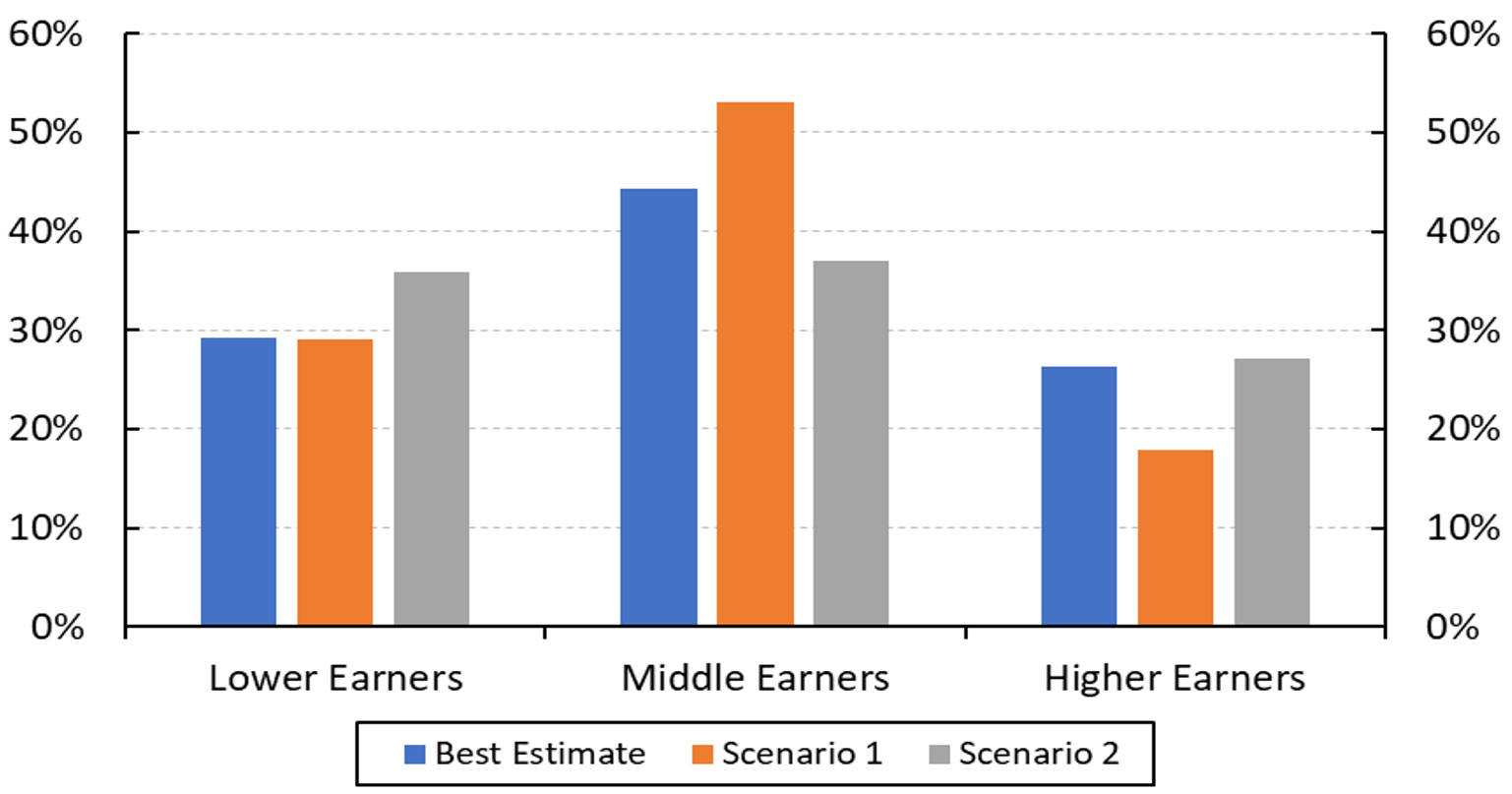
Chart 14 - Text version
| Level | Best Estimate | Scenario 1 | Scenario 2 |
|---|---|---|---|
| Lower Earners | 29.30% | 29.03% | 35.93% |
| Middle Earners | 44.35% | 53.01% | 36.97% |
| Higher Earners | 26.35% | 17.96% | 27.10% |
E.5.1.3 Results
While the projected total earnings are the same as under the best-estimate assumption, the scenarios result in different total contributory earnings, as well as different average contributory earnings due to the variations in earnings distributions.
Scenario 1 would result in an increase in total contributory earnings of 6.8% while Scenario 2 would result in a decrease in total contributory earnings of 11.6%.
For the base CPP, an increase in contributory earnings leads to a lower MCR and vice versa. While a change in contributory earnings will also result in a change in future expenditures, the impact of the immediate change in contributions outweighs the impact of the deferred and gradual increase in expenditures. Scenario 1 therefore creates downward pressure on the MCR while Scenario 2 creates upward pressure.
The impact on the base CPP MCR for each scenario is shown in Table 115.
| Scenario | MCRTable 115 Footnote 1 | Absolute change relative to best-estimate |
|---|---|---|
| Best-estimate | 9.19% | -no data |
| Scenario 1: Benefit to middle earners | 8.98% | −0.21% |
| Scenario 2: Benefit to higher earners | 9.61% | 0.42% |
|
Table 115 Footnotes
|
||
E.5.2 Acute economic event
E.5.2.1 Context
The best-estimate assumptions of this report are set in the context of sustained moderate economic growth over the projection period. Individual sensitivity tests and long-term higher and lower growth economic scenarios illustrate the impact of sustained differences in assumptions compared to the best estimates on the Plan. The purpose of this scenario is to illustrate the impact of an acute, relatively short-term economic event on the MCR of the base CPP. This scenario could be instigated by any number of causes, for example, geopolitical events, escalating trade tensions, public health crises, etc. The economic environment resulting from the acute economic shock is characterized by high inflation, high unemployment, low real wage growth and low real return on assets.
The acute economic event scenario draws on historical shocks and patterns in underlying variables but is not based on one particular period of history.
The event would be characterized by a short burst of high inflation that surpasses what was seen during the COVID-19 pandemic. The disruption in the economy would cause immediate job losses. Real wages would decline as the weak labour markets would not result in wages keeping up with the high inflation. The scenario is also assumed to be global in nature and impacts global financial markets. Both equity and fixed income assets would experience short-term negative returns due to the stagflationary nature of the event.
E.5.2.2 Assumptions
The acute economic event scenario introduces economic shocks beginning in 2026 and is assumed to unfold over a four-year period. Under such a scenario, inflation is projected to rise sharply in 2026 before gradually returning to the Bank of Canada's target range within three years, following a similar trajectory as observed during the COVID-19 pandemic. Specifically, inflation is assumed to reach 7% in 2026, then decline to 4% in 2027, 3% in 2028, and return to the 2% target rate by 2029.
It is assumed that unemployment rates will remain elevated relative to the best-estimate assumptions for a few years following the acute economic event. The unemployment rate is assumed to peak at 11.0% in 2026, then decline to 9.0% in 2027. Further decreases are assumed in 2028 and 2029, with rates of 8.0% and 7.0%, respectively. By 2030, the unemployment rate is assumed to return to the best-estimate ultimate level of 6.1%.
It is assumed that only a portion of inflation is reflected in nominal wage increases, leading to lower real wage growth under this scenario. This pass-through rate is projected to gradually rise, reaching 100% by 2028. Real wage growth is assumed to be -4% in 2026, -2% in 2027, and 0% in 2028, before returning to the ultimate best-estimate assumption of 0.8% in 2029.
Additionally, it is assumed that during the acute economic event, only a portion of inflation is reflected in nominal base CPP returns. This results in lower real rates of return compared to the best-estimate assumptions, with projected real returns of -3% in 2026 and -1% in 2027. Positive real returns of 1% and 4% are assumed in 2028 and 2029, respectively. From 2030 onward, all assumptions are set to revert to the best-estimate levels.
E.5.2.3 Results
Under the acute economic event scenario, the base CPP MCR increases by 0.36 percentage points to 9.55% for the year 2034 and thereafter. Under the base CPP, higher inflation normally leads to lower MCRs given that the impact of higher nominal wages (i.e. more contributions) and investment returns outweigh the impact of higher expenditures. However, in the current scenario, only part of the inflation is reflected in nominal wage increases and returns, while it is fully reflected in expenditures.
E.5.3 Climate change
This section presents potential climate scenarios and the framework used to estimate the impact on economic and investment assumptions, and ultimately on the MCR for the base CPP. It is important to note that the purpose of this section is to foster a better understanding of the potential impact of climate risk on the CPP. The scenarios presented are meant as tools to illustrate the risks. No probabilities are assigned to the likelihood of any given scenario occurring. This section is not intended to represent OCA forecasts or predictions, and the results should be interpreted with caution.
E.5.3.1 Context
Climate change can affect the CPP through various channels given its potential impact on the future demographic, economic, and investment environments. As stated in the Global Risks Report 2025 by the World Economic Forum, the top four risks in terms of severity identified over the next ten years are environmental risks, with the top risk being extreme weather events.
The uncertainty section of the 31st CPP Actuarial Report included analysis to illustrate downside risks associated with three hypothetical climate scenarios.
Since the 31st CPP Actuarial Report, the OCA has conducted an actuarial Climate Change Study (the Study) to better assess how climate change can affect the OCA's overall assumption-setting process for its actuarial valuations, with a special focus on the CPP. According to the Study, there is still a lot of uncertainty on the direction and magnitude of potential impacts from climate change, and the risk is evolving constantly. In addition, research and data to quantify the full impact of climate change on the demographic, economic, and investment environments are incomplete and, in certain cases, somewhat conflicting. The OCA is therefore not ready to incorporate the potential impacts from climate change explicitly in the best-estimate assumptions and continues to believe that scenario analysis is an appropriate approach for understanding and illustrating this risk.
In line with the recommendations presented in the Study, the OCA decided on the following for the present report:
- Hypothetical climate scenarios: Update scenarios based on more recently available information.
- Demographic assumptions: Exclude demographics from climate change scenario analysis, due to the high level of uncertainty and the lack of Canadian-specific research.
- Economic assumptions: Maintain a similar framework to that used in the 31st CPP Actuarial Report. This framework builds on a foundation for relating economic assumptions to potential shocks in Gross Domestic Product (GDP) from climate change.
- Investment assumptions: Enhance the framework used in the 31st CPP Actuarial Report by incorporating additional dynamics. This involves integrating factors such as climate change impacts on fixed income returns, as well as incorporating GDP impacts by different markets.
E.5.3.2 Framework
Consistent with the framework of the 31st CPP Actuarial Report, the OCA continues to consider GDP as a critical variable to assess and illustrate the potential climate change impact on the base CPP MCR. GDP is an overarching macroeconomic variable that can be used to adjust the future economic and investment environments. Additionally, policy rates are added as another variable. Nominal policy rates are deemed to be a reasonable proxy for the long-term government bond yields in Canada, as they reflect the Bank of Canada's stance on monetary policy, which influences the interest rates in the economy. Therefore, climate change impacts on policy rates can be used to adjust returns on fixed income asset classes.
For this report, the OCA used a subset of scenarios from the Network of Central Banks and Supervisors for Greening the Financial System (NGFS). The NGFS publishes a variety of climate scenarios covering a wide range of physical and transition risks, which are well recognized by the financial industry.
The scenarios presented in this report are subsets of three NGFS climate scenarios, that is, Net Zero 2050, Delayed Transition, and Current Policies. The narratives for these scenarios are presented below and are similar to those of the three scenarios in the 31st CPP Actuarial Report. However, since various levels of risks can be assessed within the same scenario narrative under the most recent NGFS data release (in November 2024), the OCA has updated its scenario selection to better benefit from this flexibility.
It is worthwhile to point out that NGFS climate scenario impacts are all relative to the NGFS baseline scenario, which is defined as a hypothetical scenario with neither physical nor transition risks. The baseline scenario should not be assessed against the best-estimate assumptions of this report. For illustration purposes only, the differences relative to the NGFS baseline scenario were applied to the best-estimate assumptions of this report. Given that the range of impacts in NGFS scenarios is quite wide, the analysis remains appropriate to illustrate risk.
Below are descriptions of the narratives underlying the selected scenarios and the framework used to adjust the economic and investment assumptions under the scenarios to estimate potential impacts on the base CPP MCR. Then, in the following sections, greater details on the selected scenarios and the resulting base CPP MCR are presented.
Net zero 2050: assumes that ambitious climate policies are introduced immediately. Under this scenario narrative, global warming is limited to 1.5° C by the end of the 21st century through stringent climate policies and innovation, and global net zero CO2 emissions are reached around 2050.
Delayed transition: assumes that new climate policies are not introduced until 2030, and the level of action differs across countries and geographies based on currently implemented policies. Strong policies are then needed to limit global warming to be below 2 °C by the end of 21st century.
Current policies: assumes that no further climate policies are implemented, leading to high physical risk. Under this scenario narrative, global warming exceeds 3 °C by the end of the 21st century, leading to irreversible changes.
The GDP and policy rates impacts from the selected NGFS climate scenarios are translated into impacts on the base CPP MCR using the approach described below.
- Adjustments to economic growth: a simplified approach is used, where the changes in Canadian GDP growth are translated one-for-one into changes in labour productivity growth through the real wage increase assumption.
- Adjustments to equity investment returns: changes in GDP growth are incorporated in the developed market public equities and real assets return assumptions through the growth in earnings component, which is proxied by developed market GDP growth per capita. These adjustments also flow through return assumptions for emerging market equities and private equities, which are expressed using a premium over developed market public equities. The framework is enhanced in this report to consider the GDP impact of both Canada and the U.S., since a significant part of developed public equities is invested in the U.S. under the current base CPP investment portfolio.
- Adjustments to fixed income returns: this report reflects potential impacts from transition risk on fixed income returns. For this purpose, impacts on Canadian policy rates from the selected NGFS scenarios are used as a proxy for impacts on the long-term Government of Canada bond yields, which serve as the first building block to develop return assumptions for all fixed income asset classes (marketable bonds, non-marketable bonds, and credit).
E.5.3.3 Illustrative scenarios
The section with illustrative scenarios and estimated quantitative impacts on the base CPP MCR was removed from this revised report. The scenarios originally presented in this section were developed using NGFS Phase V long-term scenarios, which incorporate a new physical risk damage function originally published by Kotz et al.Footnote 22 in Nature. The paper received academic critique following its publication, and was retracted on December 3, 2025Footnote 23. Although the NGFS has not made any changes to their Phase V release, they confirmed the retraction of the Kotz et al. paper and indicated that users should consider this when interpreting and applying Phase V results.
The decision to remove the section was taken to avoid potential misrepresentation of risks given concerns with the public data used for the illustrative scenarios as described above. The OCA remains committed to continue assessing the potential impact of climate risk on the CPP and will publish a quantitative analysis once updated data is released.
Appendix - F – Adjustment factors
F.1 Introduction
As described in Appendix A, CPP beneficiaries can ask for their retirement pension at any time between ages 60 and 70. However, adjustment factors are applied to the unreduced retirement pension, resulting in a downward adjustment for early (pre-65) and upward adjustment for late (post-65) pension take-up. The current legislated adjustment factor for early pension take-up is 0.6% for each month between the start of the pension and age 65, and the factor for late pension take-up is 0.7% for each month between age 65 and the start of the pension. The current legislated adjustment factors are applied to both components of the CPP (base CPP and additional CPP).
In accordance with subsection 115(1.11) of the Canada Pension Plan, in the first actuarial report prepared after 2015 and in every third report that follows, the Chief Actuary is required to specify the adjustment factors as calculated according to a methodology that they deem appropriate. The Chief Actuary may also specify the adjustment factors more frequently if they consider it necessary. The federal and provincial Ministers of Finance, as part of their triennial review of the financial state of the CPP, review the adjustment factors specified by the Chief Actuary and may make recommendations as to whether they should be changed.
The 27th CPP Actuarial Report as at 31 December 2015, prepared in 2016, was the first report for which the Chief Actuary was required to specify the adjustment factors. The methodology used to calculate the factors is described in the study: Canada Pension Plan Actuarial Adjustment Factors: Actuarial Study No. 18 (AS18). The factors specified in the 27th CPP Actuarial Report were 0.6% per month and 0.7% per month for early (pre-65) and late (post-65) pension take-up, respectively. These factors are the same as the current legislated ones. At that time, the factors were specified for the base CPP only, since the additional CPP was not yet in effect.
Subsequently, this 32nd CPP Actuarial Report as at 31 December 2024 is the second report for which the Chief Actuary is required to specify the factors in accordance with the legislation. The purpose of this appendix is to specify these factors and to describe the methodology used to calculate them. This is the first time that the analysis is done for both components of the CPP (base CPP and additional CPP). Given the different provisions and financing approaches, the factors are calculated separately for each component.
The adjustment factors will next be specified no later than in the CPP Actuarial Report as at 31 December 2033.
F.2 Methodology
In accordance with the Canada Pension Plan, the adjustment factors specified in this report are based on a methodology that is deemed appropriate by the Chief Actuary. For this report, the factors are determined using the same methodology as the one described in AS18, which was used to determine the adjustment factors specified by the Chief Actuary in the 27th CPP Actuarial Report.
The underlying principle of the methodology is to determine the adjustment factors that result in the steady-state contribution rate for the base CPP, or the AMCRs for the additional CPP, remaining the same whether all the Plan's contributors start their retirement pension at age 60, 65, or 68, with age 65 being the benchmark scenario for the target steady-state contribution rate and AMCRs.
For this purpose, it is assumed that the changes in retirement behaviour associated with collective pension take-up at any of these ages would follow from certain changes in the labour market environment. In particular, compared to the best-estimate assumptions of this report, the scenario with collective take-up at:
- age 60 assumes a weaker labour market environment.
- age 65 (the benchmark scenario) assumes a stronger labour market environment.
- age 68 assumes a stronger labour market environment than under the age 65 scenario.
The anchor points at ages 60 and 68 were selected based on an analysis of historical and expected pension take-up patterns. Statistical data show that prior to age 65, the majority of early pension take-up occurs at age 60, and this is projected to continue. After age 65, there is more uncertainty surrounding the recent late retirement trend as well as the impact of auto-enrolment at age 70 on retirement patterns. In addition, the distribution of take-up ages is more even until age 70. It was therefore decided to use the average late take-up age of 68 for pension take-up after age 65.
The methodology is deemed appropriate since it recognizes all of the benefits and financing provisions of the Plan as well as aligns retirement benefit take-up behaviour with the labour market environment.
Note that the adjustment factors determined as a result of this analysis do not ensure that the steady-state contribution rate and AMCRs will remain the same independent of the actual or assumed retirement pension take-up rates. That is, as individuals start their CPP pension at different ages, rather than collectively at a single age, the application of the calculated adjustment factors may lead to variations in the steady-state contribution rate and AMCRs.
F.3 Assumptions for alternative take-up age scenarios
The results of this analysis are based on the best-estimate assumptions of this report modified as described below in order to develop plausible labour market environments associated with the take-up of the CPP retirement pension by all contributors at selected ages. The specific assumptions that are modified are those relating to the labour force participation rates, unemployment rate, and average employment earnings.
The following plausible alternative scenarios are considered and consist of assumed labour market environments associated with collective pension take-up at ages 60, 65 and 68:
- For the scenario of collective pension take-up at age 60 (weaker labour market environment), the labour force participation rates and average employment earnings are decreased for ages between 50 and 59 while the unemployment rate is increased for all ages.
- For the scenarios of collective pension take-up at ages 65 and 68 (stronger labour market environments), the labour force participation rates and average employment earnings are increased for ages over 55, while the unemployment rate is decreased for age 68 scenario.
For all scenarios, it is assumed that working beneficiaries aged 65 and older choose not to contribute to the CPP.
Table 116 summarizes the modifications made to this report's best-estimate assumptions for each take-up age scenario.
| Collective age at pension take-up | Labour force participation rates | Unemployment rate | Average employment earnings |
|---|---|---|---|
| Age 60 | Ages 50-59: same as best-estimate ages 60-64 | 6.6% (2028+) |
Ages 50-59: same as best-estimate age 60 Ages 60-69: 60% working beneficiaries' earnings / 40% regular contributors' earnings aged 60-69 |
| Age 65 (Benchmark) | Ages 55-64: same as best-estimate ages 50-54 | No modification | Ages 55-64: same as best-estimate age 54 |
| Age 68 |
Ages 55-64: same as best-estimate ages 50-54 Ages 65-69: same as best-estimate ages 60-64 |
5.8% (2028+) |
Ages 55-64: same as best-estimate age 54 Ages 65-69: same as best-estimate age 64 |
All other best-estimate assumptions of this report are used without modification. A description of the best-estimate assumptions of the 32nd CPP Actuarial Report is provided in Appendix - B.
F.4 Results
The adjustment factors determined on the basis of this 32nd CPP Actuarial Report are specified as follows:
| Basis | Pre-65 downward monthly adjustment factor | Post-65 upward monthly adjustment factor |
|---|---|---|
| Legislated for Base and Additional CPP | 0.6% | 0.7% |
| Base CPP | 0.6% | 0.7% |
| Additional CPP | 0.4% | 0.5% |
The difference in the adjustment factors between the base CPP and the additional CPP is due to the different fundamental characteristics of the additional CPP relative to the base CPP. In particular, the additional CPP is fully funded whereas the base CPP is partially funded. The additional CPP also has different benefits provisions and a different investment portfolio.
For the base CPP, the adjustment factors specified by the Chief Actuary are the same as the current legislated adjustment factors. However, for the additional CPP, the specified adjustment factors are 20 basis points lower than the current legislated adjustment factors for both pre-65 and post-65 pension take-up.
Changing the legislated adjustment factors for the additional CPP to be in line with those determined under this report, as specified in Table 117 above, would result in an increase in the FAMCR of 0.04% and in the SAMCR of 0.16%. Considering the best-estimate AMCRs determined in this report of 2.01% and 8.04%, the resulting FAMCR and SAMCR would be 2.05% and 8.20%, respectively.
Table 118 shows the cumulative impact on the retirement pension at each integer age when applying the legislated monthly adjustment factors as well as the monthly adjustment factors specified for this report.
| Age | Legislated for both base and additional CPP | Specified for base CPP | Specified for additional CPP |
|---|---|---|---|
| Pre-/Post-65 monthly factors: 0.6% / 0.7% |
Pre-/Post-65 monthly factors: 0.6% / 0.7% |
Pre-/Post-65 monthly factors: 0.4% / 0.5% |
|
| 60 | 64.0% | 64.0% | 76.0% |
| 61 | 71.2% | 71.2% | 80.8% |
| 62 | 78.4% | 78.4% | 85.6% |
| 63 | 85.6% | 85.6% | 90.4% |
| 64 | 92.8% | 92.8% | 95.2% |
| 65 | 100.0% | 100.0% | 100.0% |
| 66 | 108.4% | 108.4% | 106.0% |
| 67 | 116.8% | 116.8% | 112.0% |
| 68 | 125.2% | 125.2% | 118.0% |
| 69 | 133.6% | 133.6% | 124.0% |
| 70 | 142.0% | 142.0% | 130.0% |